





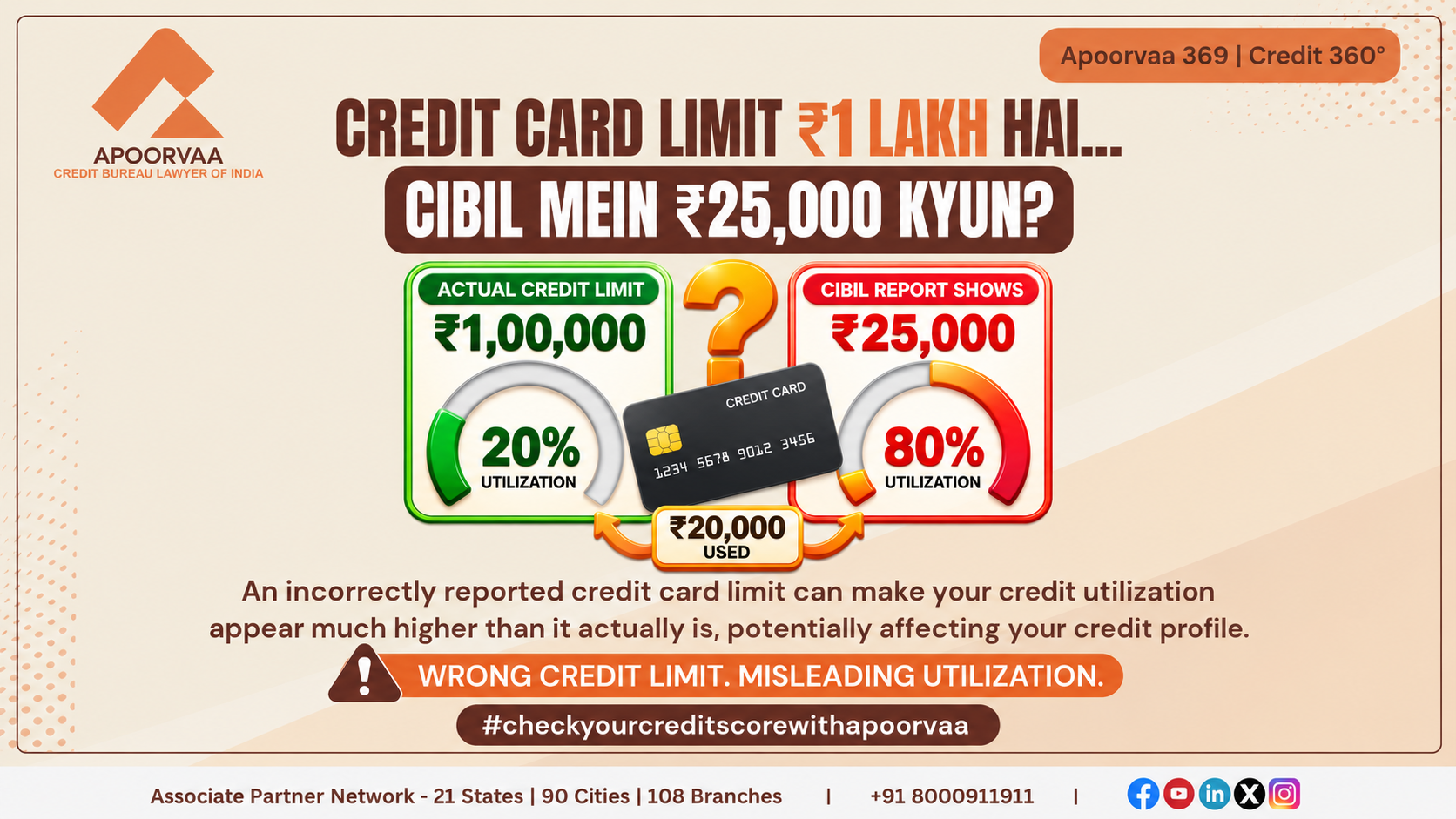
“My credit-card limit is ₹1 lakh, but my CIBIL Report shows only ₹25,000. Can this affect my credit score?”
Yes, an incorrectly reported credit-card limit can potentially affect how your credit profile is assessed.
Many borrowers concentrate on their CIBIL Score, overdue amounts or repayment history. However, the accuracy of the credit limit reported by the lender also matters, particularly when assessing credit utilisation.
A card with an actual limit of ₹1,00,000 may present a different picture if the CIBIL Report incorrectly reflects only ₹25,000.
Let’s understand why this discrepancy deserves attention.
1. Why Does My CIBIL Report Show the Wrong Credit Card Limit?
A credit-card limit is the maximum credit facility sanctioned by the card issuer, subject to applicable conditions.
The limit appearing in a CIBIL Report is based on information furnished by the reporting credit institution.
A difference may arise for several reasons:
- The bank recently increased the credit limit, but the updated information has not yet appeared.
- The report reflects information from an earlier reporting date.
- The lender has furnished an incorrect limit.
- The consumer is comparing a temporary or available limit with the sanctioned credit limit.
Not every difference is automatically a reporting error.
The effective date of the sanctioned limit and the credit report’s reporting date must be considered before concluding that the information is inaccurate.
2. How Does Credit Utilisation Work?
Credit utilisation generally describes how much of an available revolving credit limit has been used.
A simple illustrative calculation is:
Credit Utilisation (%) = Outstanding Balance ÷ Credit Limit × 100
For example, if a credit card has a limit of ₹1,00,000 and an outstanding balance of ₹20,000:
₹20,000 ÷ ₹1,00,000 × 100 = 20% utilisation
This indicates that the outstanding balance represents 20% of the sanctioned limit.
Credit utilisation is relevant to understanding revolving credit exposure. However, this simple formula should not be applied indiscriminately to personal loans, home loans or other instalment loans.
Their repayment structures and credit-risk characteristics differ.
3. ₹1 Lakh Actual Limit vs ₹25,000 Reported Limit
Consider the central example.
| Particulars | Actual account | CIBIL-reported figures |
| Credit-card limit | ₹1,00,000 | ₹25,000 |
| Outstanding balance | ₹20,000 | ₹20,000 |
| Illustrative utilisation | 20% | 80% |
The outstanding amount remains unchanged.
Only the credit-limit figure differs.
Yet the illustrative utilisation increases from 20% to 80% when calculated using the lower reported limit.
<escape>20% Actual Utilisation → 80% Illustrative Utilisation Using Reported Figures</escape>
This difference may create an inaccurate impression of how extensively the borrower is using the sanctioned credit facility.
Importantly, these are illustrative calculations. They do not establish that TransUnion CIBIL’s proprietary scoring model will necessarily calculate utilisation in precisely this manner or change the score by a particular number of points.
Nevertheless, an incorrectly low limit is a material account-level detail worth examining.
4. Can an Incorrect Credit Limit Affect My CIBIL Score?
Potentially, yes.
Credit utilisation and overall credit behaviour can be relevant to credit-risk assessment.
If the reported credit limit is inaccurate, the information available for interpreting revolving credit exposure may also be inaccurate.
However, the effect on an individual CIBIL Score cannot be determined from this example alone.
A borrower’s overall credit profile also includes repayment history, outstanding obligations, account types, credit enquiries and other relevant information.
It is important to distinguish:
- High utilisation: A relatively large portion of a revolving credit limit is being used.
- Overdue payment: An amount has become payable but remains unpaid.
- EMI default: A scheduled loan repayment has not been made as required.
- Settlement: An account has been resolved under agreed settlement terms.
These are different credit-reporting concepts and should not be treated as interchangeable.
An inaccurate credit limit does not automatically mean the borrower has missed payments or defaulted.
Equally, correcting an inaccurate limit does not guarantee a particular score increase or loan approval.
5. Credit Limit vs Current Balance vs Available Credit vs High Credit
These four terms are often confused, although they represent different information.
| Term | Meaning |
| Credit Limit | Sanctioned maximum credit-card facility |
| Current Balance | Outstanding amount reported by the lender |
| Available Credit | Unused portion of the limit currently available, subject to issuer adjustments |
| High Credit | Highest credit amount recorded or reported under the relevant account field; not necessarily the sanctioned limit |
For example, a ₹1,00,000 credit limit with ₹20,000 outstanding may suggest ₹80,000 of unused limit before considering pending transactions, holds or other adjustments.
However, High Credit should not automatically be interpreted as Credit Limit. The relevant report field and lender records must be examined.
6. What If My Bank Recently Increased My Credit Limit?
Suppose a bank increased a consumer’s credit-card limit from ₹25,000 to ₹1,00,000 on 5 October.
A CIBIL Report reflecting an earlier reporting date may still show ₹25,000.
This does not necessarily establish inaccurate reporting.
Under RBI’s credit-information reporting framework, credit institutions are required to update information on a fortnightly basis, as of the 15th and last day of the month, or at shorter agreed intervals. Reporting and processing timelines also apply.
Therefore, the effective date of the limit increase and the lender’s reporting date are essential when examining the difference.
A reporting delay should not automatically be treated as a genuine reporting discrepancy.
7. When Does a Credit-Limit Difference Require Correction?
A genuine discrepancy may exist where the lender’s confirmed sanctioned credit limit differs from the information furnished to the credit bureau, after accounting for relevant reporting dates.
For example, if the bank’s records confirm a ₹1,00,000 limit but the report continues to incorrectly reflect ₹25,000, the difference may warrant investigation.
The consumer’s latest limit confirmation and the relevant credit-report information provide important evidence.
TransUnion CIBIL recognises incorrect credit limits among potential account-information inaccuracies.
Such information may require verification and correction through the reporting lender and applicable credit-bureau process.
Importantly, the purpose of Credit Rectification is to establish accurate account information, not to manufacture a higher credit score.
8. Why a Complete Credit-Report Review Matters
A credit report should not be assessed only through its three-digit score.
Credit-limit accuracy, outstanding balances, repayment history, account status and credit enquiries can all contribute to understanding the borrower’s credit profile.
An incorrectly low credit-card limit may present a misleading picture of revolving credit exposure.
However, it does not automatically establish a repayment default, nor does correction guarantee loan approval.
A professional review helps distinguish genuine reporting inaccuracies from legitimate account information and temporary reporting differences.
Frequently Asked Questions
Can a wrong credit-card limit affect my CIBIL Score?
Potentially. An incorrect limit may affect the information used to assess credit utilisation, but no specific score impact can be guaranteed.
Why is my increased credit limit not showing in CIBIL?
The increase may be recent, and the report may reflect an earlier reporting date. The effective date and lender’s reported information matter.
Is High Credit the same as Credit Limit?
No. High Credit and the sanctioned Credit Limit are different concepts and should not be confused.
Will correcting my credit limit increase my score?
Not necessarily. Correction improves the accuracy of account information; any scoring outcome depends on the broader credit profile and scoring model.
My Perspective
In my professional experience, borrowers frequently concentrate on their credit score while overlooking the accuracy of individual account fields.
A credit-card limit incorrectly reported as ₹25,000 instead of ₹1,00,000 is not merely a difference in presentation. It may change how the borrower’s revolving credit exposure appears.
I believe credit-information accuracy is fundamental to meaningful credit assessment.
The objective should always be to identify whether the lender’s reported information correctly reflects the underlying account records.
Accurate credit reporting matters as much as understanding the score itself.
Final Takeaway
If your actual credit-card limit is ₹1,00,000 but CIBIL shows ₹25,000, do not ignore the difference.
First establish whether it reflects a recent limit increase, an earlier reporting date or genuinely inaccurate information.
YOUR CREDIT LIMIT MATTERS. ACCURATE CREDIT REPORTING MATTERS MORE.
Is Your Credit Card Limit Incorrectly Reported in CIBIL?
Apoorvaa provides professional Credit Report analysis to identify genuine account-level discrepancies and assess whether Credit Rectification is appropriate.
If your confirmed credit-card limit and CIBIL Report do not match, understanding the reason is the first step towards accurate reporting.
Purchase your Credit Report and get it professionally analysed by Apoorvaa.
📞 8000 911 911
Apoorvaa – Credit Bureau Lawyer of India
Correction of inaccurate credit information does not guarantee a specific credit-score increase or loan approval.
Related Credit Education
- CIBIL Current Balance Zero: Does It Mean Your Credit Card Is Closed?
- NOC vs Settlement Letter: Why Does CIBIL Still Show Settled?
- Can You Freeze CIBIL Report to Prevent Fake Loans in India?
About the Author
Advocate Apurva Bhagat is the Founder of Apoorvaa – Credit Bureau Lawyer of India. Through his articles and educational initiatives, he helps borrowers understand credit reports, banking practices, and informed financial decision-making. His objective is to promote financial awareness through practical and responsible guidance.

Comments are closed