




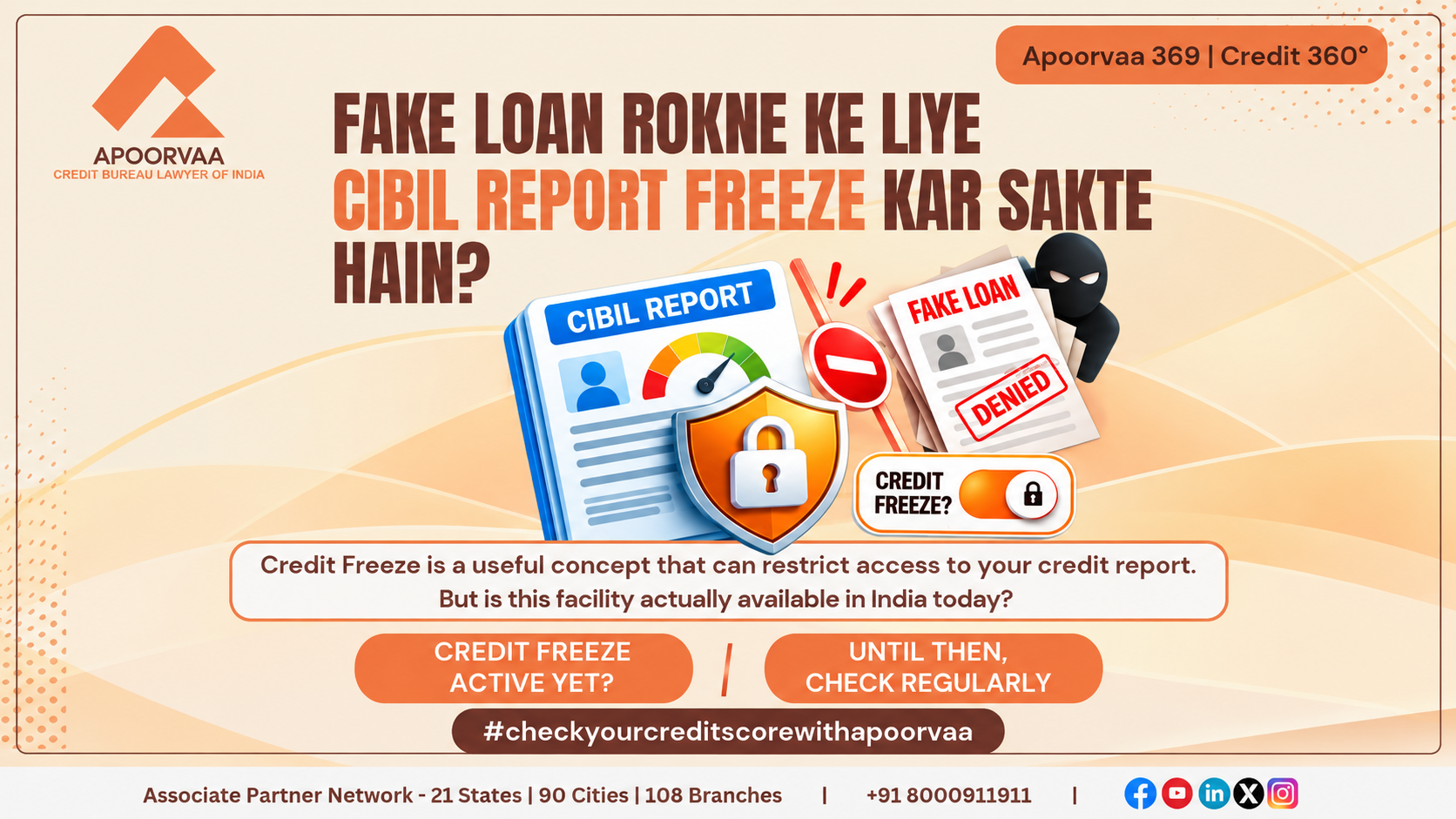
“Can you really press one button and freeze CIBIL Report so that no lender can access it?”
This question has attracted attention after claims about “Credit Freeze” appeared in media and online discussions.
The concept sounds powerful.
You log in to your credit-bureau account.
You activate a freeze.
Your Credit Report becomes inaccessible for new credit checks.
A fraudster attempting to obtain a loan using your identity therefore faces an additional barrier.
But there is an important difference between understanding the concept of a credit freeze and establishing that a specific consumer facility is actually available in India.
As of now, after reviewing current official consumer resources, I could not verify an active consumer facility on TransUnion CIBIL that allows an individual to simply press a “Credit Freeze” button and block lenders from accessing the CIBIL Report.
The current official CIBIL resources I reviewed instead describe facilities such as:
- Credit Report access
- Credit monitoring
- CIBIL Alerts
- New-enquiry alerts
- New-account alerts
- Personal-information change alerts
- Online disputes for inaccurate information
Therefore, consumers should not currently treat social-media or newspaper references to a “CIBIL Credit Freeze” as confirmed instructions for activating such a facility.
There is, however, an important nuance.
CRIF High Mark—one of India’s other Credit Information Companies—currently has an official educational article explaining the concept of freezing a credit report and describing generic request methods.
But its existence should not be interpreted as proof that a single CIBIL button exists, or that one action automatically freezes reports across all four Indian Credit Information Companies.
India has four CICs: TransUnion CIBIL, Experian, Equifax and CRIF High Mark.
That distinction matters.
1. Can You Freeze Your CIBIL Report in India Right Now?
Based on the official CIBIL consumer resources reviewed for this article, I could not establish the availability of a consumer-facing CIBIL Report Freeze facility that allows an individual to switch off lender access to their CIBIL Report.
CIBIL’s current consumer ecosystem prominently provides monitoring and alert functionality.
For example, CIBIL Alerts can notify eligible subscribed consumers when there is:
- A new enquiry
- A new loan or credit-card account
- A change in personal information
- A delinquency change
- A change in credit utilisation
- A change in the CIBIL Score
That is valuable.
But an alert is not the same thing as a freeze.
Monitoring tells you that something has changed.
A true credit freeze, conceptually, restricts access before new credit is granted.
These should not be confused.
Therefore, as of the date of this article:
CIBIL Alerts — Confirmed
CIBIL Credit Monitoring — Confirmed
CIBIL Dispute Facility — Confirmed
One-button consumer CIBIL Report Freeze — Not verified from the current official CIBIL resources reviewed
Because products and regulatory frameworks can change, this position should always be checked against the latest official information.
2. What Is a Credit Freeze?
A credit freeze—sometimes called a security freeze in jurisdictions where such frameworks exist—is generally designed to restrict access to a consumer’s credit report for new credit activity.
Conceptually, imagine a fraudster has obtained enough of your personal information to attempt a loan or credit-card application in your name.
If the applicable credit report is frozen and the lender cannot obtain the report required for its credit assessment, that restriction may create an additional obstacle to opening new credit.
But three cautions are important.
First: A Foreign Credit-Freeze System Does Not Automatically Apply in India
The existence of credit-freeze mechanisms in another country does not establish that Indian consumers have the same legal rights, procedures or technical controls.
Indian credit information operates under its own statutory and regulatory framework.
Second: “CIBIL” Is Not the Entire Indian Credit-Bureau System
India’s credit-reporting ecosystem includes four Credit Information Companies:
TransUnion CIBIL
Experian
Equifax
CRIF High Mark
Therefore, even if a freeze mechanism exists or develops at one bureau, consumers should not assume that it automatically blocks access to their credit information maintained by every other CIC.
Third: A Credit Freeze Should Not Be Described as Complete Fraud Protection
Even where a genuine freeze mechanism exists, its exact protection depends on how that framework is designed.
A freeze should therefore not be marketed as:
“Activate this and nobody can ever commit financial fraud using your identity.”
That would be too broad.
Its actual scope, exceptions, participating entities and effect on credit applications would need to be established from the governing Indian framework.
3. Credit Freeze vs CIBIL Alerts: What’s the Difference?
This is probably the most important distinction for consumers today.
Credit Freeze
Conceptually:
Restricts access to the credit report for specified new-credit purposes, subject to the applicable framework.
Its role is primarily preventive.
Credit Monitoring
Credit monitoring watches the credit profile for changes.
It does not necessarily prevent the underlying event from occurring.
Its role is primarily observational and early-detection oriented.
Credit Alerts
CIBIL currently provides alerts for specified changes in a consumer’s credit profile under eligible subscription plans.
For example, an alert can be generated when a:
New enquiry is added
or
New account is added
This can be extremely useful when the activity is unfamiliar.
But the alert should not be described as having prevented the enquiry or account from being created.
It helps the consumer detect the activity earlier.
Credit Report Dispute
A dispute operates differently again.
A dispute becomes relevant when information already appearing in the Credit Report is believed to be inaccurate.
For example:
“I never applied for this loan.”
or
“I do not recognise this enquiry.”
The consumer can then seek verification/correction through the relevant lender/CIC framework.
So we have four separate concepts:
Freeze → Restrict
Monitoring → Watch
Alert → Notify
Dispute → Investigate/Correct
Confusing these concepts can lead consumers to believe they have protection that a particular product does not actually provide.
4. Can a Credit Freeze Prevent Fake Loans?
A properly designed credit-freeze mechanism could potentially create an important additional barrier against certain forms of fraudulent new-credit activity.
That is why the concept deserves serious attention in India.
But it would be incorrect to say:
“Credit Freeze means fake loans become impossible.”
Fraud prevention is broader than credit-bureau access.
Identity theft, forged documentation, compromised KYC information, account takeover and other fraud methods may involve different systems.
Therefore, even if a consumer-controlled freeze mechanism becomes broadly available, its actual effectiveness would depend on questions such as:
- Which Credit Information Companies participate?
- Which users are restricted from accessing the report?
- For which permissible purposes does the restriction apply?
- Are there exceptions?
- How is the consumer authenticated?
- How is the freeze lifted?
- Can it be temporarily lifted for a genuine loan application?
- Does one request apply to one bureau or all four CICs?
- How quickly does the restriction become effective?
Until an official Indian framework answers such questions, consumers should avoid assuming how a future freeze would operate.
5. What Does CIBIL Currently Offer to Detect Suspicious Activity?
While I could not verify the claimed CIBIL Freeze button, consumers are not without tools.
TransUnion CIBIL currently provides CIBIL Alerts under eligible subscription plans.
Its official information states that consumers can receive alerts when specified changes occur in their credit profile, including:
New Enquiry Added
This can matter because an unfamiliar enquiry may indicate that somebody has attempted to seek credit using the consumer’s identity or details.
It does not automatically prove fraud—but it deserves attention.
New Account Added
An unfamiliar loan or credit-card account is potentially much more serious and should be investigated promptly.
Personal Information Changed
An unexpected new address or phone number can also deserve examination.
Delinquency Change
This helps the consumer monitor changes in repayment-related information.
CIBIL itself positions these alerts as a credit-monitoring mechanism that can help consumers identify potentially incorrect data and possible credit fraud.
This is an important distinction:
Monitoring does not prevent identity theft.
But monitoring may help you discover suspicious credit activity earlier and take appropriate action.
6. Can Lenders Access Your Credit Report Whenever They Want?
This statement requires qualification.
It would be misleading to say:
“Any lender can perform a hard enquiry whenever it wants.”
India’s credit-information ecosystem is governed by the Credit Information Companies (Regulation) Act, 2005, the applicable Rules and Regulations, and RBI directions.
The framework provides for credit information to be furnished to specified users and for permissible purposes.
For example, CRIF High Mark’s current member portal expressly identifies permissible purposes including new credit origination and management of an existing credit portfolio.
RBI materials also explain that Credit Information Reports can be obtained by specified users under the CIC framework.
Therefore, credit-report access should be understood within this statutory and permissible-purpose framework—not as unrestricted access available to anybody.
Another important nuance is consent.
Older banking practices relied on a specific borrower consent clause for sharing credit information. RBI later clarified that, after the CICRA framework came into force, that particular consent clause was no longer required to be insisted upon by banks for submission of credit information to CICs.
This does not mean that credit information can be accessed for any purpose whatsoever.
The statutory framework still matters.
7. What Should You Monitor Until the Position on Credit Freeze Becomes Clearer?
Consumers frequently check only one number:
The Credit Score.
That is not enough for fraud monitoring.
A Credit Report should also be examined for:
Enquiries
Do you recognise the lenders that accessed your credit profile for credit applications?
Newly Added Accounts
Is there any loan or credit card that you never applied for?
Personal Information
Are unfamiliar addresses, phone numbers or other identifying details appearing?
Account Information
Do the balances, account ownership, payment history and status correspond with your actual credit facilities?
This is why regular Credit Report review can be useful.
Not because checking your report magically prevents fraud.
It does not.
Its value is that suspicious information may be identified earlier.
And earlier identification can allow the consumer to approach the concerned lender and applicable Credit Information Company without waiting until a future loan application reveals the problem.
8. What If You See an Enquiry You Never Made?
An unfamiliar credit enquiry should not automatically be treated as proof that a fraudulent loan has been sanctioned.
An enquiry and a loan account are different things.
However, if your Credit Report shows an enquiry from a lender you do not recognise—and you did not apply for credit with that institution—it deserves attention.
The first questions should be:
Which lender made the enquiry?
When was it made?
Did you submit any loan or credit-card application around that date?
Could it relate to an application made through an authorised lending channel or platform?
If the enquiry genuinely cannot be connected to any credit application made by you, the matter should be investigated with the concerned institution and, where appropriate, through the relevant Credit Information Company framework.
The important point is:
Unknown Enquiry ≠ Automatically Fake Loan
But:
Unknown Enquiry = Something You Should Verify
This is also where credit alerts can be useful.
An alert about a newly added enquiry may help a consumer notice unfamiliar credit activity earlier instead of discovering it months later.
9. What If a Fake/Unknown Loan Appears in Your Credit Report?
An unfamiliar loan or credit-card account is more serious than simply seeing an enquiry you do not recognise.
Suppose you check your Credit Report and find:
A lender you have never borrowed from
A loan you never applied for
An account number you do not recognise
An outstanding balance relating to an unknown facility
The first step should not be to assume that the account can simply be “deleted from CIBIL.”
The underlying facts need to be established.
The consumer may need to determine:
- Which institution reported the account?
- What type of credit facility is being reported?
- When was the account opened?
- What ownership information is associated with it?
- Does the lender have an application/KYC trail corresponding to the consumer?
- Is the account genuinely fraudulent, incorrectly mapped or otherwise inaccurately reported?
If the consumer did not obtain the facility, the matter may require investigation with the reporting lender and the concerned Credit Information Company.
Depending on the facts, suspected identity misuse or fraud may also require action through the appropriate fraud-reporting or law-enforcement channels.
The key principle remains:
An unknown loan should be investigated—not ignored.
10. Credit Freeze, Monitoring and Dispute Solve Different Problems
Consumers should understand where each mechanism fits.
Credit Freeze
A genuine credit-freeze mechanism would be primarily preventive.
Its purpose would generally be to restrict specified access to the consumer’s credit information, subject to the rules of the particular framework.
Credit Monitoring
Monitoring helps the consumer observe changes in the Credit Report.
It is primarily an early-detection mechanism.
Credit Alerts
Alerts notify the consumer about specified changes or events.
For example, CIBIL currently describes alerts relating to new enquiries and new accounts for eligible subscribed consumers.
Credit Report Dispute
A dispute becomes relevant after potentially inaccurate information is identified.
Its purpose is verification and, where justified, correction.
Therefore:
Freeze → Restrict
Monitoring → Detect
Alert → Notify
Dispute → Verify / Correct
None of these terms should be used interchangeably.
11. Why Regular Four-Bureau Credit Monitoring Still Matters
Another common misunderstanding is treating “CIBIL” as a generic name for the entire Indian credit-reporting system.
India has four Credit Information Companies:
TransUnion CIBIL
Experian
Equifax
CRIF High Mark
This distinction matters because information appearing in one Credit Report should not automatically be assumed to appear identically in every other bureau’s report at the same point in time.
There may be differences in lender submissions, reporting cycles, account information or the way information is reflected.
For a consumer concerned about identity misuse, unknown accounts or suspicious credit activity, broader monitoring can therefore provide a more complete view.
The consumer should not examine only the score.
Attention should also be given to:
Enquiries
Do you recognise the credit applications associated with them?
New Accounts
Do you recognise every loan and credit-card facility?
Personal Information
Are the reported addresses, phone details and other identifying information familiar?
Account Information
Do the account ownership, balances, status and repayment information correspond with your actual facilities?
Regular review does not itself prevent a fraudulent loan.
Its benefit is earlier detection of suspicious or inaccurate information.
12. Why One “Freeze CIBIL” Button Would Need Careful Regulatory Design
From a consumer-protection perspective, the idea of a consumer-controlled credit freeze deserves serious consideration.
But implementing such a mechanism in India would raise important practical and regulatory questions.
For example:
Would It Apply to One CIC or All Four?
If a consumer freezes only a CIBIL Report, what happens when a lender obtains information from another CIC?
A meaningful broader framework would need to clarify whether restrictions operate separately at each CIC or through some coordinated mechanism.
Which Types of Access Would Be Restricted?
Would the freeze apply only to new-credit underwriting?
Would existing lenders still have access for account management and portfolio monitoring where permitted?
Would other legally permitted uses remain available?
How Would the Consumer Authenticate the Request?
A secure freeze mechanism would require reliable consumer authentication.
The exact process should come from the official framework—not speculation about an OTP button or app workflow.
How Would Genuine Credit Applications Work?
Consumers who intentionally apply for a home loan, vehicle loan, business loan or credit card would need clarity about how access can be restored or temporarily permitted.
How Quickly Would Freeze and Unfreeze Requests Take Effect?
For fraud prevention, timing can matter.
An official framework would need to establish operational timelines.
These are precisely the reasons we should not publish speculative instructions today about how an Indian CIBIL Freeze “will” work.
Until CIBIL or the relevant regulatory authorities officially announce and document such a mechanism, any activation procedure would be speculation.
13. Can a Future Credit Freeze Completely Stop Fake Loans?
Consumers should be careful with absolute claims.
Even a well-designed credit freeze should not automatically be described as complete protection against all financial fraud.
Fraud can involve:
- Identity theft
- Forged or compromised documents
- Misused KYC information
- Account takeover
- Impersonation
- Other forms of financial or digital fraud
A credit-access restriction could potentially add an important preventive layer against certain fraudulent new-credit activity.
But its actual effectiveness would depend on the scope of the framework.
Therefore, if such a facility is officially introduced, consumers should examine what it actually covers rather than relying on headlines such as:
“Freeze CIBIL and fake loans become impossible.”
14. What Should Consumers Watch for If a Credit Freeze Facility Is Introduced in India?
If TransUnion CIBIL, RBI or another competent authority announces a consumer-controlled freeze mechanism in the future, I would recommend checking the official documentation for at least these points:
1. Who is providing the facility?
CIBIL alone, individual CICs, or a coordinated system?
2. What exactly is frozen?
Access to the entire report or only certain forms of new-credit access?
3. Who can still access the report?
Are there permitted exceptions?
4. Does the consumer need to freeze each bureau separately?
5. How is identity verified?
6. How can the freeze be lifted or temporarily relaxed?
7. Is there any charge?
8. What happens to an existing loan or credit card?
9. Does the mechanism affect credit monitoring and alerts?
Most importantly:
Use official instructions—not screenshots, forwarded WhatsApp messages or social-media claims.
15. What Can Consumers Do Today?
Until a CIBIL consumer freeze facility is officially verified, consumers can still take practical steps to improve awareness of their credit information.
Regularly review your Credit Reports.
Don’t look only at the score.
Review:
Enquiries
Newly added accounts
Personal information
Account ownership
Outstanding balances
Repayment information
If an unfamiliar enquiry appears, verify it.
If an unknown loan appears, investigate it promptly.
If information is inaccurate, use the applicable lender/CIC verification and correction framework.
Where appropriate, credit-monitoring alerts can also help consumers identify new activity sooner.
But remember:
Monitoring ≠ Prevention
Checking your Credit Report does not itself stop identity theft or prevent every fraudulent loan.
Its value is that suspicious credit activity may become visible earlier.
Frequently Asked Questions
1. Can I freeze my CIBIL Report with one button today?
As of now, the official CIBIL consumer resources reviewed for this article did not establish an active consumer-facing CIBIL Report Freeze button that allows an individual to block lender access to the report.
Because services can change, consumers should verify the latest position directly from official sources.
2. Are CIBIL Alerts the same as a Credit Freeze?
No.
Alerts notify eligible consumers about specified changes such as new enquiries or accounts.
A genuine credit freeze would involve restricting specified access to the credit report.
3. Can CIBIL Alerts prevent a fake loan?
Alerts should not be described as preventing the underlying fraudulent activity.
They can help consumers detect certain suspicious changes earlier.
4. I found an enquiry from a lender I don’t recognise. Does that mean someone took a fake loan?
Not necessarily.
An enquiry does not establish that a loan was sanctioned.
But an enquiry that cannot be connected to any genuine application should be verified.
5. What if a loan I never took appears in my Credit Report?
The account should be investigated with the reporting lender and relevant Credit Information Company. The objective is to establish whether the account is fraudulent, incorrectly mapped or otherwise inaccurately reported and pursue appropriate correction/action based on the facts.
6. Does checking my CIBIL Report regularly prevent identity theft?
No.
Regular monitoring does not itself prevent identity theft. It may help you identify suspicious enquiries, accounts or information earlier.
7. If CIBIL introduces a freeze, will it automatically freeze Experian, Equifax and CRIF High Mark too?
That should not be assumed.
Any future framework would need to specify whether a freeze applies to one CIC or operates across multiple CICs.
8. Should I monitor only CIBIL?
For a broader understanding of your reported credit information, reports from all four Indian CICs can be relevant, particularly where the concern involves an unknown loan, enquiry or potential reporting discrepancy.
My Perspective
When I first saw claims that consumers could simply freeze their CIBIL Report to stop fake loans, I found the concept very interesting from a consumer-protection perspective.
If properly designed, a consumer-controlled restriction on new-credit access could potentially become another useful layer in fraud prevention.
But there is an equally important responsibility when discussing credit information publicly:
We should not present a concept as an active facility until it is officially verified.
As of now, I could not verify the claimed one-button consumer CIBIL Freeze facility through the current official CIBIL resources reviewed for this article.
What consumers can use today includes credit-report access, monitoring, alerts and the dispute/correction framework.
These are useful tools—but they are not the same as freezing a Credit Report.
If an official CIBIL Credit Freeze facility is introduced, we should examine its actual scope carefully:
Does it cover only CIBIL?
Does it extend across all four CICs?
Which lender accesses are restricted?
What exceptions exist?
How does a genuine borrower temporarily allow access?
Until those questions are officially answered, we should separate:
Confirmed Facts from Future Possibilities.
In the meantime, consumers should regularly understand their complete credit profile—not only their score.
An unfamiliar enquiry may deserve verification.
An unknown loan deserves prompt investigation.
And inaccurate credit information deserves evidence-based rectification.
Final Takeaway
Can you freeze your CIBIL Report today with one button and prevent every lender from accessing it?
As of now, I could not verify such a consumer facility from the current official CIBIL resources reviewed for this article.
What is confirmed is that consumers have access to mechanisms including Credit Reports, monitoring, alerts and dispute facilities.
Remember:
Credit Freeze ≠ Credit Monitoring
Credit Monitoring ≠ Fraud Prevention
Credit Alert ≠ Credit Freeze
Unknown Enquiry ≠ Automatically a Fake Loan
Unknown Loan = Requires Prompt Investigation
CIBIL ≠ All Four Indian Credit Information Companies
If a formal consumer credit-freeze mechanism is introduced, it could become an important development for credit-information security.
But until then, consumers should rely on official information rather than speculative activation instructions.
Found an Unknown Loan or Enquiry in Your Credit Report?
If your Credit Report contains a loan, enquiry, account or other credit information that you do not recognise, the first step is to establish what has actually been reported and whether it corresponds with the underlying lender records.
Apoorvaa provides professional Credit Report assessment and Credit Rectification assistance for individuals and businesses where credit information requires investigation and, where justified, correction.
📞 8000 911 911
Apoorvaa – Credit Bureau Lawyer of India
Credit Rectification does not guarantee removal of accurately reported information, prevention of fraud, any particular increase in a credit score or approval of a future loan application.
Related Credit Education
- EMI Never Paid Late but CIBIL Shows DPD? What Should You Check?
- CIBIL Report Is Correct but Experian, Equifax or CRIF High Mark Is Wrong? Here’s What It Means
- Wrong Ownership in CIBIL Report: Can a Guarantor, Joint or Individual Loan Status Affect Your Credit Profile?
About the Author
Advocate Apurva Bhagat is the Founder of Apoorvaa – Credit Bureau Lawyer of India. Through his articles and educational initiatives, he helps borrowers understand credit reports, banking practices, and informed financial decision-making. His objective is to promote financial awareness through practical and responsible guidance.

Comments are closed