




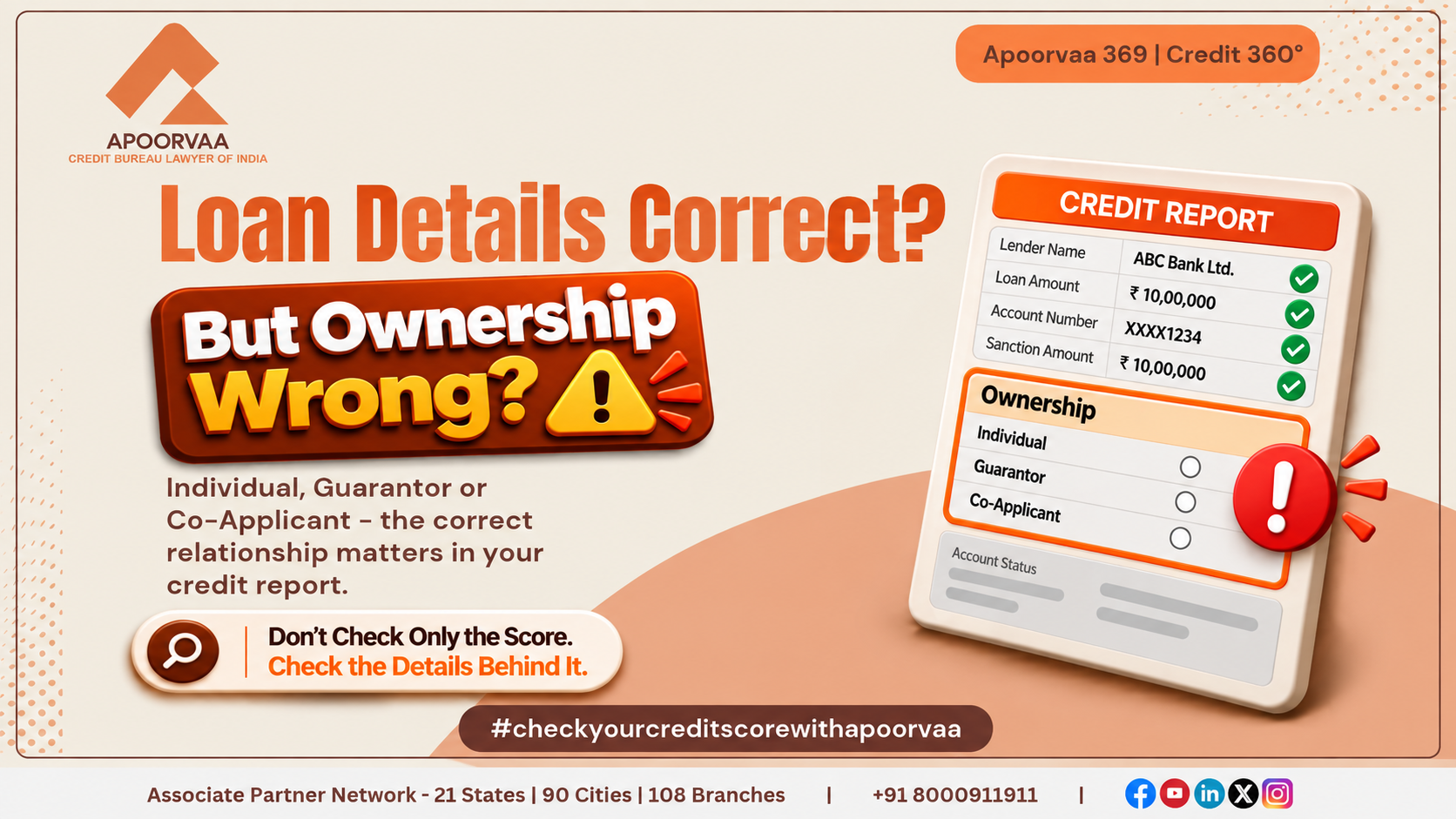
“The loan is related to me. The lender is correct. The loan amount is correct. Even the account details are correct. But the ownership shown in my CIBIL Report is wrong. Does it matter?”
Yes, it can matter.
When most people review a CIBIL Report, they immediately look at the CIBIL Score, current balance, overdue amount and repayment history.
But there is another account-level field that deserves attention:
Ownership
TransUnion CIBIL explains that the ownership field tells a lender who is responsible for payments on a particular loan or credit card. Its consumer guidance identifies four ownership indicators: Single, Joint, Authorized User and Guarantor.
This means two credit accounts can have exactly the same sanctioned amount and lender but represent very different relationships for the person whose report is being reviewed.
If that relationship is incorrectly classified, the problem is not necessarily that the entire loan is fraudulent or unknown.
The problem may be that a genuine credit relationship is being represented incorrectly.
That distinction is important.
What Does Ownership Mean in a CIBIL Report?
The Account Information section of a CIBIL Report contains information about the credit facilities reported by lenders.
According to TransUnion CIBIL, this section can include the lender, type of credit facility, account number, ownership details, dates, loan amount, current balance and payment history.
Ownership therefore provides context about your relationship with that particular credit account.
For example, you may be:
the sole borrower,
jointly responsible with another borrower,
a guarantor for somebody else’s borrowing,
or, in an applicable credit-card arrangement, an authorized user.
These relationships should not be treated as interchangeable.
What Are the Official CIBIL Ownership Categories?
TransUnion CIBIL’s consumer guidance describes four ownership indicators.
1. Single Ownership
CIBIL describes Single ownership as a situation where you are solely responsible for making payments on the account.
In practical terms, this is what many customers informally refer to as an “individual loan.”
For example, if you independently take a personal loan from a bank and are the borrower responsible for that account, the relationship is fundamentally different from merely standing as guarantor for another person’s borrowing.
That distinction matters when interpreting your credit obligations.
2. Joint Ownership
Under Joint ownership, CIBIL explains that you and another person bear joint responsibility for payments, and the account can also reflect on the other individual’s credit report.
A joint borrower should therefore not be viewed in exactly the same manner as someone who has no borrowing relationship with the account.
Likewise, Joint and Guarantor are not simply two names for the same relationship.
The underlying legal and contractual position matters.
3. Guarantor
A Guarantor is associated with a credit facility taken by another borrower but provides a guarantee in relation to that obligation.
CIBIL explains that a guarantor pledges to repay a loan taken by a third party and provides a guarantee to the lender regarding that obligation. CIBIL also specifically advises customers to monitor guaranteed and joint accounts because repayment problems on such accounts can affect their ability to access credit.
This is where an important legal clarification is necessary.
A guarantor should not be described as someone with “no liability” simply because the loan belongs primarily to another borrower.
Under Section 128 of the Indian Contract Act, 1872, the liability of a surety is co-extensive with that of the principal debtor unless otherwise provided by the contract.
Therefore, being a guarantor is a genuine legal relationship with the debt.
But that still does not mean:
Guarantor = Single borrower
The nature in which the person is connected with the account should be represented accurately.
4. Authorized User
CIBIL also identifies Authorized User as an ownership indicator, particularly in relation to add-on credit cards. Its guidance explains that this reflects on the report while distinguishing the payment responsibility associated with the account.
Although today’s topic is primarily concerned with Single, Joint and Guarantor classifications, Authorized User is important because it demonstrates the broader principle:
An account appearing in your Credit Report does not, by itself, tell the complete story of your relationship with that account.
The ownership field provides additional context.
“This Loan Is Not Mine” and “Ownership Is Wrong” Are Two Different Problems
This is one of the most important distinctions in today’s topic.
Suppose your CIBIL Report contains a personal loan from a bank you have never dealt with.
You never applied for the loan.
You never borrowed the money.
You have no relationship with the account.
That is fundamentally different from this situation:
You genuinely stood as guarantor for a loan.
The lender is correct.
The account is genuine.
The loan amount may also be correct.
But the CIBIL Report represents your relationship with that account as Single instead of Guarantor.
In the first situation, the question is:
“Why is an account that does not belong to me appearing in my report?”
In the second situation, the question is:
“Why is a genuine account relationship being reported under the wrong ownership classification?”
Both can involve credit-report accuracy.
But they are not the same reporting problem.
Loan Details Are Correct but Ownership Is Wrong — Is It Still a Credit Report Error?
Potentially, yes.
A credit account contains several data fields.
The fact that the lender name, sanctioned amount or other account details are correct does not automatically establish that every field within that account is also correct.
Ownership is itself part of the account information that needs to accurately reflect the credit relationship.
CIBIL’s own material instructs customers to check account details including ownership, and its report-reading guidance specifically tells customers to look for account information that is not factually correct.
Therefore, a customer should not assume:
“The loan account exists, so the ownership field cannot be disputed.”
If the credit relationship is genuine but the ownership classification does not correspond with the actual relationship documented with the lender, that may represent an account-level reporting discrepancy requiring review.
At the same time, disputing the ownership field does not automatically mean the entire genuine loan should be deleted from the Credit Report.
That distinction is critical.
Why Guarantor and Individual Ownership Should Not Be Confused
Consider this situation.
A person agrees to stand as guarantor for another borrower’s loan.
The credit facility genuinely exists.
The guarantee genuinely exists.
But suppose the account is incorrectly represented in that person’s CIBIL Report as though the person were the Single borrower.
The distinction is meaningful because the reported relationship with the credit facility is different.
A Single borrower is shown as solely responsible for payments on the account under CIBIL’s ownership terminology.
A guarantor has a guarantee relationship connected with the principal borrower’s obligation.
The guarantor may have substantial legal liability—that should not be understated—but this does not transform the guarantor into the principal borrower for reporting purposes.
Correct liability and correct classification are two separate questions.
The guarantor relationship may be genuine.
The legal liability associated with the guarantee may also be genuine.
Yet the ownership classification can still require correction if it inaccurately describes that relationship.
Why Ownership Information Can Matter to a Lender
When evaluating a credit application, lenders may review the applicant’s CIBIL Report alongside income, existing obligations, repayment capacity, internal eligibility criteria and other underwriting information.
CIBIL itself explains that lenders use credit reports and scores when evaluating loan applications, while the final lending decision depends on the credit institution’s own policy.
Account ownership helps provide context for the credit facilities appearing in the report.
This is why we should avoid saying:
“Every bank will calculate a Guarantor account as exactly this much EMI.”
Different lenders can apply their own underwriting and credit policies.
But it is reasonable to say that accurate account-level information matters when a lender is trying to understand an applicant’s overall credit exposure and obligations.
If the relationship itself is incorrectly classified, the report may not accurately communicate the nature in which the customer is connected with that credit facility.
Does Wrong Ownership Automatically Reduce Your CIBIL Score?
This question requires careful wording.
We should not promise or claim that changing an ownership field will automatically increase a CIBIL Score by a particular number of points.
TransUnion CIBIL calculates the Score from information in the Accounts and Enquiries sections of the report, but its public material does not provide a formula stating that changing Guarantor to Single—or Single to Guarantor—will cause a guaranteed predetermined Score movement.
Therefore, the primary concern should be accuracy, not a promised Score increase.
The better question is:
“Does the ownership field accurately represent my relationship with this credit facility?”
If the answer is no, the account information deserves attention regardless of whether anyone can promise a particular Score outcome.
Why the Complete CIBIL Report Matters More Than the Score
Imagine a customer checks their CIBIL Score and sees:
Score: 775
They may conclude that everything is fine.
But the Account Information section may contain a credit facility where:
the lender is correct,
the loan amount is correct,
the account itself is genuine,
but the ownership classification is not.
The Score alone will not explain that discrepancy.
This is precisely why a Credit Report should not be reviewed only from the top of the first page.
The Score is one part of the credit profile.
Account-level information tells you how individual credit relationships are being reported.
And ownership is one of those details.
When that detail is incorrect, the issue needs to be understood as an accuracy problem in the credit information, rather than automatically treating the entire loan as unknown or fraudulent.
That distinction becomes especially important when the account involves a Single borrower, Joint borrower or Guarantor relationship and the reported classification does not match the actual credit documents and lender records.
What If You Are Shown as a Guarantor Instead of the Actual Borrower?
Ownership errors can work in either direction.
Suppose you are actually the Single borrower of a loan, but the account is being shown under a different ownership relationship such as Guarantor.
The loan itself may still be genuine. The lender, sanctioned amount and account details may all correspond with your actual facility.
But the relationship being reported is inaccurate.
Similarly, a genuine Joint borrower should not automatically be represented as a Single borrower, and a genuine Guarantor relationship should not be reported as though the person were the sole borrower.
The principle is straightforward:
The ownership field should reflect the actual relationship between the person and the credit facility.
The objective is not to choose whichever ownership category appears more favourable.
It is to ensure that the information being reported is factually correct.
Does Being a Guarantor Mean the Loan Has Nothing to Do With Your Credit Profile?
No.
This is another misconception that should be avoided.
Sometimes a guarantor says:
“This is not my loan, so it should not appear anywhere in my CIBIL Report.”
That conclusion does not necessarily follow.
A genuine guarantee creates a real relationship with the credit obligation.
As discussed above, Section 128 of the Indian Contract Act, 1872 provides that the liability of the surety is co-extensive with that of the principal debtor unless the contract provides otherwise.
Therefore, a genuine Guarantor relationship should not be treated in the same way as a completely unknown loan or an account with which the person has no connection.
The correct question is not simply:
“Is this loan mine?”
It is:
“What is my actual relationship with this credit facility, and is that relationship being reported correctly?”
That distinction prevents two opposite mistakes—treating a genuine guarantee as a completely unrelated account, or treating a guarantor as though they were the Single borrower.
What Happens If the Primary Borrower Does Not Pay?
A guarantor should understand that a guarantee is not merely an informal reference given to a bank.
It can carry legal consequences.
Under Indian contract law, the liability of a surety is generally co-extensive with that of the principal debtor unless otherwise provided by the contract.
Therefore, it would be inaccurate to say that a guarantor has no responsibility and that the account becomes relevant only after it turns NPA.
The precise rights and liabilities can depend on the guarantee documentation and the circumstances of the credit facility.
From a credit-report perspective, TransUnion CIBIL also advises individuals to monitor accounts where they are joint holders or guarantors because repayment problems associated with such facilities can be relevant to their credit profile.
A genuine guarantor liability should therefore not be confused with an ownership-reporting error.
If you really are the guarantor, the objective is not to convert a genuine guarantee into “no relationship.”
The objective is to ensure that the report correctly identifies the relationship.
Wrong Ownership vs Genuine Legal Liability
Consider these two situations.
Situation A: Correct Guarantor Reporting
You signed as guarantor for a genuine loan.
The CIBIL Report correctly reflects the relationship as Guarantor.
In this case, the mere fact that you are not the principal borrower does not automatically make the account erroneous.
Situation B: Incorrect Single Ownership
You signed only as guarantor, but the account is reported as though you are the Single borrower.
Here, the credit relationship exists, but the ownership classification may be inaccurate.
These situations require completely different interpretations.
This is why Credit Rectification should begin with identifying the actual discrepancy rather than simply trying to remove an account that appears unfavourable.
What About Joint Loans?
Joint borrowing also needs to be understood separately.
Where two people genuinely take a credit facility jointly, both have a relationship with that borrowing.
A common example may involve a housing loan taken jointly by spouses or family members, although the exact contractual position depends on the loan documents.
If a genuine Joint borrower is instead reported as Single, Guarantor or another incorrect category, the issue is again one of how the relationship is being represented.
Likewise, a person should not assume that changing Joint ownership to another category is appropriate merely because they do not personally make the EMI payment every month.
Who physically transfers the EMI and who is contractually connected with the loan are not necessarily the same question.
The loan documentation and lender records are therefore important when assessing whether the ownership information is correct.
Can Wrong Ownership Affect How Your Credit Profile Is Understood?
Potentially, yes.
A lender assessing a fresh application may consider the applicant’s Credit Report together with other information such as income, existing obligations, repayment capacity and its own underwriting policy.
Ownership information helps provide context about how an applicant is related to the credit facilities appearing in the report.
If a person who is actually a Guarantor is incorrectly represented as the Single borrower, the account-level information may communicate a different relationship from the one that actually exists.
Similarly, if a genuine Single or Joint borrower is shown under the wrong ownership category, the report may not accurately describe that person’s relationship with the account.
However, this should not be converted into a universal claim such as:
“Correcting ownership will definitely increase your loan eligibility.”
or
“The bank will definitely remove this EMI from its calculation.”
Each lender applies its own credit and underwriting policies.
The fundamental issue is simpler:
Credit information used for assessment should accurately represent the underlying credit relationship.
Will Correcting Ownership Increase Your CIBIL Score?
There is no responsible way to promise this.
If an ownership field is genuinely inaccurate, correcting the information is important because the Credit Report should accurately reflect the credit relationship.
But Credit Rectification should not be presented as:
“Change Guarantor to Single and gain X points.”
or
“Correct the ownership and your Score will definitely increase.”
The CIBIL Score is calculated using the broader information in the credit profile, and TransUnion CIBIL does not publish a formula guaranteeing a specific Score change following correction of an ownership field.
Therefore:
Accuracy should be the objective—not a promised Score increase.
What If the Ownership Error Is on a Closed Loan?
A closed account should not automatically be ignored.
The account may no longer have an active outstanding balance, but the information associated with the credit facility can still form part of the credit history reflected in the report.
If the ownership classification itself is inaccurate, the fact that the loan has already been closed does not make the underlying data discrepancy irrelevant.
Again, the objective is not necessarily deletion of the entire account.
The question remains:
Does the Credit Report accurately represent the person’s relationship with that credit facility?
Can an Ownership Error Be Corrected?
Where ownership information is genuinely inaccurate, it may need to be addressed through the appropriate credit-information correction or dispute mechanism involving the relevant credit institution and Credit Information Company.
But there is an important limitation.
TransUnion CIBIL does not independently change credit information merely because a customer asks for a different ownership classification. CIBIL’s dispute framework involves verification of disputed credit information with the relevant credit institution.
Therefore, the underlying lender records and actual credit relationship matter.
This is also why a customer should avoid assuming:
“I will dispute the ownership and the complete loan will disappear.”
If the credit facility is genuine, disputing one inaccurate field does not automatically justify deletion of the entire account.
The correction should correspond with the actual facts.
Why Checking Only the CIBIL Score Can Miss This Problem
An ownership discrepancy demonstrates exactly why a Credit Report should not be reduced to a three-digit Score.
A customer may have a good Score and still have inaccurate account-level information.
Another customer may have a lower Score while all account information is factually correct.
Therefore:
Good Score ≠ Every detail is necessarily correct
and
Low Score ≠ There must necessarily be a reporting error
The account-level information needs to be understood separately.
When reviewing a Credit Report, ownership is one of the details that can help explain how the customer is connected with each credit facility.
Frequently Asked Questions
1. What does ownership mean in a CIBIL Report?
Ownership describes the person’s reported relationship with a credit account. CIBIL’s consumer material identifies Single, Joint, Authorized User and Guarantor as ownership indicators.
2. Is “Individual” an official CIBIL ownership category?
CIBIL’s consumer guidance uses Single for an account where the person is solely responsible for payments. “Individual borrower” may be used conversationally to explain this relationship, but Single is the official ownership terminology used in that guidance.
3. My loan details are correct but ownership is wrong. Can the report still contain an error?
Yes. Ownership is an account-level data field. A genuine account can contain an inaccurate ownership classification even when other account details are correct.
4. Is wrong ownership the same as an unknown loan?
No. An unknown loan means the person disputes the underlying relationship with the account. A wrong-ownership case can involve a genuine account where the person’s relationship with it has been incorrectly classified.
5. If I am a guarantor, can I simply remove the loan from my CIBIL Report?
A genuine guarantee should not automatically be treated as an unrelated account. If the reported ownership is accurate, merely preferring that the account not appear does not make the information incorrect.
6. Does a guarantor have legal liability for the loan?
A guarantee can create genuine legal liability. Under Section 128 of the Indian Contract Act, the surety’s liability is co-extensive with that of the principal debtor unless otherwise provided by the contract.
7. Is a Joint borrower the same as a Guarantor?
No. They represent different relationships with a credit facility and should not be treated as interchangeable.
8. Will correcting wrong ownership increase my CIBIL Score?
No specific Score increase can be guaranteed. The primary objective of correcting an ownership discrepancy is to ensure the Credit Report accurately reflects the credit relationship.
9. Can ownership be wrong even on a closed account?
Yes. An account being closed and its ownership information being accurate are separate questions.
10. Should I check ownership even if my CIBIL Score is good?
Yes. A Score alone does not establish that every account-level detail in the Credit Report is accurate.
My Perspective
In practice, a Credit Report error does not always mean that an entire loan is unknown.
Sometimes the lender is correct.
The loan amount is correct.
The account itself is genuine.
But the relationship with that account is being reported incorrectly.
A person who is actually a Guarantor should not be represented as the Single borrower merely because both relationships can involve legal responsibility. Similarly, a genuine Joint borrower should be reported according to the actual credit relationship.
At the same time, we should not misuse Credit Rectification to deny genuine liability.
If somebody has genuinely given a guarantee, correcting an ownership error does not mean pretending that the guarantee never existed.
The objective should always be:
Does the Credit Report accurately represent the actual credit relationship?
That is why I consistently recommend understanding the complete Credit Report—not just checking the CIBIL Score.
Final Thought
When reviewing your CIBIL Report, don’t stop at:
Score
Current Balance
or
Payment History.
Also understand how each account is connected to you.
If a loan is genuinely yours, jointly held or guaranteed by you, the ownership information should reflect that relationship accurately.
And if the loan is genuine but its ownership classification is wrong, that is fundamentally different from claiming:
“This loan does not belong to me.”
Correct identification of the problem is the first step toward responsible Credit Rectification.
Professional Credit Report Assessment
If your CIBIL Report contains a genuine loan account but the Single, Joint, Guarantor or other applicable ownership information appears incorrect, Apoorvaa – Credit Bureau Lawyer of India can professionally review the complete Credit Report to understand whether a genuine reporting discrepancy exists.
The objective is accurate credit reporting—not deletion of legitimate credit relationships or promises of a particular Score increase.
📞 +91 8000 911 911
Apoorvaa – Credit Bureau Lawyer of India
Credit Rectification does not guarantee deletion of correctly reported credit information, a particular CIBIL Score, loan eligibility or loan approval.
Related Credit Education
About the Author
Advocate Apurva Bhagat is the Founder & President of Apoorvaa – Credit Bureau Lawyer of India and works in the field of credit-bureau law and Credit Rectification.
His work focuses on helping individuals and businesses understand credit-reporting discrepancies, distinguish genuine credit obligations from inaccurate reporting, and approach Credit Rectification through accurate analysis of the complete credit profile.

Comments are closed