




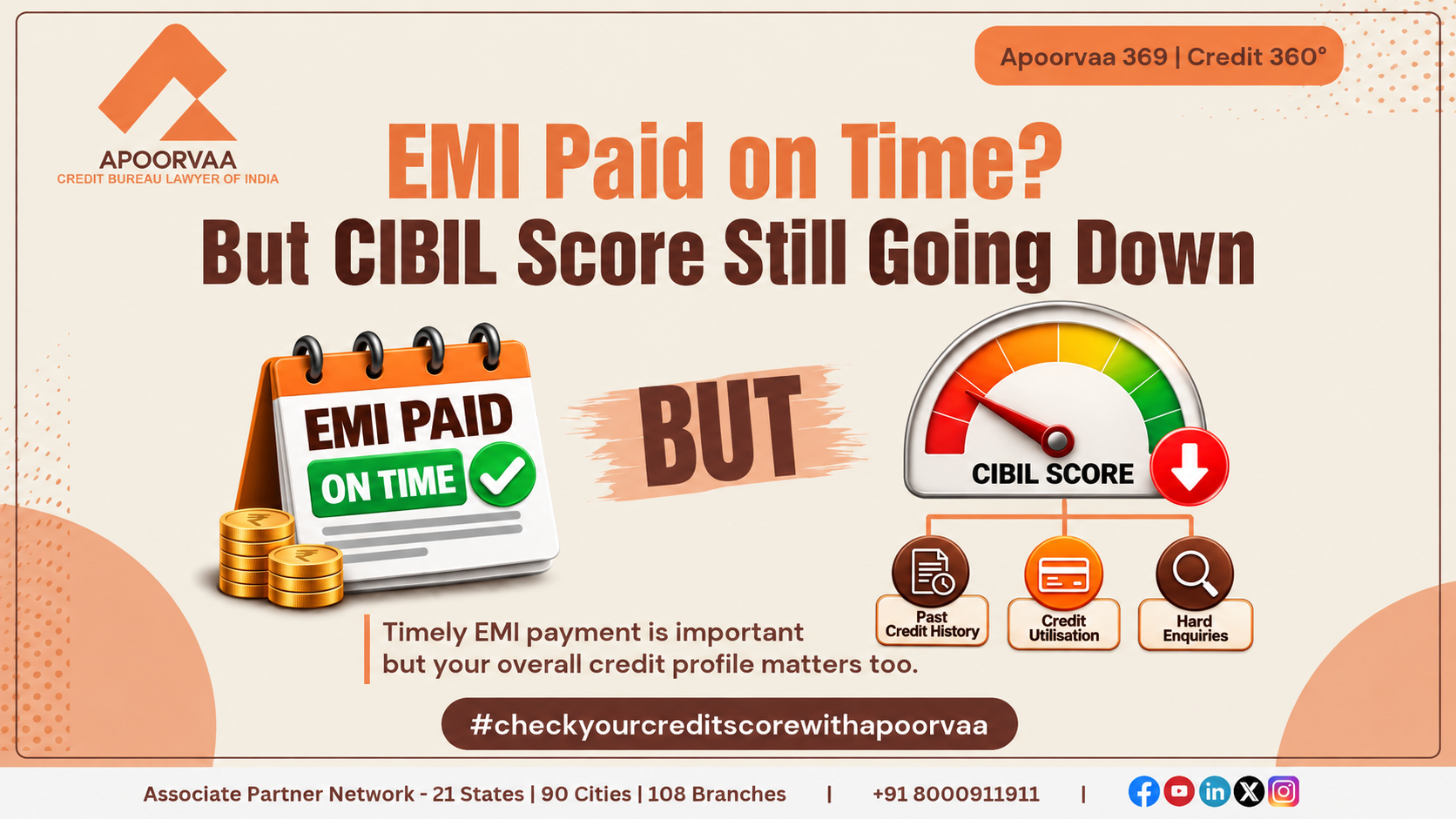
“My EMI is regular, so why is my CIBIL Score still falling?”
This is a question many borrowers ask after checking their latest CIBIL Score.
They may be paying the home-loan EMI on time. The car-loan EMI may also be regular. Credit-card payments may be made before the due date.
Yet the borrower checks the CIBIL Score and finds that it has decreased.
The immediate reaction is:
“I haven’t missed an EMI. So why is my CIBIL Score going down?”
The answer lies in understanding one fundamental point:
Timely EMI repayment is important, but your CIBIL Score is not calculated from one EMI or one loan alone.
TransUnion CIBIL explains that the Score is a three-digit summary of credit history derived from information in the Accounts and Enquiries sections of the CIBIL Report. Its current guidance identifies factors including payment history, credit utilisation, age or depth of credit and enquiries.
Therefore, paying your current EMI regularly is positive credit behaviour, but it does not create a guarantee that your Score must increase every month.
To understand why a CIBIL Score is going down, the broader credit profile needs to be considered.
Paying EMIs on Time Is Important — But It Is Not the Only Factor
Payment history is an important component of the CIBIL Score.
CIBIL’s current guidance explains that payment history reflects how consistently payments have been made, including whether they were on time or delayed, made in full or in part, and whether there were non-payments or other delinquencies.
So regular EMI payment certainly matters.
But consider a borrower with several credit facilities:
Home Loan – EMI regular
Car Loan – EMI regular
Personal Loan – older repayment history
Credit Cards – balances changing every month
Past Loan – previous adverse account history
Recent Loan Applications – multiple lender enquiries
Looking only at the home-loan EMI tells us about one part of that person’s credit behaviour.
The CIBIL Score reflects a much broader credit history.
This is why:
“I am paying this EMI on time” does not automatically mean “my CIBIL Score must increase.”
What Factors Can Affect Your CIBIL Score?
TransUnion CIBIL’s current consumer guidance identifies several important factors that can influence the Score.
Understanding these helps explain why a borrower can maintain regular current EMIs while still seeing movement in the overall Score.
1. Your Overall Payment History
The first factor is not merely:
“Did I pay this month’s EMI?”
It is your broader payment history.
CIBIL states that late payments, missed payments and delinquencies can negatively affect the Score.
Therefore, your current loan may be perfectly regular while another account has a different history.
For example, an older loan may have experienced delayed payments or other adverse repayment behaviour.
Your current good repayment behaviour is important, but it does not mean that the rest of your credit history ceases to exist.
Credit history needs to be understood as a timeline—not as a single month’s EMI.
2. Credit Card Utilisation
Another important factor is credit utilisation.
Credit utilisation broadly refers to how much of the available revolving credit you are using.
CIBIL explains that higher utilisation can indicate greater reliance on available credit and may negatively affect the Score.
For example, a person may say:
“I always pay my credit-card bill on time.”
That is important.
But the report may also show substantial balances relative to the available credit limits.
These are different aspects of credit behaviour.
Timely payment answers one question.
Credit utilisation answers another.
Both can be relevant to the overall credit profile.
Is 9% Credit Utilisation the Rule?
No universal 9% rule should be stated.
You may see different percentages suggested online as the “perfect” utilisation ratio.
But we should not present 9%, 10%, 20% or any other specific number as a guaranteed CIBIL threshold unless the official scoring methodology supports such a claim.
CIBIL’s official guidance is broader: it advises borrowers to keep balances low and avoid using too much available credit.
The practical principle is therefore:
Avoid excessive dependence on available revolving credit rather than chasing a supposedly guaranteed percentage.
There is no reason to tell every borrower that crossing one particular percentage automatically causes a specific Score drop.
3. Multiple Recent Loan or Credit-Card Applications
Another factor that borrowers frequently overlook is credit enquiries.
When you apply for a loan or credit card, the lender may access your CIBIL Report as part of its assessment.
This creates a credit enquiry associated with the application.
CIBIL states that multiple loan applications and too many enquiries within a short period may affect the Score.
Consider a borrower who has approached:
Bank A for a personal loan
then
Bank B
then
an NBFC
then
another lender
within a relatively short period.
The borrower may still be paying every existing EMI on time.
But the credit profile now contains multiple recent enquiries.
This is why regular EMI payment should not be analysed independently from the rest of the report.
Hard Enquiry vs Checking Your Own CIBIL Score
This distinction is important.
A hard enquiry generally occurs when a lender accesses the CIBIL Report in connection with a new loan or credit-card application.
Repeated credit applications can therefore result in multiple lender enquiries.
But checking your own CIBIL Score and Report is different.
CIBIL specifically states that checking your own CIBIL Score does not affect it.
Therefore:
Lender enquiry following a credit application → can be relevant to the Score
Checking your own CIBIL Score → does not reduce the Score
Borrowers should not avoid reviewing their own report because they fear that merely checking it will lower the Score.
4. Age and Depth of Your Credit History
Another factor is the length or depth of credit history.
CIBIL describes the age of credit as the length of time a person has held credit accounts and identifies depth of credit in terms of the duration of the existing credit history.
A longer history of responsible credit management can provide more information about how a borrower has managed credit over time.
This again demonstrates why the Score cannot be reduced to:
“I paid the last three EMIs correctly.”
The scoring system is looking at a broader history.
5. Credit Mix and Overall Credit Exposure
The types of credit facilities in a borrower’s profile can also matter.
CIBIL’s educational guidance discusses credit mix, including the relationship between secured facilities such as home or automobile loans and unsecured facilities such as personal loans and credit cards.
But this point should not be misunderstood.
It does not mean:
“Take another type of loan to improve your credit mix.”
In fact, CIBIL specifically advises that a balanced credit mix should develop naturally and not through unnecessary borrowing.
That is particularly important because borrowers are sometimes advised to take a new loan purely to “build CIBIL.”
Such advice can oversimplify how the Score works.
Can Taking a New Loan Just to Improve Your CIBIL Score Backfire?
It can create additional factors that need to be considered.
A borrower with a declining Score may sometimes be told:
“Take a small loan, pay the EMI for two to four months and your CIBIL Score will automatically increase.”
There is no guaranteed formula of this kind.
Taking a new loan can involve a new credit application and therefore a lender enquiry. If sanctioned, it can also create an additional credit account and increase the borrower’s overall credit exposure.
CIBIL itself advises that credit mix should develop through genuine credit needs rather than unnecessary borrowing.
Therefore:
Taking unnecessary debt solely to increase the CIBIL Score should not be presented as a guaranteed score-improvement strategy.
The borrower first needs to understand why the existing credit profile is producing the current Score.
Otherwise, a new loan may add another layer to a problem that has not yet been diagnosed.
6. Past Credit History Can Still Matter
Suppose your current home-loan EMI is perfectly regular.
But an older credit facility contains adverse information associated with its history.
Depending on the account, this may include previous overdue history or statuses such as Settlement, Write-Off or Suit Filed.
Your current EMI does not automatically erase the history of another account.
This is why a borrower can truthfully say:
“I haven’t missed any EMI on my current loan.”
while the complete Credit Report may still contain information from earlier credit relationships that is relevant to understanding the overall profile.
The right approach is not to assume that every adverse historical entry is an error.
Instead, determine whether it represents:
genuine credit history
or
inaccurate or improperly updated information.
That distinction is fundamental to responsible Credit Rectification.
7. Paying Only the Minimum Amount Due on a Credit Card
This is another area where borrowers can become confused.
A customer may say:
“I always pay my credit card on time.”
But what does “pay” mean in that situation?
Are they paying the full amount due, or only the minimum amount due?
CIBIL’s credit-card guidance recommends paying the entire amount due by the due date. It explains that where only the minimum amount is paid, interest can continue to apply to the outstanding balance.
This does not mean we should claim:
“Paying only the minimum due automatically reduces your CIBIL Score by X points.”
There is no basis for such a universal claim.
But carrying substantial outstanding balances can affect credit utilisation and the broader credit profile.
Therefore, simply saying:
“I paid my credit card on time”
may not tell us everything we need to know about the account.
Why Your Complete CIBIL Report Matters More Than One EMI
This is the central lesson of today’s topic.
Your CIBIL Report contains information about your credit history, including open and closed credit accounts, payment history and credit enquiries. Your CIBIL Score is derived from information in that broader report.
So when someone asks:
“Why is my CIBIL Score going down when my EMI is regular?”
the answer cannot be found by looking only at that EMI.
The complete credit profile may need to be understood across:
current and previous repayment behaviour,
credit-card utilisation and outstanding balances,
recent lender enquiries,
age and depth of credit history,
credit mix and overall exposure,
and
significant historical account information where applicable.
The Score is the visible number.
The CIBIL Report provides the context behind that number.
And until the complete profile is understood, assuming that one regular EMI must automatically produce a higher Score can lead to the wrong conclusion.
Can Your CIBIL Score Change Even When You Have Not Missed a Payment?
Yes.
This is one of the reasons borrowers should avoid treating the CIBIL Score as a simple reward system where:
One EMI paid on time = Score must increase
The Score reflects the broader credit information available in the CIBIL Report. As that credit profile changes—through balances, utilisation, new enquiries, new or closed accounts and other credit activity—the resulting Score can also change.
Therefore, a movement in the Score does not automatically mean that a new late payment has occurred.
The more useful question is:
“What has changed in my overall credit profile?”
That question takes us beyond one EMI and toward the complete Credit Report.
Why Your Score May Not Increase Immediately After Good Repayment Behaviour
Another common expectation is:
“I have paid all my EMIs properly for the last three months. Why hasn’t my Score increased?”
There is no fixed rule that says a particular number of timely EMI payments must produce a particular increase in the CIBIL Score.
TransUnion CIBIL does not provide a guaranteed formula such as:
3 regular EMIs = 30-point increase
or
6 months of repayment = Score above 750
Credit scoring does not work through such a fixed public formula.
A borrower’s profile may contain multiple accounts and several years of credit history. Recent responsible repayment behaviour is important, but it exists within that broader profile.
This is why promises such as:
“Take one loan, pay it for two to four months and your CIBIL Score will automatically improve.”
should be treated carefully.
There is no guaranteed score-improvement formula or universal timeline.
What About Old Settlement, Write-Off, Suit Filed or Overdue History?
A borrower may currently be paying every EMI on time but have older accounts with significant credit history.
For example, the Credit Report may contain information relating to:
past overdue payments,
Settlement,
Write-Off,
or
Suit Filed.
Current good repayment behaviour does not automatically mean that historical account information ceases to be relevant when understanding the complete credit profile.
However, another distinction is essential.
Adverse information does not automatically mean inaccurate information.
If an older loan genuinely had delayed payments or another correctly reported status, the fact that it is unfavourable does not by itself make it a Credit Rectification error.
A different situation exists when information is inaccurate, belongs to the wrong account, does not correspond with lender records or has not been appropriately updated.
That is where the accuracy of the Credit Report becomes important.
Genuine Credit-History Issue vs Incorrect Credit Reporting
When a CIBIL Score is going down, customers sometimes immediately assume:
“There must be an error in my CIBIL.”
That may or may not be true.
Broadly, two different situations need to be distinguished.
Situation 1: The Credit Report Is Accurately Reflecting the Credit History
The report may correctly show existing balances, previous repayment behaviour, enquiries or other legitimate credit information.
In such a case, the Score movement should not automatically be described as a reporting error.
Situation 2: Information in the Credit Report Appears Incorrect or Outdated
A different issue arises when account information does not correspond with the actual credit facility or lender records, or relevant updates do not appear to have been appropriately reflected.
That can require further examination.
This distinction is important because:
Credit Rectification is about correcting genuine credit-reporting issues—not manufacturing a different credit history.
Can Closing a Credit Card or Old Account Always Improve Your Score?
Not necessarily.
Borrowers sometimes receive generic advice such as:
“Close all your credit cards and your CIBIL Score will improve.”
That should not be presented as a universal solution.
Credit accounts form part of the broader credit profile. Closing an account can change aspects of that profile, including available credit and the composition of active accounts.
Whether that change is helpful cannot be determined from one generic rule.
This again reinforces the importance of analysing the complete profile rather than taking isolated actions solely to chase a Score.
Can Applying for Multiple Loans Make the Situation More Complicated?
It can.
Imagine someone notices that their Score has fallen.
They urgently need a loan, so they apply with several banks and NBFCs hoping that one will approve the application.
Each genuine credit application may involve a lender accessing the Credit Report, resulting in an enquiry.
CIBIL identifies frequent enquiries as one of the factors that can influence the Score and advises borrowers to apply for new credit in moderation.
Therefore, repeatedly applying for credit simply because one lender has declined the application may add further enquiry activity to the profile.
This is why understanding the reason behind the existing credit position can be more useful than repeatedly making fresh applications without first examining the report.
Can Taking a New Loan Just to Improve Your CIBIL Score Backfire?
This deserves special attention because the advice is surprisingly common.
A borrower may be told:
“Your CIBIL is low. Take a small loan, pay it properly for a few months and your Score will automatically become good.”
That is not a guaranteed strategy.
A new loan application can generate a lender enquiry.
If the loan is approved, it creates an additional credit obligation and changes the borrower’s overall credit exposure.
It may also affect the composition of the credit profile.
Taking credit because you genuinely need and can responsibly manage it is one thing.
Taking unnecessary debt solely because someone promises that it will automatically increase your CIBIL Score is another.
There is no universal rule that a new loan plus two, three or four timely EMIs will produce a predetermined Score improvement.
Before adding another loan, it is more sensible to understand why the existing profile is producing the current Score.
Why the CIBIL Score Alone Cannot Tell You the Root Cause
Suppose your CIBIL Score moves from:
770 → 742
The number tells you that the Score changed.
But the number alone does not necessarily tell you why.
To understand the possible reason, the underlying Credit Report becomes important.
For example, has there been new credit activity?
Have new lender enquiries appeared?
Have revolving balances or utilisation changed?
Has another account reported different payment information?
Is there historical adverse information that the borrower overlooked?
Or does some information appear inconsistent with the actual account position?
The Score is an indicator.
The Credit Report provides the underlying credit information that needs to be understood.
This distinction is particularly important when a borrower believes everything is fine simply because one current EMI is being paid regularly.
Why Your Complete CIBIL Report Matters More Than One EMI
Consider two borrowers.
Both are paying their current home-loan EMI on time.
Borrower A
The broader profile has responsible repayment behaviour, moderate use of available credit, limited recent credit applications and no unexplained adverse account information.
Borrower B
The current home-loan EMI is also regular, but the broader report contains substantial revolving balances, multiple recent enquiries and significant older account history.
Both borrowers can truthfully say:
“My EMI is regular.”
But their complete credit profiles are clearly not identical.
This is why the question:
“Are you paying your EMI on time?”
is important, but incomplete.
The more useful question is:
“What does your complete CIBIL Report show across all your credit facilities?”
Frequently Asked Questions
1. Why is my CIBIL Score going down even though all my EMIs are on time?
Timely repayment is important, but the Score reflects a broader credit profile. Payment history, utilisation, enquiries, age/depth of credit and other aspects of the credit profile can be relevant.
2. Does paying every EMI on time guarantee that my CIBIL Score will increase?
No. Timely repayment is positive credit behaviour, but there is no guarantee that the Score must increase after each regular EMI.
3. Will taking a new loan improve my CIBIL Score?
There is no guaranteed rule that taking a new loan will improve the Score. A new application can create an enquiry and, if sanctioned, adds another credit obligation.
4. How many months does it take to increase a CIBIL Score?
There is no universal guaranteed timeline. The result depends on the borrower’s overall credit profile and the information being reported.
5. Does paying only the minimum amount due on my credit card count as an on-time payment?
Paying at least the required minimum by the due date is different from paying the entire outstanding balance. Carrying the remaining balance can result in interest and may contribute to higher utilisation. It should not be claimed that minimum-payment behaviour alone automatically reduces the Score by a fixed amount.
6. Is 9% the ideal credit utilisation ratio?
There is no official universal rule that 9% is the guaranteed ideal threshold. CIBIL’s guidance generally encourages responsible use of available credit and avoiding excessive utilisation.
7. Do multiple loan enquiries affect CIBIL Score?
CIBIL identifies frequent enquiries for new credit as a factor that can affect the Score. Multiple applications within a short period can therefore be relevant.
8. Will checking my own CIBIL Report reduce my Score?
No. Checking your own CIBIL Score or Report does not lower your Score.
9. Can old Settlement or Write-Off information still matter even when my present EMIs are regular?
Historical account information can remain relevant to understanding the broader credit profile. Whether any particular information is correct or requires updating should be assessed separately.
10. Does a falling CIBIL Score automatically mean my report contains an error?
No. Score movement can result from legitimate changes in the credit profile. A reporting issue should be considered where the underlying information itself appears inaccurate or has not been appropriately updated.
My Perspective
Many borrowers tell me:
“Sir, I have not missed a single EMI. Why is my CIBIL Score still going down?”
My first response is that we should not analyse the CIBIL Score from one EMI alone.
We need to understand the complete credit profile.
What is happening across the credit cards?
What does the previous repayment history show?
Are there recent credit enquiries?
Are older accounts carrying significant adverse information?
Has the overall credit exposure changed?
And, importantly, is the information appearing in the Credit Report accurate?
A regular EMI is certainly positive. But there is no provision that says paying one loan regularly must automatically increase the CIBIL Score every month.
Similarly, taking a new loan simply to “build CIBIL” should not be treated as a guaranteed solution.
The right starting point is to understand why the Score and the underlying credit profile are behaving the way they are.
Final Thought
If your CIBIL Score is going down despite regular EMI payments, don’t immediately take another loan, repeatedly apply with different lenders or assume that your Score must be wrong.
Start with the broader question:
What does my complete CIBIL Report show?
Your current EMI is one part of your credit behaviour.
Your credit-card utilisation, lender enquiries, overall account history, previous repayment performance and other information in the Credit Report can provide the wider context.
And if the underlying report contains inaccurate or improperly updated information, that is when the issue becomes one of Credit Report accuracy rather than simply Score improvement.
Professional Credit Report Assessment
If you are paying your EMIs regularly but cannot understand why your CIBIL Score or overall credit profile is deteriorating, Apoorvaa – Credit Bureau Lawyer of India can professionally review your complete Credit Report to identify whether there is a genuine credit-history concern or a reporting issue requiring Credit Rectification.
The objective is to understand the root cause behind the credit profile, not to promise a particular Score increase or timeline.
📞 +91 8000 911 911
Apoorvaa – Credit Bureau Lawyer of India
Credit Rectification does not guarantee a particular CIBIL Score, a fixed number of points, a specific improvement timeline, loan eligibility or loan approval.
Related Credit Education
- Good Credit Score: 5 Important Benefits You Should Know
- Importance of Good Credit Score: 7 Reasons It Matters
- How to Improve CIBIL Score: Fix Credit Issues First
About the Author
Advocate Apurva Bhagat works in the field of credit-bureau law and Credit Rectification and is the Founder & Chairman of Apoorvaa – Credit Bureau Lawyer of India.
Through professional practice and credit education, he focuses on helping individuals and businesses understand their complete credit profiles, distinguish genuine credit history from reporting inaccuracies, and approach Credit Rectification through proper analysis rather than shortcuts or guaranteed score-improvement claims.

Wrong Ownership In CIBIL Report: Can A Guarantor, Joint Or Individual Loan Status Affect Your Credit Profile?
[…] Why Is My CIBIL Score Going […]