





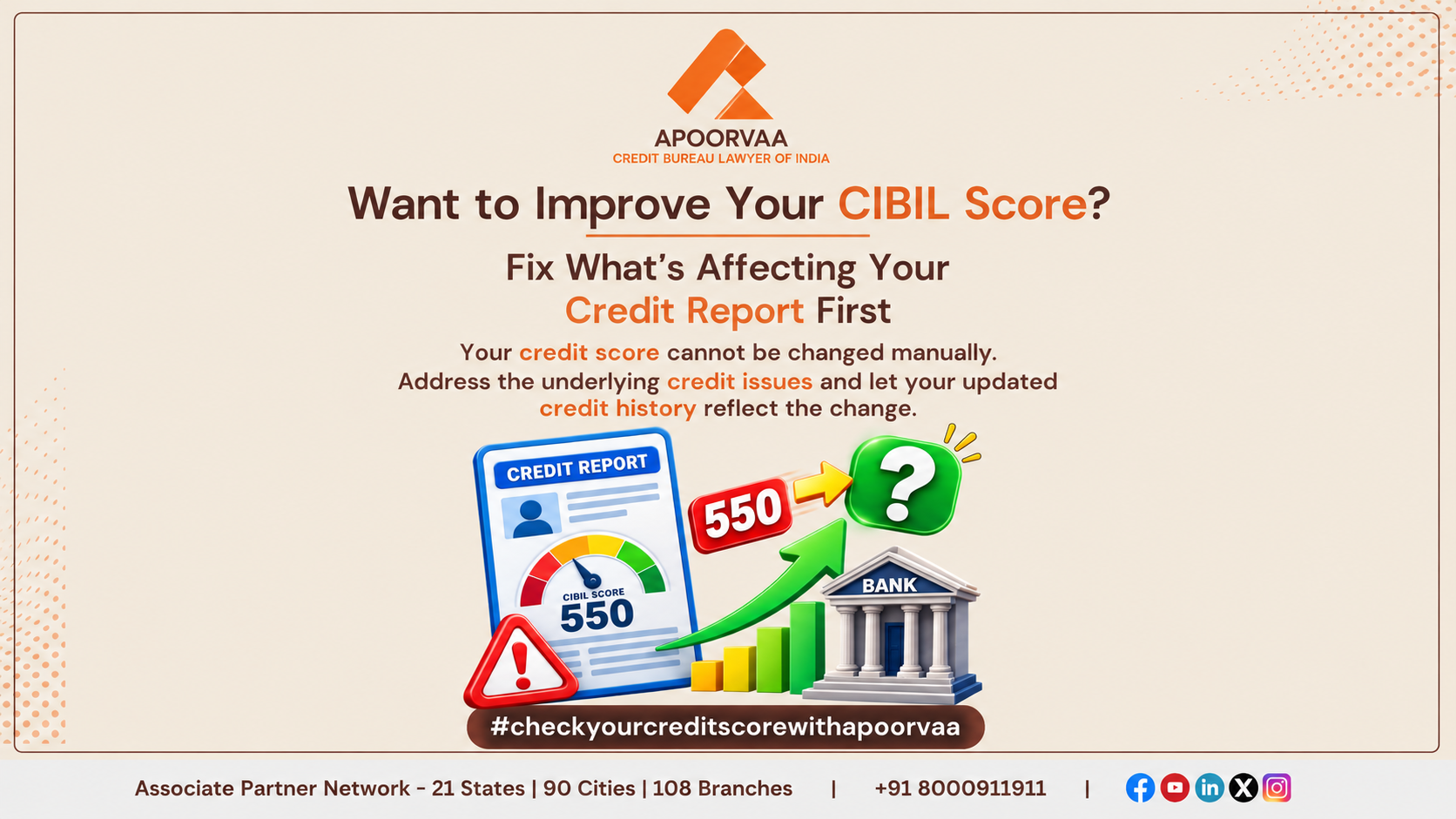
How to improve CIBIL Score is one of the most common questions we receive from borrowers.
A customer may say:
“My CIBIL Score is 600. The bank manager has told me that if it becomes 700, my chances of getting the loan will improve. Can you increase my score from 600 to 700?”
The question sounds straightforward.
But this is not how a credit score works.
A CIBIL Score is not a number that a person, consultant, bank employee or credit bureau representative can simply change manually on request.
The score is calculated from information contained in the individual’s credit history.
Therefore, if you want to understand why your score is low, the correct starting point is not:
“How do I add 100 points?”
The correct starting point is:
“What is appearing in my credit report that may be affecting my credit profile?”
That difference is fundamental to understanding genuine CIBIL Score improvement.
You Cannot Simply Ask Someone to Change 600 to 700
A CIBIL Score generally ranges between 300 and 900. TransUnion CIBIL explains that the score is calculated using information in the Accounts and Enquiries sections of the CIBIL Report.
This means the score is an output of the underlying credit information.
It should not be treated like an editable field.
For example, suppose your score is 550 and your report contains:
- Unpaid loan obligations
- Significant overdue amounts
- Repeated repayment delays
- Write-Off or Settled-related information
- High credit utilisation
- Multiple recent credit enquiries
- Other adverse repayment information
Simply sending an email saying:
“Please increase my score to 700”
does not address any of those underlying factors.
Similarly, paying someone merely to “add points” to your score without addressing the underlying credit profile is not a legitimate approach to Credit Rectification.
Your Credit Report Comes Before Your Credit Score
Many borrowers focus almost entirely on the three-digit score.
They open the report and immediately look for:
650
700
750
800
But if the objective is to understand the score, the underlying report deserves equal attention.
Your credit report can contain information about your credit accounts, balances, payment history, enquiries and account status.
Therefore, when a score is lower than expected, examine the report and ask:
Which accounts are currently active?
Are any genuine dues still outstanding?
Have there been recent repayment delays?
Is an old delinquent account still appearing?
Are there Write-Off or Settled-related accounts?
Are balances being reported correctly?
Are there accounts or enquiries that I do not recognise?
Only after understanding the underlying information can you determine what action may actually be required.
Genuine Outstanding Dues Cannot Be Ignored Just to Increase the Score
Consider a borrower who took money from a bank in the past but did not complete the required repayment.
The unpaid obligation continues to be reflected in the borrower’s credit history according to the lender-reported information.
Now the borrower wants a fresh loan and says:
“I don’t want to pay the old bank dues. Just increase my CIBIL Score.”
These are two different objectives.
If the old dues are genuine and accurately reported, simply wanting a higher score does not make the underlying obligation disappear.
The appropriate course is first to understand the account and address the genuine outstanding obligation with the concerned lender through the applicable process.
After the lender-side resolution, the relevant account information should subsequently be reported and updated appropriately.
Only then should the customer evaluate the resulting credit profile.
This is why genuine CIBIL Score improvement cannot be separated from responsible treatment of the underlying credit history.
Paying Old Dues Does Not Mean Someone Manually Adds Points
This distinction is equally important.
Suppose an old genuine outstanding account is appropriately resolved.
What happens next?
It is not:
Payment → Someone adds 100 points to CIBIL
The process is closer to:
Understand Account → Resolve Applicable Dues → Obtain Relevant Documentation → Lender Updates Credit Information → Updated Credit Profile → Score Recalculated
The exact score after an update cannot responsibly be guaranteed in advance.
Why?
Because a CIBIL Score is based on the broader credit profile—not one account alone.
Other loans, repayment behaviour, credit utilisation, enquiries, age of credit and additional credit information may also influence the score.
Therefore, a professional should not promise:
“Pay this account and your score will definitely become 750.”
The legitimate objective is to ensure that the underlying account is appropriately addressed and the resulting information is accurately reflected.
What If the Negative Information Is Correct?
This is where borrowers need to distinguish between something that is negative and something that is incorrect.
Suppose your report correctly shows that you delayed several loan repayments.
That information may negatively affect your credit profile.
But its negative effect does not automatically make it an error.
Similarly, if genuine bank dues remain unpaid, their presence in the credit history cannot simply be challenged only because you now need a higher score.
This principle is important:
Negative credit information ≠ Incorrect credit information
Credit Rectification should not be used to manufacture a credit history that never existed.
Where information is genuine, the underlying financial/account issue may need to be addressed appropriately.
Where information is genuinely inaccurate, the appropriate verification and rectification process should be followed.
What If the Credit Report Contains an Error?
Now consider a completely different situation.
Suppose your credit report shows:
A loan account that does not belong to you
An incorrect outstanding amount
An account status inconsistent with the lender’s records
A payment that has not been appropriately reflected
or another genuine reporting discrepancy.
In such circumstances, simply paying money to improve the score would also be the wrong approach.
The issue should first be verified and rectified.
TransUnion CIBIL explains that it cannot make changes to credit information without confirmation from the concerned credit institution; disputes involving account information are routed through the relevant lender for verification.
Therefore, the correct action depends on why the score is being affected.
If the underlying information is genuine, address the genuine issue.
If the information is inaccurate, address the reporting discrepancy.
Credit Rectification and Score Improvement Are Not the Same Thing
This distinction is central to today’s topic.
Credit Rectification
Credit Rectification focuses on the underlying information in the credit report.
The objective may involve understanding, verifying and appropriately addressing account information through the relevant lender and credit-bureau process.
Credit Score Improvement
Score improvement is generally the result of changes in the overall credit profile over time.
That may involve:
- Timely repayment
- Resolution of genuine outstanding obligations
- Responsible credit utilisation
- Fewer unnecessary credit applications
- Building a stronger repayment history
- Correction of genuine reporting inaccuracies where applicable
Therefore, Credit Rectification should not be sold as:
“Give us your 550 score and we will make it 750.”
That oversimplifies how the credit system works.
The better approach is:
Understand what is affecting the credit profile → address what legitimately needs to be addressed → ensure accurate reporting → allow the scoring system to reflect the updated credit history.
Why You Should Access Your Credit Report Before Applying for an Important Loan
If you know that you may require a:
Home loan
Business loan
Loan against property
Vehicle loan
or another major credit facility in the coming months, do not wait until the loan application is submitted to understand your credit profile.
Access your credit report beforehand.
Review the accounts.
Check the repayment information.
Identify genuine outstanding obligations.
Look for information you do not recognise.
And understand whether anything requires action.
If an old issue needs lender communication, payment, documentation or rectification, the process may take time.
Starting early gives you the opportunity to address legitimate issues before the loan requirement becomes urgent.
Why CIBIL Score Improvement Starts With the Credit Profile
When someone wants to improve a CIBIL Score, the natural question is:
“What should I do to increase my score?”
But there is no single answer that applies to every customer.
Two people may both have a CIBIL Score of 600, but the reasons behind those scores can be completely different.
One person may have genuine outstanding bank dues.
Another may have an old Write-Off or Settled account.
Someone may have repeated repayment delays.
Another person may have an account or information that he or she does not recognise.
This is why the score alone cannot determine the solution.
The more important question is:
What is happening inside the credit report that is affecting the overall credit profile?
Understanding that difference is the foundation of genuine Credit Rectification and credit-health improvement.
Different Credit Problems Require Different Solutions
A common misconception is that every low CIBIL Score can be addressed using the same formula.
That is not how credit profiles work.
Consider some common situations:
Genuine Outstanding Bank Dues
If an old loan has genuine unpaid dues, the underlying financial obligation cannot simply be ignored while trying to increase the score.
The account itself needs to be understood and appropriately addressed.
Write-Off or Settled Account
A Write-Off or Settled status has a specific history behind it.
Before deciding what can be done, it is important to understand the account, its past repayment position and the lender-reported information.
Incorrect Credit Information
Sometimes the problem is not the customer’s repayment behaviour but information that appears inconsistent with the actual account position.
Such cases require a completely different approach from genuine unpaid dues.
Unknown Loan or Credit Account
If a customer finds a loan or credit facility that he or she does not recognise, the first objective should be to understand why that account is appearing.
Repayment Behaviour
If the credit profile is being affected by genuine recent payment delays, the issue cannot simply be treated as a reporting error.
These examples demonstrate why professional credit analysis should begin with the cause of the problem rather than the desired score.
Why Old Bank Accounts Can Require Detailed Assessment
Older delinquent accounts can be particularly complicated.
Suppose a loan was taken many years ago and is now appearing with adverse information in the credit report.
A customer may look at the report and ask:
“How much do I need to pay to fix this?”
The answer may not always be available simply by looking at the amount appearing in the credit report.
An old account can involve its historical position, payments made in the past, lender records, outstanding obligations and the lender’s current account position.
Therefore, an old credit issue should not be approached with assumptions such as:
“Whatever amount is showing in CIBIL, just pay that amount.”
or
“Pay this fixed percentage and the account will automatically become clear.”
Credit Rectification requires understanding the actual issue before determining what course of action may be appropriate.
This is also why two customers with apparently similar Write-Off or Settled accounts may not necessarily have identical solutions.
Payment and Credit Report Rectification Are Not the Same Thing
Another important misunderstanding is:
“Once I make the payment, my CIBIL is automatically fixed.”
Payment can be an important part of resolving a genuine outstanding obligation, but payment, lender-side account resolution and subsequent credit-bureau reporting are different stages.
The final question should always be:
What is reflecting in the updated credit report?
A customer should not assume that an account has been rectified merely because a payment has been made.
Similarly, verbal confirmation that:
“Your CIBIL work is done”
should not replace verification through the latest credit report.
The credit report itself ultimately needs to reflect the relevant lender-reported update.
Why an Exact CIBIL Score Increase Cannot Be Guaranteed
This is one of the most important points for anyone searching for ways to improve a CIBIL Score.
Suppose your current score is 580.
Can somebody guarantee:
“We will make it 700”?
A responsible answer should be no.
Your score depends on the overall credit profile.
Even after one account is appropriately addressed, other factors may continue to influence the score.
Therefore, claims such as:
“100-point guaranteed increase”
“550 to 750 guaranteed”
“We can manually increase your CIBIL Score”
should be approached carefully.
The legitimate objective is to address the factors that can appropriately be addressed and ensure that the underlying credit information reflects the correct position.
The score should be the outcome—not the product being manually sold.
Credit Improvement and Credit Rectification Are Different
This distinction is important for customers to understand.
Credit Improvement
Credit improvement generally relates to developing healthier credit behaviour over time.
This may include maintaining timely repayments, managing credit responsibly and avoiding unnecessary financial stress.
Credit Rectification
Credit Rectification becomes relevant when there is a specific issue within the credit profile that needs to be understood, verified or appropriately addressed.
That could involve matters such as:
- Old outstanding bank dues
- Write-Off or Settled accounts
- Incorrect account information
- Unknown credit accounts
- Reporting discrepancies
- Account information that requires further verification
Therefore, someone asking:
“How can I increase my CIBIL Score?”
may actually need to ask:
“Do I have a credit-behaviour problem, an unresolved account issue, a reporting problem—or a combination of these?”
That distinction determines what kind of action may be required.
Why Credit Rectification Requires More Than Looking at the Score
A three-digit score gives an important indication of the credit profile.
But it does not by itself explain the complete reason behind the customer’s situation.
For Credit Rectification, the account-level information matters.
For example:
Two customers may both have a score of 620.
Customer A may have an old genuine outstanding loan.
Customer B may have information in the report that appears inconsistent with his actual records.
The number is the same.
The underlying problem is completely different.
Therefore, applying the same solution merely because two people have similar scores would be inappropriate.
This is where experience in understanding credit reports, lender-reported information and different types of credit issues becomes important.
When Should You Consider Professional Credit Rectification?
Not every low score requires professional Credit Rectification.
If the score is primarily affected by recent borrowing behaviour that is accurately reported, responsible financial behaviour over time may be what is required.
However, professional assessment can become particularly relevant when the report contains issues such as:
Old bank dues that you do not know how to address
Write-Off or Settled-related accounts
An old Current Balance or overdue amount requiring examination
An account you do not recognise
Information that appears inconsistent with your records
An account that remains problematic even after earlier action
Multiple credit-report issues where the customer does not understand what should be addressed first
At this point, the objective should not simply be:
“Increase my score.”
It should be:
“Understand what is affecting my credit profile and determine what can legitimately be done about it.”
The Right Approach to Credit Rectification
At Apoorvaa – Credit Bureau Lawyer of India, we believe Credit Rectification should begin with understanding the customer’s actual credit problem.
The broad approach is straightforward:
Understand the Credit Report → Identify the Underlying Issue → Determine the Appropriate Course of Action → Work Toward Accurate Reporting → Verify the Outcome
Different cases can require different approaches because the history behind each account can be different.
Most importantly, the customer should understand what the problem was and should ultimately be able to verify the outcome through the updated credit report.
The objective is not to create an artificial CIBIL Score.
It is to work toward a healthier and accurately reported credit profile.
Do Not Wait Until Your Loan Requirement Becomes Urgent
Credit problems are often discovered at the worst possible time.
A customer may be preparing for:
A home loan
Business funding
Loan against property
Vehicle finance
Balance transfer
or another important financial requirement.
The lender checks the credit profile, and only then does the customer discover an old problem.
At that point, the customer may want the issue resolved immediately.
But an old credit issue cannot always be understood or addressed overnight.
This is why reviewing your credit report before an important borrowing requirement arises can be valuable.
If there is a genuine issue, you have more time to understand it and seek appropriate assistance.
Frequently Asked Questions
Can my CIBIL Score be increased from 600 to 700?
There is no legitimate method of simply selecting a target number and manually changing the score. The underlying credit profile must first be understood.
Can someone guarantee a 100-point CIBIL Score increase?
An exact score increase should not be guaranteed because the score depends on multiple aspects of the overall credit history.
Can CIBIL Score improve without clearing genuine old bank dues?
If genuine unpaid obligations are affecting the credit profile, simply ignoring those obligations while targeting a higher score does not address the underlying issue. The particular account should first be properly assessed.
Does paying old bank dues automatically fix CIBIL?
Not necessarily. Resolving the financial obligation and ensuring that the relevant lender-reported information is appropriately updated are connected but distinct aspects of the process.
Can a Write-Off or Settled account affect the credit profile?
Such account information can be relevant to the overall credit profile. The appropriate course of action depends on the history and current position of the particular account.
What if an account in my CIBIL Report does not belong to me?
An unknown account should be examined and verified rather than assumed to be genuine or simply paid.
Can every negative entry be removed?
No. Information should not be treated as incorrect merely because it negatively affects the credit profile. Genuine information and inaccurate information require different approaches.
When should I seek Credit Rectification assistance?
Professional assistance can be useful when you do not understand the reason behind a credit-report issue, have old or complicated accounts, identify potential reporting discrepancies or need help understanding what can appropriately be addressed.
Final Takeaway
If you want to improve your CIBIL Score, don’t begin by chasing a number.
A score of 550, 600 or 650 is an outcome of the broader credit profile.
The more important task is to understand:
What is affecting the credit profile?
Is the issue genuine or potentially inaccurate?
Is there an unresolved bank obligation?
Does an old account require further assessment?
Is there a credit-reporting issue that needs to be addressed?
Once the underlying problem is understood, the appropriate course of action becomes clearer.
This is why genuine Credit Rectification is not about promising:
“We will increase your CIBIL Score by 100 points.”
It is about understanding the credit problem correctly and working toward an appropriate, accurate and verifiable outcome.
Related Credit Education
- Importance of Good Credit Score: 7 Reasons It Matters
- Low CIBIL Score: 5 Common Reasons Behind It
- Good Credit Score: 5 Important Benefits You Should Know
About the Author
Advocate Apurva Bhagat is the Founder of Apoorvaa – Credit Bureau Lawyer of India and works in Credit Rectification, credit-report analysis and credit-related borrower guidance.
His approach focuses on understanding the underlying reason behind a credit problem rather than simply targeting a higher score. Different credit issues require different assessments, and the objective of Credit Rectification should be an appropriate and verifiable outcome reflected in the customer’s credit profile.
A low CIBIL Score is the result. Understanding what is causing it is the first step toward addressing it correctly.

CIBIL Problem Not Resolved? Find The Root Cause First
[…] How to Improve CIBIL Score: Fix […]
CIBIL Score Improvement: Can Your Score Increase In 24 Hours?
[…] How to Improve CIBIL Score: Fix Credit Issues First […]