





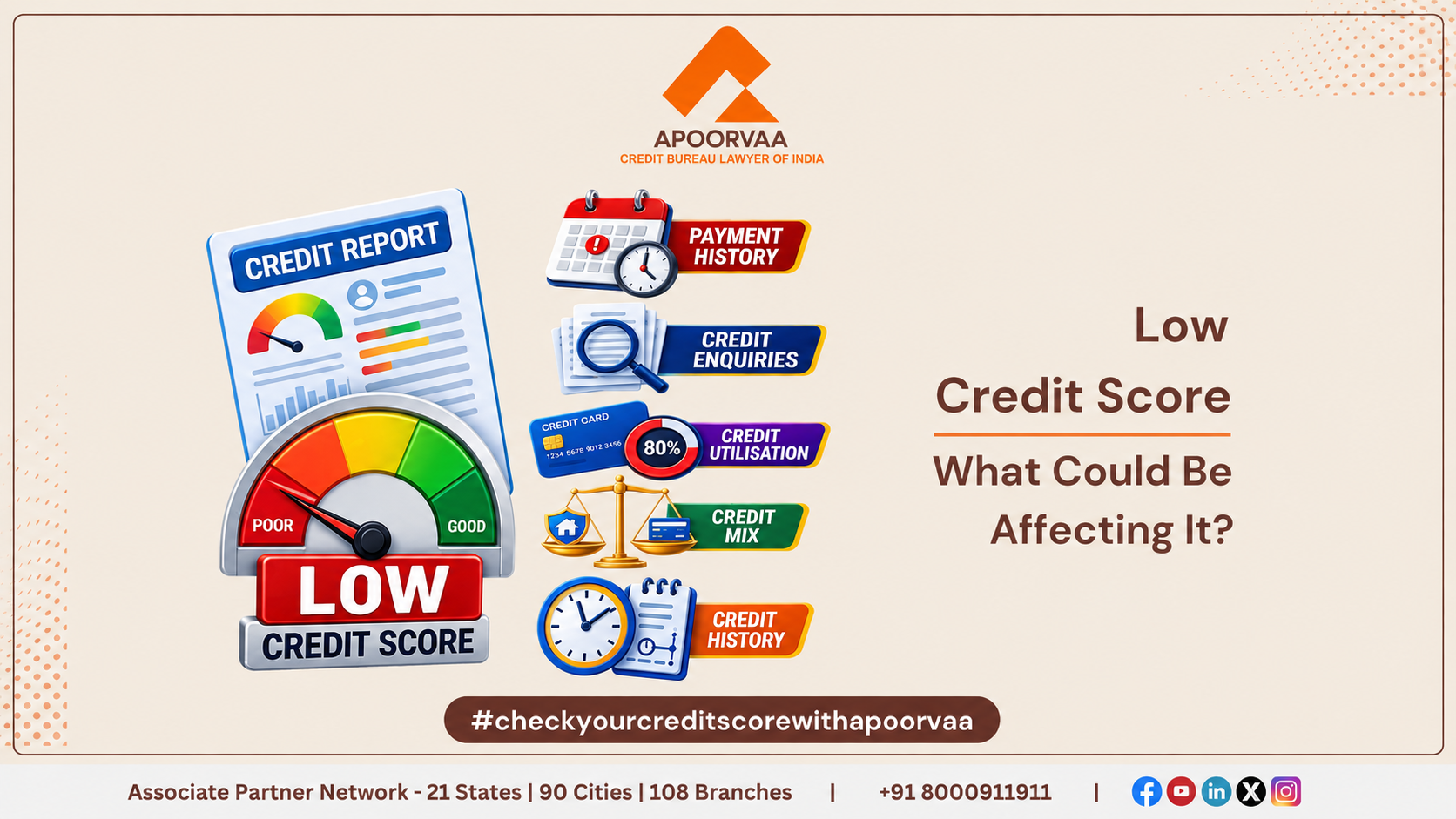
A Low CIBIL Score can be caused by several factors within your credit profile, and understanding the actual reason is more important than immediately searching for ways to increase the score. Delayed loan or credit card payments, frequent credit enquiries, high credit utilisation, an imbalanced credit mix and a short credit history are five common factors that can influence your credit score.
When people check their credit report and find that the score is lower than expected, their first question is usually:
“Mera CIBIL Score kam kyun hai?”
That is actually the right question to ask.
Before trying to improve a score, you first need to understand what is affecting it.
A credit score is not decided by one single loan, one single payment or one single factor. It is based on information contained in your overall credit profile.
Today, let us understand five important reasons that may contribute to a Low CIBIL Score.
1. Delayed Loan or Credit Card Payments
Your repayment behaviour is one of the most important parts of your credit profile.
Whenever you take a loan or use a credit card, the lender expects payment according to the agreed schedule.
If an EMI or credit card payment becomes overdue, that repayment behaviour can be reported as part of your credit history.
For example, suppose you have:
- A home loan
- A personal loan
- Two credit cards
Your home-loan EMI is regular, but one credit card repeatedly remains overdue.
You may think:
“Baaki sab payments toh regular hain. Ek card se kya farak padega?”
But the credit report reflects repayment behaviour across your reported credit facilities.
Repeated or recent payment delays can therefore negatively influence your overall credit profile.
Understanding DPD
This is also where DPD – Days Past Due becomes important.
DPD indicates how many days a payment remained overdue during a particular reporting period.
Depending on the reporting, you may see values such as:
000 – generally indicates no days past due for that reporting period.
30 – indicates approximately 30 days past due.
60 – indicates a longer payment delay.
90 – indicates a still more serious delinquency.
Therefore, when analysing a Low CIBIL Score, don’t look only at the number displayed at the top of the report.
Review the payment history of individual accounts.
A score tells you that something may be affecting the profile.
The detailed credit report helps you understand what that something may be.
Recent Payment Behaviour Can Matter
There is also an important practical distinction between an old repayment issue and current financial behaviour.
Suppose someone had a payment delay many years ago but has subsequently maintained responsible repayment behaviour for a long period.
Compare that with someone whose home-loan EMI has bounced repeatedly during the last three months.
These are not identical credit situations.
A lender evaluating a new application may consider the complete and current credit profile while making its lending decision.
Therefore, if your score has recently fallen, one of the first things to examine is whether any current or recent account has developed payment irregularities.
2. Too Many Credit Enquiries
The second factor is frequent credit enquiries.
Whenever you apply for a new loan or credit card, the lender may access your credit report as part of its credit assessment.
Such lender-initiated checks in connection with credit applications can appear as enquiries in your credit report.
One enquiry does not mean that your credit profile is automatically damaged.
The concern arises when a person makes multiple credit applications within a relatively short period.
Consider this situation.
Your personal-loan application is rejected by Bank A.
You immediately apply with Bank B.
Then Bank C.
Then an NBFC.
Then another digital lender.
Within a short period, several credit enquiries may appear.
This pattern can become part of the overall credit assessment and may indicate that the consumer is seeking credit from multiple sources.
Therefore, repeatedly applying for credit without first understanding why the previous application was rejected may not be a good strategy.
Check Before Applying Again
If your loan application is rejected, don’t immediately send applications to several other lenders.
First understand:
- Your current CIBIL Score
- Your complete credit report
- Existing outstanding loans
- Recent payment behaviour
- Number of recent enquiries
- Any negative account status
- Your overall eligibility
Then decide whether another credit application is appropriate.
This can help prevent unnecessary enquiries from accumulating.
Checking Your Own CIBIL Report Is Different
People sometimes become afraid to check their own credit report because they believe:
“Agar baar-baar CIBIL check karunga toh score kam ho jayega.”
There is an important distinction between checking your own credit information and a lender accessing your report because you have applied for new credit.
The concern discussed here relates primarily to repeated credit applications and the associated lender enquiries—not simply responsibly monitoring your own credit profile.
Regularly reviewing your own report can actually help you identify problems before you make an important loan application.
3. High Credit Utilisation
The third reason behind a Low CIBIL Score can be high credit utilisation, particularly in relation to revolving credit such as credit cards.
Credit utilisation broadly refers to how much of your available revolving credit you are using.
For example:
Suppose your credit card limit is ₹1,00,000.
If your reported outstanding balance is ₹20,000, your utilisation is relatively lower.
But if you regularly use ₹80,000–₹90,000 of the available ₹1,00,000 limit, you are using a very large portion of the credit available to you.
Even if payments are being made, consistently high utilisation can influence how your overall credit behaviour is assessed.
This is why simply saying:
“Maine kabhi EMI late nahi ki”
does not automatically mean every other aspect of the credit profile is ideal.
Repayment history is important, but it is not the only factor.
Credit Utilisation and Unsecured Borrowing Are Not Exactly the Same Thing
This distinction is worth understanding.
In everyday discussions, people sometimes use high credit utilisation and too much unsecured borrowing as though they mean exactly the same thing.
They do not.
Credit utilisation commonly relates to the proportion of available revolving credit being used, particularly credit-card limits.
Unsecured borrowing refers to facilities without specific collateral, such as many personal loans and credit cards.
A person can therefore have:
- High credit-card utilisation,
- Significant unsecured borrowing,
- Or both.
Each needs to be understood in the context of the complete credit profile.
This is why proper credit-report analysis should go beyond simply looking at the three-digit score.
Don’t Take New Credit Only to Manipulate Utilisation
Another mistake is trying to artificially “fix” the credit profile by immediately opening additional credit facilities.
Before taking another card or loan, understand why utilisation is high in the first place.
If the underlying problem is excessive dependence on borrowed money, adding more credit may not solve the financial issue.
The objective should be to build responsible and sustainable credit behaviour, not merely find a temporary technique for changing a number.
4. An Imbalanced Credit Mix
The fourth factor that can contribute to a Low CIBIL Score is the nature and mix of credit facilities in your overall credit profile.
Credit accounts can broadly include secured and unsecured credit.
Secured loans are backed by an underlying asset or security. Examples may include:
- Home loans
- Certain vehicle loans
- Loans against property
Unsecured credit does not generally have specific collateral backing the facility. Examples may include:
- Personal loans
- Credit cards
- Certain unsecured business loans
A credit profile consisting heavily of unsecured borrowing may be assessed differently from a profile demonstrating a more balanced borrowing pattern.
However, this does not mean that everybody needs to take a secured loan simply to improve their CIBIL Score.
That would be the wrong interpretation.
The objective is to understand that your overall borrowing pattern matters.
Don’t Take a Loan Just to Create a Credit Mix
This is an important practical point.
Once people hear that credit mix can influence their credit profile, they sometimes think:
“Mere paas sirf credit card hai, toh kya mujhe secured loan lena chahiye?”
Not necessarily.
Never borrow money unnecessarily simply to create what you believe is an ideal credit mix.
Every loan creates:
- Repayment responsibility
- Interest cost
- EMI commitment
- Additional financial exposure
Credit should primarily be taken when there is a genuine financial requirement and you have the capacity to repay it.
A healthy credit profile should develop from responsible financial behaviour, not unnecessary borrowing designed only to influence the score.
5. Short Credit History
The fifth factor behind a Low CIBIL Score can be the length and depth of your credit history.
Consider someone who has recently entered the formal credit system.
Perhaps they received their first credit card six months ago and have never previously taken a loan.
Their credit history is naturally limited.
Compare this with someone who has maintained various credit facilities responsibly over several years.
The second person’s credit report contains a longer record from which repayment behaviour can be evaluated.
This is why the age of your credit history can form part of the overall credit profile.
A Short Credit History Does Not Mean You Are a Bad Borrower
This distinction is important.
A person with a limited credit history is not necessarily financially irresponsible.
They may simply not have enough established credit history yet.
For example, a young professional may have:
- Stable employment
- Good income
- No payment defaults
- One recently opened credit card
Yet the person’s credit history may still be relatively new.
There is no need to panic or start taking multiple loans just to build history quickly.
Credit history develops with time and responsible usage.
Pay obligations on time, use available credit responsibly and allow your credit profile to mature naturally.
Are These the Only Reasons for a Low CIBIL Score?
No.
These are five common factors that can influence a CIBIL Score, but every credit profile is different. The impact of each factor depends on the borrower’s overall credit history and the information reported across their credit accounts.
Other issues can also require attention.
For example, a credit report may contain:
- Overdue accounts
- Settlement-related reporting
- Written-off accounts
- Recent repayment irregularities
- Incorrect account information
- An unfamiliar credit facility
- Guarantor-related exposure
- Multiple active obligations
- Other adverse account information
Therefore, if you have a Low CIBIL Score, don’t automatically assume that one of these five factors must be the only reason.
The complete report needs to be understood.
How Do You Find the Actual Reason Behind Your Low CIBIL Score?
This is where many borrowers make their biggest mistake.
They look at the score and immediately start searching:
“CIBIL Score kaise badhaye?”
Instead, start with:
“Mere credit report mein kya hai?”
Obtain your latest credit report and examine it systematically.
Step 1: Review Every Credit Account
Check every loan and credit card appearing in the report.
Make sure you recognise each facility.
If an unknown loan appears, do not ignore it. The ownership and reporting of that account may need investigation.
Step 2: Review Payment History
Check whether your reported accounts show payment delays, overdue amounts or DPD.
Pay particular attention to recent repayment behaviour.
Step 3: Review Current Balances
Understand how much credit you currently owe and how your revolving credit facilities are being utilised.
Step 4: Review Credit Enquiries
Look at recent enquiries and ask:
“Have I applied for too many loans or credit cards within a short period?”
Step 5: Review Account Status
Check whether any facility contains potentially adverse status information such as settlement or write-off related reporting.
Step 6: Check Whether the Information Is Accurate
This is extremely important.
There is a difference between:
genuine negative information
and
incorrect negative information.
If you genuinely delayed an EMI, an accurate record of that delay should not be treated as a reporting error merely because it affects your score.
But if information in the report is genuinely inaccurate, the discrepancy should be identified and addressed through the appropriate lender and credit-bureau process.
Don’t Try to “Repair” the Score Before Understanding the Report
A Low CIBIL Score is an outcome of the information and behaviour reflected in your overall credit profile.
Therefore, trying random methods to increase the number without understanding the underlying cause can waste time and may even create additional problems.
For example:
Your problem may be high utilisation, but you keep applying for new loans.
Your problem may be recent missed EMIs, but you focus only on closing an old account.
Your problem may be an incorrect loan account, but you start making payments without first establishing whether the account actually belongs to you.
Your problem may be repeated enquiries, but you continue applying with additional lenders.
Different problems require different responses.
Diagnosis should come before rectification.
Common Mistakes People Make When Their CIBIL Score Is Low
1. Applying to Multiple Banks
A rejected loan application should not automatically be followed by applications to several other lenders.
First understand why the original application encountered difficulty.
2. Looking Only at the Score
The score is important, but the report contains the information needed to understand your credit profile.
3. Believing in Instant Score Improvement
Credit history develops over time.
Be cautious of anyone promising a guaranteed score increase within an unrealistic fixed period.
4. Raising Disputes Against Genuine Information
A dispute is meant for information that requires verification or correction.
It is not a mechanism for deleting accurate negative history simply because it is affecting your score.
5. Taking Unnecessary Loans to Build Credit History
Do not create debt merely for the purpose of manipulating a credit score.
6. Ignoring Recent Payment Problems
If current EMIs are repeatedly bouncing, focus on resolving the present financial problem instead of concentrating only on an old entry.
Practical Checklist for a Low CIBIL Score
If your score is lower than expected, follow this sequence:
✔ Obtain your latest complete credit report.
✔ Review every loan and credit card account.
✔ Check payment history and DPD.
✔ Review outstanding balances and credit utilisation.
✔ Check recent credit enquiries.
✔ Understand your secured and unsecured credit exposure.
✔ Review the length of your credit history.
✔ Identify adverse account statuses.
✔ Verify whether all reported information is accurate.
✔ Address genuine financial obligations appropriately.
✔ Dispute only information that is genuinely inaccurate.
✔ Continue responsible repayment behaviour.
The objective should not simply be:
“Mujhe score jaldi badhana hai.”
The objective should be:
“Mujhe apna complete credit profile samajhna aur healthy banana hai.”
Frequently Asked Questions
Why is my CIBIL Score low even though I pay my EMIs?
Timely EMI payment is important, but your overall credit profile contains other information too. Credit utilisation, enquiries, credit mix, length of credit history and other reported account information may also be relevant.
Can too many loan enquiries affect my CIBIL Score?
Frequent applications for new credit can result in multiple lender enquiries appearing within a short period. Therefore, avoid repeatedly applying without understanding your eligibility and existing credit profile.
Does high credit card utilisation affect my credit profile?
High utilisation of available revolving credit can be a factor in your overall credit profile. Responsible credit-card usage involves more than simply making the minimum payment on time.
Is having unsecured loans bad for CIBIL?
An unsecured loan is not automatically negative. The overall borrowing pattern, repayment behaviour and complete credit profile matter. Avoid assuming that a particular loan category by itself makes a credit profile bad.
Can a new borrower have a lower score because of limited credit history?
A relatively short credit history provides less historical credit behaviour to evaluate. Credit history develops naturally over time as credit is used and repaid responsibly.
Should I take another loan to improve my credit mix?
Do not take unnecessary debt solely to try to influence your score. Borrow based on genuine financial requirements and repayment capacity.
Can a Low CIBIL Score be improved?
The appropriate approach depends on why the score is low. Genuine repayment issues, high utilisation, repeated enquiries, limited history and inaccurate reporting are different situations and should not all be treated with the same solution.
Final Thoughts
A Low CIBIL Score should not immediately create panic.
It should create a question:
“What is happening inside my credit report?”
Today’s five factors provide a useful starting point:
1. Delayed loan or credit card payments
2. Frequent credit enquiries
3. High credit utilisation
4. Imbalanced credit mix
5. Short credit history
But don’t stop at the list.
Every credit profile is different.
One borrower may have a payment-history problem.
Another may have excessive utilisation.
Another may simply have a limited credit history.
And another may have inaccurate information that requires verification.
That is why the correct sequence is:
Understand the report → Identify the reason → Verify the information → Address the actual issue → Maintain responsible credit behaviour.
Improving your credit profile should be the result of correct financial behaviour and accurate credit reporting, not shortcuts.
Is Your CIBIL Score Low? Understand the Reason First
If your CIBIL Score is lower than expected, don’t begin with shortcuts or assumptions.
Start with your complete credit report.
At Apoorvaa – Credit Bureau Lawyer of India, we work in the field of Credit Rectification and Credit Report analysis, helping individuals and businesses understand the information appearing in their credit profiles and identify genuine credit-reporting issues.
A detailed analysis can help distinguish between:
- Genuine repayment history
- Current financial behaviour
- High credit exposure
- Reporting discrepancies
- Incorrect account information
- Other negative observations requiring attention
Where information is accurate, the focus should be on appropriate financial action and responsible credit behaviour.
Where information is genuinely incorrect, the appropriate rectification process can be followed with the concerned institution and credit bureau.
Don’t focus only on increasing the three-digit number. First understand why your credit profile looks the way it does.
About the Author
Advocate Apurva Bhagat is the Founder of Apoorvaa – Credit Bureau Lawyer of India and works in the field of Credit Rectification, Credit Report analysis and credit-related borrower guidance.
Through his professional practice and financial-awareness initiatives, he focuses on helping individuals and businesses understand their credit reports, identify genuine reporting problems and follow an appropriate process based on the facts of each case.

CIBIL Rectification: How To Verify Your Report Is Corrected
[…] Low CIBIL Score: 5 Common Reasons Behind It […]
CIBIL Problem Not Resolved? Find The Root Cause First
[…] Low CIBIL Score: 5 Common Reasons Behind It […]