





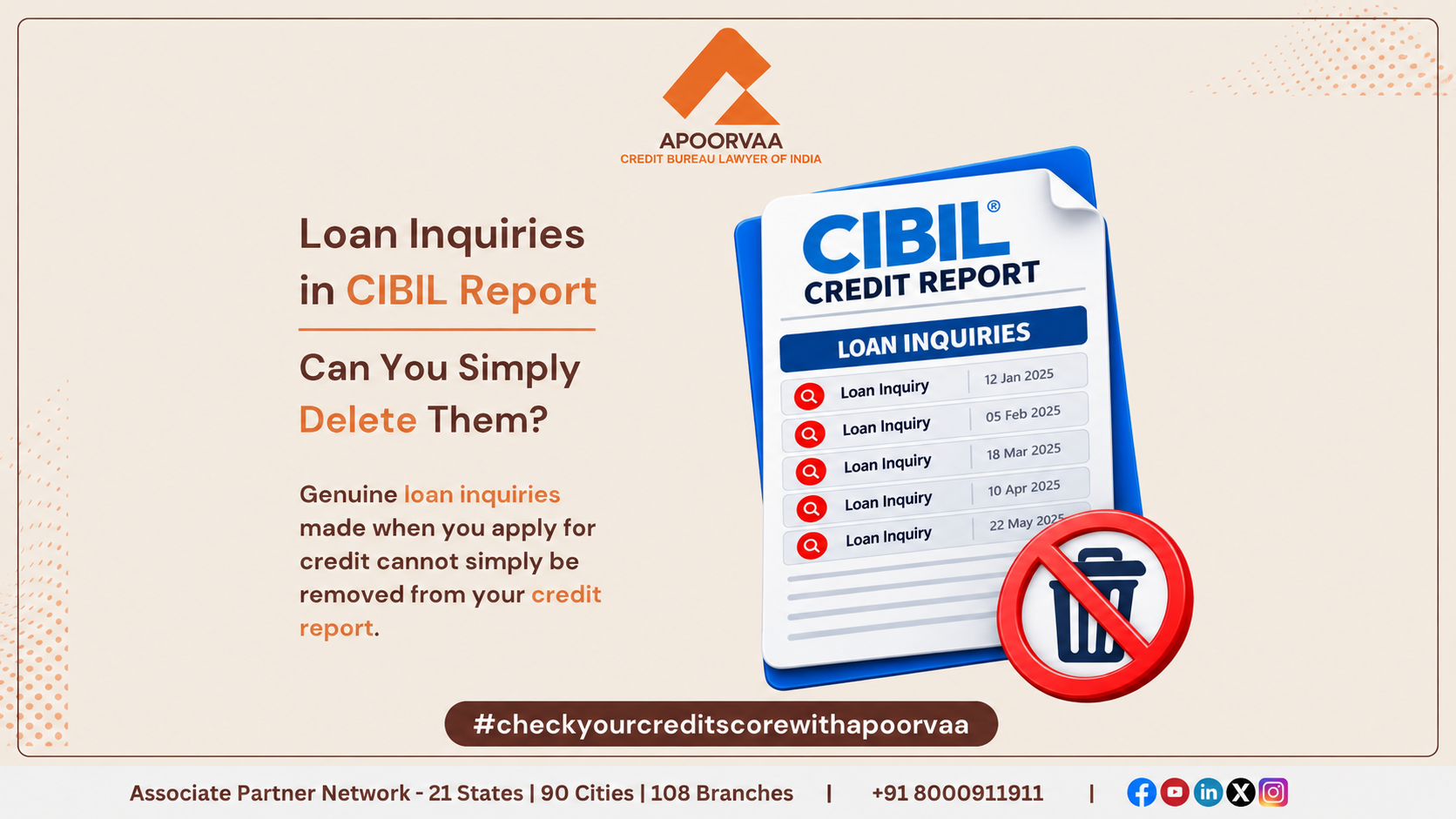
CIBIL Enquiries are created when lenders access your credit report in connection with applications for loans or other credit facilities. A common question we receive is whether these loan enquiries can later be deleted from the CIBIL Report simply because there are too many of them. If the enquiries genuinely arose from credit applications made by you, they cannot simply be removed merely to make the credit profile look better.
This question often arises after someone has applied for a loan with several banks.
For example:
A borrower approaches Bank A for a personal loan.
The application does not proceed.
The borrower then approaches Bank B.
Then Bank C.
Then an NBFC.
Within a short period, several enquiries appear in the credit report.
The borrower later becomes concerned and asks:
“Can I keep one enquiry and remove the remaining enquiries from my CIBIL Report?”
If those enquiries genuinely arose because you applied for credit with those lenders, you should not expect them to be deleted simply because you now want fewer enquiries on the report.
Understanding why CIBIL Enquiries appear is therefore important before trying to remove them.
What Are CIBIL Enquiries?
When you apply for a loan or credit card, the lender needs to assess whether it wants to extend credit to you.
As part of this assessment, the lender may obtain your credit information.
The lender can evaluate several factors according to its credit policy, including your:
- Credit history
- Existing loans
- Repayment behaviour
- Outstanding obligations
- Credit score
- Income and repayment capacity
- Overall eligibility
When a lender accesses your credit report in connection with a credit application, information about that access may appear in the Enquiries section of your CIBIL Report.
Therefore, an enquiry is not itself a loan.
It indicates that your credit report was accessed by a lender in connection with a credit assessment.
What Information Can an Enquiry Show?
The Enquiries section can help you understand recent credit applications associated with your credit profile.
An enquiry entry may contain information relating to matters such as:
- Name of the lender
- Date of enquiry
- Type or purpose of credit
- Amount, where applicable
This makes the enquiry section useful for more than simply looking at how many times your report has been checked.
It can also help you verify:
“Do I actually recognise these credit applications?”
That question becomes particularly important when an enquiry appears that you do not remember authorising or initiating.
Can Genuine CIBIL Enquiries Be Removed?
This is where the answer needs to be precise.
If you genuinely applied for a loan or credit facility and the lender legitimately accessed your credit report in connection with that application, you cannot simply request deletion of that accurate enquiry because:
- The loan was rejected.
- You did not finally take the loan.
- You changed your mind.
- Another lender sanctioned the loan.
- Too many enquiries are now visible.
- You believe fewer enquiries will make the report look better.
Suppose you genuinely applied with 10 different lenders, and all 10 accessed your credit report for those applications.
You cannot simply decide later:
“Ek enquiry rehne do, baaki 9 delete karwa do.”
If those nine enquiries accurately represent genuine credit applications, they are part of the reported credit history.
This distinction is important because credit rectification should correct inaccurate information—it should not be used to erase accurate information merely because it is undesirable.
Loan Rejected? The Enquiry Does Not Automatically Become Invalid
This is another common misunderstanding.
Suppose you applied for a ₹10 lakh personal loan.
The lender accessed your CIBIL Report.
After completing its assessment, the lender rejected the application.
You may think:
“Loan mila hi nahi, toh enquiry kyun rehni chahiye?”
Because the enquiry represents the lender’s access to your credit information during the application process.
It does not represent whether the loan was ultimately approved or rejected.
Therefore:
Loan sanctioned → enquiry may appear.
Loan rejected → enquiry may still appear.
Application not ultimately pursued → a genuine enquiry already made does not automatically become inaccurate.
The enquiry records the credit check, not the final outcome of the loan application.
What If You Do Not Recognise a CIBIL Enquiry?
This is different.
Suppose your CIBIL Report shows an enquiry from a lender, but you genuinely never applied for any loan or credit card with that institution.
Do not automatically treat this in the same way as a genuine enquiry.
Ask:
Did I make this application?
Did I authorise an intermediary, DSA, fintech platform or lender to process a credit application?
Do I recognise the institution and date?
If an enquiry genuinely appears incorrect or unrecognised, it may require investigation with the concerned institution and through the appropriate credit-bureau dispute mechanism.
This is fundamentally different from asking for deletion of an enquiry that you know resulted from your own loan application.
Genuine Enquiry
You applied for credit → lender accessed your report → enquiry accurately appears.
It should not be disputed merely because you want it removed.
Unrecognised or Incorrect Enquiry
You do not recognise the application or believe the enquiry information is inaccurate.
That is a matter requiring verification and, where appropriate, correction.
This distinction protects the credibility of the credit rectification process.
Why Do Multiple Loan Enquiries Matter?
If you make several credit applications within a short period, multiple lender enquiries may become visible in your credit profile.
From a credit-risk perspective, frequent applications for new credit can be relevant because they may indicate that a consumer is actively seeking borrowing from multiple sources.
This does not mean:
“One enquiry will destroy your CIBIL Score.”
Nor should consumers become unnecessarily afraid of making a legitimate credit application.
The concern is the pattern of repeated applications.
For example:
You need a personal loan.
Instead of first understanding your eligibility, you submit applications simultaneously to several banks, NBFCs and digital lenders.
Each institution may independently access your credit information.
The result can be a cluster of enquiries over a relatively short period.
That is why borrowers should avoid treating loan applications as:
“Apply everywhere and see who approves.”
A more disciplined credit-application strategy can help avoid unnecessary enquiries.
Loan Rejected? Understand the Reason Before Applying Again
Suppose Bank A does not proceed with your loan application.
Your immediate response should not necessarily be:
“Try Bank B, C, D and E today.”
First understand your current financial and credit position.
Review:
- Your CIBIL Score
- Complete CIBIL Report
- Current loan obligations
- Recent repayment history
- DPD and overdue amounts
- Credit-card utilisation
- Existing enquiries
- Income eligibility
- Loan amount requested
- Other negative observations in the report
The rejection may not even be caused by the score alone.
A lender may consider multiple eligibility and risk factors according to its own credit policy.
Repeated applications without understanding the underlying problem can therefore create more enquiries without solving the original issue.
Checking Your Own CIBIL Report Is Different
Another misconception deserves clarification.
Some consumers avoid monitoring their credit report because they believe:
“Har baar CIBIL check karne se enquiry lagegi aur score kam hoga.”
Checking your own credit information is different from a lender accessing your report because you have applied for new credit.
Consumers should not avoid responsible credit monitoring because they confuse it with lender-generated credit enquiries.
In fact, checking your report before applying for an important loan can help you identify:
- Existing repayment issues
- Unexpected accounts
- Incorrect information
- High outstanding balances
- Multiple previous enquiries
That information can help you make a more informed borrowing decision.
Can a CIBIL Enquiry Be Disputed?
Yes—but the purpose of a dispute is to address an enquiry that you do not recognise or believe has been incorrectly reported, not to remove genuine CIBIL Enquiries simply because there are too many of them.
This distinction is essential.
Suppose your report shows five enquiries:
- Three are from banks where you knowingly applied for loans.
- One is from a credit card application you made online.
- One is from a lender you do not recognise at all.
The first four should not be treated as errors merely because you would prefer fewer enquiries.
The fifth deserves verification.
Before raising a dispute, therefore, ask:
“Is this enquiry genuinely incorrect, or do I simply want it removed?”
Those are two very different situations.
What Should You Do If an Enquiry Is Not Yours?
If you find an unfamiliar enquiry in your CIBIL Report, start by checking the details carefully.
Look at:
- Name of the lender
- Date of enquiry
- Type of credit
- Enquiry amount, where reported
- Whether you made any application around that date
Also consider whether you had applied through:
- A DSA
- Loan marketplace
- Fintech platform
- Online lending portal
- Bank representative
- Other credit intermediary
Sometimes consumers remember approaching a platform for a loan but do not realise that their application may have been processed with one or more lending institutions.
Therefore, first establish whether the enquiry has any connection with an application you actually initiated.
If you genuinely do not recognise it, the matter should be taken up for verification through the appropriate process with the concerned institution and credit bureau.
One Loan Request Can Sometimes Lead to Multiple Lender Enquiries
This deserves particular attention in today’s digital lending environment.
A consumer may think:
“Maine toh sirf ek jagah loan ke liye details di thi.”
But that “one place” may have been an intermediary or digital platform rather than the actual lender.
Depending on the application process and the authorisations provided by the consumer, the application may be considered by different lending partners.
This can result in enquiries from institutions whose names the consumer may not immediately recognise.
That does not automatically mean those enquiries are fraudulent or incorrect.
But neither should an unfamiliar enquiry simply be ignored.
The correct approach is:
Identify → Verify → Dispute if genuinely inaccurate.
This is also why borrowers should understand what they are consenting to before submitting PAN, Aadhaar, mobile number and other information through online loan platforms.
Can Someone Remove All Your Genuine Loan Enquiries for a Fee?
Be very cautious with such claims.
If someone says:
“Aapke CIBIL mein 15 enquiries hain. Hum 14 delete karwa denge.”
the first question should be:
“Were those enquiries actually incorrect?”
If all 15 enquiries genuinely arose from credit applications made or authorised by you, simply wanting a cleaner-looking report does not make those enquiries inaccurate.
Credit rectification is not about artificially rewriting legitimate credit history.
It is about ensuring that the information associated with your credit profile is accurate and appropriately reported.
Therefore, promises to delete genuine CIBIL Enquiries should be treated cautiously.
CIBIL Enquiry and Loan Account Are Not the Same Thing
Another common misunderstanding is that every enquiry means a loan has been opened.
It does not.
An enquiry indicates that a lender accessed your credit information in connection with a credit assessment.
A loan account represents an actual credit facility reported against your profile.
For example, you may apply for a personal loan with three lenders.
All three may check your credit report.
Only one ultimately sanctions and disburses the loan.
Your report may therefore contain multiple enquiries even though you finally obtained only one loan.
So:
Enquiry ≠ Loan Account
This distinction is particularly important when reviewing an unfamiliar credit report entry.
If an actual loan account appears that you never took, that requires a different type of investigation from an unfamiliar enquiry.
Can Multiple CIBIL Enquiries Affect Your Credit Score?
Frequent applications for new credit can be relevant to your credit profile, and multiple enquiries within a short period may influence the score.
But avoid interpreting this as a fixed formula.
It would be incorrect to say:
“One enquiry reduces your score by exactly X points.”
The effect of an individual enquiry should not be treated as a guaranteed fixed number.
Your credit score reflects the overall information in your credit profile.
This is why the better strategy is not to become obsessed with deleting enquiries after making them.
Instead, control unnecessary new credit applications before they happen.
What If You Already Have Too Many Genuine Enquiries?
Suppose you have already applied with several lenders and now your CIBIL Report contains numerous genuine enquiries.
Do not panic.
And do not start searching for someone who promises to delete them.
Instead:
Stop Unnecessary Applications
Avoid submitting additional loan or credit-card applications without a genuine requirement.
Review Your Complete Credit Report
There may be other factors affecting your profile that deserve greater attention, including:
- Recent payment delays
- DPD
- High credit utilisation
- Overdue balances
- Settlement-related reporting
- Other account-status issues
Understand Why Your Applications Are Being Rejected
If several lenders have already declined your application, submitting another ten applications may not solve the underlying problem.
Understand your eligibility and credit position first.
Maintain Responsible Credit Behaviour
Continue making existing loan and credit-card payments according to schedule and manage your overall credit exposure responsibly.
The objective is to improve the quality of your credit behaviour, not artificially erase legitimate history.
Don’t Raise False Disputes Against Genuine Enquiries
This is another practice to avoid.
A dispute mechanism exists so that consumers can seek verification or correction where credit information appears inaccurate.
It should not be treated as:
“Try disputing everything negative and see what gets removed.”
If you recognise the lender, remember making the application and know that the lender legitimately accessed your report, there is no proper basis to describe that enquiry as unknown merely because you now regret making the application.
Dispute processes work best when the issue is clearly identified and supported by facts.
How to Reduce Unnecessary CIBIL Enquiries in the Future
The best approach to excessive enquiries is prevention.
Before applying for another loan:
1. Check your credit profile first.
Understand your current score and complete report.
2. Evaluate your eligibility.
Consider income, existing EMIs and other obligations.
3. Avoid applying randomly.
Do not send applications to numerous lenders simply to test who approves.
4. Understand online consent.
Before submitting details to a loan marketplace or digital platform, understand how your application and credit information may be used.
5. Investigate rejection before reapplying.
If one application fails, understand the likely problem before immediately approaching several more lenders.
A planned application is better than repeated trial-and-error borrowing.
Common Mistakes With CIBIL Enquiries
1. Trying to Delete Genuine Enquiries
An accurate enquiry does not become incorrect simply because the loan was not sanctioned.
2. Applying With Multiple Lenders Simultaneously
This can generate several enquiries within a short period.
3. Assuming Every Unknown Lender Name Means Fraud
First check whether the enquiry could have arisen through an application made via an intermediary or lending platform.
4. Ignoring a Truly Unrecognised Enquiry
If you genuinely did not apply for or authorise the relevant credit application, investigate it.
5. Confusing an Enquiry With a Loan Account
An enquiry indicates access to your credit information. It does not necessarily mean that a loan was sanctioned or disbursed.
6. Paying Someone to “Clean” Genuine Enquiries
Be cautious of anyone promising guaranteed deletion of accurate enquiries.
Practical CIBIL Enquiry Checklist
When reviewing the Enquiries section of your CIBIL Report:
✔ Check the lender name.
✔ Check the enquiry date.
✔ Check the credit type and amount, where available.
✔ Match each enquiry with applications you remember making.
✔ Consider applications made through DSAs or digital platforms.
✔ Identify enquiries you genuinely do not recognise.
✔ Verify unfamiliar enquiries before assuming they are incorrect.
✔ Raise an appropriate dispute where information genuinely requires verification or correction.
✔ Do not dispute genuine enquiries merely to reduce their number.
✔ Avoid unnecessary new credit applications going forward.
Frequently Asked Questions About CIBIL Enquiries
Can I remove loan enquiries from my CIBIL Report?
A genuine enquiry arising from an actual credit application cannot simply be removed because you want fewer enquiries. If an enquiry is genuinely incorrect or unrecognised, it can be taken up for verification through the appropriate process.
Can I remove nine enquiries and keep only one?
Not if all ten accurately resulted from credit applications made or authorised by you. Accurate information should not be disputed merely to make the report appear better.
My loan was rejected. Can I remove that enquiry?
The rejection of the loan does not automatically make the enquiry invalid. The enquiry reflects the lender’s credit check during the application process.
What if I never applied with the lender shown in my report?
First verify whether the application could have been processed through a DSA, marketplace or other intermediary. If you genuinely do not recognise or authorise the enquiry, take it up with the concerned institution and through the appropriate dispute process.
Do multiple enquiries affect CIBIL Score?
Frequent applications for new credit and the resulting enquiries can be relevant to your credit profile. However, do not assume a fixed number of score points for each enquiry.
Does checking my own CIBIL Report create the same type of enquiry?
Checking your own credit information for monitoring purposes should not be confused with lender enquiries generated when you apply for credit.
Does a CIBIL enquiry mean a loan has been sanctioned?
No. An enquiry means that your credit information was accessed in connection with a credit assessment. The application may ultimately be approved, rejected or not pursued.
Final Thoughts
CIBIL Enquiries should be understood as part of your credit history—not as entries that can simply be deleted whenever their number becomes inconvenient.
If you genuinely applied for credit and the lender legitimately checked your credit report, the resulting enquiry should not be treated as an error simply because:
the loan was rejected,
you did not finally take the loan,
or
you now have too many enquiries.
At the same time, consumers should not ignore an enquiry they genuinely do not recognise.
The correct distinction is simple:
Genuine enquiry → don’t try to artificially delete it.
Incorrect or unrecognised enquiry → verify and dispute where appropriate.
And if you already have numerous genuine enquiries, focus on what you can control going forward:
Avoid unnecessary applications, understand your eligibility before applying and maintain responsible credit behaviour.
About the Author
Advocate Apurva Bhagat is the Founder of Apoorvaa – Credit Bureau Lawyer of India and works in the field of Credit Rectification, Credit Report analysis and credit-related borrower guidance.
Through his professional practice and financial-awareness initiatives, he focuses on helping individuals and businesses understand credit reports, identify genuine reporting discrepancies and follow the appropriate process rather than relying on shortcuts or promises of artificial credit-report cleaning.

Importance Of Good Credit Score: 7 Reasons It Matters
[…] CIBIL Enquiries: Can Loan Enquiries Be Removed? […]
Hard Inquiry Vs Soft Inquiry: What Is The Difference And How Do Credit Enquiries Affect Your CIBIL Report?
[…] CIBIL Enquiries: Can Loan Enquiries Be Removed? […]
Does Loan Rejection Affect Your CIBIL Score? Understanding Hard Enquiries And Repeated Applications
[…] CIBIL Enquiries: Can Loan Enquiries Be Removed? […]