




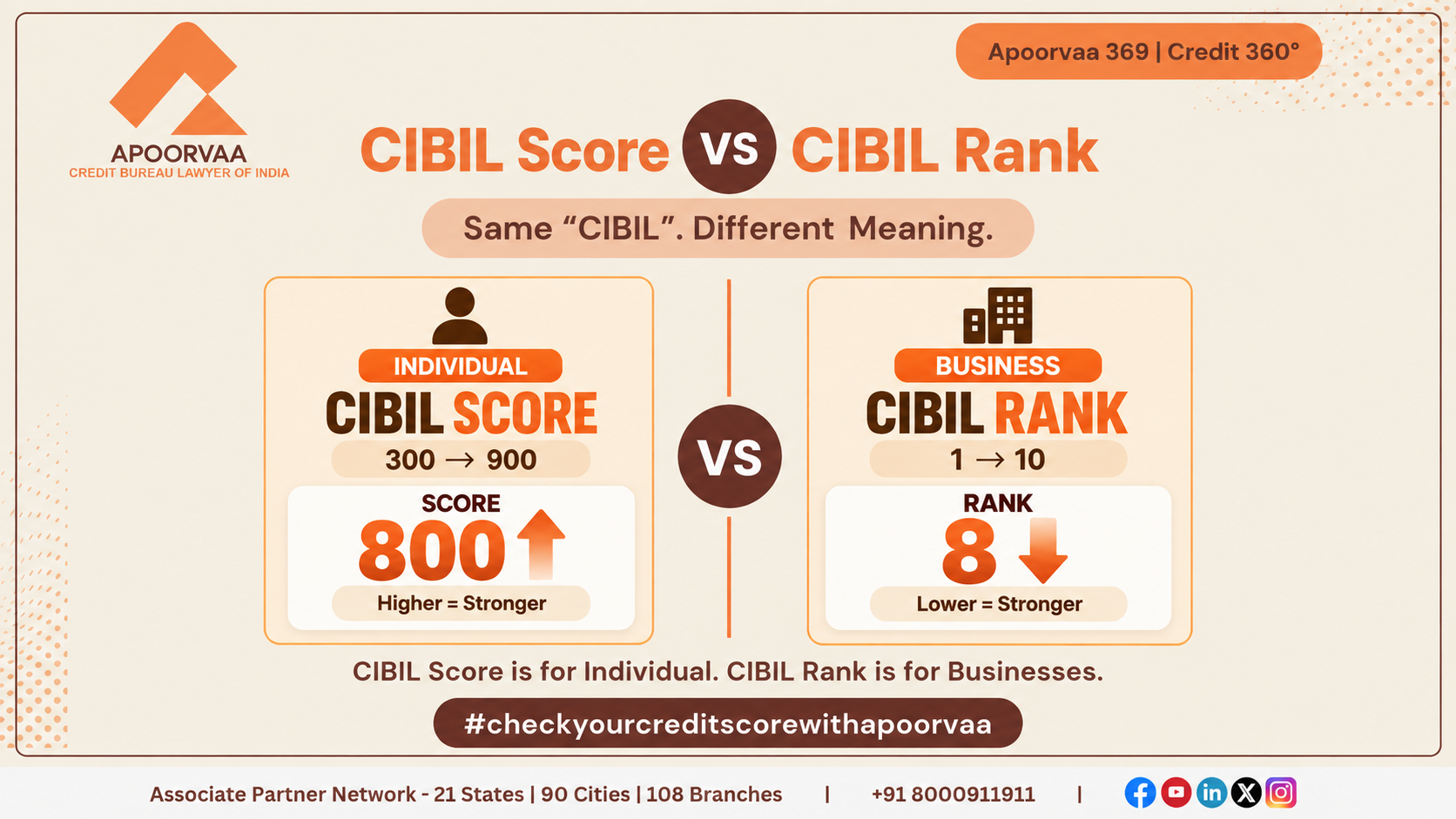
CIBIL Score vs CIBIL Rank is one of the most important distinctions to understand when discussing personal and business credit.
Imagine a business owner whose personal CIBIL Score is 800, while the business has a CIBIL Rank of 8.
Both numbers may look relatively high.
But do they both indicate a strong credit profile?
No. The direction of interpretation is different.
For an individual CIBIL Score, a higher number generally represents a stronger credit profile.
For CIBIL Rank, the scale works in the opposite direction: the closer the Rank is to 1, the stronger the position in terms of the risk indicator.
So:
CIBIL Score 800 → generally a strong individual credit score
CIBIL Rank 8 → should not be interpreted as “8 out of 10 is excellent”
This simple distinction becomes especially important when a business owner approaches a bank for business finance.
What Is a CIBIL Score?
A CIBIL Score is a three-digit numerical summary of an individual’s credit history.
According to TransUnion CIBIL, the Score currently ranges from:
300 to 900
The Score is derived using information from the Accounts and Enquiries sections of the individual’s CIBIL Report.
Generally, the closer the Score is to 900, the stronger the individual’s credit profile appears from a credit-history perspective.
For example:
800 CIBIL Score is not interpreted in the same way as 500 CIBIL Score.
But one important qualification must always be remembered:
A high CIBIL Score does not guarantee loan approval.
TransUnion CIBIL itself explains that even where the Score is high, the lender considers other details before determining creditworthiness. The final decision to lend belongs to the lender, not CIBIL.
Therefore, the CIBIL Score should be understood as an important credit-risk indicator—not as an approval certificate.
What Information Influences an Individual CIBIL Score?
CIBIL identifies several important aspects of an individual’s credit behaviour.
These include factors such as:
Payment History
Whether credit obligations have generally been paid on time.
Credit Utilisation
How much available revolving credit is being utilised.
Age of Credit
The history and maturity of the credit profile.
Credit Enquiries
Applications for new credit can result in lender enquiries forming part of the credit profile.
The CIBIL Report itself contains considerably more detail than just the Score, including active and inactive loan and credit-card accounts, payment history and lender enquiries.
This is why I repeatedly emphasise:
Do not judge an individual’s complete credit health only from the three-digit Score.
The Score is important, but the underlying report provides the context.
What Is CIBIL Rank?
Now we move from the individual to the business.
TransUnion CIBIL’s current Company Credit Report information describes CIBIL Rank as a numerical summary of the company’s Company Credit Report (CCR).
The current scale is:
10 to 1 — where 1 is the best Rank
CIBIL states that the Rank is currently available for commercial borrowers with credit exposure up to ₹50 crore.
CIBIL also describes the Rank as indicating the company’s repayment behaviour and as one of the factors considered by lenders while evaluating a loan application.
So, unlike the individual Score:
With CIBIL Rank, lower is better.
That reversal is what creates so much confusion.
CIBIL Score 800 vs CIBIL Rank 8: Are Both Good?
This is the simplest way to understand today’s topic.
Suppose Mr A owns ABC Pvt. Ltd.
His personal credit position shows:
CIBIL Score: 800
His company’s commercial credit profile shows:
CIBIL Rank: 8
Someone unfamiliar with commercial credit may think:
“800 is high, so it is good. Rank 8 out of 10 is also high, so that must be good.”
But that interpretation is incorrect.
For the individual Score:
Higher → generally stronger
For the business Rank:
Closer to 1 → stronger
CIBIL specifically states that a Rank closer to 1 is associated with better chances of securing a loan.
Therefore:
800 and 8 cannot be interpreted using the same logic.
Why Does CIBIL Rank Work in the Opposite Direction?
Think of the two numbers differently.
The CIBIL Score functions like a score.
The CIBIL Rank functions like a ranking position/risk indicator.
In a ranking system, being closer to Rank 1 represents the stronger position.
TransUnion CIBIL describes CIBIL Rank as summarising the Company’s Credit Report and indicating the company’s likelihood of missing payments. Its commercial material states that Rank 1 represents the least probability of default.
This is why business owners should not read a CIBIL Rank as though it were a school examination score.
Rank 8 does not mean the business has achieved “8 out of 10.”
It reflects a different credit-risk scale.
What Is a Company Credit Report (CCR)?
Just as an individual has a CIBIL Report, a business can have a Company Credit Report (CCR).
TransUnion CIBIL defines the CCR as a factual record of the company’s credit payment history, compiled from information received from credit institutions.
Its purpose is to help lenders make informed credit decisions.
The CIBIL Rank is therefore not an isolated number.
It is derived from the company’s broader commercial credit profile.
This distinction is important because a business owner may look only at:
“My Rank is 8.”
But the more useful question is:
“What does my Company’s Credit Report show behind that Rank?”
That is where the real analysis begins.
What Can Influence a Company’s CIBIL Rank?
According to TransUnion CIBIL, two major parameters used to calculate the CIBIL Rank are:
Past Repayment Behaviour
How the business has handled its credit repayment obligations is important.
Late payments, overdue amounts or defaults can influence the commercial credit profile.
Credit Utilisation
The extent to which the business is using available credit is another important parameter identified by CIBIL.
CIBIL’s current educational material also explains that Rank calculation uses the business’s credit history reported by lenders.
This means a weak Rank should not immediately be interpreted as:
“There must be an error in the company’s CIBIL Report.”
That conclusion can be wrong.
The Rank may be reflecting genuine credit behaviour or risk characteristics.
Alternatively, there may be information in the commercial report that requires closer examination.
Those are two fundamentally different situations.
Can You Have a Good CIBIL Score but a Weak CIBIL Rank?
Yes.
This is perhaps the most important takeaway from today’s topic.
The individual and the business do not necessarily have identical credit profiles.
A business owner may personally have:
- timely repayment history,
- controlled personal credit utilisation,
- limited personal borrowing,
- and a strong individual CIBIL Score.
At the same time, the company may have a commercial credit profile reflecting different repayment behaviour, credit utilisation or credit exposure.
Therefore, it is entirely possible to see:
Personal CIBIL Score: 800
while the business has:
CIBIL Rank: 8
There is no contradiction.
The two numbers are assessing different credit profiles.
A Good Personal Score Does Not Automatically Make the Company’s Credit Profile Strong
This distinction becomes particularly relevant when promoters or directors apply for business finance.
A business owner may say:
“My personal CIBIL Score is 800. Why is the bank concerned about my company’s CIBIL?”
Because the personal Score and commercial credit profile serve different purposes.
The personal CIBIL Score summarises the individual’s credit history.
The CIBIL Rank summarises information derived from the company’s CCR for eligible commercial borrowers.
Therefore:
Personal credit strength should not automatically be treated as proof of business credit strength.
And the reverse is also important.
A strong commercial Rank should not be interpreted as a guarantee that every business loan will be sanctioned.
Lenders make their own credit decisions using their applicable policies and underwriting criteria.
Does CIBIL Rank 8 Mean There Is an Error in the Company Report?
No—not automatically.
This is where today’s video needs an important professional distinction.
If a bank tells a business:
“Your CIBIL Rank is weak.”
the business should not immediately conclude:
“There must be incorrect data. I need to remove something from CIBIL.”
A weaker Rank may reflect genuine repayment or utilisation patterns.
But there can also be situations where underlying commercial credit information appears inaccurate, inconsistent or outdated.
These situations must not be confused.
Weak credit information is not automatically wrong credit information.
The correct approach is to understand the Company Credit Report behind the Rank and identify what the report is actually showing.
That is far more meaningful than looking only at the number 8, 9 or 10 and assuming that every weaker Rank requires “rectification.”
CIBIL Rank and CIBIL MSME Rank: Understand the Terminology
Business borrowers may hear different terms during conversations with banks and financial professionals, including CIBIL Rank, CIBIL MSME Rank or CMR.
The terminology can sometimes create confusion, but the important point for a business owner is to understand which commercial credit indicator and report the lender is referring to, rather than assuming it works like an individual’s CIBIL Score.
For eligible commercial borrowers, TransUnion CIBIL’s Company Credit Report includes a CIBIL Rank, expressed on a scale where 1 represents the strongest position and 10 the weakest end of the scale.
Therefore, when a banker says:
“Your company’s CIBIL Rank is 8.”
do not interpret it as 8 marks out of 10.
The commercial credit profile behind that Rank needs to be understood in its proper context.
Why Business Owners Should Review Both Personal and Commercial Credit Profiles
For many entrepreneurs, especially promoters of MSMEs and closely held businesses, personal and business borrowing can exist side by side.
The promoter may have personal:
- home loans,
- vehicle loans,
- credit cards,
- personal loans,
while the business may separately have:
- working-capital facilities,
- term loans,
- business loans,
- overdraft or cash-credit facilities,
- and other commercial borrowings.
These credit relationships do not automatically create identical credit profiles.
This is why a business owner preparing for important business finance should understand both profiles where they are relevant to the proposed lending transaction.
Personal CIBIL Score tells one story. The Company’s Credit Report and applicable commercial Rank tell another.
A strong personal Score should therefore not create false confidence about the company’s commercial credit position.
Can a Good CIBIL Score and Weak CIBIL Rank Exist Together?
Yes—and there is a logical reason.
Imagine a promoter with a personal CIBIL Score of 800.
Personally, the promoter may have maintained timely repayments and controlled credit usage.
Now consider the company.
The business may have experienced pressure on working capital, higher credit utilisation or delays in servicing certain commercial facilities.
The result could be:
Individual Credit Profile
CIBIL Score: 800
Business Credit Profile
CIBIL Rank: 8
These numbers are not conflicting with each other.
They relate to different borrowers and different underlying credit information.
This is precisely why an entrepreneur should not assume:
“My CIBIL is 800, so my company’s CIBIL must also be good.”
What Does a Weak CIBIL Rank Actually Tell You?
A weaker CIBIL Rank should be treated as a risk indicator requiring understanding, not as proof of an error.
TransUnion CIBIL identifies repayment behaviour and credit utilisation among important parameters associated with CIBIL Rank.
Therefore, if a company has a weaker Rank, the appropriate question is not immediately:
“How can I increase the Rank?”
A more useful question is:
“What does the underlying Company Credit Report show about the business’s credit profile?”
That distinction changes the quality of the entire discussion.
A number can tell you that the commercial credit profile deserves attention.
The underlying report helps provide the context.
Genuine Negative Credit History vs Incorrect Credit Reporting
This is one of the most important distinctions in professional Credit Rectification.
Suppose a business genuinely delayed repayment on a credit facility.
If that repayment behaviour is accurately reflected in its commercial credit information, the fact that it negatively affects the business’s credit profile does not automatically make the information incorrect.
Similarly, genuine outstanding obligations or other correctly reported credit information should not be classified as an “error” simply because the business wants a stronger Rank.
On the other hand, there may be circumstances where a business believes that material information appearing in its commercial credit report does not accurately reflect the underlying facility.
That is a different matter.
Negative information and inaccurate information are not the same thing.
Professional assessment should always preserve that distinction.
Does CIBIL Rank 8, 9 or 10 Automatically Mean Business Loan Rejection?
No.
A CIBIL Rank is an important commercial credit-risk indicator, but it should not be presented as an automatic approval or rejection rule applicable to every lender.
A lender may use commercial credit information as part of a wider credit assessment.
Depending on the lender and product, that assessment can also involve factors such as:
Business financial performance — turnover, profitability, cash flow and other financial indicators may be relevant.
Existing obligations — the lender may consider the business’s current debt exposure and repayment commitments.
Repayment capacity — the ability of the business to service the proposed facility matters.
Nature and purpose of finance — working capital, term finance and other facilities can involve different assessment criteria.
Security or collateral, where applicable — secured lending may involve assessment of the proposed security in addition to credit information.
Lender’s internal credit policy — every lender can have its own eligibility, risk and underwriting criteria.
Therefore:
Strong CIBIL Rank ≠ Guaranteed Business Loan Approval
and
Weak CIBIL Rank ≠ Automatic Rejection by Every Lender
The lending decision ultimately belongs to the respective lender.
Why the Company Credit Report Matters More Than Looking Only at the Rank
This is similar to the distinction we discussed with individual borrowers.
For an individual:
Do not look only at the CIBIL Score. Understand the Credit Report.
For a business:
Do not look only at the CIBIL Rank. Understand the Company Credit Report.
Suppose the Rank is weaker than expected.
Simply knowing that the company has Rank 8 does not fully explain what is happening.
The business needs to understand the commercial credit information underlying that risk assessment.
This is particularly important before concluding that the business needs Credit Rectification.
What If a Business Finds Information That Appears Incorrect?
This is where professional credit-report analysis can become relevant.
A business may believe that certain information appearing in its commercial credit profile does not correspond with its actual credit facility or records.
The appropriate objective is not:
“Remove everything negative so the Rank becomes 1.”
The objective should be:
“Determine whether the underlying credit information is being reported accurately.”
Where information is genuine, it should not be misrepresented as an error.
Where there appears to be a genuine reporting inconsistency, the matter may require appropriate assessment.
This is a more responsible approach than promising a predetermined Rank.
Can Credit Rectification Guarantee CIBIL Rank 1?
No.
No responsible Credit Rectification service should promise that a company will definitely move from Rank 8 to Rank 1.
Similarly, it should not promise that correcting a genuine reporting issue will automatically result in business-loan approval.
Why?
Because the CIBIL Rank is generated from the commercial credit information and applicable risk model, while the ultimate lending decision belongs to the lender.
Credit Rectification should therefore focus on genuine reporting concerns, not guaranteed numerical outcomes.
Should You Check Your Business Credit Profile Before Applying for Finance?
For an important business borrowing decision, understanding the credit profile before approaching lenders can be valuable.
Many business owners discover commercial credit concerns only after a banker says:
“Your CIBIL Rank is not satisfactory.”
That is very late in the process.
A better approach is to understand the company’s commercial credit position beforehand, particularly when the business already has multiple credit facilities or a significant borrowing history.
For promoters whose personal credit profile is also relevant to the proposed finance, understanding the individual profile can be equally important.
Do not wait for a rejection to discover what your credit reports contain.
CIBIL Score vs CIBIL Rank: The Simplest Way to Remember
The distinction can be summarised very simply:
| CIBIL Score | CIBIL Rank | |
| Primarily relates to | Individual credit profile | Eligible commercial/business borrower |
| Current scale | 300–900 | 10–1 |
| Better direction | Higher is generally better | Closer to 1 is better |
| Underlying report | Individual CIBIL Report | Company Credit Report (CCR) |
| Does a strong result guarantee a loan? | No | No |
| Should the number alone be reviewed? | No | No |
So when you see:
CIBIL Score 800 + CIBIL Rank 8
remember:
800 may represent a strong individual Score.
Rank 8 should not be interpreted as “8/10 good”; the company’s underlying commercial credit profile needs to be understood.
Frequently Asked Questions
Is CIBIL Score for individuals or companies?
The CIBIL Score is used for an individual’s credit profile. Businesses can have a Company Credit Report, and eligible commercial borrowers may receive a CIBIL Rank.
What is the current CIBIL Score range?
The individual CIBIL Score ranges from 300 to 900, with a higher Score generally indicating a stronger credit profile.
Is CIBIL Rank also 300–900?
No. It is a different commercial credit-risk indicator and should not be interpreted like an individual CIBIL Score.
Is CIBIL Rank 1 better than Rank 8?
Yes. For CIBIL Rank, the direction is reversed compared with the individual Score: closer to 1 is better.
Is CIBIL Rank 8 equal to 8 out of 10?
No. This is one of the most common misunderstandings. It is a ranking/risk scale, not a marks-based score where a larger number is necessarily better.
Can I have an 800 CIBIL Score but my company have a weak CIBIL Rank?
Yes. The personal and commercial credit profiles are based on different underlying credit relationships and information.
Does a good personal CIBIL Score guarantee a business loan?
No. Business-loan underwriting can involve the business credit profile, financials, existing obligations, repayment capacity and other lender-specific criteria.
Does a weak CIBIL Rank prove that my Company Credit Report has an error?
No. A weaker Rank can reflect genuine commercial credit behaviour. The underlying Company Credit Report needs to be understood before concluding that there is a reporting error.
Can every negative business-credit entry be removed?
No. Genuine negative credit information should not automatically be treated as inaccurate information.
Can Credit Rectification guarantee Rank 1?
No. Professional Credit Rectification should not guarantee a particular Score, Rank or loan approval.
My Perspective
After working extensively with individual and business credit-report matters, I believe one of the biggest problems in credit awareness is that people focus on the number before understanding what the number represents.
An individual sees 800 and thinks:
“My loan should be approved.”
A business owner sees Rank 8 and thinks:
“8 out of 10 must be good.”
Both assumptions can lead to the wrong conclusion.
For an individual, the CIBIL Score should be understood together with the underlying Credit Report.
For a business, the CIBIL Rank should be understood together with the Company Credit Report.
And in both cases, a strong credit indicator should never be confused with guaranteed loan approval.
Understand the report first. Interpret the number in its correct context. Then identify whether there is actually a credit-reporting concern.
Final Thought
The easiest way to remember today’s topic is:
CIBIL Score → Individual → Higher is generally better
CIBIL Rank → Business/commercial profile → Closer to 1 is better
But the deeper lesson is more important.
Neither number should be viewed in isolation.
A good personal CIBIL Score does not automatically mean that the business has a strong commercial credit profile. Similarly, a weaker CIBIL Rank does not automatically prove that there is an error requiring rectification.
The real understanding comes from the credit information behind the number.
If your individual or business credit report contains information that appears inaccurate or inconsistent, it should be professionally assessed before deciding whether Credit Rectification is required.
Apoorvaa – Credit Bureau Lawyer of India
📞 +91 8000 911 911
Credit Rectification does not guarantee a particular CIBIL Score, CIBIL Rank, loan eligibility or loan approval.
Related Credit Education
- 750+ CIBIL Score but Loan Rejected? Why a Good Credit Score May Not Be Enough
- CIBIL Rank 5 but Business Loan Rejected? Here’s Why
- Four Credit Bureaus in India: Is Correcting Only CIBIL Enough?
About the Author
Advocate Apurva Bhagat works in the field of credit-report and Credit Rectification matters, with a focus on helping individuals and businesses understand credit-bureau reporting issues and distinguish genuine reporting concerns from broader lending and eligibility matters.

Comments are closed