




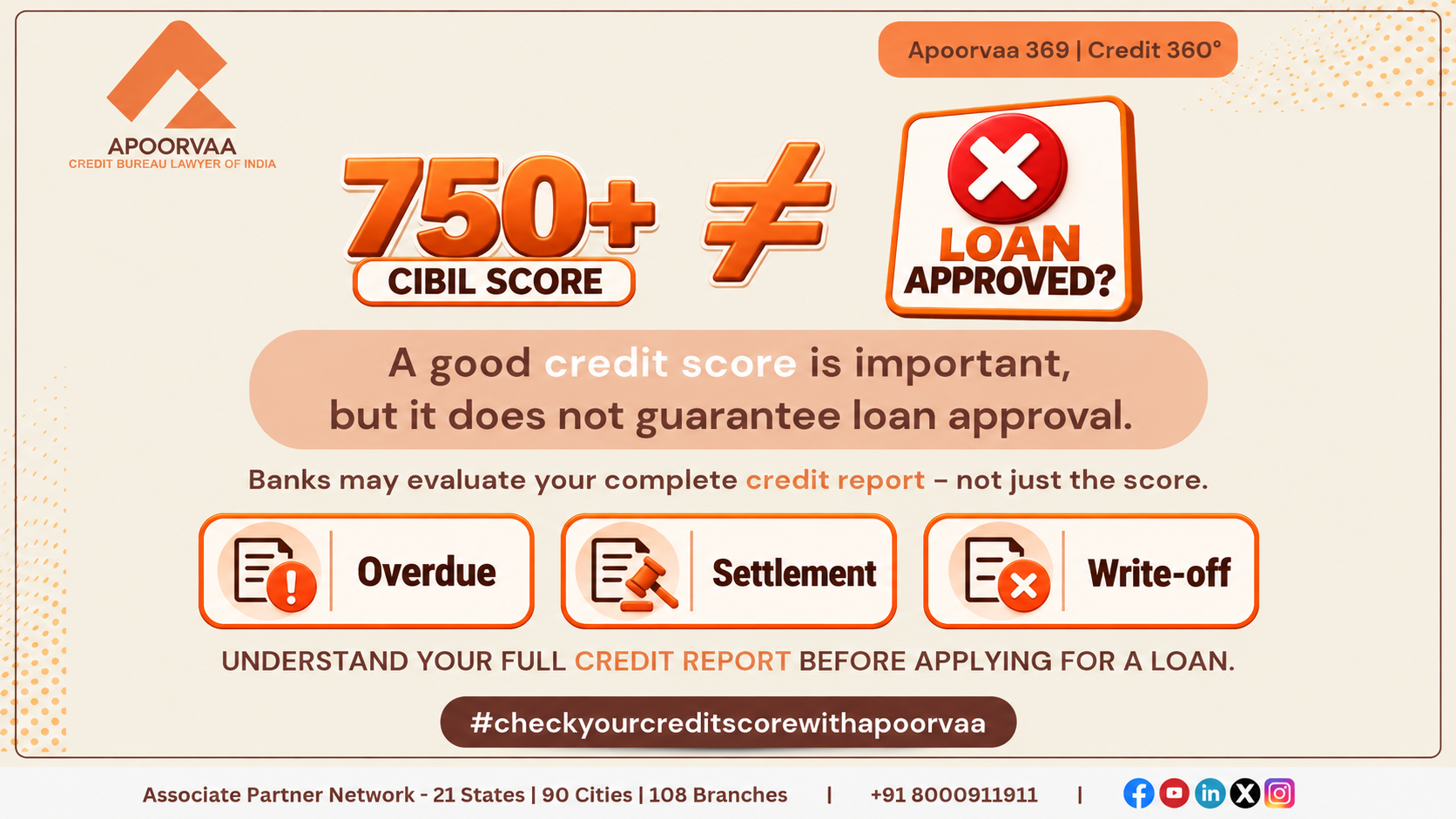
A 750 CIBIL Score is generally considered a strong starting point when you apply for credit. But having a score above 750 does not guarantee that a bank will approve your loan.
This surprises many customers.
They check their CIBIL Score, see 750, 780 or even higher, and naturally think:
“My CIBIL Score is good. Why has the bank still rejected my loan?”
The answer lies in understanding what a Credit Score actually represents.
Your CIBIL Score is important, but it is not your complete credit profile.
CIBIL itself explains that a score of 750 or more can put an applicant in contention for loan approval, but it does not guarantee approval. CIBIL also states that the decision to lend is solely dependent on the lender.
So when a loan is rejected despite a good score, the correct question is not:
“How can a bank reject a 750+ score?”
The better question is:
“What else is the lender seeing in my Credit Report and overall application?”
Your CIBIL Score Is Important — But It Is Not the Whole Report
A CIBIL Score is a three-digit numerical summary derived from information in your credit history.
TransUnion CIBIL states that the score ranges from 300 to 900 and is derived using information found in the Accounts and Enquiries sections of the CIBIL Report.
Your CIBIL Report, however, provides much more context.
It can contain information relating to your credit accounts, payment history, open and closed facilities, enquiries and other credit information reported by lenders.
This distinction is important.
Think of the score as a summary number.
The Credit Report helps explain the credit behaviour behind that number.
A lender therefore does not necessarily have to stop its assessment after seeing that your score is above 750.
Why Can a Loan Be Rejected Even With a 750+ CIBIL Score?
There is no single reason applicable to every borrower.
The lender may consider the Credit Score and Report along with its own eligibility and underwriting criteria.
CIBIL’s loan-approval guidance itself notes that banks broadly examine the CIBIL Score and Report, payment history, account details and other eligibility factors. It also makes clear that eligibility criteria differ between lenders and loan products.
For a customer with a strong score, the following areas can therefore still deserve attention.
1. Old Overdues or Repayment Delays
A score above 750 does not mean that every account in the Credit Report necessarily has a perfect repayment history.
The report may contain historical repayment information that a lender considers relevant while evaluating the application.
For example, there may have been delays in paying an EMI or another credit obligation in the past.
The lender may assess such payment behaviour as part of the customer’s broader credit history.
CIBIL itself notes that lenders examine payment history and overdue cases during the loan-approval process.
So:
A good current score does not erase the importance of the underlying repayment history.
2. Settlement in the Credit Report
A settlement can also require attention during credit assessment.
Customers sometimes assume:
“My score has already improved above 750, so an old settlement should no longer matter.”
That assumption can be risky.
A lender can evaluate the information appearing in the Credit Report rather than looking only at the current numerical score.
This is why two people with similar scores may not necessarily receive the same lending decision.
Their underlying credit histories may be different.
The key point is not that every settlement automatically causes rejection. The ultimate decision depends on the lender’s credit policy and overall assessment.
But a 750+ score should not be interpreted as making every historical credit event irrelevant.
3. Write-Off or Other Adverse Account Status
The same principle applies where an account has historically been reported with a write-off or another adverse status.
A customer may see a good score today and believe:
“The score has recovered, so the bank will only consider the current number.”
But credit appraisal can go deeper than that.
CIBIL’s own loan-approval material states that lenders may examine credit-facility statuses and suit-filed cases while evaluating applications.
Therefore, a strong score and an adverse historical account status are not contradictory.
Both can form part of the overall credit profile being assessed.
4. High Credit Utilization Can Change How the Profile Looks
Another important factor is credit utilisation.
Suppose a customer has multiple credit cards or revolving credit facilities and is regularly using a very large portion of the available limits.
The customer may still currently have a good Credit Score.
But high utilisation can indicate greater dependence on available credit.
CIBIL advises borrowers to keep balances low and avoid using too much available credit. It identifies prudent utilisation as part of maintaining a healthy credit profile.
This is why looking only at:
“My score is 760.”
may not tell the complete story.
The lender may also be looking at how the customer is using existing credit.
5. Too Many Existing Loans Can Affect Loan Eligibility
A person can have a good repayment record and still have significant existing liabilities.
Imagine a customer who has:
- a home loan,
- a car loan,
- a personal loan,
- credit-card obligations,
- and another recently opened facility.
The customer may be paying everything on time and therefore maintaining a relatively good score.
But a new lender still needs to consider whether the customer has sufficient repayment capacity for another loan.
CIBIL’s loan guidance notes that lenders can consider the relationship between existing EMI obligations and income, while its more recent educational material also identifies income, repayment capacity and existing liabilities among the factors lenders may consider.
Therefore:
Good repayment behaviour and high existing liability can exist at the same time.
A strong Credit Score does not automatically answer the lender’s affordability question.
6. Several Recent Loans May Change the Risk Picture
The timing of borrowing can also matter.
A customer may have opened several new credit facilities within a relatively short period.
Even where those accounts are being paid properly, a lender can assess the customer’s overall exposure and recent borrowing behaviour.
This is different from saying that taking a new loan is automatically negative.
It isn’t.
The issue is that lenders assess the complete application and credit profile, not a score in isolation.
A score tells an important part of the story.
It does not necessarily tell the lender whether granting one more loan fits its credit policy.
7. Multiple Recent Credit Enquiries May Also Be Visible
Whenever you apply for a loan or credit card and the lender accesses your Credit Information Report, an enquiry can be recorded in the credit history. CIBIL confirms that these lender accesses appear as Enquiries.
This is why repeatedly applying to several lenders simply because the first application was rejected may not be the best approach.
The customer should first try to understand the reason for the rejection and the overall credit position.
CIBIL itself advises applying for new credit in moderation rather than continuously seeking excessive credit.
Loan rejection should not automatically trigger multiple new loan applications without first understanding the credit profile.
A 750+ Score Is Not a Certificate of Loan Approval
This is the central message of today’s topic.
A strong CIBIL Score is valuable.
It can improve the likelihood that a credit application receives favourable consideration.
But:
750+ CIBIL Score ≠ Guaranteed Loan Approval
CIBIL itself describes the score as an important part of the loan process while explicitly stating that the lending decision belongs to the lender.
The lender may consider:
Credit Score + Credit Report + repayment behaviour + existing liabilities + income/repayment capacity + product eligibility + internal credit policy.
This explains why two applicants with the same CIBIL Score can potentially receive different lending decisions.
Before Applying for a Loan, Understand Your Complete Credit Profile
Many customers check their Credit Score only after a loan has already been rejected.
A better approach is to understand your credit position before making the application.
That does not mean obsessing over every number or trying to artificially increase the score before every loan.
It means knowing whether your Credit Report contains something that could materially affect how a lender views your credit history.
For example:
Is an old overdue still reflected?
Is there a settlement or write-off status?
Are existing liabilities already high?
Is credit utilisation unusually heavy?
Have there been several recent credit applications?
Does the Credit Report contain information you do not recognise or believe to be inaccurate?
Understanding these issues before applying can help separate a loan-eligibility issue from a potential Credit Report accuracy issue.
One Important Correction: Negative Information Is Not Automatically Wrong Information
This distinction is essential.
If your Credit Report contains an overdue, settlement, write-off or repayment delay, its presence does not automatically mean that the bureau has made an error.
If the information genuinely reflects the underlying credit facility, it is part of the customer’s reported credit history.
On the other hand, if an account, balance, payment history, ownership or status is genuinely inaccurate, that is a different matter.
CIBIL itself distinguishes report inaccuracies such as accounts or enquiries that do not belong to the individual from genuine reported credit information.
Therefore, Credit Rectification should begin with accuracy—not with the desire to remove every negative entry.
The Real Question Behind a 750+ Score
When someone says:
“My CIBIL Score is 750+, but the bank rejected my loan.”
I would not look only at the score.
The more important questions are:
What does the complete Credit Report show?
What is the customer’s current liability position?
Is there relevant historical repayment behaviour?
Are there settlements, write-offs or other account statuses?
Are there recent enquiries or multiple new facilities?
Is there any genuinely inaccurate information in the report?
And finally:
Was the rejection caused by the Credit Report at all—or by another part of the lender’s eligibility assessment?
That last question matters because not every loan rejection is a Credit Rectification problem.
A Good CIBIL Score and Loan Eligibility Are Two Different Things
A 750+ CIBIL Score can indicate a relatively strong credit profile, but it should not be treated as a certificate of loan approval.
This distinction becomes important when a customer says:
“My score is good, so there must be something wrong with my CIBIL Report if the bank rejected my loan.”
That conclusion may be premature.
A loan can be declined because of information in the Credit Report, but it can also be declined because the applicant does not meet the lender’s other eligibility or underwriting requirements.
CIBIL itself makes clear that the final decision to lend rests with the lender.
So after a rejection, the first objective should be to understand what type of problem actually exists.
Credit Report Issue or Loan Eligibility Issue?
These two situations should not be confused.
Situation 1: The Credit Report Contains a Genuine Concern
For example, the customer may discover:
- an account that does not belong to them,
- potentially incorrect outstanding information,
- inaccurate account ownership,
- repayment information that appears inconsistent,
- or an account status that does not reflect the underlying facility.
This may require closer examination from a Credit Report accuracy and Credit Rectification perspective.
Situation 2: The Credit Report Is Broadly Accurate, but the Loan Is Still Rejected
The lender may have concerns relating to:
- existing EMI burden,
- repayment capacity,
- income,
- employment or business profile,
- internal eligibility requirements,
- type of loan requested,
- existing credit exposure,
- or other underwriting parameters.
In this situation, changing the Credit Report may not address the real reason for rejection.
Not every loan rejection is a CIBIL problem.
That is one of the most important things a borrower should understand.
What Does a 750+ CIBIL Score Actually Tell You?
A good score is useful because it provides lenders with an indication of the customer’s credit history and behaviour.
But the score does not independently tell a lender everything it may want to know about the applicant.
For example, two customers may both have a CIBIL Score of 760.
Yet their profiles may look very different.
Customer A may have a long credit history, relatively manageable obligations and consistent repayment behaviour.
Customer B may also have a 760 score but have several active loans, high utilisation, recently opened facilities or a historical adverse account status.
The headline number may be similar.
The underlying profile is not.
That is why:
Same CIBIL Score does not necessarily mean same credit risk or same loan decision.
Can Old Credit History Still Matter After Your Score Improves?
Potentially, yes.
Customers sometimes believe that once their score crosses 750, older information no longer matters.
But a Credit Report contains more than the current score.
Depending on the information available in the report and the lender’s assessment policy, historical credit behaviour may still form part of the overall evaluation.
For example, a lender may consider relevant information concerning previous:
Overdues
Repayment delays
Settlements
Write-offs
Other adverse account statuses
This does not mean every historical negative entry automatically results in loan rejection.
It means a good current score should not be interpreted as automatically making the rest of the Credit Report irrelevant.
Settlement and Write-Off Are Not the Same Thing
This distinction is also important.
Customers sometimes use terms such as Settlement, Write-Off and Overdue interchangeably.
They are not identical.
An overdue generally relates to an amount that was not paid when due.
A settlement generally refers to a situation where the lender accepts an agreed amount in relation to the outstanding obligation rather than treating the account as having been repaid in the ordinary manner.
A write-off is an accounting/reporting status connected with the lender’s treatment of the account and should not automatically be interpreted as meaning that the customer’s legal obligation has disappeared.
Therefore, when such information appears in a Credit Report, it should be understood in its proper context rather than simply grouped under the label “bad CIBIL”.
High Credit Utilisation Can Exist Alongside a Good Score
Consider another example.
A customer has maintained timely payments but is regularly using a very high proportion of available revolving credit.
The score may still appear relatively strong at a particular point in time.
However, a lender can look at the broader borrowing position.
CIBIL itself advises borrowers to maintain prudent utilisation rather than excessively using available credit.
The important lesson is:
Timely payment is important, but it is not the only characteristic of a credit profile.
A customer can pay on time while simultaneously carrying significant credit exposure.
Existing Liabilities Can Matter Even With Perfect Repayment
This is one of the clearest examples of why score and loan approval should not be treated as the same thing.
Suppose a customer has:
- a home-loan EMI,
- vehicle-loan EMI,
- personal-loan EMI,
- credit-card obligations,
- and another recently opened facility.
Every EMI may be paid on time.
The customer may therefore maintain a good Credit Score.
But the next lender still needs to determine whether the customer has the capacity to take on another financial obligation.
The issue here may not be poor repayment history at all.
It may simply be:
Existing liabilities versus repayment capacity.
Credit Rectification cannot solve an affordability or eligibility problem where the Credit Report itself is accurate.
What Should You Do After a Loan Is Rejected?
One of the common mistakes after rejection is immediately applying to several other lenders.
A borrower may think:
“This bank rejected me. Let me apply to five more banks and see who approves.”
But every lender application can potentially result in another credit enquiry where the lender accesses the Credit Report.
CIBIL states that lender accesses connected with credit applications are reflected as enquiries and advises customers to apply for new credit in moderation.
Therefore, repeatedly submitting applications without understanding the original issue may be counterproductive.
A more sensible first question is:
“Why was I rejected?”
Was it because of the Credit Report?
Was it because of existing liabilities?
Was it because of income or eligibility?
Was it because of the lender’s internal policy?
Was there an adverse account status?
Or is there genuinely inaccurate information in the Credit Report?
Understanding the category of problem matters before deciding what should happen next.
Does Every Negative Entry Need to Be Removed Before Applying?
No.
This is another area where customers can receive misleading advice.
A negative-looking entry is not automatically an incorrect entry.
If an overdue, settlement, repayment delay or other status accurately represents what happened with the credit facility, its presence cannot simply be treated as a reporting error because it is affecting loan eligibility.
Credit Rectification should not be presented as:
“Remove everything negative from the report.”
Instead, the important distinction is between:
Genuine credit history
and
Genuinely inaccurate credit information.
If the information is accurate, the issue may need to be understood differently.
If the information is genuinely incorrect, incomplete, wrongly attributed or inconsistent with the underlying credit facility, then Credit Report accuracy becomes relevant.
When Does Credit Rectification Become Relevant?
Credit Rectification becomes relevant when there is a genuine concern about the accuracy or reporting of credit information.
Examples may include:
Incorrect account ownership
A loan or credit facility appears that the customer does not recognise as their own.
Potentially incorrect outstanding balance
The balance shown appears materially inconsistent with the actual facility position.
Repayment-history inconsistency
Reported repayment information appears inconsistent with the customer’s actual account history.
Incorrect account status
The reported status does not appear to reflect the underlying facility.
Other material reporting inconsistencies
Important information in the Credit Report appears inaccurate and requires proper assessment.
The purpose of professional Credit Rectification is therefore not to manufacture a particular score.
It is to address genuine credit-reporting concerns where they exist.
Can Credit Rectification Guarantee Loan Approval?
No.
This should be stated clearly.
Even where a genuine Credit Report error is appropriately corrected, the lender still makes its own credit decision.
A lender may consider income, liabilities, repayment capacity, product eligibility, internal risk policy and other factors in addition to credit information.
Therefore:
Credit Report correction ≠ Guaranteed loan approval
and
750+ CIBIL Score ≠ Guaranteed loan approval
Both distinctions protect customers from unrealistic expectations.
Should You Check Your CIBIL Report Before Applying for a Loan?
Understanding your own Credit Report before applying can be useful, particularly when you are preparing for an important loan application.
But the purpose should not simply be to check whether the score is above 750.
The real value lies in understanding your complete credit position.
Your report can help you become aware of your existing credit facilities, repayment history, enquiries and other reported information before the lender evaluates the application.
If something appears genuinely inaccurate, it is better to understand the issue rather than discovering it only after a rejection.
A Good Score Is the Beginning of Credit Assessment, Not the End
This is the central message I want customers to take from this article.
Many people have been conditioned to think:
750+ = Loan Approved
and
Below 750 = Loan Rejected
Real-world lending decisions are more complex.
A strong Credit Score is certainly valuable.
But lenders may also look at the customer’s:
complete Credit Report, repayment history, existing liabilities, credit exposure, repayment capacity and their own eligibility criteria.
Therefore, the more useful mindset is:
“My Credit Score is one important part of my loan application. What does my complete financial and credit profile look like?”
Frequently Asked Questions
Is a 750+ CIBIL Score good for a loan?
A score of 750+ is generally viewed positively, but it does not guarantee loan approval. The lender makes the final decision based on its overall credit and eligibility assessment.
Why was my loan rejected even though my CIBIL Score is 780?
There can be several reasons. The lender may consider information in your Credit Report, existing liabilities, repayment capacity, income, loan eligibility, its internal policy or other factors. The reason should not automatically be assumed to be a CIBIL error.
Can an old settlement affect a new loan application?
A settlement appearing in the Credit Report may form part of the lender’s assessment. Its impact will depend on the complete profile and the lender’s credit policy.
Can a write-off matter even if my score is above 750?
Potentially, yes. A good current score does not necessarily make all other information in the Credit Report irrelevant.
Can high credit-card utilisation affect my credit profile?
High utilisation can be relevant to the overall credit profile. CIBIL recommends maintaining prudent utilisation of available credit.
Should I apply to several banks after one bank rejects my loan?
It is generally better to first understand the possible reason for rejection. Multiple credit applications can lead to multiple lender enquiries appearing in the credit history.
Does a loan rejection mean my CIBIL Report is wrong?
No. The rejection may arise from the lender’s eligibility or underwriting criteria even where the Credit Report is accurate.
Can Credit Rectification guarantee a 750+ or 800+ score?
No responsible Credit Rectification service should guarantee a particular Credit Score.
If my Credit Report is corrected, will my loan definitely be approved?
No. Correcting genuine inaccurate information does not guarantee approval because the lender still applies its own eligibility and underwriting criteria.
My Perspective
In my experience, one of the biggest mistakes customers make is giving too much importance to the three-digit number and too little importance to the complete Credit Report.
A customer sees 760 and thinks:
“Everything in my credit profile must be perfect.”
That is not necessarily true.
Another customer sees a loan rejection and immediately assumes:
“There must be a CIBIL problem.”
That is also not necessarily true.
A good Credit Score, an accurate Credit Report and loan eligibility are connected—but they are not the same thing.
The right approach is to identify the actual issue before trying to solve it.
If the problem is a genuine Credit Report inaccuracy, it may require Credit Rectification.
If the Credit Report is accurate but the customer’s existing liabilities or eligibility do not meet the lender’s requirements, then Credit Rectification is not the answer.
Diagnose the reason first. Rectify only where there is something genuinely requiring rectification.
Final Thought
A 750+ CIBIL Score is good—but it is not a loan approval guarantee.
Your score gives the lender important information about your credit profile, but it does not replace the complete Credit Report or the lender’s own assessment.
Before applying for an important loan, don’t ask only:
“Is my CIBIL Score above 750?”
Also understand:
“What does my complete Credit Report say about me?”
Because ultimately:
Your score is a number. Your complete credit profile tells the broader story.
Need Professional Assistance With Your Credit Report?
If your loan has been rejected despite a good CIBIL Score and you believe your Credit Report may contain genuinely inaccurate account, balance, repayment, ownership or status information, the issue should be properly assessed before assuming that your score itself is the problem.
Apoorvaa – Credit Bureau Lawyer of India provides professional assistance for genuine Credit Report and Credit Rectification concerns.
📞 Free Credit Helpline: +91 8000 911 911
Credit Rectification does not guarantee a particular Credit Score, deletion of genuine credit history, loan eligibility or loan approval.
Related Credit Education
- Why Is Your Credit Score Different Across CIBIL, Experian, Equifax and CRIF High Mark?
- Good CIBIL Score but Loan Rejected? Understand Why
- How to Improve CIBIL Score: Fix Credit Issues FirstAbout the Author
Advocate Apurva Bhagat is the Founder & Chairman of Apoorvaa – Credit Bureau Lawyer of India. His work focuses on Credit Rectification, credit-bureau matters and improving awareness about how credit information can affect individuals and businesses.

Comments are closed