





When people talk about their credit history in India, one word dominates the conversation:
CIBIL.
Customers commonly tell us:
“My CIBIL is good.”
“The bank told me to correct my CIBIL.”
“My CIBIL problem has been resolved.”
But there is an important question that every borrower should understand:
What about the other three credit bureaus?
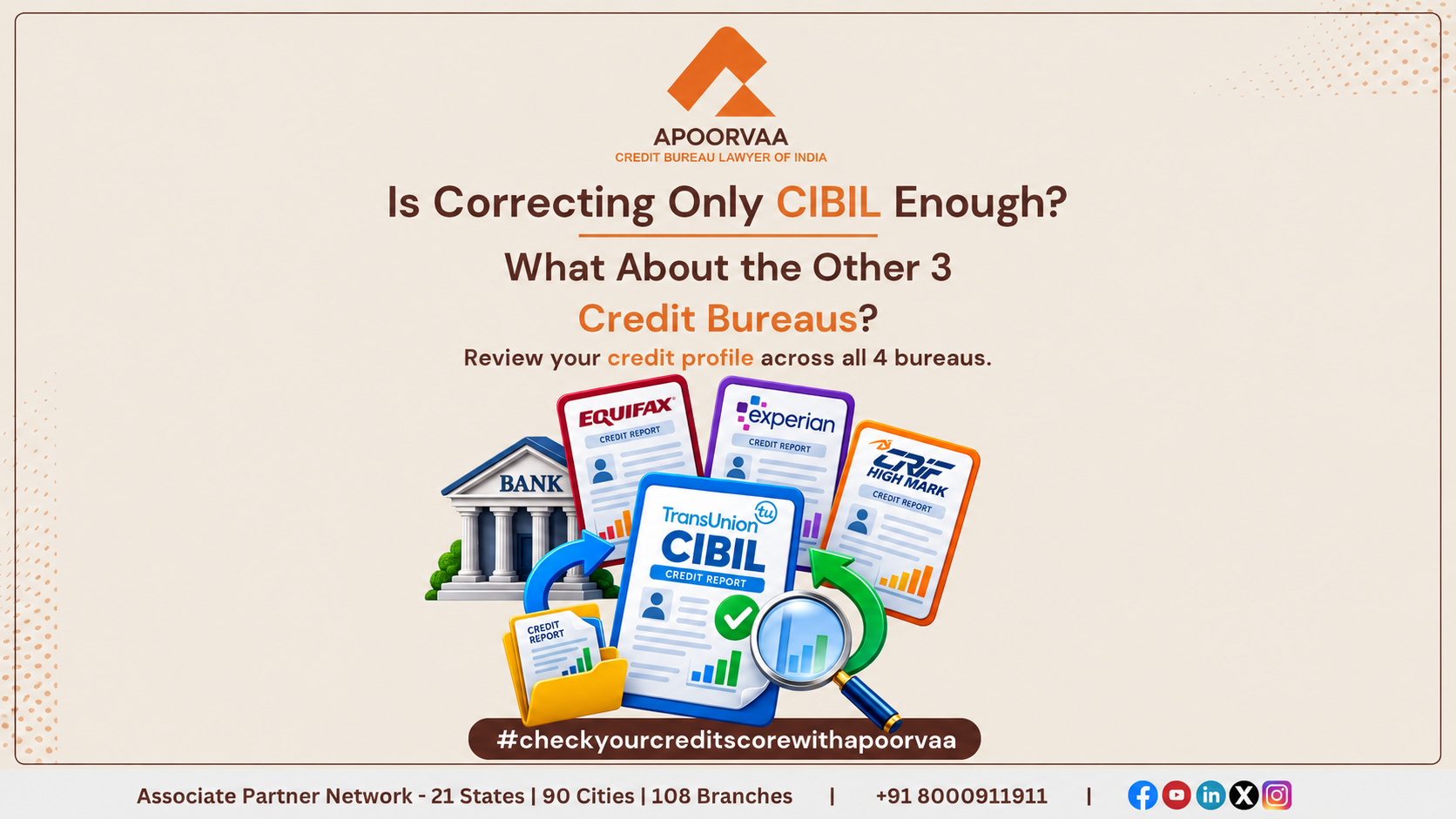
India’s credit information ecosystem is not limited to TransUnion CIBIL.
The Reserve Bank of India recognises four Credit Information Companies (CICs):
TransUnion CIBIL Limited
Equifax Credit Information Services Private Limited
Experian Credit Information Company of India Private Limited
CRIF High Mark Credit Information Services Private Limited.
Therefore, when we talk about maintaining a healthy credit profile, it is useful to think beyond only one bureau.
Why Do We Commonly Call Every Credit Problem a “CIBIL Problem”?
This happens mainly because CIBIL has become the most familiar name among Indian borrowers.
Someone’s loan gets rejected and they say:
“CIBIL mein problem hai.”
Someone has an old Write-Off and says:
“CIBIL thik karvana hai.”
Someone’s score drops and they say:
“CIBIL kharab ho gaya.”
But technically, we are talking about a broader credit information ecosystem.
CIBIL is one Credit Information Company.
Equifax, Experian and CRIF High Mark are the other three.
This distinction becomes especially important when a customer is dealing with an old or complicated credit-report issue.
Why Are There Four Credit Bureaus?
Credit Information Companies perform an important function in India’s lending ecosystem.
Banks and other regulated credit institutions submit borrower credit information to CICs in accordance with the regulatory framework.
The bureaus organise this information into credit reports and related credit-information products that authorised users can use during credit assessment.
RBI’s credit-reporting framework covers banks, financial institutions, NBFCs, housing finance companies and other regulated credit institutions. RBI has also directed credit institutions to become members of all CICs and submit data, including historical data, under the applicable framework.
This means your credit history should not be thought of as information belonging only to CIBIL.
It exists within a much broader regulated credit-reporting system.
Does Every Credit Bureau Have the Same Report?
This is where customers often become confused.
They assume:
“If my CIBIL Report shows something, all four reports must be exactly identical.”
That assumption should not be made.
The four CICs are separate organisations maintaining their respective credit-information databases.
A customer’s report from one bureau should therefore not simply be treated as a substitute for examining another bureau’s report where there is a reason to do so.
For example, a customer may be concerned about an old loan account.
The relevant question should not automatically stop at:
“What does my CIBIL show?”
A broader question may be:
“What is currently being reported about my credit profile across the credit bureaus?”
That gives the customer a more complete understanding of their credit position.
Does Every Bank Check All Four Credit Bureau Reports?
Not necessarily for every application.
This distinction is important.
Banks and other lenders have their own credit policies and underwriting processes. RBI’s framework has historically required the Credit Information Report to form part of credit appraisal, while the exact credit assessment undertaken by a lender can vary.
A particular lender may access credit information according to its internal policy, product, risk framework and lending process.
Therefore, as a customer, trying to predict:
“Which bureau will this bank check?”
may not be the most useful long-term approach.
Today you may approach one bank.
Tomorrow you may approach another.
Today you may require a personal loan.
Two years later, you may require:
A home loan
Business finance
Loan against property
Vehicle finance
or another credit facility.
The lender, product and credit-assessment policy can change.
Your objective should therefore be broader:
Maintain awareness of your overall credit profile rather than preparing only for one lender’s current requirement.
“My Bank Told Me to Correct CIBIL. Isn’t That Enough?”
This is a situation we regularly encounter.
A customer may say:
“My bank manager has checked my CIBIL Report and told me to resolve this one old account. Once it is corrected, the bank will reconsider my loan.”
For that immediate loan requirement, the customer’s attention naturally goes to CIBIL.
That is understandable.
But there is a difference between:
Solving today’s immediate lending objection
and
understanding your broader credit health for the future.
Suppose the customer deals only with the report currently being discussed by that lender.
What happens six months later if another credit requirement arises?
What happens two years later if the customer approaches a different lender?
What happens if a different credit report becomes relevant during that assessment?
This is why I believe customers should develop a multi-bureau understanding of their credit profile, particularly when dealing with significant historical credit issues.
One Bank Account Can Become a Multi-Bureau Credit Issue
This is one of the most important concepts to understand.
Suppose you had an old personal loan with Bank A.
There is only one loan.
There is only one lender relationship.
But information relating to that credit facility can form part of the credit-reporting ecosystem across the CICs.
This is why a customer should not automatically think:
“I checked one report, therefore I understand everything being reported everywhere.”
The underlying loan may be the same.
But your credit profile should be understood wherever the relevant information is being reported.
That becomes especially important in Credit Rectification.
Why Correcting One Bureau Should Not Automatically Be Assumed to Correct Every Other Bureau
This is another common misconception.
A customer may successfully see an account updated in one credit report and assume:
“Now the same thing must automatically be corrected everywhere.”
That should be verified rather than assumed.
The CICs operate separate credit-information systems.
If a customer has been dealing with an important account-level reporting issue, the sensible approach is to understand what the updated information reflects across the relevant bureau reports.
This does not mean customers should panic if they notice differences between reports.
It means those differences should be understood properly.
And where a genuine discrepancy or unresolved issue exists, it should be assessed appropriately.
Why This Matters More for Old Credit Problems
Consider someone who had repayment difficulties:
5 years ago
10 years ago
or even longer ago.
Today, that customer may have completely different financial circumstances.
Their income may have increased.
Their business may have grown.
Their current loans may be performing properly.
But when they approach a lender for an important new facility, an old credit issue may again become relevant.
The customer then says:
“I thought this problem was already resolved.”
The next question should be:
“Resolved where—and what does the current credit information actually show?”
That is a much stronger question than simply:
“Is my CIBIL Score okay?”
Technology Has Changed Credit Reporting Dramatically
Customers who have only recently started checking their credit reports may not realise how significantly India’s credit-information ecosystem has evolved.
Years ago, obtaining and working with credit information involved much more manual interaction.
Today, digital systems have made access, reporting and updating significantly faster.
The regulatory framework is also continuing to evolve.
A major recent example is RBI’s decision to increase the frequency of credit-information reporting. From July 1, 2026, credit information reporting has moved to a weekly cycle, making credit profiles more frequently updated. This makes it even more important for customers to monitor their credit information across all four bureaus.
For customers, this reinforces an important principle:
Credit health should be viewed as an ongoing financial record—not something to check only when a bank asks for it.
Today’s Lender May Not Be Tomorrow’s Lender
This is why I do not recommend building your entire credit strategy around one statement:
“My current bank only asked for CIBIL.”
That may solve today’s immediate question.
But your financial requirements can change.
Your lender can change.
Bank policies can change.
Credit-assessment technology can change.
Regulations can change.
Even the way credit information is evaluated can evolve.
We have already seen significant changes in India’s credit-reporting ecosystem over the years, and there is every reason for customers to expect further technological and regulatory evolution.
A customer should therefore aim for something more sustainable than:
“Which report do I need for this particular loan?”
The better objective is:
“Is my overall credit profile properly understood and healthy across India’s credit-information ecosystem?”
The Bigger Mistake: Thinking Credit Health Means Only CIBIL Score
For years, many borrowers have reduced credit health to a single question:
“What is my CIBIL Score?”
But today’s discussion shows why that thinking is incomplete.
Credit health is broader than:
One score.
It is broader than:
One report.
And it can be broader than:
One credit bureau.
If you have had an old Write-Off, Settled-related account, overdue amount, unknown account, incorrect information or another complicated credit-report issue, your objective should not simply be:
“Make my CIBIL Score higher.”
The more important objective is to understand what your credit history actually reflects and whether any genuine issue remains unresolved.
That is the foundation of responsible Credit Rectification.
Why Multi-Bureau Credit Health Matters
When a customer resolves an issue in one credit report, the natural feeling is:
“My credit problem is fixed.”
But where the same credit facility is reported across multiple credit bureaus, it is better to think more broadly.
India has four major Credit Information Companies:
TransUnion CIBIL
Equifax
Experian
CRIF High Mark
If an important account-level issue has affected your credit history, your objective should not be limited to seeing one bureau improve.
The stronger objective is:
Understand whether the relevant credit information is appropriately reflected across the credit ecosystem.
That is especially important when future borrowing needs may involve a different lender, different credit policy or different bureau access than today.
One Bureau Showing an Update Does Not Automatically Prove the Others Are Identical
Suppose an old loan account has been updated in your CIBIL Report.
That is important.
But it does not automatically establish that:
Equifax shows exactly the same position.
Experian shows exactly the same position.
CRIF High Mark shows exactly the same position.
The four bureaus are separate organisations with their own systems and reports.
So the better approach is not:
“CIBIL is updated, therefore everything must be updated everywhere.”
The better approach is:
“Let me understand what the relevant reports currently reflect.”
That distinction helps customers avoid making assumptions about their broader credit profile.
What If Different Bureaus Show Different Information?
This is a question many customers find confusing.
They may say:
“My CIBIL Report looks fine, but Experian is showing something different.”
or:
“One bureau shows the account as updated, but another still reflects the old position.”
A difference across bureau reports does not automatically tell you what the cause is.
It may reflect reporting timing, lender-side information, historical data, account-level differences or another reporting issue that needs to be understood.
The important point is:
Do not assume that the bureau showing the position you prefer is automatically correct and the other one is automatically wrong.
Where an important discrepancy exists, the underlying account position and the lender-reported information need to be understood properly.
This is where professional interpretation can become useful.
Why Customers Often Focus Only on CIBIL
There is a practical reason for this.
CIBIL is the most familiar bureau name in India.
Many borrowers use “CIBIL” as a general word for their entire credit profile.
Even bank staff may casually say:
“CIBIL check karvao.”
So customers naturally build the assumption:
“If CIBIL is fine, my entire credit profile is fine.”
That may be too narrow.
CIBIL remains extremely important, but a customer’s credit history exists within a broader credit-reporting framework.
For someone who has had a significant past issue—such as a Write-Off, Settled-related account, old overdue, unknown account or another reporting concern—it can be sensible to understand the position more comprehensively.
Why This Matters for Future Loan Readiness
Today’s lender may be checking one set of credit information.
Tomorrow’s lender may follow a different internal policy.
Today you may need a small personal loan.
Two years later you may require a:
Home loan
Business loan
Loan against property
Working-capital facility
Vehicle loan
or another financial product.
Your financial life changes.
Your lender can change.
The credit officer can change.
The institution’s underwriting policy can change.
That is why I do not consider it a strong long-term strategy to ask only:
“Which bureau will this bank check?”
A better long-term approach is:
“Is my credit profile properly understood across the bureaus?”
That keeps the focus on credit health rather than one immediate sanction.
A Small Loan Today Can Become a Bigger Credit Issue Tomorrow
Customers sometimes say:
“It was only a small credit-card problem from 10 years ago. Why should I worry about all four bureaus?”
The size of the original credit facility does not always determine how relevant the reporting issue may become later.
A relatively small old account can still become important when:
- A larger loan is applied for later.
- A different lender reviews the profile.
- The customer does not remember how the account was ultimately reported.
- A status remains inconsistent across reports.
- A historical account becomes the reason a credit officer asks further questions.
This does not mean every old small account should create panic.
It means that credit health should be viewed in relation to future financial flexibility, not just the original loan amount.
Why Multi-Bureau Credit Rectification Should Not Be Treated as Four Separate Loan Problems
Another misunderstanding is:
“If there are four bureaus, does that mean I have four different bank liabilities?”
No.
The underlying loan or credit facility is still the same financial account.
If there is a genuine outstanding obligation, that obligation exists with the concerned lender.
The four bureaus are different credit-information repositories.
This is why customers should distinguish between:
Resolving the underlying lender-side account issue
and
Understanding how that account is being reflected across the bureau reports.
These are related questions, but they are not the same thing.
Credit Rectification Should Be Broader Than “Fix CIBIL”
The phrase “CIBIL Rectification” has become common because of CIBIL’s strong brand recognition.
But professionally, the real issue can be broader:
Credit-report rectification across the relevant bureau ecosystem.
This matters especially where a customer’s financial requirement is long-term.
If a problem has genuinely affected the customer’s credit profile, the objective should not be:
“Make this one report look better for this one bank.”
The better objective is:
“Understand the credit issue properly and work toward a consistent, accurate and healthy credit profile.”
That is a much stronger financial position for the customer.
Why Expertise Matters When Bureau Reports Differ
A customer may compare two reports and see different:
Scores
Account statuses
Balances
Dates
Enquiries
or other account information.
At that point, it can be tempting to assume:
“One bureau is wrong.”
But differences need context.
The customer may not know:
Which lender information was reported where
When the relevant information was updated
What the account history actually shows
Whether the difference is material
Whether it represents a genuine rectification issue
This is where expertise is valuable.
The goal is not to make the customer dependent on a professional for every small difference.
The goal is to distinguish between:
A normal difference in bureau presentation
and
A meaningful credit-report issue that requires attention.
The Expert View: Don’t Build Your Credit Strategy Around One Bank’s Current Policy
From my perspective, one of the biggest mistakes a borrower can make is:
“My current bank checked CIBIL only, so I only care about CIBIL.”
That solves only today’s immediate question.
Your financial needs can change over time.
So can:
Lender policies
Credit-assessment technology
Regulatory requirements
Data-reporting practices
Risk models
The credit ecosystem is evolving continuously.
A stronger approach is to maintain awareness of your overall credit profile, not only the report that happens to matter for today’s application.
When Professional Credit Rectification Becomes Relevant
Professional assessment can become useful when:
- One bureau shows a serious account issue and another does not.
- An old account appears differently across reports.
- A Write-Off or Settled-related position remains unclear.
- An account has been addressed but the bureau reports do not appear consistent.
- The customer has multiple historical credit issues.
- The customer is preparing for an important loan and does not understand what the various reports show.
- There is uncertainty about whether a difference is merely presentational or a genuine reporting discrepancy.
At this stage, the objective should not be:
“Correct all four bureaus somehow.”
The objective should be:
“Understand the actual credit issue and determine where a legitimate rectification requirement exists.”
That distinction keeps the process professional and evidence-based.
How We Look at Multi-Bureau Credit Issues at Apoorvaa
At Apoorvaa – Credit Bureau Lawyer of India, we do not view a customer’s credit problem only through the lens of one numerical score.
Where a significant credit-report issue exists, our focus is on understanding the underlying account and the broader reporting position.
The question is not simply:
“Is CIBIL fixed?”
It is:
“What is the actual credit issue, and what does the customer’s broader credit profile reflect?”
Where professional Credit Rectification is required, the work should aim toward an outcome that is properly understood and ultimately verifiable.
Most importantly, the customer should not be left with uncertainty about whether the problem exists only in one report or whether it has broader credit-profile implications.
We Do Not Promise That Every Difference Across Bureaus Is an Error
This is important.
Credit bureaus can have different scoring models, report layouts and presentation formats.
So customers should not expect every field and score to look identical.
A difference itself does not automatically prove a reporting error.
The key question is whether there is a material inconsistency in the underlying credit information that deserves attention.
Professional Credit Rectification should therefore avoid creating fear around every variation.
It should focus on genuine, relevant credit-report issues.
Why Verification Matters After Credit Rectification
If an important account-level issue has been worked upon, the customer should not rely only on:
“Your work is completed.”
The better approach is to understand what the relevant updated credit reports now reflect.
At Apoorvaa, we believe Credit Rectification should result in an outcome that the customer can verify.
The customer should be able to understand:
What was the issue?
What has changed?
What is now reflecting?
And where relevant, the customer should independently access the official bureau reports and verify the current position.
Because credit health should be visible in the credit information itself, not only communicated verbally.
Don’t Wait Until a Different Bureau Creates a New Problem
Imagine this sequence:
Today:
Bank A reviews your current loan application.
You deal with the report that is relevant at that time.
The loan is sanctioned.
One year later:
You approach Bank B for a different facility.
A different credit-report issue now becomes relevant.
The customer then says:
“I thought my credit problem was already resolved.”
This is exactly why a broader credit-health view can be valuable.
The objective should not only be to get through today’s loan application.
It should be to remain better prepared for future financial requirements.
Frequently Asked Questions
How many credit bureaus are there in India?
India currently has four major Credit Information Companies: TransUnion CIBIL, Equifax, Experian and CRIF High Mark.
Do I need to check all four credit bureau reports?
Where you have a significant historical or unresolved credit-report issue, understanding your broader credit profile across the bureaus can be valuable. The need depends on the individual case.
Does every bank check all four bureaus for every loan?
Not necessarily. Lenders can have different internal credit policies and assessment processes.
If my CIBIL Report is corrected, are the other three automatically corrected?
You should not automatically assume that every bureau report is identical. Where the issue is important, the updated position should be verified.
Why can my scores be different across the four bureaus?
Each bureau can use its own scoring model and credit-information system. Different scores do not automatically mean an error exists.
Can one bureau show a Write-Off while another looks different?
Differences can occur and should be understood in the context of the lender-reported account information. A material inconsistency may require further assessment.
Do I have to pay the bank four times because there are four bureaus?
No. The underlying financial obligation is with the lender. The four bureaus are separate credit-information companies.
Should I rectify only the bureau my current bank is checking?
Focusing only on today’s lender may leave uncertainty about your broader future credit profile. A more comprehensive approach can be valuable where a genuine issue exists.
Does correcting all four bureaus guarantee a loan?
No. Credit Rectification and loan sanction are different matters. The lender still applies its own eligibility and underwriting criteria.
When should I seek professional assistance?
Professional assessment can help when reports across bureaus appear materially inconsistent, an old complicated account is involved, or you do not understand whether a genuine rectification issue exists.
Final Takeaway
India’s credit ecosystem is broader than CIBIL alone.
There are four major credit bureaus:
TransUnion CIBIL
Equifax
Experian
CRIF High Mark
So if you have had a significant credit-report issue, don’t automatically assume:
“CIBIL is corrected, therefore my entire credit profile is corrected.”
At the same time, don’t panic simply because scores or report formats differ across bureaus.
The important question is:
What is the underlying credit information actually showing, and is there any genuine unresolved issue?
For long-term credit health, the objective should not be:
“Which bureau is today’s bank checking?”
It should be:
“Is my overall credit profile properly understood and healthy for my future financial requirements?”
That is a much more sustainable way to think about Credit Rectification.
Related Credit Education
- Good CIBIL Score but Loan Rejected? Understand Why
- CIBIL Rectification? How to Verify It Your Report Is Corrected
- CIBIL Problem Not Resolved? Find the Root Cause First
About the Author
Advocate Apurva Bhagat is the Founder of Apoorvaa – Credit Bureau Lawyer of India and works in Credit Rectification, credit-report analysis and borrower credit guidance.
His approach focuses on understanding the complete credit profile rather than treating CIBIL as the only measure of credit health.
When an important credit issue exists, the objective should be accurate understanding, appropriate rectification where required and a result that the customer can ultimately verify.
Four Credit Bureaus in India: Is Correcting Only CIBIL Enough?
When people talk about their credit history in India, one word dominates the conversation:
CIBIL.
Customers commonly tell us:
“My CIBIL is good.”
“The bank told me to correct my CIBIL.”
“My CIBIL problem has been resolved.”
But there is an important question that every borrower should understand:
What about the other three credit bureaus?
India’s credit information ecosystem is not limited to TransUnion CIBIL.
The Reserve Bank of India recognises four Credit Information Companies (CICs):
TransUnion CIBIL Limited
Equifax Credit Information Services Private Limited
Experian Credit Information Company of India Private Limited
CRIF High Mark Credit Information Services Private Limited.
Therefore, when we talk about maintaining a healthy credit profile, it is useful to think beyond only one bureau.
Why Do We Commonly Call Every Credit Problem a “CIBIL Problem”?
This happens mainly because CIBIL has become the most familiar name among Indian borrowers.
Someone’s loan gets rejected and they say:
“CIBIL mein problem hai.”
Someone has an old Write-Off and says:
“CIBIL thik karvana hai.”
Someone’s score drops and they say:
“CIBIL kharab ho gaya.”
But technically, we are talking about a broader credit information ecosystem.
CIBIL is one Credit Information Company.
Equifax, Experian and CRIF High Mark are the other three.
This distinction becomes especially important when a customer is dealing with an old or complicated credit-report issue.
Why Are There Four Credit Bureaus?
Credit Information Companies perform an important function in India’s lending ecosystem.
Banks and other regulated credit institutions submit borrower credit information to CICs in accordance with the regulatory framework.
The bureaus organise this information into credit reports and related credit-information products that authorised users can use during credit assessment.
RBI’s credit-reporting framework covers banks, financial institutions, NBFCs, housing finance companies and other regulated credit institutions. RBI has also directed credit institutions to become members of all CICs and submit data, including historical data, under the applicable framework.
This means your credit history should not be thought of as information belonging only to CIBIL.
It exists within a much broader regulated credit-reporting system.
Does Every Credit Bureau Have the Same Report?
This is where customers often become confused.
They assume:
“If my CIBIL Report shows something, all four reports must be exactly identical.”
That assumption should not be made.
The four CICs are separate organisations maintaining their respective credit-information databases.
A customer’s report from one bureau should therefore not simply be treated as a substitute for examining another bureau’s report where there is a reason to do so.
For example, a customer may be concerned about an old loan account.
The relevant question should not automatically stop at:
“What does my CIBIL show?”
A broader question may be:
“What is currently being reported about my credit profile across the credit bureaus?”
That gives the customer a more complete understanding of their credit position.
Does Every Bank Check All Four Credit Bureau Reports?
Not necessarily for every application.
This distinction is important.
Banks and other lenders have their own credit policies and underwriting processes. RBI’s framework has historically required the Credit Information Report to form part of credit appraisal, while the exact credit assessment undertaken by a lender can vary.
A particular lender may access credit information according to its internal policy, product, risk framework and lending process.
Therefore, as a customer, trying to predict:
“Which bureau will this bank check?”
may not be the most useful long-term approach.
Today you may approach one bank.
Tomorrow you may approach another.
Today you may require a personal loan.
Two years later, you may require:
A home loan
Business finance
Loan against property
Vehicle finance
or another credit facility.
The lender, product and credit-assessment policy can change.
Your objective should therefore be broader:
Maintain awareness of your overall credit profile rather than preparing only for one lender’s current requirement.
“My Bank Told Me to Correct CIBIL. Isn’t That Enough?”
This is a situation we regularly encounter.
A customer may say:
“My bank manager has checked my CIBIL Report and told me to resolve this one old account. Once it is corrected, the bank will reconsider my loan.”
For that immediate loan requirement, the customer’s attention naturally goes to CIBIL.
That is understandable.
But there is a difference between:
Solving today’s immediate lending objection
and
understanding your broader credit health for the future.
Suppose the customer deals only with the report currently being discussed by that lender.
What happens six months later if another credit requirement arises?
What happens two years later if the customer approaches a different lender?
What happens if a different credit report becomes relevant during that assessment?
This is why I believe customers should develop a multi-bureau understanding of their credit profile, particularly when dealing with significant historical credit issues.
One Bank Account Can Become a Multi-Bureau Credit Issue
This is one of the most important concepts to understand.
Suppose you had an old personal loan with Bank A.
There is only one loan.
There is only one lender relationship.
But information relating to that credit facility can form part of the credit-reporting ecosystem across the CICs.
This is why a customer should not automatically think:
“I checked one report, therefore I understand everything being reported everywhere.”
The underlying loan may be the same.
But your credit profile should be understood wherever the relevant information is being reported.
That becomes especially important in Credit Rectification.
Why Correcting One Bureau Should Not Automatically Be Assumed to Correct Every Other Bureau
This is another common misconception.
A customer may successfully see an account updated in one credit report and assume:
“Now the same thing must automatically be corrected everywhere.”
That should be verified rather than assumed.
The CICs operate separate credit-information systems.
If a customer has been dealing with an important account-level reporting issue, the sensible approach is to understand what the updated information reflects across the relevant bureau reports.
This does not mean customers should panic if they notice differences between reports.
It means those differences should be understood properly.
And where a genuine discrepancy or unresolved issue exists, it should be assessed appropriately.
Why This Matters More for Old Credit Problems
Consider someone who had repayment difficulties:
5 years ago
10 years ago
or even longer ago.
Today, that customer may have completely different financial circumstances.
Their income may have increased.
Their business may have grown.
Their current loans may be performing properly.
But when they approach a lender for an important new facility, an old credit issue may again become relevant.
The customer then says:
“I thought this problem was already resolved.”
The next question should be:
“Resolved where—and what does the current credit information actually show?”
That is a much stronger question than simply:
“Is my CIBIL Score okay?”
Technology Has Changed Credit Reporting Dramatically
Customers who have only recently started checking their credit reports may not realise how significantly India’s credit-information ecosystem has evolved.
Years ago, obtaining and working with credit information involved much more manual interaction.
Today, digital systems have made access, reporting and updating significantly faster.
The regulatory framework is also continuing to evolve.
A major recent example is RBI’s decision to increase the frequency of credit-information reporting. From July 1, 2026, credit information reporting has moved to a weekly cycle, making credit profiles more frequently updated. This makes it even more important for customers to monitor their credit information across all four bureaus.
For customers, this reinforces an important principle:
Credit health should be viewed as an ongoing financial record—not something to check only when a bank asks for it.
Today’s Lender May Not Be Tomorrow’s Lender
This is why I do not recommend building your entire credit strategy around one statement:
“My current bank only asked for CIBIL.”
That may solve today’s immediate question.
But your financial requirements can change.
Your lender can change.
Bank policies can change.
Credit-assessment technology can change.
Regulations can change.
Even the way credit information is evaluated can evolve.
We have already seen significant changes in India’s credit-reporting ecosystem over the years, and there is every reason for customers to expect further technological and regulatory evolution.
A customer should therefore aim for something more sustainable than:
“Which report do I need for this particular loan?”
The better objective is:
“Is my overall credit profile properly understood and healthy across India’s credit-information ecosystem?”
The Bigger Mistake: Thinking Credit Health Means Only CIBIL Score
For years, many borrowers have reduced credit health to a single question:
“What is my CIBIL Score?”
But today’s discussion shows why that thinking is incomplete.
Credit health is broader than:
One score.
It is broader than:
One report.
And it can be broader than:
One credit bureau.
If you have had an old Write-Off, Settled-related account, overdue amount, unknown account, incorrect information or another complicated credit-report issue, your objective should not simply be:
“Make my CIBIL Score higher.”
The more important objective is to understand what your credit history actually reflects and whether any genuine issue remains unresolved.
That is the foundation of responsible Credit Rectification.
Why Multi-Bureau Credit Health Matters
When a customer resolves an issue in one credit report, the natural feeling is:
“My credit problem is fixed.”
But where the same credit facility is reported across multiple credit bureaus, it is better to think more broadly.
India has four major Credit Information Companies:
TransUnion CIBIL
Equifax
Experian
CRIF High Mark
If an important account-level issue has affected your credit history, your objective should not be limited to seeing one bureau improve.
The stronger objective is:
Understand whether the relevant credit information is appropriately reflected across the credit ecosystem.
That is especially important when future borrowing needs may involve a different lender, different credit policy or different bureau access than today.
One Bureau Showing an Update Does Not Automatically Prove the Others Are Identical
Suppose an old loan account has been updated in your CIBIL Report.
That is important.
But it does not automatically establish that:
Equifax shows exactly the same position.
Experian shows exactly the same position.
CRIF High Mark shows exactly the same position.
The four bureaus are separate organisations with their own systems and reports.
So the better approach is not:
“CIBIL is updated, therefore everything must be updated everywhere.”
The better approach is:
“Let me understand what the relevant reports currently reflect.”
That distinction helps customers avoid making assumptions about their broader credit profile.
What If Different Bureaus Show Different Information?
This is a question many customers find confusing.
They may say:
“My CIBIL Report looks fine, but Experian is showing something different.”
or:
“One bureau shows the account as updated, but another still reflects the old position.”
A difference across bureau reports does not automatically tell you what the cause is.
It may reflect reporting timing, lender-side information, historical data, account-level differences or another reporting issue that needs to be understood.
The important point is:
Do not assume that the bureau showing the position you prefer is automatically correct and the other one is automatically wrong.
Where an important discrepancy exists, the underlying account position and the lender-reported information need to be understood properly.
This is where professional interpretation can become useful.
Why Customers Often Focus Only on CIBIL
There is a practical reason for this.
CIBIL is the most familiar bureau name in India.
Many borrowers use “CIBIL” as a general word for their entire credit profile.
Even bank staff may casually say:
“CIBIL check karvao.”
So customers naturally build the assumption:
“If CIBIL is fine, my entire credit profile is fine.”
That may be too narrow.
CIBIL remains extremely important, but a customer’s credit history exists within a broader credit-reporting framework.
For someone who has had a significant past issue—such as a Write-Off, Settled-related account, old overdue, unknown account or another reporting concern—it can be sensible to understand the position more comprehensively.
Why This Matters for Future Loan Readiness
Today’s lender may be checking one set of credit information.
Tomorrow’s lender may follow a different internal policy.
Today you may need a small personal loan.
Two years later you may require a:
Home loan
Business loan
Loan against property
Working-capital facility
Vehicle loan
or another financial product.
Your financial life changes.
Your lender can change.
The credit officer can change.
The institution’s underwriting policy can change.
That is why I do not consider it a strong long-term strategy to ask only:
“Which bureau will this bank check?”
A better long-term approach is:
“Is my credit profile properly understood across the bureaus?”
That keeps the focus on credit health rather than one immediate sanction.
A Small Loan Today Can Become a Bigger Credit Issue Tomorrow
Customers sometimes say:
“It was only a small credit-card problem from 10 years ago. Why should I worry about all four bureaus?”
The size of the original credit facility does not always determine how relevant the reporting issue may become later.
A relatively small old account can still become important when:
- A larger loan is applied for later.
- A different lender reviews the profile.
- The customer does not remember how the account was ultimately reported.
- A status remains inconsistent across reports.
- A historical account becomes the reason a credit officer asks further questions.
This does not mean every old small account should create panic.
It means that credit health should be viewed in relation to future financial flexibility, not just the original loan amount.
Why Multi-Bureau Credit Rectification Should Not Be Treated as Four Separate Loan Problems
Another misunderstanding is:
“If there are four bureaus, does that mean I have four different bank liabilities?”
No.
The underlying loan or credit facility is still the same financial account.
If there is a genuine outstanding obligation, that obligation exists with the concerned lender.
The four bureaus are different credit-information repositories.
This is why customers should distinguish between:
Resolving the underlying lender-side account issue
and
Understanding how that account is being reflected across the bureau reports.
These are related questions, but they are not the same thing.
Credit Rectification Should Be Broader Than “Fix CIBIL”
The phrase “CIBIL Rectification” has become common because of CIBIL’s strong brand recognition.
But professionally, the real issue can be broader:
Credit-report rectification across the relevant bureau ecosystem.
This matters especially where a customer’s financial requirement is long-term.
If a problem has genuinely affected the customer’s credit profile, the objective should not be:
“Make this one report look better for this one bank.”
The better objective is:
“Understand the credit issue properly and work toward a consistent, accurate and healthy credit profile.”
That is a much stronger financial position for the customer.
Why Expertise Matters When Bureau Reports Differ
A customer may compare two reports and see different:
Scores
Account statuses
Balances
Dates
Enquiries
or other account information.
At that point, it can be tempting to assume:
“One bureau is wrong.”
But differences need context.
The customer may not know:
Which lender information was reported where
When the relevant information was updated
What the account history actually shows
Whether the difference is material
Whether it represents a genuine rectification issue
This is where expertise is valuable.
The goal is not to make the customer dependent on a professional for every small difference.
The goal is to distinguish between:
A normal difference in bureau presentation
and
A meaningful credit-report issue that requires attention.
The Expert View: Don’t Build Your Credit Strategy Around One Bank’s Current Policy
From my perspective, one of the biggest mistakes a borrower can make is:
“My current bank checked CIBIL only, so I only care about CIBIL.”
That solves only today’s immediate question.
Your financial needs can change over time.
So can:
Lender policies
Credit-assessment technology
Regulatory requirements
Data-reporting practices
Risk models
The credit ecosystem is evolving continuously.
A stronger approach is to maintain awareness of your overall credit profile, not only the report that happens to matter for today’s application.
When Professional Credit Rectification Becomes Relevant
Professional assessment can become useful when:
- One bureau shows a serious account issue and another does not.
- An old account appears differently across reports.
- A Write-Off or Settled-related position remains unclear.
- An account has been addressed but the bureau reports do not appear consistent.
- The customer has multiple historical credit issues.
- The customer is preparing for an important loan and does not understand what the various reports show.
- There is uncertainty about whether a difference is merely presentational or a genuine reporting discrepancy.
At this stage, the objective should not be:
“Correct all four bureaus somehow.”
The objective should be:
“Understand the actual credit issue and determine where a legitimate rectification requirement exists.”
That distinction keeps the process professional and evidence-based.
How We Look at Multi-Bureau Credit Issues at Apoorvaa
At Apoorvaa – Credit Bureau Lawyer of India, we do not view a customer’s credit problem only through the lens of one numerical score.
Where a significant credit-report issue exists, our focus is on understanding the underlying account and the broader reporting position.
The question is not simply:
“Is CIBIL fixed?”
It is:
“What is the actual credit issue, and what does the customer’s broader credit profile reflect?”
Where professional Credit Rectification is required, the work should aim toward an outcome that is properly understood and ultimately verifiable.
Most importantly, the customer should not be left with uncertainty about whether the problem exists only in one report or whether it has broader credit-profile implications.
We Do Not Promise That Every Difference Across Bureaus Is an Error
This is important.
Credit bureaus can have different scoring models, report layouts and presentation formats.
So customers should not expect every field and score to look identical.
A difference itself does not automatically prove a reporting error.
The key question is whether there is a material inconsistency in the underlying credit information that deserves attention.
Professional Credit Rectification should therefore avoid creating fear around every variation.
It should focus on genuine, relevant credit-report issues.
Why Verification Matters After Credit Rectification
If an important account-level issue has been worked upon, the customer should not rely only on:
“Your work is completed.”
The better approach is to understand what the relevant updated credit reports now reflect.
At Apoorvaa, we believe Credit Rectification should result in an outcome that the customer can verify.
The customer should be able to understand:
What was the issue?
What has changed?
What is now reflecting?
And where relevant, the customer should independently access the official bureau reports and verify the current position.
Because credit health should be visible in the credit information itself, not only communicated verbally.
Don’t Wait Until a Different Bureau Creates a New Problem
Imagine this sequence:
Today:
Bank A reviews your current loan application.
You deal with the report that is relevant at that time.
The loan is sanctioned.
One year later:
You approach Bank B for a different facility.
A different credit-report issue now becomes relevant.
The customer then says:
“I thought my credit problem was already resolved.”
This is exactly why a broader credit-health view can be valuable.
The objective should not only be to get through today’s loan application.
It should be to remain better prepared for future financial requirements.
Frequently Asked Questions
How many credit bureaus are there in India?
India currently has four major Credit Information Companies: TransUnion CIBIL, Equifax, Experian and CRIF High Mark.
Do I need to check all four credit bureau reports?
Where you have a significant historical or unresolved credit-report issue, understanding your broader credit profile across the bureaus can be valuable. The need depends on the individual case.
Does every bank check all four bureaus for every loan?
Not necessarily. Lenders can have different internal credit policies and assessment processes.
If my CIBIL Report is corrected, are the other three automatically corrected?
You should not automatically assume that every bureau report is identical. Where the issue is important, the updated position should be verified.
Why can my scores be different across the four bureaus?
Each bureau can use its own scoring model and credit-information system. Different scores do not automatically mean an error exists.
Can one bureau show a Write-Off while another looks different?
Differences can occur and should be understood in the context of the lender-reported account information. A material inconsistency may require further assessment.
Do I have to pay the bank four times because there are four bureaus?
No. The underlying financial obligation is with the lender. The four bureaus are separate credit-information companies.
Should I rectify only the bureau my current bank is checking?
Focusing only on today’s lender may leave uncertainty about your broader future credit profile. A more comprehensive approach can be valuable where a genuine issue exists.
Does correcting all four bureaus guarantee a loan?
No. Credit Rectification and loan sanction are different matters. The lender still applies its own eligibility and underwriting criteria.
When should I seek professional assistance?
Professional assessment can help when reports across bureaus appear materially inconsistent, an old complicated account is involved, or you do not understand whether a genuine rectification issue exists.
Final Takeaway
India’s credit ecosystem is broader than CIBIL alone.
There are four major credit bureaus:
TransUnion CIBIL
Equifax
Experian
CRIF High Mark
So if you have had a significant credit-report issue, don’t automatically assume:
“CIBIL is corrected, therefore my entire credit profile is corrected.”
At the same time, don’t panic simply because scores or report formats differ across bureaus.
The important question is:
What is the underlying credit information actually showing, and is there any genuine unresolved issue?
For long-term credit health, the objective should not be:
“Which bureau is today’s bank checking?”
It should be:
“Is my overall credit profile properly understood and healthy for my future financial requirements?”
That is a much more sustainable way to think about Credit Rectification.
Related Credit Education
- Good CIBIL Score but Loan Rejected? Understand Why
- CIBIL Rectification? How to Verify It Your Report Is Corrected
- CIBIL Problem Not Resolved? Find the Root Cause First
About the Author
Advocate Apurva Bhagat is the Founder of Apoorvaa – Credit Bureau Lawyer of India and works in Credit Rectification, credit-report analysis and borrower credit guidance.
His approach focuses on understanding the complete credit profile rather than treating CIBIL as the only measure of credit health.
When an important credit issue exists, the objective should be accurate understanding, appropriate rectification where required and a result that the customer can ultimately verify.

CIBIL Rank 5 But Business Loan Rejected? Here’s Why
[…] Four Credit Bureaus in India: Is […]
JanSamarth Portal For Business Loans: Explore Before You Apply
[…] Four Credit Bureaus in India: Is Correcting Only CIBIL Enough? […]
CIBIL Rectification: Why Choosing The Right Expert Matters
[…] Four Credit Bureaus in India: Is Correcting Only CIBIL Enough? […]
Different Credit Scores Across CIBIL, Experian, Equifax & CRIF
[…] Four Credit Bureaus in India: Is Correcting Only CIBIL Enough? […]
Different Credit Bureau Data? CIBIL Correct But Others Wrong
[…] Four Credit Bureaus in India: Is Correcting Only CIBIL Enough? […]