




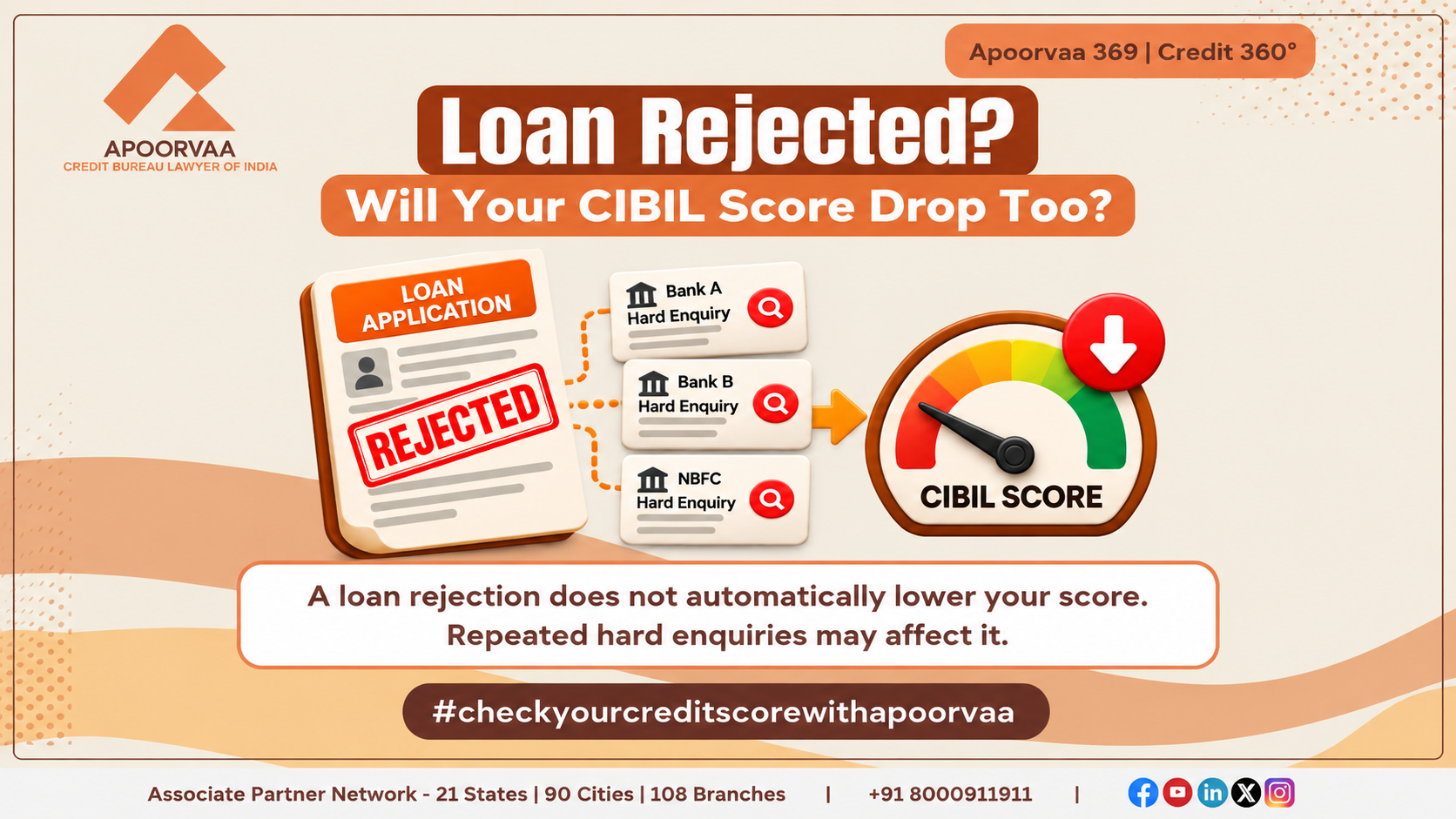
“My loan application was rejected by the bank. Will this loan rejection affect my CIBIL Score?”
This is a common concern among borrowers, particularly when they are planning to approach another bank immediately after receiving a rejection.
The direct answer is:
A loan rejection does not automatically reduce your CIBIL Score simply because the lender declined your application. However, the hard credit enquiry associated with the application may be recorded in your CIBIL Report, and repeated applications can potentially affect your credit profile.
These are two different events, and understanding the distinction is important.
A bank may reject your loan because of your credit history, repayment capacity, income, eligibility criteria or other underwriting considerations.
The rejection itself is not reported as a separate negative loan-account status in the same manner as an overdue, settlement or write-off.
However, if the lender accessed your CIBIL Report while evaluating the application, that enquiry may remain visible even when the loan was not sanctioned.
TransUnion CIBIL explains that the Enquiries section records lender checks associated with loan and credit-card applications. It also confirms that multiple applications within a short period can create repeated hard enquiries that may affect the CIBIL Score.
This means the more useful question is not simply:
“Did my loan rejection reduce my Score?”
It is:
“What happened during my loan application, and why was the application rejected in the first place?”
Does Loan Rejection Itself Reduce Your CIBIL Score?
A loan rejection and a credit enquiry should not be treated as the same thing.
Consider a simple example.
You apply for a personal loan.
The bank evaluates your application and checks your CIBIL Report.
After reviewing your credit profile and other eligibility information, the bank decides not to sanction the loan.
Two separate things have happened:
- The lender accessed your credit information while evaluating the application.
- The lender subsequently rejected the application.
The first event may generate a credit enquiry.
The second is the lender’s credit decision.
The rejection is not itself a new overdue, settlement, write-off or other adverse loan-account status.
This distinction matters because borrowers sometimes assume that every rejected application creates a separate negative remark saying “Loan Rejected” in the Credit Report.
That is not how CIBIL describes its standard Accounts and Enquiries sections.
TransUnion CIBIL explains that the Score is derived from information in the Accounts and Enquiries sections, while the decision to approve or reject credit belongs to the lender.
A rejected application can leave an enquiry without creating a new loan account.
If no loan was sanctioned or disbursed, the rejected application does not itself establish a new borrowing obligation.
But the enquiry associated with the application may still appear.
What Is a Hard Enquiry in a CIBIL Report?
A hard enquiry generally occurs when a lender accesses an applicant’s credit information in connection with a loan or credit-card application.
For example, a borrower may apply for:
- A personal loan
- A housing loan
- A business loan
- A vehicle loan
- A credit card
During the evaluation process, the concerned bank or financial institution may access the applicant’s CIBIL Score and Report.
That lender check can be recorded in the Enquiries section.
According to TransUnion CIBIL, an enquiry entry can show information such as the lender, enquiry date and type or purpose of credit requested.
Why does this matter?
Because an enquiry can be recorded even when the application does not result in a sanctioned loan.
A borrower may therefore see a lender’s enquiry in the CIBIL Report and assume:
“This enquiry means my loan was approved.”
That assumption would be incorrect.
An enquiry indicates that the lender accessed the credit information. It does not, by itself, establish whether the loan was subsequently approved or rejected.
Does One Hard Enquiry Cause a Major CIBIL Score Drop?
Not necessarily.
One of the biggest misconceptions is that a single loan application will automatically cause a dramatic reduction in the CIBIL Score.
TransUnion CIBIL describes the impact of individual credit enquiries as generally minimal, while explaining that repeated enquiries over a short period can affect the Score.
Therefore, it would be inaccurate to claim:
“One hard enquiry always reduces your CIBIL Score by 20 points.”
It would be equally inaccurate to promise:
“One hard enquiry can never affect your Score.”
The Score is calculated using the broader credit information available in the report, and CIBIL does not publish a universal fixed-point deduction applicable to every borrower and every enquiry.
The impact can depend on the overall credit profile and other information considered by the scoring model.
The important distinction is between one application and repeated credit-seeking behaviour.
One lender enquiry should not automatically become a reason for panic.
But repeatedly applying for credit without understanding why the earlier application failed can create an avoidable problem.
Why Repeated Loan Applications May Affect Your CIBIL Score
Consider a borrower whose personal loan application has been rejected.
The borrower becomes worried and immediately approaches another bank.
That application is also rejected.
The borrower then contacts several loan agents, DSAs and other lenders, hoping that somebody will approve the loan.
Over a short period, the borrower may end up submitting multiple applications.
Where those applications result in separate lender credit checks, multiple enquiries may appear in the CIBIL Report.
TransUnion CIBIL explains that lenders can use enquiry information to understand how frequently an applicant is seeking credit and whether several applications have been made close together. Repeated hard enquiries over a short period can potentially affect the Score.
This does not mean that every application produces exactly the same impact.
Nor does it mean that a fixed number of enquiries automatically triggers a particular Score reduction.
There is no responsible basis for claiming:
“Three enquiries are safe, but the fourth will reduce your Score.”
Or:
“Ten enquiries always reduce the Score by 100 points.”
The relevant concern is the broader pattern of repeated credit applications and the credit information associated with the borrower.
Can Applying Through Multiple DSAs or Loan Consultants Create Multiple Enquiries?
Potentially, yes.
A borrower may believe that giving documents to one loan consultant means only one loan application is being made.
But that is not necessarily the case.
If the application is submitted to several different lenders and those lenders independently access the borrower’s CIBIL Report, separate enquiries may be generated.
The number of enquiries depends on the actual lender checks—not simply on how many agents, consultants or intermediaries the borrower contacted.
For example, sharing documents with three consultants does not automatically mean that exactly three hard enquiries will appear.
Similarly, one intermediary may submit an application to more than one lender, depending on the customer’s authorization and the arrangement involved.
The important question is how many actual lender credit checks are being initiated.
This is particularly relevant when a borrower is already facing repeated loan rejections and is trying to find approval through multiple channels.
The urgency to obtain a loan should not replace the need to understand why the earlier application failed.
My Loan Was Rejected — Should I Immediately Apply to Another Bank?
Not without first understanding the likely reason for the rejection.
A rejected application does not necessarily mean the borrower should stop seeking credit indefinitely.
It also does not mean that every other lender will reach the same decision.
Different lenders can have different eligibility criteria, risk policies and underwriting requirements.
However, immediately submitting several new applications without understanding the original problem may be unhelpful.
Suppose a borrower has a genuine overdue amount appearing in the Credit Report.
The first lender identifies the overdue and declines the application.
The borrower then approaches five other lenders without addressing or understanding the underlying issue.
The result may be several additional enquiries while the original credit-profile concern remains unresolved.
Alternatively, suppose the borrower has a good CIBIL Score but does not meet a lender’s minimum income or repayment-capacity requirements.
In that situation, the problem may not be a Credit Report error at all.
Applying repeatedly without identifying the relevant issue can create confusion rather than clarity.
Before another application, understand whether the rejection concerns your credit profile, the lender’s eligibility requirements or another aspect of the application.
This is a more useful approach than assuming every rejection can be overcome by approaching enough banks.
Why Finding the Original Loan Rejection Reason Matters
A loan rejection can arise for several different reasons.
Some may relate to the applicant’s credit information.
Others may relate to financial eligibility or the lender’s internal requirements.
These categories should not be confused.
1. Credit-Report-Related Concerns
A lender may identify information in the Credit Report that raises questions about the applicant’s existing or historical credit obligations.
Depending on the facts and the lender’s policy, this could include overdue amounts, previous repayment problems, settlement or write-off information, or issues associated with guaranteed or jointly held credit facilities.
The presence of such information does not mean every lender must automatically reject the application.
But it may be relevant to the lender’s assessment.
2. Income and Repayment Capacity
A borrower may have a good CIBIL Score but insufficient income or repayment capacity for the requested loan amount.
For example, an applicant may already have substantial monthly financial obligations relative to their income.
The lender may therefore decline the requested facility even when the applicant has no obvious reporting discrepancy.
3. Lender-Specific Eligibility Criteria
Banks and other lenders may apply their own eligibility requirements for different credit products.
These can relate to the nature of employment or business, income, loan amount, borrower profile and other underwriting considerations.
TransUnion CIBIL confirms that the decision to grant credit rests with the credit institution and depends on its credit policy.
4. Documentation or Application-Related Concerns
An application may also face difficulties because of incomplete, inconsistent or insufficient supporting information.
This should not automatically be interpreted as evidence that the applicant’s CIBIL Score is poor.
A Good CIBIL Score Does Not Guarantee Loan Approval
This point is particularly important.
A borrower may say:
“My CIBIL Score is above 750. Why did the bank reject my loan?”
A good Score can be a positive factor in credit evaluation, but it is not the lender’s only consideration.
The lender may also assess the complete Credit Report, repayment capacity, income, existing obligations and its own eligibility requirements.
Therefore:
A loan rejection does not automatically prove that your CIBIL Score is bad.
And:
A good CIBIL Score does not automatically establish that you qualify for every loan.
Understanding the difference can prevent unnecessary repeat applications and help identify whether the original concern is related to credit reporting or another part of the lender’s assessment.
Why Your Complete CIBIL Report Matters After Loan Rejection
When a loan is rejected, many borrowers immediately check only their CIBIL Score.
But the three-digit number does not explain every detail of the credit profile.
The complete report contains the underlying Accounts and Enquiries information.
It can help provide context about existing credit facilities, repayment history, account status, credit exposure and recent lender enquiries.
For example, two borrowers may have similar CIBIL Scores but very different credit histories.
One may have multiple recent applications.
Another may have an old settlement or overdue history.
A third may have no significant adverse credit information but may not meet the lender’s income requirements.
These situations should not be approached as though they have the same root cause.
The objective after a loan rejection should be to understand the reason—not simply to find another lender willing to accept the application.
That distinction becomes even more important when the borrower is considering Credit Rectification because they believe inaccurate or outdated information may be affecting their credit profile.
What Credit-Report Issues May Be Behind a Loan Rejection?
A loan rejection does not automatically mean that the CIBIL Report contains an error.
However, the complete Credit Report may reveal information that is relevant to the lender’s decision.
The important distinction is between:
A genuine credit-history concern
and
An inaccurate or outdated reporting concern.
Both may require attention, but they should not be approached in the same way.
1. Overdue Amounts and Previous Repayment Problems
A lender may review whether the applicant has outstanding overdue amounts or a history of delayed payments.
For example, a borrower may be paying all current EMIs regularly but still have an unresolved overdue amount associated with another account.
Alternatively, the borrower may have experienced repayment problems in the past that remain reflected in the credit history.
Such information may be relevant to a lender’s assessment.
However, a genuine overdue amount is not automatically a Credit Report error simply because it affects the applicant’s ability to obtain fresh credit.
The question is whether the information accurately represents the underlying account.
2. Settlement Information
A loan or credit-card account may contain settlement-related information.
A settlement generally involves an arrangement under which the lender accepts an agreed amount in resolution of the borrower’s dues.
The reported status and surrounding account information may be relevant when another lender evaluates a fresh application.
However, the presence of a settlement does not establish that every lender must reject the borrower.
Nor does it mean that a correctly reported settlement can automatically be removed through Credit Rectification.
If the information is inaccurate or does not appropriately reflect the actual account position, that is a different matter requiring examination.
3. Write-Off Information
Write-off information can also form part of a borrower’s credit history.
A write-off should not be confused with a simple loan closure or with automatic cancellation of the borrower’s legal obligation.
The meaning of the reported information depends on the account circumstances.
If a lender reviewing a fresh application identifies write-off-related information, it may consider that history under its credit policy.
But the presence of a write-off is not, by itself, proof that the Credit Report contains an error.
4. Issues With a Guaranteed Loan
A borrower may overlook a loan for which they have provided a guarantee.
For example, a person may have guaranteed a business loan or another borrower’s credit facility.
If that facility develops repayment problems, the guarantor should not automatically assume that the account is irrelevant to their credit profile.
A guarantee can create genuine legal liability. Under Section 128 of the Indian Contract Act, 1872, the surety’s liability is generally co-extensive with that of the principal debtor unless the contract provides otherwise.
At the same time, a genuine Guarantor relationship should not be confused with an incorrectly reported ownership classification.
If a guaranteed account is relevant to a loan rejection, the actual relationship and reported account information need to be understood accurately.
Genuine Negative Credit History vs Incorrect Credit Reporting
This distinction is central to responsible Credit Rectification.
Consider two borrowers.
Borrower A: Genuine Credit-History Concern
The borrower had an actual overdue amount that was correctly reported.
The lender reviewing the new application considers that information relevant to its assessment.
The borrower may be unhappy with the outcome, but dissatisfaction with the lending decision does not make the underlying credit information inaccurate.
Borrower B: Possible Reporting Discrepancy
The borrower has repaid an account, but the Credit Report still contains information that appears inconsistent with the actual lender records or subsequent account developments.
In this situation, the concern may involve the accuracy or updating of the reported information.
These are different cases.
Credit Rectification is concerned with identifying and addressing inaccurate credit information—not making genuine credit history disappear.
A customer should therefore avoid assuming that every negative entry can be removed simply because it may be affecting loan eligibility.
Equally, a customer should not assume that every negative-looking entry must be accepted without understanding whether it accurately reflects the account.
Can an Old Credit-Report Problem Still Matter After You Start Paying EMIs Regularly?
Potentially, yes.
Some borrowers believe that taking a new loan and paying its EMI regularly for a few months will automatically overcome every previous credit concern.
That is not a reliable assumption.
Regular repayment is important, but a lender may review the broader credit history rather than considering only the most recent EMI payments.
For example, the complete report may still contain relevant information about previous overdue amounts, settlement, write-off or other account history.
The impact of that information on a particular application depends on the overall profile and the lender’s assessment.
There is no universal formula stating:
“Pay three EMIs and your previous credit problems will stop mattering.”
Similarly, there is no guaranteed timeline within which every borrower will become eligible for a fresh loan.
The better approach is to understand the actual credit profile before making another application.
Does Checking Your Own CIBIL Report Reduce Your Score?
No.
This is an important distinction from a lender’s hard enquiry.
When you check your own CIBIL Score or Report, that personal check does not reduce your CIBIL Score.
TransUnion CIBIL distinguishes between a customer accessing their own credit information and a lender checking the report in connection with a credit application.
Therefore, a borrower who has experienced a rejection should not avoid reviewing their own Credit Report out of fear that doing so will create another damaging hard enquiry.
Checking your own report and repeatedly applying for new credit are not the same activity.
The former helps you understand your credit information.
The latter may result in additional lender enquiries.
Can Multiple Loan Enquiries Be Removed From a CIBIL Report?
A borrower may notice several enquiries after submitting applications through different lenders or intermediaries.
The immediate reaction is often:
“These enquiries are affecting my CIBIL Score. Can I remove all of them?”
The answer depends on whether the enquiries are genuine and accurately reported.
A legitimate enquiry associated with an actual credit application should not automatically be treated as an error merely because the application was rejected.
However, an enquiry that the customer does not recognize or that appears factually inconsistent with the underlying circumstances may require further examination.
This is another example of the difference between:
An unfavourable but genuine credit record
and
Potentially inaccurate credit information.
No professional should promise that all hard enquiries can be deleted simply to improve a CIBIL Score.
My Loan Was Rejected — Should I Immediately Apply to Another Bank?
The practical answer is to first understand the original rejection.
That does not mean a borrower must never approach another lender.
Different lenders may have different policies, and one rejection does not establish that every future application will fail.
However, repeated applications made without understanding the problem may create additional enquiries while leaving the underlying concern unchanged.
Consider three situations.
| Situation | What the borrower needs to understand |
| Loan rejected despite a good CIBIL Score | Whether income, repayment capacity, documentation or lender eligibility criteria were relevant |
| Loan rejected with genuine adverse credit history | Whether the lender’s concern relates to accurately reported past or existing obligations |
| Whether the lender’s concern relates to accurately reported past or existing obligations | Whether the complete Credit Report contains inaccurate or insufficiently updated information requiring assessment |
The response should depend on the actual problem.
Changing the lender does not automatically change the underlying credit profile.
If the same genuine credit concern remains, approaching multiple lenders may not address it.
If the problem is unrelated to the Credit Report, Credit Rectification may not be the appropriate solution.
And if inaccurate information is genuinely present, that discrepancy deserves attention independently of whether the next loan is approved.
What If the Bank Does Not Clearly Explain Why the Loan Was Rejected?
A customer may receive a rejection communication without fully understanding the reason.
This can create confusion, especially when the borrower believes their CIBIL Score is satisfactory.
However, it would be incorrect to conclude automatically:
“The bank rejected my loan, so there must be an error in CIBIL.”
A lender’s decision may involve several factors beyond the credit score.
The relevant concern may be connected with income, repayment capacity, the requested loan amount, documentation, existing financial obligations or the lender’s internal policy.
The complete Credit Report can help identify potential credit-profile concerns, but it cannot independently establish every reason behind a lender’s decision.
Credit-report analysis and lender eligibility assessment are related, but they are not identical.
This distinction is important when deciding whether professional Credit Rectification is relevant.
Does a Loan Rejection Mean You Should Stop Applying for Credit?
Not necessarily.
A rejection is a lending decision made in relation to a particular application.
It is not a permanent declaration that the borrower can never obtain credit.
But submitting more applications without understanding the previous outcome may be counterproductive.
The objective should be to make the next credit application with a clearer understanding of the borrower’s actual position.
That includes distinguishing between:
- A credit-profile concern
- A genuine but unfavourable credit history
- An inaccurate credit-report entry
- A lender-specific eligibility issue
- A documentation or application-related issue
The correct interpretation matters more than the number of lenders approached.
Frequently Asked Questions
1. Does loan rejection directly reduce my CIBIL Score?
A loan rejection does not itself create a separate negative account status equivalent to an overdue, settlement or write-off. However, a lender’s hard enquiry associated with the application may be recorded and can potentially affect the Score.
2. Will a hard enquiry appear even if my loan is rejected?
Yes. If a lender accessed your CIBIL Report in connection with the application, the enquiry may appear even though the loan was not sanctioned.
3. Does one hard enquiry significantly reduce the CIBIL Score?
Not necessarily. CIBIL describes the impact of individual enquiries as generally minimal, but there is no guaranteed fixed-point impact applicable to every borrower.
4. Can multiple rejected loan applications affect my Score?
Repeated applications may generate multiple lender enquiries. Several hard enquiries within a short period can potentially affect the CIBIL Score.
5. How many loan enquiries are too many?
There is no responsible universal number that guarantees a particular Score impact. The broader credit profile and pattern of credit applications matter.
6. Does checking my own CIBIL Score create a hard enquiry?
No. Checking your own CIBIL Score or Report does not reduce your Score.
7. Can a loan be rejected even if my CIBIL Score is above 750?
Yes. Lenders may consider income, repayment capacity, existing obligations, eligibility criteria, documentation and the complete credit profile alongside the Score.
8. Can settlement, write-off or overdue information affect a loan application?
Such information may be relevant to a lender’s credit assessment, depending on the circumstances and its policy. It does not establish that every application must be rejected.
9. Can I remove hard enquiries after my loan is rejected?
A genuine enquiry should not automatically be treated as an error merely because the loan was rejected. Potentially inaccurate or unrecognized enquiries require separate assessment.
10. Will correcting a CIBIL Report error guarantee that my next loan is approved?
No. Correcting inaccurate credit information does not guarantee a particular CIBIL Score or loan approval. The lender makes its own credit decision.
My Perspective
When a borrower tells me, “My loan was rejected, so I immediately applied to five other banks,” the first question is not how many applications were submitted.
The first question is:
Why was the original loan rejected?
If the borrower has a genuine overdue amount, an old settlement, write-off information or a problem associated with a guaranteed facility, repeated applications may not address the underlying concern.
If the Credit Report contains inaccurate information, that discrepancy needs to be identified correctly.
And if the rejection is connected with income, repayment capacity or the lender’s eligibility criteria, the problem may not be a Credit Report error at all.
This is why I advise borrowers not to confuse loan rejection, hard enquiry and Credit Rectification.
They are connected topics, but they are not the same thing.
The objective should be to understand the root cause before submitting another loan application.
Final Thought
A rejected loan application does not automatically mean your CIBIL Score has been damaged.
But repeatedly approaching banks, NBFCs or other lenders without understanding the rejection reason may lead to additional hard enquiries.
The more important question is not:
“Which bank should I apply to next?”
It is:
“What is preventing my application from meeting the lender’s requirements?”
Sometimes the answer may be found in the complete Credit Report.
Sometimes it may relate to genuine credit history.
Sometimes it may involve inaccurate reporting.
And sometimes the reason may have nothing to do with CIBIL.
Understanding that distinction is more useful than applying repeatedly in the hope of finding an immediate approval.
Professional Credit Report Assessment
If your loan application has been rejected and you suspect that overdue information, settlement, write-off, guarantor-related account information or another credit-report discrepancy may be affecting your profile, a professional review can help identify whether the reported information is accurate and whether a genuine rectification concern exists.
Apoorvaa – Credit Bureau Lawyer of India provides professional Credit Report assessment and Credit Rectification services for individuals and businesses.
📞 +91 8000 911 911
Apoorvaa – Credit Bureau Lawyer of India
Credit Rectification does not guarantee removal of correctly reported credit information, a particular CIBIL Score, or approval of any loan. Credit decisions remain subject to the concerned lender’s assessment and policies.
Related Credit Education
- Good CIBIL Score but Loan Rejected? Check Your Complete Credit Profile
- CIBIL Enquiries: Can Loan Enquiries Be Removed?
- Wrong Ownership in CIBIL Report: Can a Guarantor, Joint or Individual Loan Status Affect Your Credit Profile?
About the Author
Advocate Apurva Bhagat is the Founder & Chairman of Apoorvaa – Credit Bureau Lawyer of India.
His work focuses on credit-bureau law, Credit Rectification and helping individuals and businesses understand the difference between genuine credit obligations, inaccurate credit reporting and lender-specific credit decisions.

Comments are closed