




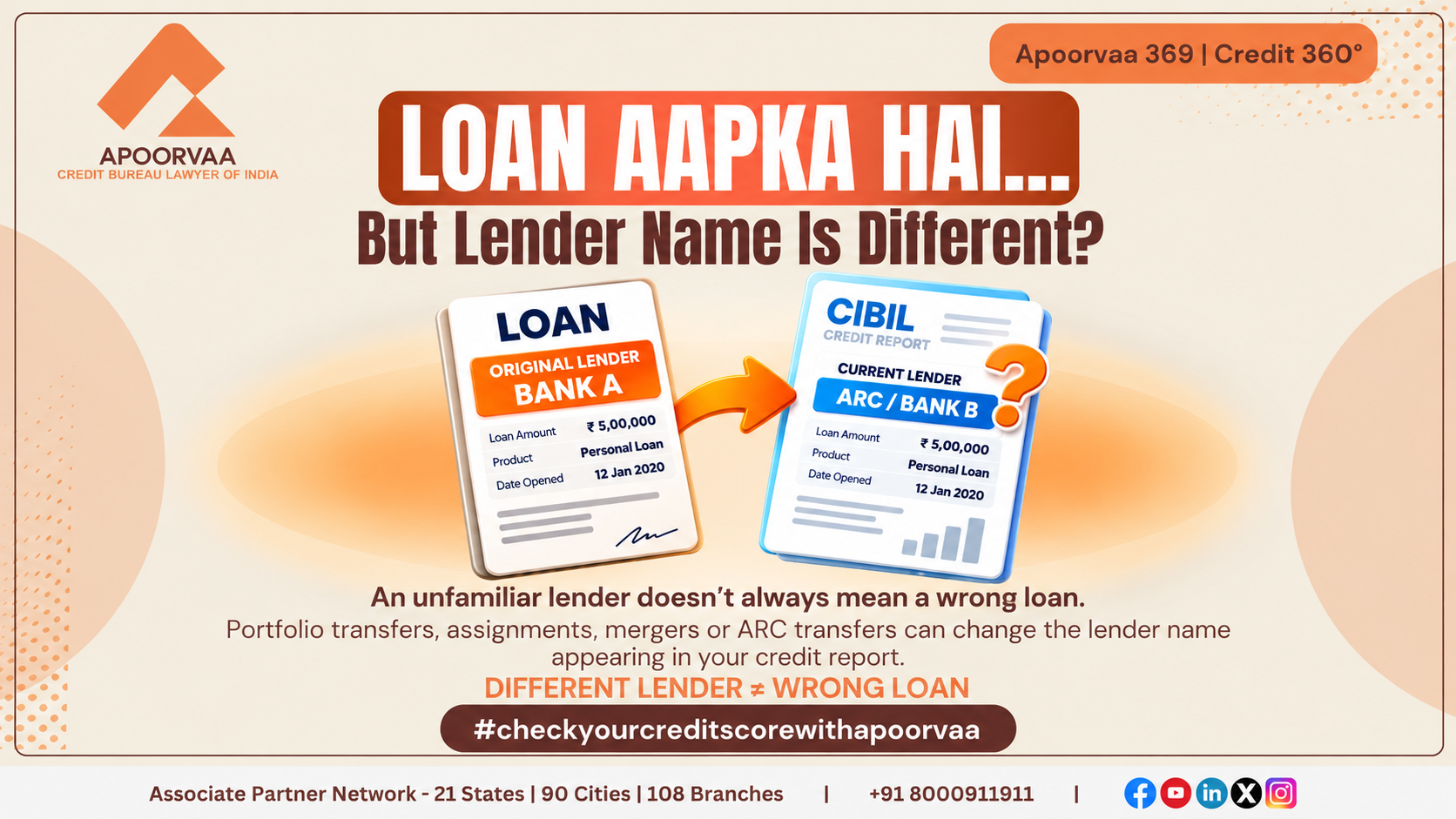
“The loan is mine, but I never took a loan from the lender shown in my CIBIL Report. Is the report wrong?”
This can be confusing.
You remember taking a loan from Bank A. The loan amount looks familiar. The product looks familiar. Even the date when the account was opened appears to match.
But when you check your CIBIL Report today, the lender or credit institution associated with the account appears to be Bank B, another financial institution or an Asset Reconstruction Company (ARC).
The immediate reaction is often:
“I never took a loan from this company. This account must be wrong.”
Not necessarily.
An unfamiliar lender name does not automatically establish that the loan account has been wrongly reported.
India’s financial and regulatory framework permits loan exposures to move between eligible entities in different circumstances. Loans may be transferred or assigned, financial institutions may undergo mergers or acquisitions, and stressed loan exposures may, subject to the applicable framework, be transferred to Asset Reconstruction Companies.
Therefore, there are two very different questions:
“I recognise the loan, but I don’t recognise the lender currently associated with it.”
and
“I don’t recognise this loan at all.”
These should not be treated as the same Credit Report issue.
1. Can the Lender Connected With Your Loan Change?
Yes.
A borrower may originally enter into a loan agreement with one bank or financial institution, while the loan exposure may subsequently move to another eligible entity through a legally recognised transaction.
RBI’s Transfer of Loan Exposures Directions, 2021 provide a regulatory framework governing transfers of loan exposures by specified lending institutions.
RBI explains that lending institutions may transfer loans for several reasons, including liquidity management, rebalancing of exposures and strategic sales.
This means that the name connected with a credit account at a later stage does not always have to remain identical to the institution from which the borrower originally obtained the loan.
That does not mean every unfamiliar lender name is automatically correct.
It means that the lender name alone is not sufficient evidence to conclude:
“This loan does not belong to me.”
The complete account relationship has to be understood.
2. What Is a Loan Transfer or Assignment?
In simple terms, a loan creates rights and obligations between the borrower and the lender.
Under applicable law and regulatory requirements, the lender’s exposure may subsequently be transferred to another eligible entity.
In the case of stressed loans, RBI’s Transfer of Loan Exposures Directions specifically state that transfers must take place through assignment or novation, subject to the applicable framework.
For a borrower looking at a Credit Report, the practical point is simpler:
The institution currently connected with the loan may not always be the same institution that originally sanctioned the loan.
This is why a borrower should avoid deciding that an account is fraudulent merely because the current institution’s name is unfamiliar.
The underlying credit facility needs to be examined.
3. Why Can an ARC Name Appear Against an Old Loan?
This is particularly relevant when borrowers encounter the name of an Asset Reconstruction Company, or ARC.
What Is an ARC?
Under RBI’s current regulatory framework, an Asset Reconstruction Company is a company registered with the Reserve Bank under Section 3 of the SARFAESI Act, 2002 for carrying on the business of asset reconstruction or securitisation, or both.
ARCs play a role in the resolution of stressed financial assets of banks and financial institutions.
RBI’s framework permits stressed loans meeting the applicable conditions to be transferred to ARCs.
So imagine:
You originally borrowed from Bank A.
Later, the relevant stressed financial asset is transferred to an ARC under the applicable legal and regulatory framework.
Years later, you obtain your Credit Report and encounter the ARC’s name in connection with the credit account.
You may say:
“I have never taken a loan from this ARC.”
That statement can be factually true—you may never have approached that ARC for a fresh loan.
But that fact alone does not prove that the account appearing in your Credit Report is unrelated to you.
The relevant question becomes:
Is this ARC connected with the loan that you originally obtained from another institution?
That relationship needs to be verified before the account is labelled incorrect.
4. Does Every Different Lender Name Mean the Loan Was Transferred to an ARC?
No.
This is an important distinction.
An ARC is only one possible context in which the entity associated with an older loan may change.
Depending on the facts, changes may also arise in connection with:
- Transfer or assignment of loan exposures
- Portfolio transactions
- Merger of financial institutions
- Acquisition or restructuring involving financial institutions
- Transfer of stressed assets to an eligible ARC
These situations have different legal and commercial structures.
Therefore, it would be incorrect to see an unfamiliar lender name and immediately conclude:
“My loan was sold to an ARC.”
The actual history of that particular account should establish what happened.
Similarly, examples involving particular banks or ARCs should not be used unless the relevant transaction itself can be independently verified.
5. Does a Different Lender Name Mean the CIBIL Report Is Wrong?
Not automatically.
Suppose you took a personal loan for ₹5 lakh from Bank A.
Later, you see another institution associated with the account in your Credit Report.
Before concluding that the account is wrong, consider whether the other account-level information corresponds with the credit facility you recognise.
Relevant information may include:
Loan/product type: Was it the type of credit facility you actually obtained?
Date opened: Does the reported opening date correspond with your loan history?
Sanctioned or high credit amount: Is the amount consistent with the facility you remember?
Account status: Does the reported status make sense in the context of the account?
Current balance and overdue information: Do these figures require further verification?
Ownership and other relevant account identifiers: Does the overall account information establish a relationship with you?
No single field should necessarily be examined in isolation.
If several key details correspond with a known loan but the institution’s name is unfamiliar, the possibility of a legitimate change in the creditor/account relationship should be investigated before calling it a wrong loan.
But there is an equally important qualification:
A legitimate transfer of a loan does not automatically prove that every other field being reported for that account is accurate.
The account still deserves complete review.
6. Loan Transfer vs Wrong Loan Reporting: How Are They Different?
Consider these two situations.
Situation A: You Recognise the Loan
You remember taking the loan.
The product is familiar.
The sanctioned amount broadly corresponds.
The opening date corresponds with your borrowing history.
But the institution currently associated with the account is unfamiliar.
Here, the first issue is to establish whether the lender/creditor relationship subsequently changed because of a transfer, assignment, merger, acquisition, ARC transaction or another legitimate event.
Situation B: You Do Not Recognise the Loan at All
You do not recognise:
the lender,
the loan amount,
the product,
the opening date,
or the underlying credit relationship.
That is a fundamentally different concern.
The question is no longer simply:
“Why has the lender name changed?”
It becomes:
“Why is this credit facility associated with my Credit Report at all?”
This distinction matters because Credit Rectification should begin with identifying the actual nature of the discrepancy.
An unfamiliar lender and an unfamiliar loan are not automatically the same thing.
7. What Happens When Financial Institutions Merge or Are Acquired?
The identity of a financial institution itself may also change over time.
Banks and other financial institutions can undergo mergers, amalgamations, acquisitions or other corporate and regulatory changes.
For a borrower, this can create a simple practical problem:
The name remembered from the original loan documents may not be the name encountered years later.
Again, this does not mean that any unfamiliar institution appearing in a Credit Report should be accepted without verification.
The principle is narrower:
A difference between the original lender’s name and the institution currently associated with the account can have a legitimate explanation.
The account history and institutional relationship should establish that explanation.
8. Does Transfer of a Loan Remove the Borrower’s Liability?
A change in the lender or creditor connected with a loan should not be confused with cancellation of the underlying debt.
If a loan exposure is legally transferred, the fact that the original lender is no longer the institution connected with the exposure does not, merely because of that transfer, mean that the borrower’s underlying obligation has disappeared.
This becomes particularly important with older stressed accounts.
A borrower may say:
“I never borrowed money from this ARC, so why should its name be connected with my old loan?”
The relevant question is not simply whether the borrower directly obtained fresh money from the ARC.
The question is whether the ARC subsequently acquired the relevant financial asset under the applicable framework.
That distinction can completely change how the entry should be interpreted.
9. Who Is Responsible for Credit Information After a Loan Transfer?
This requires careful account-level analysis.
India’s credit-information framework places obligations on Credit Institutions and Credit Information Companies regarding the furnishing, maintenance and updating of credit information.
RBI’s framework requires credit information to be kept updated and requires steps to ensure that furnished credit information is updated, accurate and complete.
Since January 2025, the regulatory framework has also moved credit-information reporting to a fortnightly basis, with information to be submitted within the prescribed period following the relevant reporting fortnight.
Where a credit exposure has changed hands, understanding which institution is currently responsible for the relevant reporting becomes important.
But the consumer should not automatically conclude:
“The original bank must correct everything.”
Nor should the consumer automatically conclude:
“The credit bureau created the new lender name.”
The relevant account history, transfer relationship and current reporting institution need to be established first.
10. Why the Complete Account Should Be Reviewed Before Calling It a CIBIL Error
You recognise the loan.
But you don’t recognise the lender name.
What should you do?
The first conclusion should not be:
“This loan is fake.”
And it should not automatically be:
“CIBIL has made a mistake.”
Instead, the Credit Report should be read as a complete account record.
Compare the lender/credit institution information with the product, opening date, sanctioned/high credit amount, account status, current balance and other relevant information.
Then determine whether the institution currently associated with the account has a legitimate relationship with the original credit facility.
If that relationship can be established, the unfamiliar name may have a valid explanation.
If the relationship cannot be established—or if other material account information is inaccurate or inconsistent—the matter may require further verification and Credit Rectification.
Different lender name ≠ automatically a wrong loan.
But equally:
A transferred loan ≠ automatically proof that every reported account detail is correct.
The purpose of professional Credit Report analysis is to understand that difference.
11. What Should You Do When You Recognise the Loan but Not the Lender?
This is where careful Credit Report interpretation becomes important.
Suppose you recognise:
- The loan product
- Approximate sanctioned amount
- Date when the account was opened
- Original borrowing relationship
- Other material account information
But you do not recognise the institution currently associated with the account.
That situation should not immediately be treated as an unknown loan.
Instead, the first question should be:
“Can the current institution be connected with the loan I originally took?”
There may have been a transfer or assignment of the loan exposure. A stressed financial asset may have been transferred to an Asset Reconstruction Company. The original financial institution may have undergone a merger, acquisition or another structural change.
RBI’s Transfer of Loan Exposures framework expressly recognises transfers of loan exposures by regulated lending institutions.
Therefore, before alleging incorrect reporting, the history of the credit facility should be understood.
12. Why Can an ARC Name Appear Against an Old Loan?
This deserves special attention because an ARC name can be completely unfamiliar to a borrower.
A borrower may say:
“I have never visited this ARC.”
“I never signed a new loan application with this company.”
“This company never gave me the original loan.”
All three statements may be true.
Yet that alone does not establish that the ARC has no relationship with the old credit facility.
An Asset Reconstruction Company (ARC) operates within a regulated framework for acquiring and resolving financial assets, including stressed financial assets transferred by lenders under applicable law and RBI regulations.
Importantly, RBI’s current directions require ARCs to become members of Credit Information Companies and submit requisite credit data in the prescribed format.
RBI specifically explains that this framework helps maintain a track of borrowers’ credit history after loans are transferred by banks and NBFCs to ARCs.
This gives us an important practical answer.
If an old stressed loan was transferred to an ARC, the ARC’s name becoming relevant to subsequent credit-information reporting does not automatically mean that a completely new loan was taken from that ARC.
The old credit relationship and subsequent transfer history need to be connected.
13. Original Lender vs Current Reporting Institution
Consider a simplified example.
You obtained a loan from:
Original Bank → ₹5,00,000 Personal Loan
Several years later, the relevant loan exposure is lawfully transferred to another eligible institution or, in an applicable stressed-asset situation, to an ARC.
Your Credit Report later contains information associated with the subsequent institution.
You may still remember only the original bank because that is where you completed the application and received the loan.
The credit-reporting position, however, may need to reflect developments that occurred after origination.
That is why a professional Credit Report review should distinguish between:
Loan origination — Who originally granted the credit facility?
and
Subsequent account/creditor relationship — Did something legally relevant happen to that exposure later?
This distinction can explain why the institution you remember and the institution currently relevant to the account may differ.
14. Does a Loan Transfer Mean Every Detail in the CIBIL Report Is Correct?
No.
This is equally important.
Once a legitimate transfer or assignment has been established, a consumer should not assume:
“Then everything reported for this account must be correct.”
The lender relationship is only one component of the account.
Other information may still require examination, including:
- Account ownership
- Loan/product type
- Date opened
- Sanctioned or high credit amount
- Current Balance
- Amount Overdue
- Account status
- Repayment information
- Date of reporting
- Other applicable account-level information
For example, the current institution may have a legitimate connection with the loan, but the reported Current Balance could still require verification.
Or the transfer itself may be valid while another account field does not correspond with the underlying records.
Therefore:
Valid lender relationship ≠ automatic validation of every reported field.
Credit-data accuracy should be assessed at the account level.
15. Loan Transfer vs Wrong Loan Reporting: How Are They Different?
This is perhaps the most important distinction in today’s topic.
Loan recognised, lender unfamiliar
You recognise the credit facility and several important account details, but the current institution’s name is unfamiliar.
The first task is to establish the relationship between the original lender and the current institution.
Loan itself completely unfamiliar
You do not recognise the loan.
The product is unfamiliar.
The amount is unfamiliar.
The opening date does not correspond with your borrowing history.
And you cannot establish a relationship with the reported credit facility.
That is a different issue.
TransUnion CIBIL itself distinguishes between disputing ownership of an account—where the consumer says the account does not belong to them—and disputing particular fields of an account that the consumer does recognise.
This distinction is extremely useful.
If the loan belongs to you but one field requires verification, that is not automatically an ownership dispute.
If the entire credit facility is unknown to you, the concern is fundamentally different.
“I don’t recognise the lender name” and “I don’t recognise the loan” should never automatically be treated as identical statements.
16. What Is the Role of the Current Credit Institution?
Where an institution is legitimately connected with the credit exposure, its role in subsequent credit-information reporting becomes important.
The regulatory framework requires Credit Institutions to take necessary steps to ensure that credit information furnished by them is up to date, accurate and complete.
Since January 1, 2025, RBI requires credit information to be updated on a fortnightly basis—as on the 15th and last day of each month—or at shorter mutually agreed intervals.
Credit Institutions must submit the information within the prescribed period following the relevant reporting fortnight.
ARCs are also specifically required to submit requisite information to Credit Information Companies and keep the information collected or maintained by them updated on a fortnightly basis.
This is particularly relevant to today’s question.
When a loan moves from one institution to another, consumers should understand not only who originally gave the loan, but also which institution is responsible for the relevant current reporting.
17. What Is the Role of TransUnion CIBIL?
TransUnion CIBIL is a Credit Information Company.
It receives credit information from participating Credit Institutions and uses that information within the credit-information system.
Where a consumer disputes lender-furnished account information, CIBIL’s published dispute process explains that the dispute may be routed to the concerned Credit Institution for verification.
CIBIL also states that it cannot modify lender-furnished information without confirmation from the relevant Credit Institution.
Therefore, if a consumer says:
“Replace this lender name because I don’t recognise it,”
the issue cannot responsibly be approached by looking only at the consumer’s recollection of the original lender.
The actual account history must establish whether the institution currently associated with the account has a legitimate connection with that loan.
18. What If You Cannot Establish Any Connection With the New Lender?
Now the situation changes.
Suppose you recognise the original loan but, after appropriate verification, you cannot establish why another institution is associated with it.
Or suppose the account contains information inconsistent with the underlying loan records.
That deserves further examination.
The relevant questions may include:
Was the loan actually transferred or assigned?
Which institution currently holds or reports the relevant exposure?
Does the account information correspond with the original credit facility?
Do the lender’s records and Credit Report tell the same story?
Has information been duplicated or otherwise inaccurately reported?
At this point, the issue may move from simple credit-report interpretation to a potential Credit Rectification matter.
But even then, the objective should not be:
“Delete the account because I don’t recognise this lender.”
The objective should be:
Establish the correct account relationship and correct any information that is demonstrably inaccurate.
19. What If Both the Original and Subsequent Institution Appear?
This situation also requires careful analysis.
Seeing more than one institution connected with what appears to be the same borrowing history should not automatically lead to the conclusion that the borrower has been charged with two loans.
But neither should apparent duplication simply be ignored.
The accounts need to be compared.
Important questions include whether the entries represent:
- Different credit facilities
- Different stages of the same underlying exposure
- A transferred or assigned account
- Separate reporting connected with a legitimate transaction
- Or an actual reporting inconsistency requiring correction
The sanctioned/high credit amount, opening dates, account status, balances and other relevant identifiers can help establish whether the entries relate to the same underlying borrowing relationship.
This is one reason why professional Credit Report analysis should not be based only on counting the number of accounts visible on the report.
The relationship between those accounts matters.
20. Should You Dispute a Legitimately Transferred Loan Just Because You Don’t Recognise the New Lender?
Generally, an unfamiliar lender name by itself is not sufficient to establish inaccurate reporting.
If the current institution has a legitimate relationship with the original credit exposure, disputing the entire account as:
“This loan does not belong to me”
may misstate the actual issue.
CIBIL’s own dispute guidance differentiates between an ownership dispute and a dispute regarding individual account fields.
That distinction matters.
If the loan is genuinely yours, the problem—if there is one—may concern a particular field, balance, status, ownership classification or reporting relationship rather than whether the underlying loan exists.
The dispute should correspond with the actual inaccuracy.
21. What If the Information Really Is Inaccurate?
Where investigation establishes that credit information requires correction, India’s credit-information framework provides a process for updation and rectification.
RBI’s compensation framework states that a complaint concerning updation or rectification of credit information should be resolved within an overall period of 30 calendar days from the date of initial filing.
Within this framework, the concerned Credit Institution has 21 calendar days to send corrected or updated credit information after being informed of the inaccuracy, leaving the Credit Information Company effectively the remaining nine days within the overall resolution period.
RBI also provides for compensation of ₹100 per calendar day where an eligible complaint remains unresolved beyond the prescribed 30-day period, subject to the framework’s conditions and exclusions.
This should not be misunderstood as:
“Any unfamiliar lender name must be corrected within 30 days.”
First there must actually be information requiring updation or rectification.
A legitimate transfer or assignment does not become an error merely because the borrower was unaware of it.
22. Why Professional Credit Report Review Can Matter
Today’s example demonstrates why Credit Rectification requires interpretation before action.
A consumer sees an unfamiliar lender and says:
“Remove this account.”
But professional review may reveal that the loan is genuinely the consumer’s and that the current institution has a legitimate connection with the original credit exposure.
In another case, the lender relationship may not be established.
In another, the lender relationship may be legitimate but the Current Balance may be inaccurate.
In another, two apparently similar accounts may require investigation to determine whether there is duplication or legitimate sequential reporting.
These are different problems.
They should not receive the same solution.
At Apoorvaa – Credit Bureau Lawyer of India, the objective of professional Credit Report assessment is therefore not simply to identify information that looks unfamiliar.
It is to determine:
What does the report actually say?
What is the history of the credit facility?
Which institution is connected with the account?
What information is supported by the underlying records?
And is there any material information that genuinely requires rectification?
That distinction helps separate a legitimate change in lender relationship from an actual Credit Report discrepancy.
Frequently Asked Questions
1. My loan is from one bank, but my CIBIL Report shows another lender. Is it wrong?
Not necessarily. The loan exposure may have been transferred or assigned, the institution may have undergone a merger or acquisition, or—in an applicable stressed-asset case—the exposure may have been transferred to an ARC. The actual account relationship should be verified before concluding that the reporting is wrong.
2. Why is an ARC showing in my CIBIL Report when I never took a loan from it?
An ARC may acquire a stressed financial asset from a bank or other eligible lender. RBI now specifically requires ARCs to report requisite credit information to CICs so borrowers’ credit history can continue to be tracked after such transfers.
3. Does an unfamiliar lender mean the loan is fraudulent?
No. An unfamiliar lender name alone does not establish fraud or incorrect reporting. The underlying account information and relationship between the original and subsequent institution should first be examined.
4. What account details should I compare?
Relevant information may include the loan/product type, date opened, sanctioned or high credit amount, account status, Current Balance, Amount Overdue, ownership and other applicable account identifiers.
5. What if I don’t recognise the loan itself?
That is different from recognising the loan but not the current lender. If the entire credit facility is unfamiliar, ownership of the account becomes a separate issue requiring verification.
6. Can a loan be transferred without becoming a new loan?
A transfer of a loan exposure can change the institution connected with the exposure without meaning that the borrower obtained a completely new loan from that institution. The precise legal effect depends on the transaction and applicable framework.
7. Does an ARC name mean my loan was written off or waived?
No. The appearance of an ARC should not by itself be interpreted as loan waiver. Transfer of a financial asset and waiver of a borrower’s liability are different concepts.
8. Can CIBIL simply remove an unfamiliar lender?
Not merely because the name is unfamiliar. CIBIL’s published dispute guidance states that lender-furnished information cannot be modified without confirmation from the relevant Credit Institution.
9. If the transfer is legitimate, can other information still be wrong?
Yes. Establishing a legitimate lender relationship does not automatically establish that every balance, status or other account field is accurate.
10. Does Credit Rectification guarantee deletion of the account?
No. Accurate information should not be expected to be deleted merely because it is unfamiliar. Rectification should focus on information that can be established as inaccurate, incomplete or inconsistent.
My Perspective
When borrowers check their Credit Reports, familiarity often becomes their first test:
“I know this bank.”
or
“I have never heard of this company.”
But credit information cannot always be interpreted only through memory of the institution that originally sanctioned the loan.
Credit relationships can evolve.
Loan exposures can be transferred.
Financial institutions can merge or be acquired.
Stressed assets can move to ARCs under the applicable regulatory framework.
And the institution relevant to current credit reporting may therefore differ from the lender whose name appears on the borrower’s original loan documents.
This does not mean consumers should blindly accept every unfamiliar lender name.
It means they should ask a better question:
“Can this institution be legitimately connected with the loan I recognise?”
If the answer is yes, examine the remaining account information for accuracy.
If that relationship cannot be established, investigate further.
And if information is genuinely inaccurate, pursue rectification based on the verified facts.
Credit Rectification should not be about deleting everything unfamiliar.
It should be about making sure the Credit Report accurately represents the borrower’s actual credit relationships.
Final Takeaway
Loan is yours but lender name is different in CIBIL Report?
Don’t immediately conclude that the loan is wrong.
First determine whether the current institution is connected with your original credit facility through a transfer, assignment, merger, acquisition, ARC transaction or another legitimate development.
Then compare the complete account information.
Remember the key distinction:
You recognise the loan but not the lender name
is different from
You do not recognise the loan at all.
And even where the lender change is legitimate, other account information should still be reviewed for accuracy.
Different lender ≠ automatically wrong loan.
Verify the complete credit relationship before reaching a conclusion.
Professional Credit Report Assessment & Rectification
Recognise the loan but don’t recognise the lender appearing in your Credit Report?
Or are the lender, balance, account status or other account-level details inconsistent with your records?
Apoorvaa provides professional Credit Report assessment and Credit Rectification services for individuals and businesses where credit information requires detailed account-level examination.
📞 8000 911 911
Apoorvaa – Credit Bureau Lawyer of India
Credit Rectification does not guarantee deletion of accurately reported information, an increase in the CIBIL Score or future loan approval.
Related Credit Education
- Alive but CIBIL Report Shows ‘Deceased’? What Should You Do?
- Loan Closed but CIBIL Shows Outstanding Balance? Here’s Why
- Unknown Loan in CIBIL Report: What If You Never Took That Loan?
About the Author
Advocate Apurva Bhagat is the Founder of Apoorvaa – Credit Bureau Lawyer of India. Through his articles and educational initiatives, he helps borrowers understand credit reports, banking practices, and informed financial decision-making. His objective is to promote financial awareness through practical and responsible guidance.

Comments are closed