




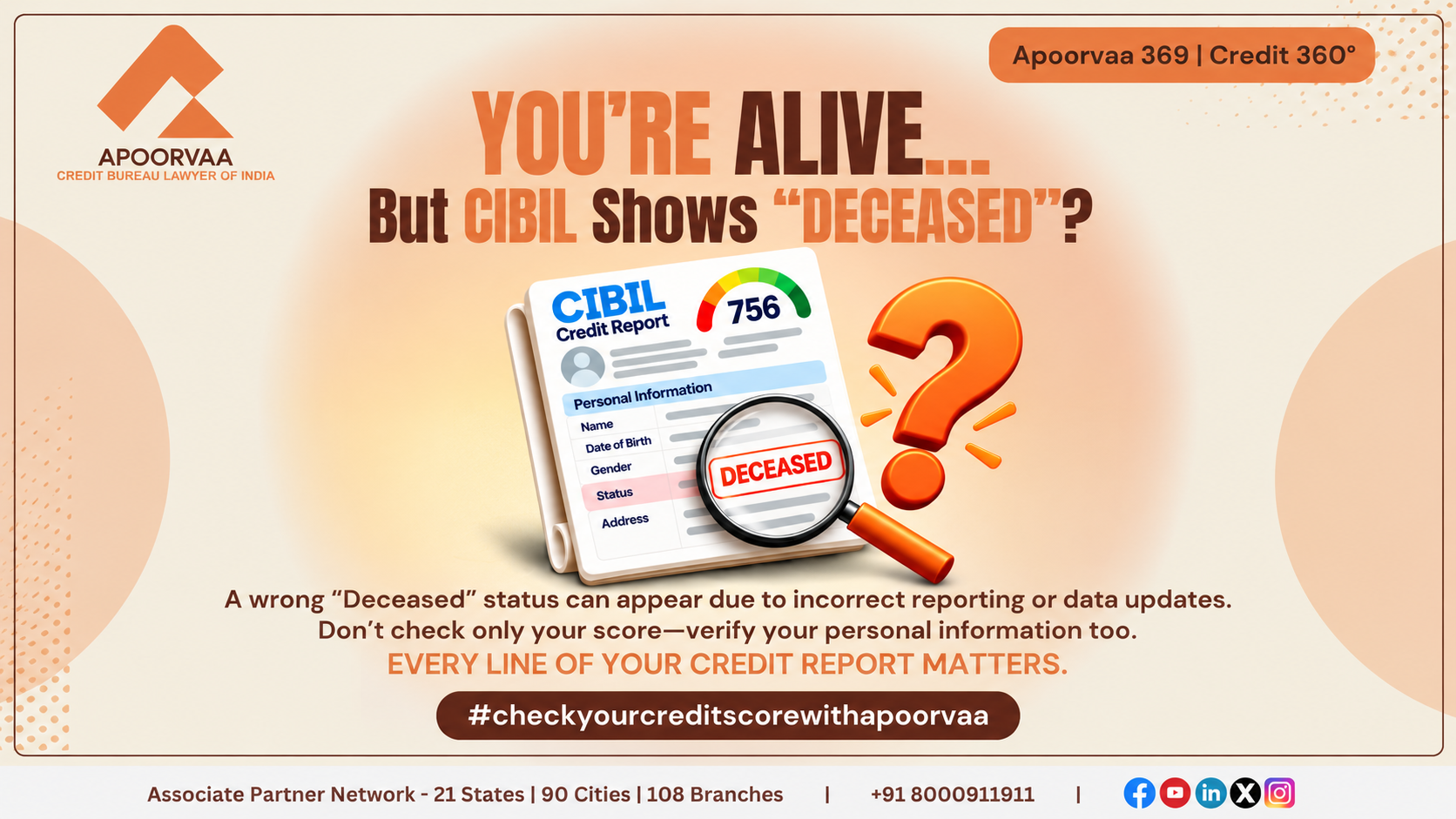
“What if you are alive, but your credit report shows you as deceased?”
It sounds unusual. It may even sound impossible.
But credit reports are data-driven records, and unusual inaccuracies can occur.
A customer of our recently shared an unusual situation involving a relative whose credit information reportedly reflected a “Deceased” status. According to the customer, even the bank manager was surprised when the information was noticed.
This example raises a much larger question about how consumers read their Credit Reports.
Most people open a CIBIL Report and immediately look for one number:
The CIBIL Score.
Others check whether there is an overdue amount, settlement, write-off or unfamiliar loan.
All of these are important.
But a Credit Report contains much more than a score.
It contains identifying information and detailed information about credit facilities. If any material information is inaccurate, the issue deserves attention—even when the CIBIL Score itself appears satisfactory.
And importantly, “Deceased” is not merely a dramatic word being used for this article. It exists within India’s prescribed consumer credit-reporting data framework.
1. Can “Deceased” Actually Be Reported in Credit Information?
Yes—but we need to describe this accurately.
The Uniform Credit Reporting Format (Consumer) forming part of the RBI’s Credit Information Reporting framework contains multiple data segments used for consumer credit reporting.
These include Name, ID, Telephone, Email, Address and account-related information.
Significantly for today’s issue, the prescribed format includes “Deceased” as an additional catalogue value under the Ownership Indicator.
This is an important technical distinction.
It would therefore be inaccurate to assume, without examining the actual report/data, that “Deceased” is necessarily a generic personal-information field displayed next to the consumer’s name.
Instead, the first step in any such case is to understand exactly where the deceased indication appears, against which reported credit facility or data element, and what information has actually been furnished.
That distinction is important for proper Credit Report analysis.
2. Why Is a Wrong “Deceased” Indication a Serious Data-Accuracy Concern?
If the consumer is alive, a deceased indication associated with that consumer’s credit information is obviously inconsistent with reality.
But the issue should not be sensationalised.
It would be inappropriate to claim that such an indication will automatically result in loan rejection or that every lender will treat it in exactly the same way.
The practical concern is simpler:
A lender reviewing a Credit Report may encounter credit information that is inconsistent with the consumer’s actual identity or status.
This may require verification or clarification during credit assessment.
RBI’s credit-information framework requires credit institutions to take necessary steps to ensure that the credit information furnished by them is up to date, accurate and complete.
Therefore, if a living consumer discovers a deceased indication in the credit information associated with them, the question is not merely:
“Is my score affected?”
The more fundamental question is:
“Does my Credit Report accurately represent me and my credit relationships?”
3. Why Checking Only Your CIBIL Score Is Not Enough
This is perhaps the most important lesson from this unusual case.
Suppose a consumer checks the CIBIL Report and sees:
CIBIL Score: 756
The consumer may conclude:
“My score looks fine. There is nothing else to check.”
That approach is incomplete.
A Credit Report contains information that helps establish who the consumer is and information concerning the consumer’s credit facilities.
TransUnion CIBIL itself advises consumers to verify that their personal information is accurate and to refer to the most recent version of their report. It also identifies incorrect personal information among errors that may be disputed.
Therefore, a consumer should not treat the score as a substitute for reading the report.
Think of it this way:
The score is one output. The Credit Report contains the underlying credit information that deserves examination.
A seemingly satisfactory score does not mean every field in the report is necessarily accurate.
4. What Other Personal Information Should You Review in Your Credit Report?
Consumers should review the identifying and contact information appearing in their Credit Reports, not merely their loan accounts.
The RBI’s Uniform Credit Reporting Format for consumers includes data categories such as:
- Consumer Name
- Date of Birth
- Gender
- Identification Type and Identification Number
- Telephone information
- Email ID
- Address information
The prescribed reporting format also contains extensive account-level information relating to credit facilities.
TransUnion CIBIL’s consumer guidance similarly identifies incorrect information such as name, phone number, PAN, email, employment information and address as examples of personal-information errors that consumers may encounter.
This means that when reviewing a Credit Report, the consumer should consider two broad questions.
First: Does this information actually identify me correctly?
Check whether the relevant personal and identification information corresponds to you.
Second: Does the credit information actually represent my credit relationships correctly?
Review the credit facilities, balances, repayment information, ownership information and other relevant account-level details.
This broader review becomes especially important when something unusual appears.
5. A “Deceased” Issue Is Different From Overdue, Settlement or Write-Off
A deceased indication should not be confused with conventional adverse credit information.
These are fundamentally different types of information.
An Amount Overdue relates to a reported unpaid amount.
A settlement relates to how a credit obligation has been resolved in circumstances different from ordinary full repayment.
A write-off concerns the treatment/status of a credit exposure and should not simply be interpreted as loan waiver.
Suit Filed is another account-related reporting element with its own meaning.
A deceased indication, by contrast, concerns the consumer/ownership information associated with credit reporting.
Therefore, discovering a wrong deceased indication should not automatically lead the consumer to ask:
“How do I increase my CIBIL Score?”
The first concern is data accuracy.
If the information is incorrect, the objective should be to establish what has been reported, identify the relevant source and have the inaccurate information appropriately investigated and corrected through the applicable framework.
6. Where Could Incorrect Information Come From?
This is where careful analysis becomes important.
If a consumer finds incorrect information in a Credit Report, it is tempting to immediately say:
“CIBIL made the mistake.”
Alternatively, the consumer may immediately blame the bank.
Neither conclusion should be made without examining the information.
Credit Information Companies maintain credit information based substantially on information furnished through the credit-reporting ecosystem by member credit institutions and other applicable reporting entities.
TransUnion CIBIL explains that when a consumer reports inaccurate data, CIBIL registers a dispute and works with the relevant bank or financial institution as part of its dispute-resolution process.
Therefore, where an incorrect deceased indication appears, the important questions include:
Which credit facility is associated with the indication?
Which credit institution furnished the relevant information?
What do the lender’s underlying records show?
Does the consumer’s documentary information support the requested correction?
Only after examining these facts should conclusions be drawn about the source of the discrepancy.
This is also why we should avoid speculating that a particular software problem, system migration, data-version change or technical glitch caused the error unless there is evidence supporting that explanation in the specific case.
7. Who Corrects Incorrect Information — The Bank or the Credit Bureau?
This question requires a more accurate answer than saying:
“CIBIL cannot do anything.”
The correction framework involves both the Credit Institution (CI) and the Credit Information Company (CIC).
A consumer can raise a dispute regarding inaccurate information appearing in a CIBIL Report. CIBIL’s current consumer guidance specifically allows consumers to initiate disputes concerning inaccuracies in the Personal Information section.
The CIC then has a role in processing the dispute under the applicable framework, while verification of information furnished by a credit institution may require that institution’s involvement.
TransUnion CIBIL explains that its dispute-resolution process includes reaching out to the respective bank or financial institution regarding disputed or inaccurate information.
RBI’s regulatory framework also places responsibilities on both Credit Institutions and Credit Information Companies regarding credit-information accuracy, customer service and rectification.
So the correct way to understand the process is:
The lender/data provider and the credit bureau have distinct but connected responsibilities.
The Credit Report should not be treated like an ordinary document where a consumer simply asks the bureau to rewrite a field without verification.
At the same time, it is inaccurate to say that the Credit Information Company has absolutely no role or power in the dispute and correction process.
8. Why Documentary Verification Matters in an Unusual Case
When information as fundamental as a deceased indication is disputed by a living consumer, proper identification and documentary verification become important.
TransUnion CIBIL’s consumer contact requirements refer to information such as:
- Name
- Date of Birth
- Gender
- Contact Number
- Identifier details such as PAN, Driving Licence or Voter ID
- Address
CIBIL also specifies identification documents for certain consumer-verification interactions.
The exact documents required in a particular dispute will depend on the nature of the information being questioned and the verification sought.
The important principle is this:
A credit-information correction should be based on verified facts and appropriate supporting records.
This becomes especially relevant when the issue is not a simple balance discrepancy but an unusual identity or ownership-related reporting inconsistency.
9. Why the Complete Credit Report Matters
A consumer may have no overdue amount.
The consumer may never have settled a loan.
There may be no write-off.
The CIBIL Score may even appear satisfactory.
And yet, another part of the Credit Report may contain information that deserves attention.
That is the larger lesson from today’s example.
Credit awareness should therefore move beyond:
“What is my CIBIL Score?”
Consumers should also ask:
“Is the information in my Credit Report actually accurate?”
RBI has long required access to a Free Full Credit Report, including the credit score, once each calendar year upon request and authentication for individuals whose credit history is available with a CIC. Importantly, RBI stated that the full report should give consumers an opportunity to identify and have errors in their credit history rectified.
That regulatory objective is significant.
A Credit Report is not merely a score-checking document.
It is a detailed credit-information record.
And when reviewing that record, every material line deserves attention.
10. What Should You Do If Your Credit Report Incorrectly Shows “Deceased”?
If you are alive but discover a “Deceased” indication associated with your credit information, the first response should not be panic.
It should be verification.
An unusual credit-report discrepancy needs to be understood before any correction is pursued.
The important questions are:
- Where exactly is the “Deceased” indication appearing?
- Which credit facility or reported information is associated with it?
- Which credit institution furnished the relevant information?
- Is the same information appearing elsewhere in the report?
- What do the underlying lender records and identification documents establish?
This distinction matters because the word “Deceased” should not automatically be treated as a conventional personal-information field next to the consumer’s name.
As discussed in Part 1, the RBI’s prescribed consumer credit-reporting format includes “Deceased” as an additional catalogue value under the Ownership Indicator.
Therefore, the actual report and underlying account information should be examined before determining what requires correction.
Credit Rectification should begin by identifying the inaccurate data—not by making assumptions about its source.
11. Check the Complete Credit Report, Not Just the Unusual Word
When consumers notice something as striking as “Deceased,” it can naturally become their only focus.
However, the complete report should still be reviewed.
For example, the consumer should verify whether the report contains accurate:
- Name and identifying information
- Date of birth
- PAN or other applicable identification information
- Address and contact information
- Credit accounts
- Account ownership information
- Current balances and overdue amounts
- Account status
- Repayment information
Why?
Because an unusual discrepancy may be isolated, or there may be other information requiring verification.
At the same time, the existence of one error does not establish that the entire Credit Report is incorrect.
Each reported item should be considered on its own facts.
This is why our approach to credit-report analysis should always be:
Don’t check only the score. Don’t check only one account. Understand the complete report.
12. Identify the Reporting Source Before Assigning Responsibility
Suppose a consumer discovers an incorrect deceased indication and immediately says:
“CIBIL has marked me as dead.”
That statement may oversimplify how the credit-information ecosystem works.
Credit Information Companies receive and process credit information furnished by credit institutions and other applicable reporting entities.
Where disputed information originates from information furnished by a particular credit institution, verification of the underlying records may require that institution’s involvement.
TransUnion CIBIL’s dispute-resolution guidance explains that when inaccurate data is disputed, it approaches the relevant credit institution for verification. CIBIL also provides mechanisms through which consumers can dispute inaccuracies appearing in their reports.
Therefore, the appropriate question is not simply:
“Who made the mistake?”
It is:
“What information is inaccurate, who furnished the relevant information, and what do the verified records establish?”
That distinction prevents consumers from incorrectly blaming either the bank or the bureau before the source has been established.
13. Who Corrects Incorrect Information — The Bank or the Credit Bureau?
Both the Credit Institution (CI) and the Credit Information Company (CIC) have roles within the credit-information correction framework.
But their roles are not identical.
Role of the Credit Institution
The credit institution maintains the underlying account records and furnishes credit information through the reporting framework.
Where disputed information relates to data furnished by that institution, verification against its records is important.
RBI’s framework places obligations on credit institutions regarding the accuracy, completeness and updating of credit information furnished to CICs.
Role of the Credit Information Company
The CIC maintains and processes credit information received through the reporting ecosystem and provides consumers with access to dispute-resolution mechanisms.
TransUnion CIBIL allows consumers to dispute inaccuracies in both personal and account information appearing in their Credit Reports.
Where verification from the concerned credit institution is necessary, the correction process involves communication with that institution.
Therefore, saying that “CIBIL has absolutely no power to edit, delete or alter anything” is too broad.
A more accurate explanation is:
A CIC cannot simply change lender-furnished credit information merely because a consumer requests it without following the applicable verification and dispute framework. The concerned credit institution and CIC have connected responsibilities in investigating and resolving disputed information.
That is an important distinction in professional Credit Report Rectification.
14. Why Supporting Documents Matter
When a living consumer disputes information indicating that they are deceased, identity verification naturally becomes important.
Depending on the nature of the discrepancy, appropriate documents may help establish matters such as:
- The consumer’s identity
- Date of birth
- PAN or other identification information
- Address
- Relevant credit account
- Relationship with the concerned lender
- Information inconsistent with the disputed reporting
The purpose of documentation is not simply to send as many papers as possible.
It is to establish the facts relevant to the disputed information.
For example, an error involving identification information may require different evidence from an error involving a loan balance or account status.
The documents should correspond to the information that actually requires verification.
This is also why unusual cases can benefit from a proper Credit Report assessment before rectification is pursued.
15. How Long Can Credit Information Rectification Take?
Consumers should not be promised an overnight correction.
RBI has established a framework for the delayed updation/rectification of credit information.
Under RBI’s 26 October 2023 framework, a complaint concerning inaccurate credit information is to be resolved within an overall period of 30 calendar days from the date of initial filing.
The framework apportions time between the Credit Institution and Credit Information Company: the CI gets 21 calendar days to send updated credit information to the CIC, leaving the CIC effectively nine days for resolution after receiving it. Where a qualifying complaint is not resolved within 30 calendar days, compensation of ₹100 per calendar day may become applicable, subject to the framework’s conditions.
This should be understood carefully.
₹100 Per Day Does Not Apply to Every Credit Report Issue
A consumer should not assume:
“There is an error in my CIBIL Report, so I will automatically receive ₹100 per day.”
The RBI compensation framework has eligibility conditions and exclusions.
The nature of the complaint, when it was filed, whether the information could be resolved within the framework and responsibility for the delay all matter.
Therefore, compensation should never be presented as an automatic benefit arising from every reporting discrepancy.
16. An Incorrect “Deceased” Indication Is Not the Same as Bad Credit History
This distinction deserves emphasis.
Suppose a consumer’s report contains an inaccurate deceased indication.
That does not automatically mean the consumer has:
- Failed to repay a loan
- Defaulted
- Settled an account
- Had an account written off
- Had a Suit Filed classification
- Accumulated an overdue amount
Those are different credit-reporting issues.
A deceased indication is a data-accuracy concern associated with the reported consumer/ownership information.
Adverse credit history, by contrast, concerns the consumer’s reported credit accounts and repayment behaviour.
The distinction matters because the objective of rectification should correspond to the actual error.
If an accurately reported overdue exists elsewhere in the report, correcting an unrelated inaccurate deceased indication does not make that overdue inaccurate.
Similarly, accurate historical repayment delays do not become removable merely because another part of the Credit Report contains an error.
Credit Rectification means correcting inaccurate information—not cleaning away accurate credit history.
17. Will Correcting “Deceased” Automatically Increase Your CIBIL Score?
Not necessarily.
Consumers sometimes assume that every Credit Report correction must increase their CIBIL Score.
That is not a safe assumption.
The purpose of correcting an inaccurate deceased indication is first and foremost to ensure that the consumer’s credit information is accurate.
Whether a particular correction affects the score depends on the nature of the information and the scoring methodology applicable to the consumer’s overall credit profile.
Therefore, no professional should promise:
“Once this is corrected, your score will definitely increase.”
Similarly, correction of inaccurate information does not guarantee future loan approval.
Banks and financial institutions make lending decisions using multiple factors, which may include credit information, income, existing obligations, repayment capacity, internal policies and product-specific eligibility requirements.
Accuracy is the objective. A guaranteed score increase or loan approval is not.
18. Why This Issue Matters Beyond One Unusual Case
The “Alive but Deceased” example is unusual.
But the lesson behind it is relevant to every consumer.
Many people check their Credit Report only when:
- Their loan application is rejected.
- Their CIBIL Score falls.
- They want a home loan or business loan.
- A bank asks for clarification.
- They discover an unfamiliar credit account.
Credit-report review should not necessarily begin only after a problem appears.
RBI requires CICs to provide individuals whose credit history is available with them access to one Free Full Credit Report, including the credit score, once in a calendar year upon request and authentication. One purpose identified by RBI is to give consumers an opportunity to identify and have errors in their credit history rectified.
That objective goes far beyond checking a three-digit number.
A complete Credit Report deserves attention because credit-data accuracy matters at multiple levels.
19. When Professional Credit Report Review May Be Appropriate
A straightforward typographical discrepancy may be easy for a consumer to recognise.
But unusual cases can involve questions that are not immediately obvious.
For example:
Where exactly is the disputed information appearing?
Is it personal information, ownership information or account-level information?
Which credit institution furnished it?
Is the same discrepancy appearing across multiple accounts or only one facility?
What documentary records establish the correct position?
Has the information already been disputed but remained unresolved?
These questions become especially relevant when a consumer encounters unusual or inconsistent reporting.
At Apoorvaa – Credit Bureau Lawyer of India, professional Credit Report review focuses on understanding the complete credit profile, identifying genuine reporting discrepancies and determining the nature of the Credit Rectification concern.
The purpose is not to promise deletion of every negative entry.
The purpose is to determine whether the information being reported accurately represents the consumer and the underlying credit relationship.
Frequently Asked Questions
1. Can a living person’s credit information actually show “Deceased”?
India’s prescribed consumer credit-reporting format includes “Deceased” as an additional catalogue value under the Ownership Indicator. If a living consumer encounters such an indication, the actual report and associated credit facility should be examined to determine exactly what has been reported.
2. Does “Deceased” necessarily appear as a personal-information status next to my name?
Not necessarily. It should not be described that way without examining the actual report. The prescribed reporting framework includes “Deceased” under the Ownership Indicator, making the precise location and context important.
3. Does a wrong deceased indication mean CIBIL made the mistake?
Not automatically. The source of the disputed information should be established before assigning responsibility.
4. Should I check personal information even if my CIBIL Score is good?
Yes. Consumers should review the complete Credit Report, including relevant identification, contact and account information, rather than relying only on the score.
5. Can incorrect personal information be disputed?
Yes. TransUnion CIBIL provides mechanisms for disputing inaccuracies in personal and account information.
6. Can CIBIL independently change whatever information I request?
Credit-information corrections operate through a verification and dispute framework involving the CIC and, where applicable, the concerned credit institution. A requested change is not automatically made simply because it has been requested.
7. Does correcting an inaccurate deceased indication guarantee a higher CIBIL Score?
No. The primary objective is accurate credit information. A particular correction does not guarantee a score increase.
8. Will correction guarantee that my next loan is approved?
No. Lending decisions depend on multiple factors and the concerned lender’s assessment.
9. Does one inaccurate field mean my entire Credit Report is wrong?
No. Each relevant field and credit account should be examined individually.
10. Should an incorrect deceased indication simply be deleted?
The objective should be to have inaccurate information appropriately investigated and corrected so that the credit information reflects the verified position. The precise correction depends on what was actually reported and the underlying records.
My Perspective
The unusual question behind today’s discussion is:
“What if you are alive, but your credit report shows you as deceased?”
The immediate reaction may be shock.
But as a credit-bureau lawyer, I see a larger lesson in this example.
Consumers have been conditioned to associate a Credit Report primarily with the CIBIL Score.
They ask:
“Is my score above 750?”
“Do I have any overdue?”
“Is there any settlement or write-off?”
Those are important questions.
But they are not the only questions.
A Credit Report is a detailed credit-information record.
Your identity information matters.
Your account ownership information matters.
Your balances matter.
Your account status matters.
Your repayment history matters.
And unusual information appearing anywhere in that record deserves to be understood in its correct context.
At the same time, consumers should not automatically blame the bank, the credit bureau or a technical system before identifying where the information originated.
First understand the report. Then identify the discrepancy. Then establish the correct information through appropriate records.
That is the foundation of meaningful Credit Rectification.
Final Takeaway
Alive but CIBIL Report Shows ‘Deceased’? What Should You Do?
Do not check your Credit Report only for the CIBIL Score.
Review your personal and identification information.
Review your credit accounts.
Review ownership and account-level information.
Review balances, overdue amounts, account status and repayment history.
And if something unusual appears, do not immediately assume its cause.
Identify what has actually been reported, establish the source and verify the correct position through appropriate documentation.
A wrong deceased indication is rare and unusual—but it demonstrates an important principle:
Every material line of your Credit Report matters.
Professional Credit Report Assessment & Rectification
Found unusual, inaccurate or inconsistent information in your Credit Report?
Apoorvaa provides professional Credit Report assessment and Credit Rectification services for individuals and businesses where credit information requires detailed account-level examination.
📞 8000 911 911
Apoorvaa – Credit Bureau Lawyer of India
Credit Rectification does not guarantee deletion of accurately reported information, an increase in the CIBIL Score or future loan approval.
Related Credit Education
- Loan Closed but CIBIL Shows Outstanding Balance? Here’s Why
- Unknown Loan in CIBIL Report: What If You Never Took That Loan?
- CIBIL Score 756 but Loan Rejected? Check All Four Credit Bureau Reports
About the Author
Advocate Apurva Bhagat is the Founder of Apoorvaa – Credit Bureau Lawyer of India. Through his articles and educational initiatives, he helps borrowers understand credit reports, banking practices, and informed financial decision-making. His objective is to promote financial awareness through practical and responsible guidance.

Comments are closed