




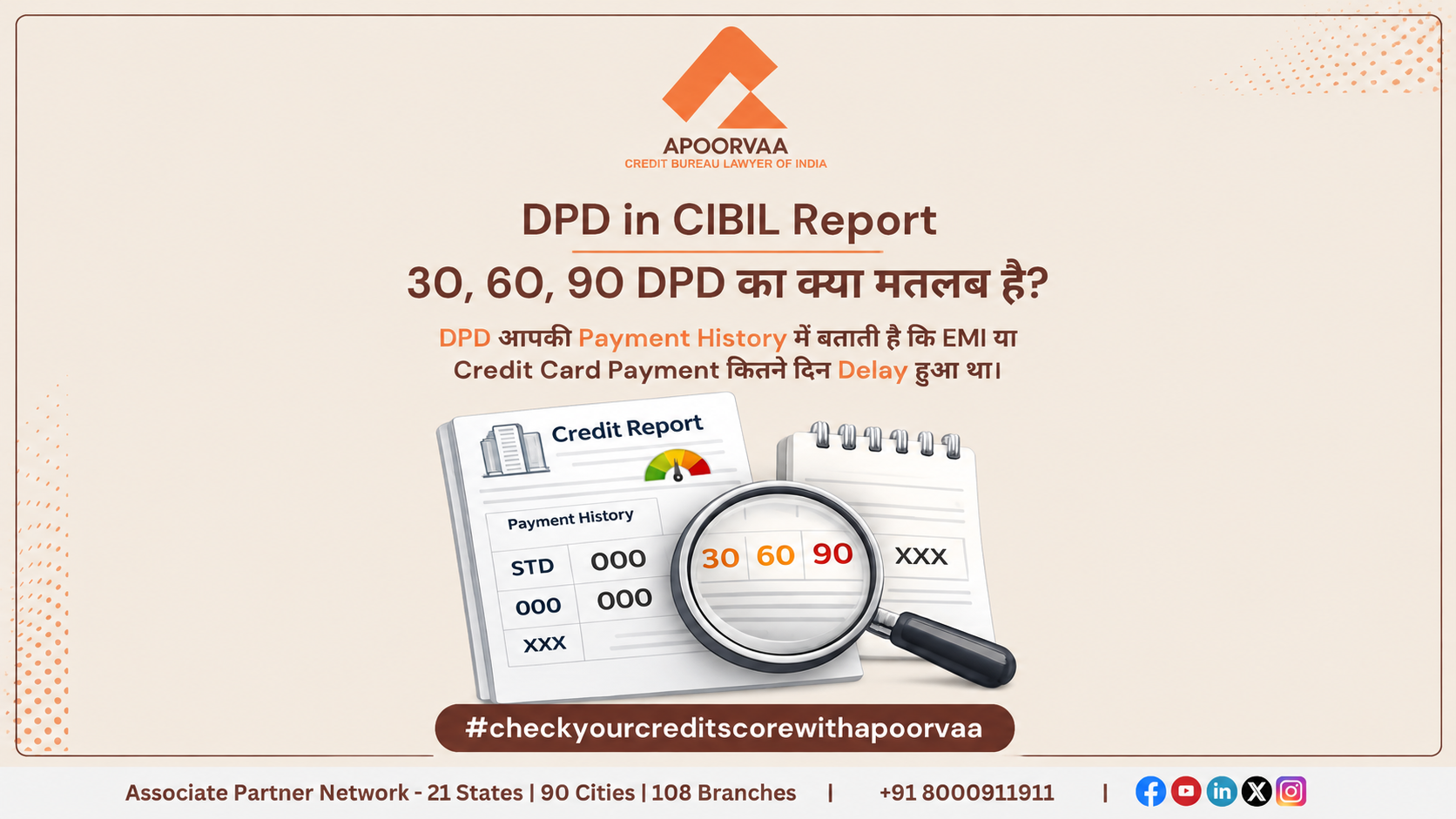
DPD in CIBIL Report is one of the most important sections borrowers should understand while reviewing their credit history. A report may contain entries such as 000, STD, XXX, 30, 60, 90, SMA, SUB, DBT or LSS against different reporting periods of a loan or credit-card account.
For someone unfamiliar with a credit report, these numbers and codes can immediately create concern.
Borrowers frequently ask:
“What does 90 DPD mean?”
“Why is an old payment delay still showing?”
“What does STD or XXX mean?”
“What if my report shows SMA, SUB, DBT or LSS?”
“Can DPD ever be rectified or removed from my CIBIL Report?”
These are important questions because the payment-history section provides information about how a particular credit account was reported during different periods.
However, every code does not mean the same thing, and an old payment delay should not automatically be viewed in the same manner as recent repayment stress.
Understanding these distinctions is essential before drawing conclusions about your credit profile.
What Is DPD in a CIBIL Report?
DPD stands for Days Past Due.
In simple terms, DPD indicates how many days a payment remained overdue for a particular credit facility during a reporting period.
Suppose you have a loan with a monthly EMI.
If the EMI was due but remained unpaid beyond the due date, the lender may report the delinquency through the applicable payment-history information.
For example:
- 30 DPD indicates that the payment was reported approximately 30 days past due.
- 60 DPD indicates a longer period of delinquency.
- 90 DPD represents an even longer overdue position.
- Other numerical DPD values may also appear depending on the reported payment history.
The important point is that DPD should always be read along with the account, month and year against which it appears.
A 90 DPD reported recently and a historical 90 DPD from many years ago do not necessarily present the same current credit-risk picture.
How to Read the Payment History in Your CIBIL Report
Borrowers often make the mistake of looking only at the CIBIL Score.
The score is important, but the detailed credit report provides the information behind the credit profile.
The payment-history section may contain numerical DPD values as well as different reporting or asset-classification codes.
Therefore, when analysing an account, you may encounter:
000 | STD | XXX | 30 | 60 | 90 | SMA | SUB | DBT | LSS
These entries should not all be interpreted in the same manner.
Let’s understand them individually.
What Does 000 Mean?
000 generally indicates that there were no days past due for the relevant reporting period.
In simple terms, the account was not reported as overdue for that particular period.
Borrowers normally do not need to treat 000 as a negative DPD entry.
What Does STD Mean?
STD stands for Standard.
It generally indicates that the account was classified as a standard asset for the relevant reporting period.
Some borrowers become worried when they see letters instead of 000 in their payment history.
However, STD itself should not automatically be treated as a delinquency.
What Does XXX Mean?
XXX generally indicates that payment-history information was not reported or was unavailable for that particular period.
This is another code that borrowers sometimes mistakenly interpret as a negative remark.
XXX should not automatically be read as a default or payment delay.
The surrounding account information should always be examined before reaching a conclusion.
What Do 30, 60 and 90 DPD Mean?
Numerical DPD values require closer attention.
If the payment history shows:
30 DPD
The account was reported as approximately 30 days past due for that reporting period.
60 DPD
The payment remained overdue for a longer period, reaching approximately 60 days past due.
90 DPD
The account was reported at approximately 90 days past due, indicating a more serious period of repayment delinquency.
You may also see other numerical values depending on how the particular account was reported.
The higher number itself is important, but it should never be examined without considering when the delinquency occurred and what happened to the account afterward.
What Does SMA Mean?
SMA stands for Special Mention Account.
This classification is used to identify accounts showing signs of repayment stress.
Under RBI’s framework for term loans, Special Mention Account categories are broadly linked to the period for which principal, interest or another amount remains overdue:
- SMA-0: up to 30 days
- SMA-1: more than 30 days and up to 60 days
- SMA-2: more than 60 days and up to 90 days
The precise regulatory treatment can depend on the type of credit facility and applicable framework, but for an ordinary borrower, seeing SMA means the concerned account deserves closer examination.
It should not simply be ignored as an unfamiliar code.
What Does SUB Mean?
SUB stands for Sub-Standard.
This represents a more serious asset classification.
Under RBI’s prudential asset-classification framework, an account that has become a non-performing asset can subsequently fall into the Sub-Standard category according to the applicable classification rules.
For a borrower reviewing a credit report, SUB therefore deserves considerably more attention than a normal STD entry.
The account history, outstanding position and subsequent resolution should all be examined.
What Does DBT Mean?
DBT stands for Doubtful.
A doubtful classification represents a further deterioration in the asset classification compared with a sub-standard account.
It indicates a significantly stressed credit facility under the applicable asset-classification framework.
If DBT appears in a credit report, the borrower should review the complete history of that account rather than concentrating only on the current CIBIL Score.
What Does LSS Mean?
LSS stands for Loss.
This is a serious asset classification.
A loss asset is one where the lender or relevant authority has identified the loss and the asset is considered substantially uncollectible, although some recovery value may still exist.
Therefore, LSS should never be interpreted like 000, STD or XXX.
It represents a materially different account history that requires proper understanding.
Numerical DPD and Asset Classification Are Not the Same Thing
This distinction is particularly important.
When a borrower sees 30, 60 or 90, the numbers indicate the reported number of Days Past Due.
Codes such as STD, SUB, DBT and LSS, on the other hand, relate to the reported classification/status of the asset or account.
SMA identifies repayment stress under the applicable special-mention framework.
Therefore, reading the payment history correctly requires more than simply searching for numerical DPD.
A proper credit-report analysis examines the entire reporting pattern.
Why DPD Matters During Loan Assessment
DPD provides lenders with information about a borrower’s repayment behaviour.
When considering a fresh loan application, a lender may evaluate the overall credit profile, including factors such as:
- Frequency of delayed payments.
- Severity of delinquency.
- How recently the delays occurred.
- Whether the concerned account remains unresolved.
- Subsequent repayment behaviour.
- Current outstanding liabilities.
- Other information appearing in the credit report.
Consider two borrowers.
One borrower had a 90-day delay several years ago, subsequently resolved the account and maintained regular repayment behaviour thereafter.
Another borrower has an active housing loan where the last three EMIs have recently been delayed and is now applying for an unsecured business loan.
Both may have DPD in their credit history.
But the two situations do not necessarily represent the same current lending risk.
Recency, severity, frequency and subsequent repayment behaviour matter when understanding DPD.
Can DPD Be Removed from a CIBIL Report?
This is perhaps the most important question.
The answer depends on whether the information is accurate or incorrect.
When the DPD is accurate
Suppose you genuinely delayed an EMI by 90 days during a particular month.
You later cleared the outstanding amount and obtained the appropriate closure or No Due documentation.
Clearing the liability can change the current position of the account as appropriately reported by the lender.
But it does not automatically mean that the genuine historical payment delay should become 000.
The historical payment behaviour and current account position are two different things.
When the DPD is incorrect
Now consider a different situation.
Your report shows 90 DPD, but your bank statement and payment records establish that the payment was made according to the agreed schedule.
That is not simply an old negative history that you want removed.
It may be a credit-reporting discrepancy.
In such a situation, the payment records should be examined, supporting documents collected, and the matter taken up through the appropriate lender and credit-information correction/dispute process.
This is the fundamental principle borrowers should understand:
Credit rectification is not about deleting genuine payment history. It is about identifying and addressing inaccurate, inconsistent or improperly reported credit information through the appropriate process.
Old DPD vs Recent DPD: Why the Difference Matters
A borrower may become worried after discovering an old 30, 60 or 90 DPD from many years ago.
But credit assessment should not be reduced to one historical number.
Banks and financial institutions have their own lending policies and risk-assessment criteria. An isolated historical delay followed by years of disciplined repayment behaviour presents a different profile from an account showing repeated recent payment problems.
Therefore, when analysing DPD, ask:
How old is it?
How serious was the delay?
Was it an isolated incident or repeated behaviour?
Was the underlying account subsequently resolved?
What does the recent payment history show?
These questions provide far more useful information than simply asking:
“How can I remove this DPD?”
How to Verify Whether DPD Is Correctly Reported
Before trying to rectify DPD in CIBIL Report, the first question should always be:
Is this DPD actually incorrect?
Suppose your report shows 60 DPD against a particular loan account. Do not immediately raise a dispute simply because the entry is affecting your credit profile.
First, identify:
- The concerned loan or credit-card account.
- Month and year of the reported DPD.
- EMI or payment due date.
- Actual payment date.
- Amount that was due.
- Amount actually paid.
- Whether any payment remained outstanding.
Then compare the credit report with available records such as bank statements, loan statements, payment receipts and lender correspondence.
If the records establish that the payment was genuinely delayed, the DPD may correctly represent historical repayment behaviour.
If the lender’s reporting does not match the actual payment records, however, there may be a legitimate credit-reporting discrepancy that requires rectification.
What If DPD Is Incorrectly Reported?
Incorrect DPD should not be ignored.
For example, imagine that your report shows 90 DPD, but your bank statement establishes that the EMI was paid according to schedule.
Or the report continues to show delinquency for a period where the lender’s own statement reflects a different position.
In such situations, collect all available supporting documents.
These may include:
- Bank statements.
- EMI payment receipts.
- Loan account statements.
- Credit-card statements.
- Email correspondence.
- Payment acknowledgements.
- Loan closure documents.
- No Due Certificate, where applicable.
- Any written communication from the lender.
The discrepancy should then be taken up with the concerned lender and, where appropriate, through the prescribed credit-information dispute/correction process.
The important point is that a dispute must be based on facts and supporting evidence.
A dispute mechanism is meant to address inaccurate information. It should not be treated as a tool for deleting genuine negative history.
What If the Account Shows SMA, SUB, DBT or LSS?
These entries require more detailed examination than simply asking whether a payment was 30 or 60 days late.
If your payment history contains SMA, SUB, DBT or LSS, examine:
- When the classification first appeared.
- What the account status was during that period.
- Whether the account had become overdue.
- Whether payments were subsequently made.
- How the lender currently reports the account.
- Whether the classification matches the lender’s records.
- Whether the account has since been closed or otherwise resolved.
Do not assume that making a payment today will automatically erase historical classifications.
Similarly, do not assume that every such classification is necessarily correct merely because it appears in the credit report.
Accuracy must be verified against the underlying account records.
Does Paying the Outstanding Amount Remove DPD?
This is one of the most common misconceptions surrounding credit rectification.
Suppose your loan showed:
30 → 60 → 90 DPD
and you later paid the outstanding amount.
Paying the genuine dues can resolve the outstanding liability and the lender should report the account’s subsequent/current position appropriately.
However, that does not automatically mean the earlier payment history becomes:
000 → 000 → 000
If you genuinely made those payments late, the historical DPD reflects what occurred during those reporting periods.
There is an important difference between:
Clearing an outstanding liability
and
Changing historical repayment behaviour.
Credit rectification should ensure that the information is accurate. It should not create a credit history that never existed.
Does a No Due Certificate Remove Historical DPD?
Not automatically.
A No Due Certificate can be an important document because it may establish that no amount remains payable to the lender as per the terms under which the certificate was issued.
But it does not necessarily mean that every previous DPD entry should disappear from the payment history.
For example, if a borrower genuinely delayed payments several years ago and subsequently cleared the account in full, both facts may form part of the broader credit history:
There was a historical payment delay, and the liability was subsequently resolved.
This distinction is particularly important when borrowers are told that obtaining a No Due Certificate will automatically convert their entire previous payment history into 000.
Can an Old DPD Cause Loan Rejection?
There is no responsible way to say that every old DPD will cause rejection or that an old DPD can never matter.
Banks and financial institutions have their own lending policies, underwriting standards and risk-assessment criteria.
Consider a borrower who had 90 DPD on a credit-card account many years ago but subsequently resolved the account and maintained disciplined repayment behaviour.
Now compare that person with someone whose active housing loan has shown repeated payment delays during the last three months and who is currently applying for an unsecured business loan.
The second situation presents a much more immediate question about current repayment behaviour.
This is why lenders may look beyond the existence of DPD and consider:
- Recency of the delinquency.
- Severity of the delay.
- Frequency of delayed payments.
- Account status.
- Subsequent repayment behaviour.
- Existing obligations.
- Overall credit profile.
- Current repayment capacity.
- Nature of the new credit being requested.
An old DPD therefore needs context, not panic.
Recent DPD Requires More Immediate Attention
If your active loan is currently showing repeated numerical DPD, the situation deserves immediate attention.
For example, if the last few EMIs on an existing loan have repeatedly bounced and you are simultaneously applying for another loan, a lender may consider that recent repayment behaviour during its assessment.
First understand why the payments are being delayed.
The reason could involve:
- Cash-flow problems.
- Insufficient bank balance.
- Auto-debit failure.
- A disputed amount.
- Incorrect lender reporting.
- Genuine financial difficulty.
Once the reason is known, the borrower can determine the appropriate response.
Ignoring recent delinquency while concentrating entirely on removing a much older DPD is usually the wrong priority.
Can You Improve Your Credit Profile Even If Old DPD Remains?
Yes, borrowers should distinguish between removing accurate history and improving their present credit behaviour.
Even where an accurate historical DPD remains part of the report, the borrower can focus on responsible credit management going forward.
Important practices include:
- Paying current EMIs on time.
- Paying credit-card dues responsibly.
- Avoiding repeated payment delays.
- Keeping genuine outstanding liabilities under control.
- Reviewing credit reports periodically.
- Correcting genuine reporting errors.
- Avoiding unnecessary credit enquiries.
- Maintaining documentation for resolved accounts.
A credit profile develops over time.
Therefore, consistent responsible repayment behaviour is generally more meaningful than searching for someone who promises to erase every old negative entry.
Don’t Fall for “DPD Removal” Guarantees
Borrowers should be particularly careful when someone promises:
“We can remove every DPD from your CIBIL Report.”
The correct question is:
Why is the DPD there?
If the DPD is factually incorrect, there may be a legitimate basis for rectification.
If it accurately records a genuine historical payment delay, simply wanting a cleaner report does not make that information incorrect.
Similarly, classifications such as SMA, SUB, DBT or LSS should be analysed using the account history and lender records rather than approached with a blanket promise of deletion.
Professional credit rectification begins with diagnosis, documentation and accuracy.
DPD Checklist: What Should You Check?
If your CIBIL Report contains DPD or asset-classification codes, review these points:
✔ Account: Which loan or credit card contains the entry?
✔ Period: Which month and year does it relate to?
✔ DPD: Does it show 30, 60, 90 or another numerical value?
✔ Classification: Does it show STD, SMA, SUB, DBT or LSS?
✔ Accuracy: Does the entry match your actual repayment records?
✔ Documents: Do you have statements and payment evidence?
✔ Account Status: Is the account active, closed, settled or otherwise reported?
✔ Recency: Is the problem recent or historical?
✔ Pattern: Was it a single delay or repeated delinquency?
✔ Current Position: Are your existing repayments now regular?
This type of complete analysis provides much more useful information than looking only at the three-digit CIBIL Score.
Frequently Asked Questions
What is DPD in a CIBIL Report?
DPD stands for Days Past Due. It indicates how many days a payment was overdue for a particular credit account during a reporting period.
What do 30, 60 and 90 mean in DPD?
They indicate increasing periods for which the payment was reported past due. The account, month, year and subsequent repayment history should also be considered when interpreting them.
What do SMA, SUB, DBT and LSS mean?
SMA means Special Mention Account, SUB means Sub-Standard, DBT means Doubtful and LSS means Loss. These codes provide information relating to the account’s classification/status and should be analysed differently from ordinary numerical DPD.
Can DPD be removed after payment?
Paying genuine outstanding dues can resolve the liability, but it does not automatically erase accurate historical DPD. If the reported DPD itself is inaccurate, the borrower can pursue correction through the appropriate process with supporting evidence.
Does a No Due Certificate remove old DPD?
Not automatically. A No Due Certificate may establish that the relevant dues have been resolved, but an accurate historical payment delay may still remain part of the reported payment history.
Can incorrect DPD be rectified?
Yes. If the payment history does not match the actual account records, supporting documents should be collected and the discrepancy taken up with the concerned lender and through the applicable credit-information correction/dispute process.
Will 90 DPD from many years ago automatically stop me from getting a loan?
Not necessarily. Lenders make credit decisions based on their policies and the applicant’s overall profile. The age and severity of the delinquency, subsequent repayment behaviour, current obligations and other factors may be considered.
Final Thoughts
When you see DPD in CIBIL Report, don’t immediately ask:
“How can I remove it?”
First ask:
“Is it correct, when did it occur, why did it occur, and what is the current position of that account?”
A numerical DPD such as 30, 60 or 90 tells one part of the repayment story. Codes such as SMA, SUB, DBT and LSS may reveal another important part of the account’s reported classification history.
An old, accurately reported payment delay cannot simply be treated as an error because it is inconvenient today. At the same time, borrowers should not accept genuinely incorrect DPD or classification information without examining the records and taking appropriate action.
Most importantly, an old DPD and an ongoing pattern of recent missed payments should not automatically be treated as the same credit situation.
The purpose of proper credit analysis is not to create an artificially perfect credit history.
It is to make sure your credit report accurately represents your financial history, rectify genuine reporting problems, resolve current credit issues and build stronger repayment behaviour going forward.
Need Professional Guidance?
DPD-related cases are not always as simple as seeing 30, 60 or 90 and deciding that the entry needs to be removed.
A complete credit report may contain numerical DPD, SMA, SUB, DBT, LSS, account-status information, outstanding balances and historical lender reporting. Understanding how these entries relate to each other is important before deciding whether credit rectification is actually required.
At Apoorvaa – Credit Bureau Lawyer of India, we work on Credit Rectification, Credit Report analysis and credit-related borrower guidance.
If your CIBIL Report contains an unexpected DPD, an old negative account, incorrect payment history or a classification that you do not understand, a professional review can help determine:
- What the entry actually means.
- Whether it matches the lender’s records.
- Whether there is a genuine outstanding issue.
- Whether the information appears inaccurate and requires rectification.
- What documentation may be required for the appropriate process.
Don’t try to remove a DPD simply because it looks negative. First understand whether it is accurate. Correct diagnosis is the foundation of proper Credit Rectification.
About the Author
Advocate Apurva Bhagat is the Founder of Apoorvaa – Credit Bureau Lawyer of India and works in the field of Credit Rectification, Credit Report analysis and credit-related borrower guidance.
Through his professional work and financial-awareness initiatives, he focuses on helping individuals and businesses understand complex credit-reporting issues, lender reporting, repayment history and the appropriate process for addressing genuine credit-report discrepancies.
His educational content is aimed at helping borrowers understand their credit information correctly and make informed decisions before taking action.

Comments are closed