



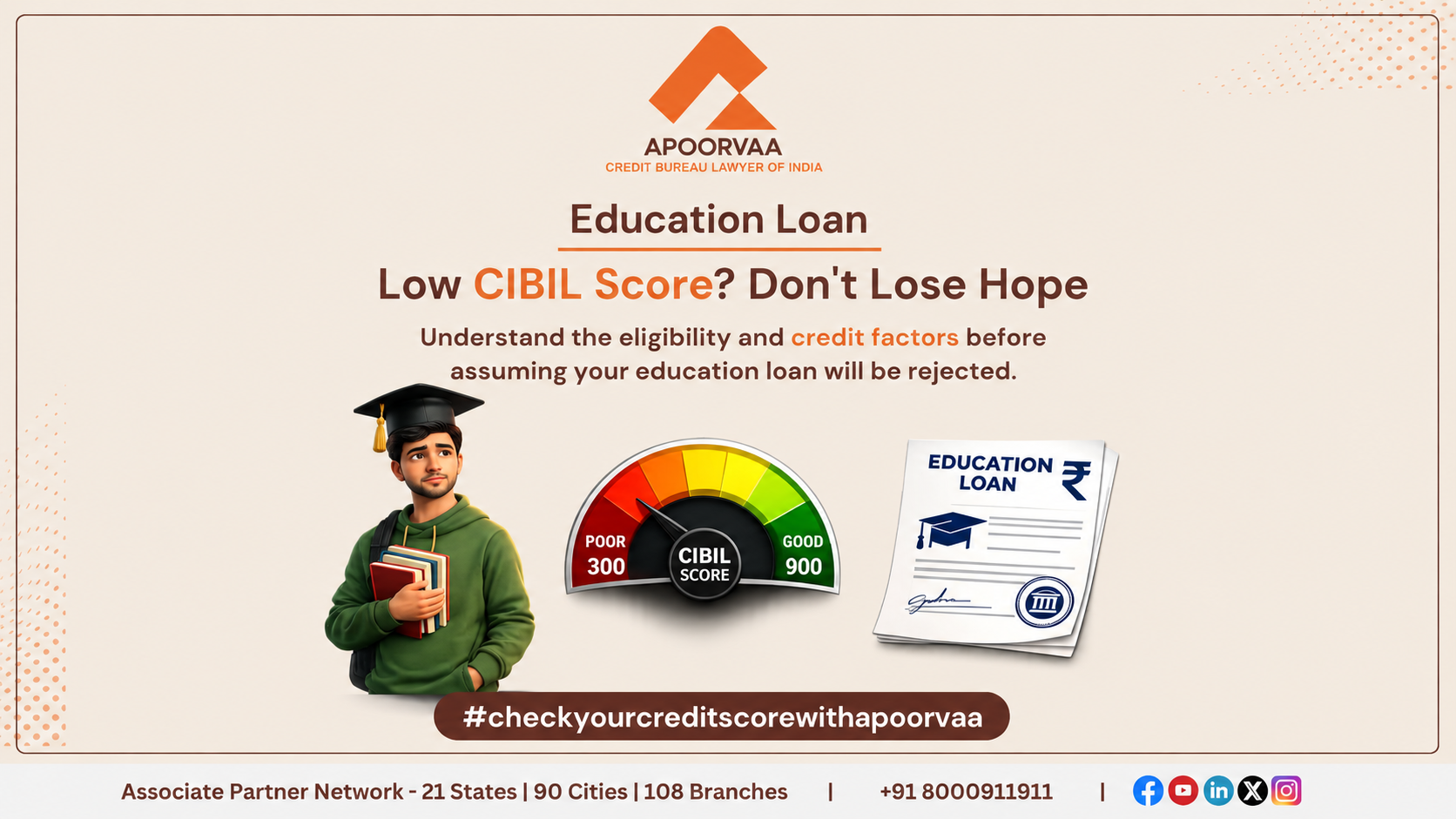
An Education Loan with Low CIBIL Score can become a serious concern for students and parents, particularly when college admission, fee payment or overseas education deadlines are approaching.
A negative entry in the credit report often creates an immediate fear:
“My CIBIL Score is low. Does this mean the bank will reject my education loan?”
The answer should not be reduced to a simple yes or no.
Education loans have a different purpose from ordinary consumer borrowing. They are intended to enable students to pursue higher education and build future earning capacity. In fact, Indian courts have previously examined situations where education-loan applications were rejected because the parent or co-borrower had an unsatisfactory credit score.
This is why a student or parent should not automatically conclude that a low CIBIL Score means the end of the education-loan journey.
At the same time, it is equally important to understand the applicable loan scheme, the student’s eligibility, the role of the co-borrower and the lender’s assessment process before drawing any conclusion.
Why Education Loans Need to Be Understood Differently
Consider the basic difference between an education loan and an ordinary personal loan.
When an employed person applies for a personal loan, the lender can evaluate the applicant’s existing income and present repayment capacity.
A student may not yet have a regular income.
The entire purpose of the education loan is to help the student complete higher education, acquire qualifications and eventually generate income through employment, professional practice or another career opportunity.
Therefore, evaluating an education loan only through the student’s current financial position would not tell the complete story.
The student’s:
- academic record,
- selected course,
- educational institution,
- cost of education,
- future prospects,
- loan requirement,
- applicable education-loan scheme,
- co-borrower structure,
may all become relevant to the assessment.
This is also why no credit history should not automatically be confused with bad credit history.
A 19- or 20-year-old student who has never taken a loan or used a credit card may naturally have little independent borrowing history.
The Important Principle Behind Education Lending
Education has long received special consideration within India’s lending framework.
The Kerala High Court’s 2022 decision involving education-loan applicants is particularly useful for understanding the reasoning behind this approach.
In that matter, State Bank of India had rejected education-loan applications because the co-applicants/co-borrowers did not meet the required CIBIL criteria. The Court considered the purpose of education lending and observed that, in the circumstances before it, repayment possibilities for an education loan were to be assessed with reference to the student’s projected future earnings rather than simply the financial position of the parents. It directed the applications to be reconsidered, disregarding the low credit scores of the co-obligants, if the students were otherwise eligible.
The judgment also discussed education as a priority-sector category and stressed that eligibility conditions for such lending should have a connection with the purpose the lending framework seeks to achieve.
For students and parents, the practical lesson is important:
Do not assume that one negative credit factor automatically tells the complete story of an education-loan application.
But Does This Mean CIBIL Score Can Never Matter?
This requires careful understanding.
The 2022 judgment should not be interpreted as a permanent nationwide rule that no bank can ever consider credit history in an education-loan application.
Credit appraisal can depend on the applicable loan scheme, lender policy, loan structure, borrower and co-borrower requirements, and other circumstances.
This distinction has become especially important because a Kerala High Court decision delivered in July 2026 took a different view and held, in the cases before it, that a bank could consider the credit score or credit report of a parent/co-borrower while considering an education-loan application. The Court allowed reconsideration where applicants could provide an eligible co-borrower with a satisfactory credit profile.
Therefore, neither of these statements should be treated as universally correct:
“Low CIBIL means you cannot get an education loan.”
or
“CIBIL has absolutely no relevance to any education loan.”
The correct approach is to understand the individual application and the applicable lending framework.
Student’s Credit Profile and Parent’s Credit Profile Are Not the Same Question
This distinction is frequently missed.
When someone says:
“Our CIBIL is low.”
the first question should be:
Whose credit report are we discussing?
Is it:
- the student’s?
- the father’s?
- the mother’s?
- the proposed co-borrower’s?
These are not necessarily identical situations.
A student with no borrowing history is very different from a co-borrower with an unresolved default, settled account or significant overdue amount.
Before assuming that the education loan cannot proceed, understand whose credit profile is creating the concern and why.
What If There Is a Genuine Negative Entry?
Suppose the relevant credit report contains an overdue loan, delayed payments, an incorrect outstanding balance or another negative observation.
Ignoring it is not the solution.
The borrower should first obtain and review the complete credit report.
Identify:
- Which account is creating the issue?
- Is the information correct?
- Is any amount genuinely outstanding?
- Has a payment already been made but not updated?
- Is documentation available?
- Does any information require correction?
If an actual payment obligation remains, understand it and communicate with the concerned lender.
If information is inaccurate, follow the appropriate correction or dispute process with supporting documentation.
The objective should be to resolve the underlying credit issue properly, not merely find a temporary way around it.
Don’t Panic and Apply Everywhere
Another mistake families make is submitting education-loan applications to several lenders immediately after facing difficulty with one bank.
This reaction can create unnecessary confusion.
Before making multiple applications, first understand why the original application faced difficulty.
Was the concern related to:
- credit history?
- co-borrower eligibility?
- documentation?
- course eligibility?
- institution eligibility?
- loan amount?
- another lending criterion?
Once the actual reason is known, the family can decide the appropriate next step instead of making repeated applications without addressing the underlying issue.
What Students and Parents Should Do Before Applying
An education loan is often linked to strict timelines. Admission confirmation, fee deadlines, visa applications, accommodation payments and travel arrangements can all depend on receiving finance at the right time.
Therefore, credit-related concerns should ideally be identified before the education-loan application becomes urgent.
Students and parents should consider the following steps before approaching a lender:
- Review the relevant credit reports in advance.
- Check whether any loan or credit-card account shows overdue payments.
- Verify whether previously closed accounts are correctly reported.
- Identify settled, written-off or disputed accounts.
- Keep repayment and closure documents ready.
- Understand who will be the co-borrower.
- Check the eligibility requirements of the particular education-loan scheme.
- Keep admission, course and fee-related documents organised.
Early preparation gives the family time to address genuine issues instead of discovering them when an admission deadline is only a few days away.
If the Credit Report Has a Problem, Find the Reason First
A low CIBIL Score is an outcome. It does not explain the entire problem.
The credit report does.
For example, suppose a parent’s credit report shows a low score. The reason could be an existing overdue, an old settlement, delayed repayment history, high outstanding credit, an incorrectly reported account or another credit-related issue.
Each situation requires a different approach.
Therefore, the first question should not be:
“How do we increase the CIBIL Score quickly?”
It should be:
“What exactly is affecting the credit profile?”
Once the underlying issue is identified, the borrower can determine what needs to be addressed with the concerned lender or credit institution.
This is particularly important when an education loan is involved because searching for shortcuts can consume valuable time without solving the actual problem.
Correct Genuine Credit Issues Through the Proper Process
If an amount is genuinely outstanding, understand the lender’s records and the repayment obligation before taking further action.
If the amount has already been paid but the credit report has not been updated correctly, preserve the payment evidence and communicate with the concerned lender.
Similarly, if an account or other information appears inaccurate, use the appropriate correction or dispute mechanism with proper supporting documents.
Documents such as payment receipts, loan closure letters, lender correspondence, account statements and No Dues Certificates, where applicable, can become important during this process.
The objective should not simply be to make the score look better before applying for an education loan.
The objective should be to make sure that the credit report accurately reflects the borrower’s actual credit position.
What If the Education Loan Is Declined?
A loan rejection can be stressful, especially when a student’s admission is already confirmed.
But a rejection should not automatically lead to panic or repeated applications.
First, try to understand the reason behind the lender’s decision.
If the concern relates to the student’s or co-borrower’s credit profile, determine exactly what the bank has considered.
If possible, obtain clarification in writing.
Then examine whether the issue can be addressed through:
- Correction of inaccurate credit information.
- Resolution of genuine outstanding dues.
- Submission of missing documentation.
- Compliance with the applicable education-loan scheme.
- An eligible alternative co-borrower, where permitted.
- Reconsideration or other remedies available in the circumstances.
The appropriate response depends entirely on why the application was declined.
This is also why a professional review can be useful in complicated cases. A credit-related rejection, documentation problem and eligibility problem are three different situations and should not be treated as though they require the same solution.
Don’t Try to Hide a Poor Credit History
When an education deadline is approaching, families sometimes become vulnerable to promises of quick credit solutions.
That is dangerous.
Creating alternative identities, manipulating personal information, hiding existing liabilities or using other questionable methods does not genuinely resolve a credit problem.
Credit rectification should always involve understanding the actual issue and following the lawful process available for resolving or correcting it.
A temporary workaround can create a much larger financial or legal problem later.
A Practical Education Loan Checklist
Before submitting an education-loan application, students and parents should check:
✔ Is the student’s admission confirmed?
✔ Have we understood the lender’s education-loan eligibility requirements?
✔ Who will be the borrower and co-borrower?
✔ Have we reviewed the relevant credit reports?
✔ Are there any genuine overdue or negative accounts?
✔ Are all closed accounts correctly reflected?
✔ Do we have supporting documents for previously resolved accounts?
✔ If there is incorrect information, have we started the appropriate correction process?
✔ Are academic, admission and fee documents complete?
✔ Have we understood the reason before making repeated applications?
Preparation cannot guarantee loan sanction because the final lending decision remains subject to the applicable scheme and lender assessment. However, it can prevent avoidable problems from becoming last-minute obstacles.
Frequently Asked Questions
Can I get an education loan with a low CIBIL Score?
A low CIBIL Score should not automatically be treated as the end of an education-loan application. The outcome depends on factors such as the applicable scheme, lender’s assessment, nature of the credit issue, student profile, co-borrower requirements and other eligibility conditions.
Does a student need a CIBIL Score for an education loan?
Many students have little or no previous borrowing history because they have never taken a loan or used credit independently. Absence of credit history should not automatically be equated with a poor repayment record.
Can the parent’s CIBIL Score affect an education loan?
It can become relevant where the parent is a co-borrower and the applicable lending framework permits the lender to assess the co-borrower’s creditworthiness. As discussed earlier, courts have examined this issue differently depending on the applicable scheme and circumstances.
What should I do if my parent’s credit report contains a negative entry?
First identify the account and understand whether the information is accurate. Genuine outstanding obligations and incorrectly reported information require different approaches. Do not try to increase the score without first understanding the underlying issue.
Should I apply to another bank immediately after rejection?
Not necessarily. First understand why the original application was declined. If the same underlying issue remains unresolved, approaching multiple lenders may not solve the problem.
Can credit rectification guarantee education-loan approval?
No. Credit rectification can help address genuine credit-report issues, but loan approval ultimately depends on the lender’s eligibility criteria, applicable scheme, credit assessment and other factors.
Final Thoughts
A student’s higher-education plan should not be abandoned merely because someone in the family sees a low CIBIL Score and assumes that an education loan is impossible.
At the same time, borrowers should not assume that credit history has no relevance whatsoever.
The correct approach lies between these two extremes.
Understand whose credit profile is creating the concern, why the score is low, what the credit report actually contains, what education-loan scheme is being considered, and what eligibility requirements apply.
The 2022 Kerala High Court decision discussed earlier demonstrated why education lending cannot always be viewed in exactly the same manner as ordinary consumer borrowing. At the same time, subsequent judicial developments reinforce the importance of examining the applicable scheme and individual facts rather than relying on a single universal rule.
For students and parents, the practical message remains straightforward:
A low CIBIL Score is a reason to investigate and understand the problem—not a reason to immediately give up on the education plan.
Need Professional Guidance?
Education-loan cases can become complicated when a student’s or co-borrower’s credit report contains overdue accounts, settlements, incorrect reporting, unresolved lender information or other negative observations.
Simply knowing that the CIBIL Score is low is not enough. The important step is identifying why it is low and whether the underlying issue can be legitimately resolved or corrected.
At Apoorvaa – Credit Bureau Lawyer of India, we work on credit rectification and credit-report-related matters. Our approach begins with analysing the credit report, identifying the actual problem and understanding the appropriate process for dealing with the concerned lender or credit institution.
If an education-loan application is being affected by a credit-report issue, professional analysis can help you distinguish between a genuine credit liability, a reporting error and an issue requiring a structured rectification process.
Don’t wait until an admission or fee deadline is approaching. Understanding the credit problem early gives you more time to take the appropriate action.
About the Author
Advocate Apurva Bhagat is the Founder of Apoorvaa – Credit Bureau Lawyer of India and works in the field of Credit Rectification, Credit Report analysis and credit-related borrower guidance.
Through his professional work and financial-awareness initiatives, he focuses on helping individuals and businesses understand credit-reporting issues, banking processes and lawful methods of addressing credit-related problems.
His educational content aims to simplify complex credit and banking matters so that borrowers can understand the consequences of financial decisions before taking action.

Comments are closed