




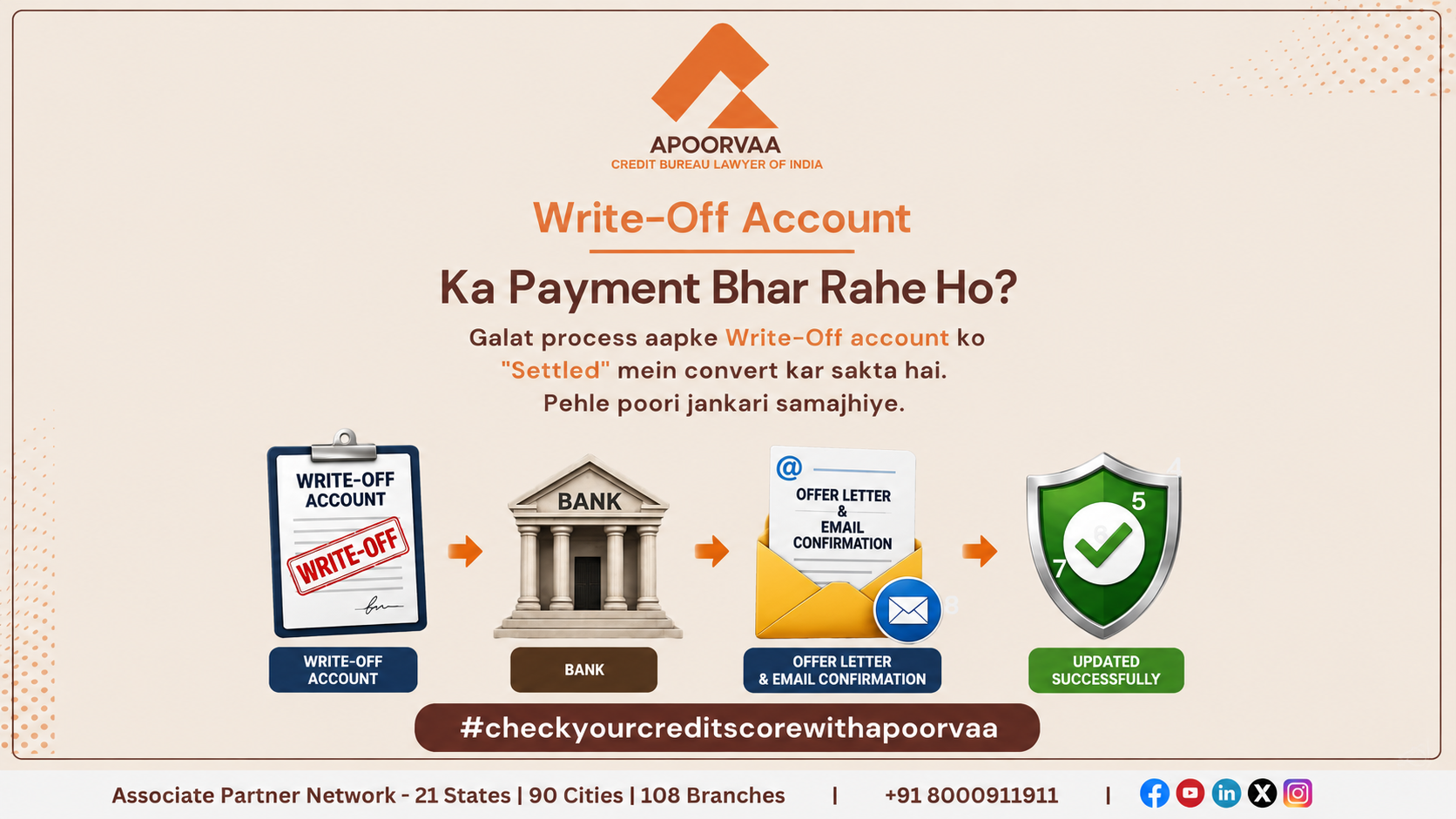
A Write-Off Account Payment is not as simple as paying the amount demanded by the bank. Many borrowers assume that once they make the payment, the write-off status will automatically disappear from their credit report. Unfortunately, that is not always how the process works.
One small misunderstanding during a Write-Off Account Payment can create unnecessary delays, repeated follow-ups, and further confusion later. Before paying any write-off account, it is important to understand the account status, communicate clearly with the bank, and obtain proper written confirmation regarding how the account will be updated.
A little preparation before making the payment can save significant time and help you avoid avoidable complications in the future.
What Does a Write-Off Status Mean?
When borrowers see the term “Write-Off” in their credit report, many immediately believe that the loan has been cancelled or that payment is no longer required.
That assumption is incorrect.
A write-off is an accounting classification used by the lender. It does not automatically mean that the borrower’s responsibility has ended.
If a write-off account still appears in your credit report and you intend to resolve it, the process should be handled carefully.
The objective should not simply be to make a payment.
The objective should be to understand how the account will be updated after the payment.
Never Visit the Bank Without Understanding Your Objective
Many borrowers visit their bank and simply ask,
“How much do I have to pay?”
That is the wrong starting point.
Instead, explain your objective clearly.
Inform the bank that:
- The account is showing as Write-Off in your credit report.
- You want to understand the available payment option.
- You want to know how the account will be updated after payment.
- You want proper written communication before making payment.
This discussion helps ensure that both you and the bank understand the purpose of the payment.
Explain That You Want the Correct Credit Report Update
One important mistake borrowers make is assuming that every payment produces the same result.
It does not.
When discussing a Write-Off Account Payment, clearly explain to the bank that your objective is not merely to deposit money.
Your objective is also to understand how the lender proposes to update the account after payment.
Discuss the matter openly before making any financial commitment.
Clear communication at this stage can prevent misunderstanding later.
Communicate Directly With the Bank
If the lending institution still operates, communicate directly with the bank whenever possible.
You may:
- Visit the branch personally.
- Send an email.
- Submit a written request.
- Maintain written communication throughout the process.
When contacting the bank, provide sufficient information to identify the account.
This may include:
- Loan account number or credit card number.
- Customer identification details.
- Basic KYC information, where required.
- Contact details.
- A copy of the relevant page of the credit report showing the write-off status, if appropriate.
Providing complete information allows the bank to understand your request more efficiently.
Written Communication Is Better Than Verbal Discussion
Many borrowers rely entirely on verbal conversations at the branch.
Later, when confusion arises, they discover that they have no documentary evidence of what was discussed.
Whenever possible, communicate through:
- Official email
- Written application
- Acknowledged letter
- Branch receipt
- Official response from the bank
Written communication protects both the borrower and the lender.
If clarification becomes necessary later, written records are far more useful than relying on memory.
Ask for an Offer Letter or Email Confirmation
Before making a Write-Off Account Payment, try to obtain written confirmation from the bank regarding the payment terms.
Depending on the bank’s process, this may be provided through:
- An offer letter
- Official email
- Written confirmation
- Other authorised communication
The document should clearly explain the payment terms and the amount expected from the borrower.
Obtaining confirmation before payment helps reduce uncertainty and creates a useful record for future reference.
Don’t Assume Every Amount Offered Produces the Same Result
Sometimes borrowers receive a discounted amount for resolving an old account.
Without fully understanding the terms, they make the payment believing that every issue has been permanently resolved.
Later, they discover that the account has been updated differently from what they expected.
The problem often arises because the borrower focused only on the payment amount and not on the complete understanding of the payment terms.
Before making any payment, always understand:
- What amount is being requested.
- Why that amount has been calculated.
- How the lender proposes to update the account.
- What documents will be issued after payment.
Understanding these points beforehand can prevent unnecessary confusion later.
Common Mistakes Borrowers Make During a Write-Off Account Payment
Many borrowers genuinely want to clear their old dues and improve their credit profile. However, during a Write-Off Account Payment, small mistakes can create unnecessary delays and confusion.
Some of the most common mistakes include:
1. Paying Without Understanding the Payment Terms
The borrower receives the payment amount and immediately deposits it without understanding what the payment represents.
Before making any payment, always understand:
- Why this amount has been calculated.
- Whether it represents the complete amount required under the agreed terms.
- What documents will be issued after payment.
- How the lender proposes to update the account.
A few extra questions before payment can prevent unnecessary follow-up later.
2. Relying Only on Verbal Conversations
Many borrowers visit the branch, receive verbal guidance from a staff member, make the payment, and leave without obtaining anything in writing.
Months later, when they try to verify what was agreed, they discover that there is no documentary evidence.
Whenever possible, communicate through:
- Official email
- Written application
- Acknowledged letter
- Official bank response
Written communication provides clarity and reduces future disputes.
3. Not Preserving Important Documents
Some borrowers make the payment but fail to preserve the documents connected with the transaction.
Always keep copies of:
- Offer letter (where issued)
- Email confirmation
- Payment receipt
- Bank transaction proof
- Acknowledged application
- Any communication received from the bank
Maintaining proper records can be extremely useful if clarification becomes necessary in the future.
Why Written Proof Is Important
One situation frequently seen is that a borrower completes the payment based on verbal discussions.
Later, when the expected update does not appear in the credit report, the borrower approaches the bank for clarification.
If there is no written communication, it becomes difficult to establish what was originally discussed or agreed.
This is why written communication is not merely a formality.
It protects both the borrower and the bank by creating a clear record of the process.
What Should You Do After Making a Write-Off Account Payment?
Making the payment is not the final step.
After the payment has been processed, continue to monitor the progress.
A practical approach includes:
Verify That the Payment Has Been Credited
Keep the payment receipt and bank transaction proof safely.
Preserve Every Communication
Maintain copies of:
- Emails
- Letters
- Offer letters
- Payment acknowledgements
- Receipts
Organising these documents can save considerable time if clarification is required later.
Review Your Updated Credit Report
After allowing reasonable time for the lender to update the records, obtain a fresh credit report.
Check whether the account information has been updated as expected.
If you notice any discrepancy, contact the lender with your supporting documents.
A Practical Checklist Before Making a Write-Off Account Payment
Before making any payment, ask yourself:
✅ Have I understood the current account status?
✅ Have I communicated directly with the bank?
✅ Have I explained that I want clarity regarding the account update?
✅ Have I requested written communication?
✅ Have I obtained an offer letter or email confirmation, wherever available?
✅ Do I understand the payment terms?
✅ Will I receive appropriate documentation after payment?
✅ Have I preserved copies of every important document?
Following this checklist can help reduce misunderstandings and unnecessary follow-up.
Final Thoughts
A Write-Off Account Payment should never be treated as a routine payment.
The objective is not simply to clear an outstanding amount. It is equally important to understand the payment terms, maintain written communication, preserve proper documentation, and know how the lender proposes to update the account.
A careful approach today can help avoid unnecessary confusion tomorrow.
Whenever you deal with an old write-off account, communicate clearly, obtain written confirmation wherever possible, and maintain complete records of every step.
Frequently Asked Questions
Can I simply pay the amount shown by the bank?
Before making payment, understand the payment terms, obtain written communication wherever possible, and clarify how the account will be updated.
Why should I communicate with the bank in writing?
Written communication creates a record of the discussion and helps avoid misunderstandings later.
Should I keep copies of payment documents?
Yes. Always preserve payment receipts, offer letters, email confirmations, and other important documents for future reference.
When should I check my credit report again?
After allowing sufficient time for the lender to update the account, obtain a fresh credit report and verify the updated information.
Why is documentation important?
Proper documentation provides evidence of communication and payment if any clarification becomes necessary in the future.
Planning a Write-Off Account Payment?
Before making any payment, understand the account status, communicate with the bank in writing wherever possible, obtain appropriate confirmation, and preserve every important document.
Taking these precautions can help you avoid unnecessary follow-ups and make better-informed financial decisions while resolving a write-off account.
About the Author
Advocate Apurva Bhagat is the Founder of Apoorvaa – Credit Bureau Lawyer of India. Through his articles and educational initiatives, he helps borrowers understand credit reports, banking practices, and informed financial decision-making. His objective is to promote financial awareness through practical and responsible guidance.

Suit Filed In CIBIL Report: What Does It Mean And Why Can It Still Show After Loan Repayment?
[…] Write-Off Account Payment: Avoid This Costly Mistake […]