




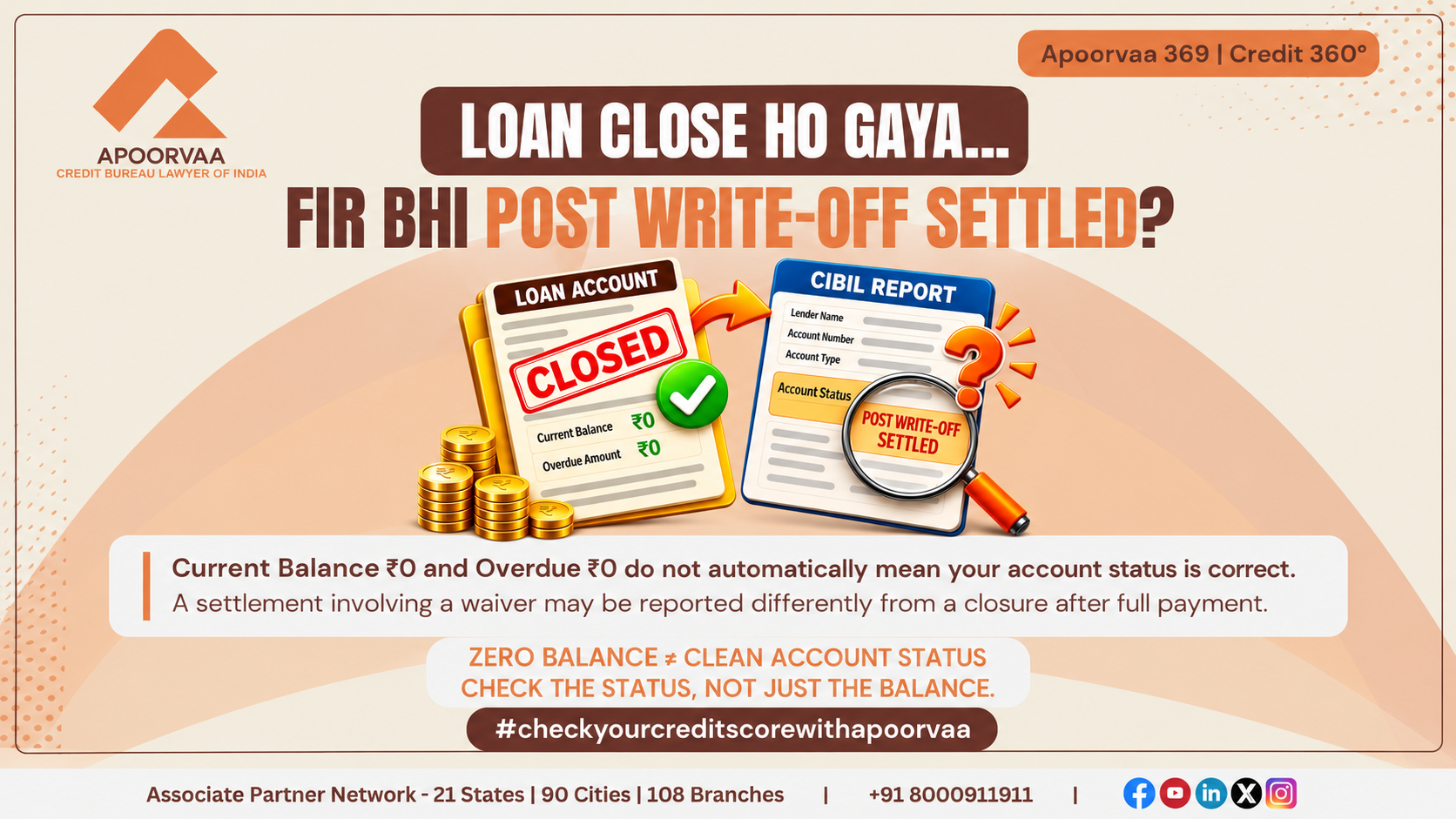
“My loan is closed and the outstanding balance is zero. Why does CIBIL still show Post Write-Off Settled?”
Imagine paying the amount agreed with your lender, receiving confirmation that no further payment is presently due, and then checking your CIBIL Report.
The account shows:
- Current Balance: ₹0
- Amount Overdue: ₹0
- Account Status: Post Write-Off Settled
Naturally, you may wonder why a settlement-related status remains when the balance is already zero.
Does it mean the bank has failed to update your payment? Does it indicate an incorrect Credit Report? Can the status be changed to Closed?
The answer depends on the account’s earlier history, the nature of the payment arrangement and the lender’s reporting records.
A zero balance and a Post Write-Off Settled status can coexist without necessarily being contradictory.
The balance describes the amount currently reported against the account. The status may describe how the account reached that position.
Understanding this distinction is essential before determining whether Credit Rectification is required.
1. What Does Post Write-Off Settled Mean in a CIBIL Report?
Post Write-Off Settled is a credit-reporting classification associated with an account that has undergone a write-off and subsequently been settled.
TransUnion CIBIL’s published guide to Credit Report terminology identifies Post (WO) Settled as one of the possible values within its written-off and settled status information.
The terminology matters because a loan can pass through different stages during its lifecycle.
For example, an account may experience repayment difficulties, be written off by the lender and subsequently become the subject of a negotiated settlement.
Following that arrangement, the lender may report the account with a zero Current Balance and zero Amount Overdue while retaining the relevant historical classification.
This does not necessarily mean the borrower still has an unpaid balance.
It means the account’s present balance and historical repayment classification are communicating different information.
However, whether Post Write-Off Settled is the correct classification for a particular account must be assessed against the actual write-off history, settlement terms and lender records.
2. Write-Off, Settlement and Post Write-Off Settled: Understanding the Sequence
These expressions are closely related but should not be treated as identical.
What Is a Loan Write-Off?
A write-off may arise when a lender recognises that a loan has become impaired and makes the relevant accounting treatment.
Importantly, an accounting write-off does not necessarily mean the borrower has been released from the underlying obligation.
The Reserve Bank of India’s Framework for Compromise Settlements and Technical Write-offs, dated 8 June 2023, explains that a technical write-off is an accounting action that does not itself involve waiving the lender’s claims against the borrower.
Therefore, the statement “The bank has written off my loan, so I no longer owe anything” is not automatically correct.
The legal and financial position depends on the actual circumstances and applicable documents.
What Is a Settlement?
A settlement may involve an arrangement under which the lender accepts an agreed payment to resolve its claims against the borrower.
In a compromise settlement, the lender may agree to sacrifice or waive part of the amount otherwise due.
For example, a borrower may negotiate a final payment that is lower than the amount claimed by the lender.
Once the agreed settlement is completed, the lender’s records may reflect no further amount due under that arrangement.
But this does not automatically mean the account must be classified as an ordinary loan closure in the Credit Report.
An agreed settlement and full repayment under the original loan terms are not necessarily the same event.
It is equally important not to confuse every routine interest adjustment, charge reversal or payment concession with a compromise settlement. The nature of the transaction must be established from the lender’s records and the applicable agreement.
What Is Post Write-Off Settled?
The Post Write-Off Settled classification concerns a settlement associated with an account that had undergone a write-off.
The important distinction is the account’s sequence of events.
A borrower may have completed the payment required under the settlement arrangement, resulting in a zero reported balance.
Nevertheless, the report may continue to reflect the historical write-off and settlement classification.
That classification should not be assumed to be incorrect solely because the payment has been completed.
3. Post Write-Off Settled vs Settled vs Closed: What Is the Difference?
These statuses can communicate materially different information about an account.
| Reported classification | Broad interpretation | Important consideration |
| Closed | The account is reported as closed | Closure alone does not explain every aspect of its earlier repayment history |
| Settled | The account was resolved through a settlement arrangement | The settlement terms and amount accepted by the lender matter |
| Post Write-Off Settled | The account was settled following a write-off | The earlier write-off and subsequent settlement are relevant to the classification |
This comparison is a general explanation, not a substitute for examining the actual Credit Report and lender records.
For instance, a borrower may use the everyday expression “my loan is closed” simply because the lender is no longer asking for payment.
But “no further payment due” and “reported with a normal Closed classification” are not necessarily equivalent.
A borrower who completed a compromise settlement after a write-off may have a zero outstanding balance while the account retains a settlement-related classification.
Conversely, if the lender’s records establish that the reported classification is inaccurate, that may raise a genuine correction issue.
The determining factor is not the borrower’s preferred wording. It is whether the reported information corresponds with the verified account history.
4. Why Does Post Write-Off Settled Show Even When the Balance Is Zero?
This is the central issue in today’s video.
Many borrowers concentrate on two fields:
Current Balance: ₹0
Amount Overdue: ₹0
Both are important. But neither field, considered alone, establishes the account’s complete repayment history.
The Current Balance describes the balance reported at the relevant date.
The Amount Overdue describes the amount reported as overdue.
The written-off or settled classification addresses a different aspect of the account.
Consider an illustrative sequence:
- A loan experiences repayment difficulties.
- The lender records a write-off.
- The borrower and lender subsequently enter into a settlement arrangement.
- The borrower completes the agreed settlement payment.
- The lender reports a zero balance while retaining the applicable Post Write-Off Settled classification.
In such circumstances, the zero balance and the historical classification may both be accurate.
Zero Balance does not automatically mean Clean Account Status.
At the same time, the presence of Post Write-Off Settled does not prove that every reported detail is correct.
The account history must support the classification.
That is why the actual repayment arrangement becomes so important.
5. What If I Paid the Full Amount but the Report Still Shows Post Write-Off Settled?
This is where the nature of the payment arrangement becomes particularly important.
Consider two different situations.
Situation A: The Borrower Completed a Compromise Settlement
Suppose the lender had written off the account and subsequently agreed to accept a negotiated amount in full and final settlement.
The borrower completed the agreed payment, and the lender updated the Current Balance and Amount Overdue to ₹0.
In this situation, the settlement-related classification may accurately reflect the account’s history.
The fact that the borrower paid everything required under the settlement agreement does not necessarily mean the borrower repaid the entire amount originally due under the loan.
Full payment of an agreed settlement amount is not always the same as full repayment without a compromise.
Situation B: The Borrower Claims to Have Repaid the Entire Amount Due
Now consider a borrower who states that they paid the entire amount due, including applicable interest and charges, without entering into a compromise settlement.
However, the Credit Report continues to reflect Post Write-Off Settled.
This situation requires a different examination.
Relevant records may include the lender’s account ledger, payment receipts, settlement correspondence, closure confirmation and the reporting classification.
An important question is whether the lender had previously written off the account and, if so, how the subsequent repayment was recorded.
Another question is whether the lender actually agreed to sacrifice any portion of its claim.
A routine reversal of an incorrectly charged fee, a contractual adjustment or another ordinary payment adjustment should not automatically be treated as a compromise settlement.
Equally, payment of the entire amount demanded in a final settlement letter does not, by itself, establish that no compromise occurred.
The actual account history—not merely the final payment receipt—determines whether the reported classification requires correction.
Even where full repayment is established, a historical write-off may remain relevant under applicable reporting requirements. Full payment does not automatically guarantee deletion of accurate historical information.
6. Can an Incorrect Post Write-Off Settled Status Be Corrected?
Yes. Where the reported information is established to be inaccurate, correction may be appropriate under the applicable credit-information framework.
However, there is an important distinction between an incorrect classification and an accurate but unfavourable classification.
If the lender’s verified records support a post-write-off settlement, the borrower cannot assume that the classification must be removed simply because the account now has a zero balance.
On the other hand, where the reporting does not accurately reflect the actual account history, the discrepancy may warrant investigation.
For example, questions may arise where:
- The lender’s records do not support the reported settlement classification.
- The report contains an incorrect Current Balance or Amount Overdue.
- The account’s closure or repayment information has not been accurately updated.
- Material information differs from the verified payment and account records.
Under the Credit Information Companies (Regulation) Act, 2005 and the applicable RBI directions, Credit Institutions and Credit Information Companies have responsibilities concerning credit-information accuracy and correction.
The concerned lender plays an important role because it furnishes the underlying account information.
TransUnion CIBIL provides a mechanism for consumers to dispute potentially inaccurate information, but the bureau generally requires verification from the reporting Credit Institution before modifying lender-furnished details.
Raising a dispute does not automatically establish that the reported status is wrong.
The objective is to determine whether the information accurately represents the verified account history.
7. Does Post Write-Off Settled Mean My Next Loan Will Be Rejected?
Not necessarily.
A settlement or write-off history may be relevant when a lender evaluates a new credit application.
However, lending decisions are not determined by a single Credit Report field in isolation.
A lender may also consider the applicant’s income, repayment capacity, existing obligations, credit history, requested loan amount, product type, security and its internal credit policy.
Consequently, it would be incorrect to claim that every application involving a Post Write-Off Settled account will be rejected.
It would be equally incorrect to assume that the status has no possible lending implications.
The classification may influence credit assessment, but it does not establish the outcome of every future loan application.
This is why understanding the accuracy of the complete Credit Report is important before applying for additional credit.
8. Why Professional Credit Report Examination Matters
The presence of Current Balance ₹0 and Amount Overdue ₹0 can give borrowers the impression that every aspect of the account has been resolved.
Financially, the reported balance may indeed be zero.
But the historical classification may communicate something different.
Professional examination helps distinguish between:
- An accurately reported post-write-off settlement.
- A completed compromise settlement with no present outstanding balance.
- A repayment arrangement that may have been incorrectly classified.
- An account containing inaccurate balance, overdue or closure information.
At Apoorvaa – Credit Bureau Lawyer of India, the focus is on understanding the actual credit relationship and identifying whether the reported information corresponds with the verified account position.
The objective of Credit Rectification is not to erase every unfavourable historical event.
It is to examine material discrepancies and pursue correction where the facts and applicable framework support it.
Frequently Asked Questions
1. My Current Balance and Amount Overdue are ₹0. Why does Post Write-Off Settled still appear?
Because the zero balance and the historical account classification communicate different information. A completed settlement following a write-off may result in a zero balance while retaining the relevant settlement classification.
2. Does Post Write-Off Settled mean I still owe money?
Not necessarily. The reported Current Balance and Amount Overdue should be examined separately from the historical status. The actual financial obligation also depends on the relevant lender records and settlement terms.
3. Is Post Write-Off Settled the same as Closed?
No. An ordinary Closed classification and a Post Write-Off Settled classification may reflect different repayment histories. The correct classification depends on the underlying account events.
4. If I paid the entire settlement amount, can the status automatically become Closed?
No. Completing a negotiated settlement does not automatically establish that the account should be reported as an ordinary closure.
5. What if I paid the full amount without receiving a settlement concession?
The payment and account records should be examined to determine whether the reported classification accurately reflects the account history. Full payment alone does not guarantee deletion of accurate historical write-off information.
6. Can CIBIL independently remove an accurate Post Write-Off Settled status?
A dispute is not a mechanism for automatically deleting accurate information. Lender-furnished information generally requires verification through the concerned Credit Institution before correction.
7. Will Post Write-Off Settled prevent me from obtaining another loan?
Not automatically. Lenders may consider the account history alongside other credit, financial and product-specific factors when evaluating an application.
My Perspective
In my experience, borrowers often concentrate on whether the outstanding amount has become zero.
That is understandable.
When a person completes a payment arrangement, they naturally expect the loan account to reflect that payment.
However, payment completion and historical credit reporting are two different considerations.
A lender may correctly report that no amount is presently outstanding while also reporting that the account was previously written off and subsequently settled.
The important question is whether that historical classification accurately represents what happened.
If a borrower entered into a genuine compromise settlement following a write-off, the account’s reporting should be understood in that context.
If the borrower disputes the classification and the records establish a different repayment history, the discrepancy deserves examination.
My perspective is simple:
Do not assume that a zero balance proves the entire account status is correct. Equally, do not assume that every settlement-related status is an error.
Credit Rectification should be based on verified facts and accurate reporting.
Final Takeaway
If your loan payment is complete but your CIBIL Report still shows Post Write-Off Settled, examine the distinction between the account’s present balance and its historical classification.
Remember:
Current Balance ₹0 does not automatically mean normal Closed status.
Amount Overdue ₹0 does not automatically erase an earlier write-off or settlement.
Full payment of a compromise settlement does not necessarily mean full repayment without a concession.
And most importantly:
An accurate historical classification should not be confused with an incorrect Credit Report entry.
Where the reported information does not correspond with the verified lender records, professional examination may help establish whether Credit Rectification is appropriate.
Professional Credit Report Assessment & Rectification
Have you completed your loan payment but your CIBIL Report still reflects Post Write-Off Settled?
Are you uncertain whether the reported classification accurately matches your repayment and closure records?
Apoorvaa provides professional Credit Report assessment and Credit Rectification services for individuals and businesses where account status, settlement history or other material credit information requires examination.
📞 8000 911 911
Apoorvaa – Credit Bureau Lawyer of India
Credit Rectification does not guarantee removal of accurately reported historical information, an increase in any credit score or approval of a future loan application.
Related Credit Education
- Loan ₹5 Lakh but CIBIL Shows ₹50 Lakh? Check Your Guarantor Status
- Loan Closed but CIBIL Shows Outstanding Balance? Here’s Why
- Loan Closed but CIBIL Shows Settled? Understand the Difference
About the Author
Advocate Apurva Bhagat is the Founder of Apoorvaa – Credit Bureau Lawyer of India. Through his articles and educational initiatives, he helps borrowers understand credit reports, banking practices, and informed financial decision-making. His objective is to promote financial awareness through practical and responsible guidance.

Comments are closed