



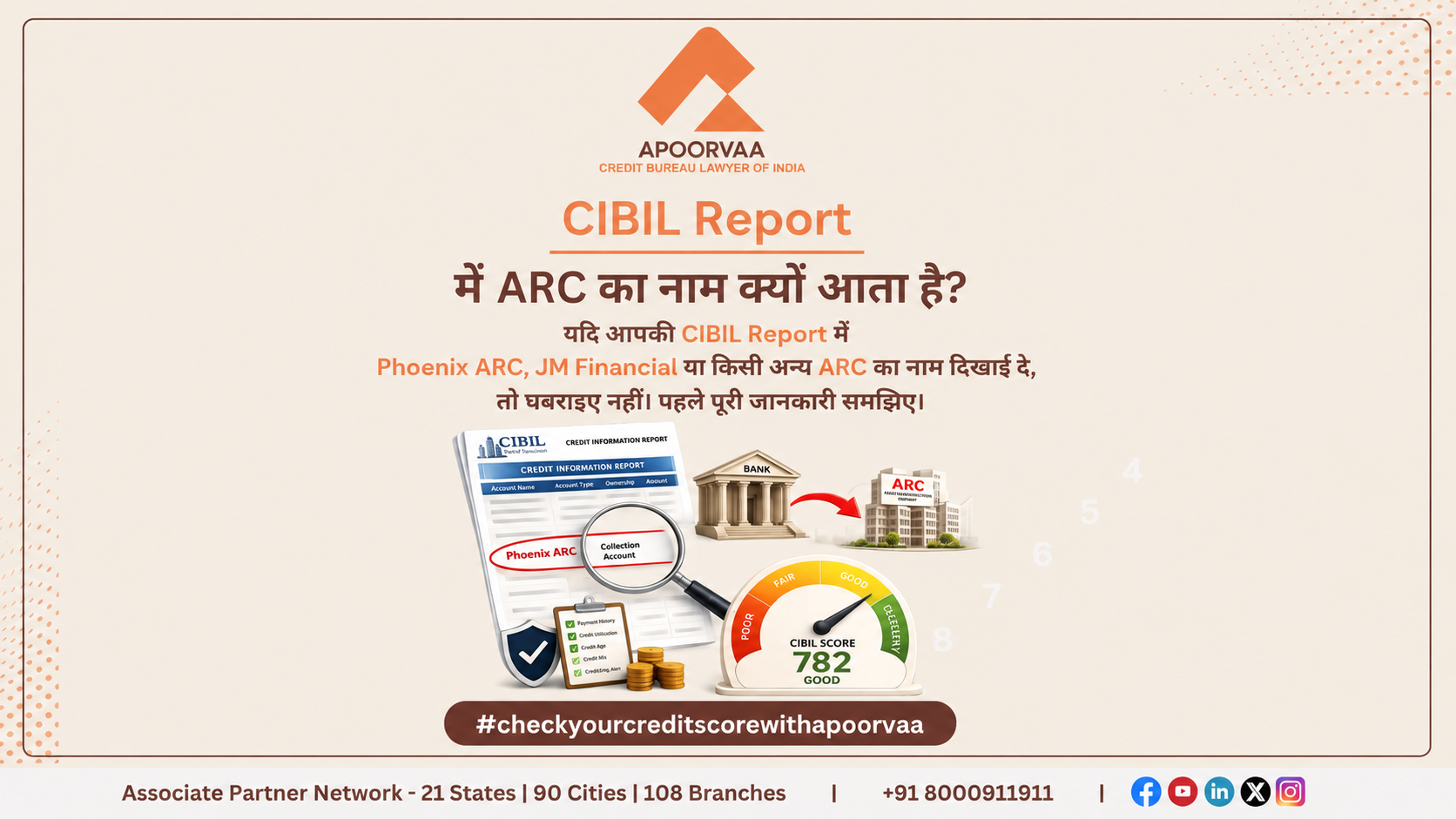
Many borrowers become worried when they notice an ARC in CIBIL Report and do not recognize the name. Instead of the bank from which they originally borrowed, the report may display names such as Phoenix ARC, JM Financial ARC, or another Asset Reconstruction Company (ARC).
The first reaction is usually:
- “Is this a mistake?”
- “Has someone changed my loan?”
- “Why is the original bank’s name missing?”
In many cases, the answer is much simpler than people imagine. Understanding why an ARC appears in your CIBIL Report can help you make informed financial decisions and avoid unnecessary confusion before making any payment.
What Is an Asset Reconstruction Company (ARC)?
An Asset Reconstruction Company (ARC) is a financial institution that acquires eligible loan accounts from banks and financial institutions in accordance with applicable laws and regulatory guidelines.
When a bank transfers a loan account to an ARC, the ARC may become responsible for managing the account, communicating with the borrower, recovering outstanding dues, and reporting account information to credit bureaus.
Because of this transfer, the name displayed in your CIBIL Report may change from the original lender to the ARC.
Therefore, seeing an ARC in CIBIL Report does not automatically mean that something is wrong. It often indicates that the loan ownership or recovery rights have been transferred.
Why Does an ARC Name Replace the Original Bank?
Many borrowers remember taking a loan from one bank but later find a completely different organisation listed in their CIBIL Report.
This usually happens because the original lender has transferred the loan account to an Asset Reconstruction Company.
For example, your report may now show:
- Phoenix ARC
- JM Financial ARC
- Another registered Asset Reconstruction Company
Although you never directly borrowed from these organisations, they may now manage the account after the transfer.
That is why an ARC in CIBIL Report should never surprise you without first understanding the complete history of the loan.
Should You Be Worried?
Not necessarily.
The presence of an ARC in CIBIL Report is not proof of fraud or an incorrect credit report.
However, you should never ignore it either.
Instead, verify why the ARC appears and confirm whether the transfer has taken place correctly.
Understanding the reason behind the entry is always better than making assumptions.
Verify Who Currently Owns the Loan
Before making any payment, confirm who currently has the legal authority to recover the outstanding amount.
Ask for written confirmation that clearly mentions:
- Original lender’s name
- Current loan owner
- Loan account number
- Outstanding amount
- Transfer details
- Contact information of the authorised institution
Official documentation provides clarity and helps you avoid future disputes.
Never rely only on telephone conversations or verbal assurances.
Never Make Payment Without Written Communication
Many borrowers receive recovery calls from people claiming to represent an ARC.
Do not transfer money simply because someone calls you.
Instead, request official communication before making any payment.
The document should clearly explain:
- Why the ARC is contacting you
- Whether the account has been transferred
- The amount payable
- The purpose of the payment
- The authorised bank account
- The documents you will receive after payment
Written communication protects both the borrower and the institution.
Understand the Difference Between Settlement and Full Closure
One of the biggest mistakes borrowers make is assuming that every payment permanently closes the loan.
That is not always true.
Before making payment, clearly understand whether the proposal is for a loan settlement or a full loan closure.
A loan settlement means the institution agrees to accept less than the total outstanding amount.
A full loan closure generally means the borrower pays the complete amount required to close the account.
Since these two outcomes can have different implications, never assume they are the same.
Always ask the institution to explain the payment terms in writing before you proceed.
Get Everything in Writing Before You Pay
Whether you plan to settle the loan or close it completely, never make a payment without obtaining proper written communication from the authorised institution.
The written communication should clearly mention:
- The total amount payable
- Whether the payment is for loan settlement or full loan closure
- The payment deadline
- The authorised bank account for payment
- The documents that will be issued after payment
- How the account will be updated with the credit bureau
Many borrowers make the mistake of trusting verbal assurances. If a dispute arises later, proving a phone conversation can be difficult. A written letter or email provides much stronger protection.
What Documents Should You Collect?
Once the payment is completed, preserve every important document related to the transaction.
Keep copies of:
- Offer Letter
- Settlement Letter (if applicable)
- Loan Closure Letter (if applicable)
- Payment Receipt
- Bank Transaction Proof
- No Dues Certificate (where issued)
- Email Communication
- Updated Loan Statement
These documents may become extremely valuable if your credit report is not updated correctly or if any future dispute arises.
Check Your CIBIL Report Again
Many borrowers believe that once payment is made, the matter is over.
Unfortunately, that is not always the case.
After allowing sufficient time for the institution to report the payment, download a fresh CIBIL Report and verify:
- Whether the outstanding amount has been updated
- Whether the account status reflects the written agreement
- Whether the lender’s details are accurate
- Whether any overdue amount is still being reported
- Whether duplicate reporting exists
If you notice any discrepancy, immediately contact the concerned institution with your supporting documents.
Common Mistakes Borrowers Make
Many credit reporting issues arise because borrowers make avoidable mistakes.
Some of the most common mistakes include:
- Making payment without verifying who currently owns the loan.
- Trusting only verbal commitments.
- Not understanding the difference between settlement and full closure.
- Failing to obtain written confirmation before payment.
- Losing important payment documents.
- Never checking the updated CIBIL Report after payment.
Avoiding these mistakes can save significant time, money, and stress in the future.
When Should You Seek Professional Guidance?
If you are uncertain about the ownership of the loan, the payment terms, or the information appearing in your CIBIL Report, it is advisable to obtain professional guidance before making any financial decision.
Independent verification can help you understand:
- Whether the ARC is legally entitled to recover the loan.
- Whether the payment proposal is appropriate.
- Whether the documents provided are sufficient.
- Whether the reporting terms are clearly explained.
Taking professional advice before payment is often simpler than resolving a complicated dispute later.
Final Thoughts
Seeing an ARC in CIBIL Report should not create panic, but it should encourage careful verification.
Before making any payment, always:
- Verify who currently owns the loan.
- Understand why the ARC appears in your CIBIL Report.
- Obtain written communication.
- Clearly understand whether the payment is for settlement or full closure.
- Preserve every important document.
- Review your updated CIBIL Report after the payment is reported.
An informed borrower makes better financial decisions. Taking a little extra time to verify the facts today can help prevent unnecessary credit-related problems in the future.
Frequently Asked Questions (FAQs)
Why is an ARC appearing in my CIBIL Report?
An ARC may appear because your loan has been transferred from the original lender to an Asset Reconstruction Company. This does not automatically indicate an error, but you should verify the details.
Does an ARC in CIBIL Report mean my loan has been sold?
In many cases, yes. The original lender may have transferred the loan or the recovery rights to an Asset Reconstruction Company. Always confirm the details through official communication.
Should I pay immediately if an ARC contacts me?
No. First verify the identity of the organisation, obtain written communication, and understand the purpose of the payment before transferring any money.
What is the difference between loan settlement and full closure?
A loan settlement generally involves paying less than the total outstanding amount, while a full closure generally involves paying the complete amount required to close the loan. Always ask the institution to specify this in writing.
Should I download my CIBIL Report after payment?
Yes. Download a fresh CIBIL Report after the payment has been processed to ensure the account information has been updated correctly.
Have you noticed an unfamiliar ARC in your CIBIL Report?
Before making any payment, verify the loan ownership, understand the payment terms, and obtain proper written documentation. Taking informed decisions today can help protect your financial future and avoid unnecessary disputes tomorrow.
About the Author
Advocate Apurva Bhagat is the Founder of Apoorvaa – Credit Bureau Lawyer of India. He regularly educates borrowers, business owners, and financial professionals on credit reports, banking practices, loan documentation, and credit rectification through articles, videos, and awareness initiatives.

Comments are closed