





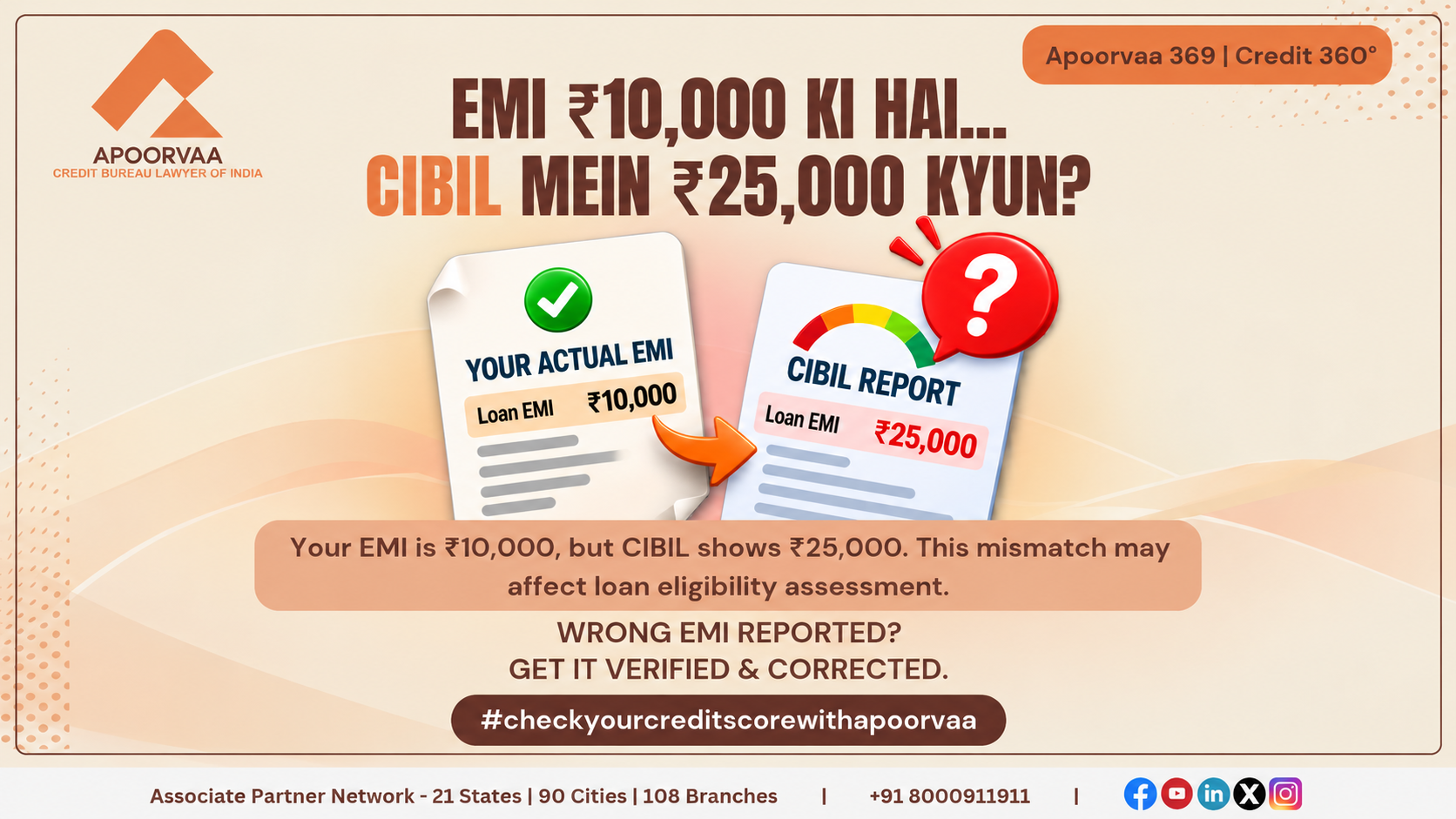
“My loan EMI is ₹10,000, but my CIBIL Report shows ₹25,000. Can this affect my loan eligibility?”
This is a practical credit-report concern that deserves attention.
A borrower may be paying a monthly Equated Monthly Instalment (EMI) of ₹10,000, while the EMI Amount field in their CIBIL Report reflects ₹25,000.
The immediate concern is whether a bank considering a new loan could treat the borrower as having a higher monthly repayment obligation than they actually have.
A Wrong EMI Amount in CIBIL Report may create questions during loan assessment, but it does not automatically establish loan rejection, reduced eligibility or a lower CIBIL Score.
The correct approach is to understand the reported field, verify the contractual EMI and determine whether the information requires correction by the concerned lender.
1. Why Is My EMI Amount Wrong in the CIBIL Report?
A CIBIL Report contains information about credit facilities reported by banks and other credit institutions.
Depending on the account and report format, its Account Information section may display an EMI Amount.
This field should not be confused with other loan information.
| Credit-report field | What it generally represents |
| EMI Amount | The reported instalment amount associated with the loan |
| Current Balance | The outstanding loan balance reported for the account |
| Amount Overdue | The amount reported as overdue, if any |
| Sanctioned Amount | The amount originally sanctioned under the credit facility |
| Repayment History | The reported pattern of payments over previous months |
These fields serve different purposes.
For example, an EMI of ₹10,000 does not mean the loan’s Current Balance is ₹10,000.
Similarly, an Amount Overdue entry is not necessarily the borrower’s regular monthly instalment.
Before concluding that an EMI is incorrectly reported, the relevant field and reporting date must be examined.
Who Is Responsible for the Reported EMI Information?
TransUnion CIBIL compiles credit information received from its member credit institutions.
The reporting lender is responsible for supplying accurate account information.
CIBIL does not independently decide the contractual EMI payable by the borrower.
Therefore, when a genuine EMI reporting discrepancy is identified, verification with the concerned lender is important.
2. ₹10,000 Actual EMI vs ₹25,000 Reported EMI: A Practical Example
Consider a borrower with an existing personal loan.
The latest repayment schedule confirms a monthly EMI of ₹10,000.
However, the borrower’s CIBIL Report displays an EMI Amount of ₹25,000 for that account.
<escape>Actual monthly EMI: ₹10,000</escape>
<escape>Reported EMI: ₹25,000</escape>
Difference: ₹15,000 per month
This difference is significant because the two amounts represent different monthly repayment obligations.
Suppose the borrower now applies for another loan.
If a lender relies on the higher reported figure without further verification, it could assess the borrower as having ₹15,000 more in monthly commitments than the actual contractual obligation.
Over twelve months, that represents a difference of ₹1,80,000 in the obligations being considered.
However, this is an illustrative calculation—not proof that the borrower owes an additional ₹1,80,000 or that the lender will calculate eligibility incorrectly.
The actual lending decision depends on the institution’s assessment and verification process.
3. Can an Incorrect EMI Affect Loan Eligibility?
Potentially, yes.
When evaluating a new loan application, lenders commonly consider the applicant’s existing financial commitments.
An EMI represents a recurring repayment obligation.
If an existing EMI is overstated in information reviewed during the assessment, it may create an inaccurate impression of the borrower’s available repayment capacity.
However, this does not mean every lender determines loan eligibility solely from the EMI Amount shown in a CIBIL Report.
A lender may review:
- Income and employment or business information.
- Bank statements showing actual EMI debits.
- Existing loan obligations.
- The latest repayment schedule or loan statement.
- Credit history and other relevant financial documents.
- Its own credit and underwriting policies.
A bank may identify the discrepancy and seek clarification rather than rely on the higher reported figure.
An incorrect EMI may influence an assessment if it is used without verification. It does not automatically cause rejection.
4. How Do Banks Assess Existing Monthly Loan Obligations?
Lenders may assess whether a borrower has sufficient income or cash flow to manage an additional EMI.
Depending on the lender and loan product, this assessment may involve the Fixed Obligation to Income Ratio (FOIR), Debt-to-Income Ratio (DTI) or other repayment-capacity measures.
Understanding the Possible Difference
Assume a salaried borrower has:
- Monthly income: ₹60,000
- Other monthly loan obligations: ₹5,000
- Actual EMI on the disputed account: ₹10,000
Their total existing monthly loan obligations would be ₹15,000.
But if the disputed EMI is treated as ₹25,000, the assessed obligations could become ₹30,000.
| Assessment | Using actual EMI | Using reported EMI |
| Monthly income | ₹60,000 | ₹60,000 |
| Other EMIs | ₹5,000 | ₹5,000 |
| EMI under review | ₹10,000 | ₹25,000 |
| Total monthly obligations | ₹15,000 | ₹30,000 |
| Illustrative obligation-to-income ratio | 25% | 50% |
This simplified example demonstrates why EMI accuracy may matter.
It does not represent a universal FOIR formula, a bank’s actual underwriting calculation or a specific loan-approval threshold.
A lender may calculate obligations differently and verify the amount through additional records.
Why Supporting Documents Matter
A bank statement showing a regular ₹10,000 debit may provide useful evidence of the amount currently being collected.
However, the debit alone may not establish the full contractual position.
The latest repayment schedule, loan statement and relevant lender records should also be considered, particularly where instalments have recently changed.
5. Can a Wrong EMI Amount Affect the CIBIL Score?
A wrong EMI amount in a CIBIL Report does not automatically mean the borrower’s CIBIL Score will decrease.
Credit scoring considers multiple aspects of reported credit behaviour. The precise treatment of individual data fields within TransUnion CIBIL’s scoring methodology is not publicly disclosed in full.
Therefore, it would be inaccurate to claim that an EMI mismatch of ₹15,000 necessarily reduces the score by a specific number of points.
It is important to distinguish two issues:
Loan eligibility: An overstated EMI may affect an assessment of monthly repayment capacity if a lender uses that figure without appropriate verification.
CIBIL Score: The presence of an incorrect EMI figure does not, by itself, establish a particular scoring impact.
Regardless of the score, inaccurate credit information deserves attention.
6. Why Might the Reported EMI Differ From the Actual EMI?
An EMI mismatch does not always mean that the lender originally reported incorrect information.
Several circumstances may explain the difference.
Interest-rate revision: A change in the applicable interest rate may result in a revised instalment or loan tenure, depending on the loan terms.
Loan restructuring: A formally revised repayment arrangement may change the contractual EMI.
Recent repayment-schedule change: The lender may have updated the instalment, while the credit report still reflects an earlier amount.
Reporting delay: Credit information may not yet reflect a recent account update.
Reporting error: The lender’s submitted information may contain an incorrect EMI amount.
These possibilities must be assessed against the latest contractual records and the reporting period.
7. What Documents Help Verify the Correct EMI?
The correct EMI should be established using reliable, current loan records.
Relevant documents may include:
- The latest repayment schedule.
- The current loan statement.
- The original sanction letter and any subsequent revision documents.
- Bank statements showing regular EMI debits.
- Relevant confirmation from the lending institution.
An original sanction letter may not reflect a later EMI revision.
Similarly, a bank debit of ₹10,000 should be considered alongside the contractual repayment schedule, rather than treated as conclusive evidence in isolation.
The objective is to identify the EMI applicable to the relevant reporting period.
8. When Does Incorrect EMI Reporting Require Rectification?
If the lender’s verified records establish that the contractual EMI was ₹10,000 for the relevant period, but the applicable CIBIL account entry incorrectly reflects ₹25,000, the discrepancy may require correction.
Under India’s credit-information framework, reporting credit institutions are responsible for the accuracy of information they furnish.
TransUnion CIBIL maintains credit information received from its member institutions; it does not independently determine or revise a borrower’s contractual instalment.
Accordingly, a genuine reporting error should be examined with the concerned lender and corrected through the applicable credit-information dispute process.
RBI’s framework generally provides an overall 30-calendar-day period for resolving eligible credit-information correction complaints. Compensation of ₹100 per calendar day may apply to eligible delays beyond that period, subject to the prescribed conditions and exclusions.
A correction request does not guarantee a score increase or a new loan approval.
9. Why Complete Credit-Report Analysis Matters
A borrower may focus on the CIBIL Score while overlooking inaccurate account-level information.
However, credit-report accuracy extends beyond the score.
EMI Amount, Current Balance, Amount Overdue, repayment history and other reported fields convey different information.
An inaccurate EMI should be evaluated in the context of the complete account record rather than treated as proof of broader credit-report errors.
Professional Credit Report analysis can help identify inconsistencies, assess their significance and determine whether appropriate Credit Rectification is required.
My Professional Perspective
When a borrower reports that the actual EMI is ₹10,000 but the CIBIL Report shows ₹25,000, my priority is not to predict whether the next loan will be rejected.
It is to establish the correct contractual EMI and determine whether the lender-reported information is accurate.
A credit report is an important financial document. Its accuracy matters even when a particular discrepancy has not demonstrably affected the score or a lending decision.
Accurate credit information should be the objective—not assumptions about score changes or guaranteed loan eligibility.
Final Takeaway
ACTUAL EMI ₹10,000 | REPORTED EMI ₹25,000
The ₹15,000 difference may matter when existing repayment obligations are assessed.
But it does not automatically establish loan rejection or a reduction in the CIBIL Score.
The appropriate response is to verify the current EMI against lender records and seek correction when the reported information is genuinely inaccurate.
Professional Credit Report Analysis — Apoorvaa
If your CIBIL Report contains an incorrect EMI amount or another account-level discrepancy, professional analysis can help you understand the reported information and identify concerns requiring verification.
Purchase your Credit Report and get it professionally analysed by Apoorvaa.
📞 8000 911 911
Related Credit Education
- Loan Closed but CIBIL Report Shows ‘Restructured’? What Does It Mean?
- Loan Closed but CIBIL Shows Outstanding Balance? Here’s Why
- Loan Is Yours but Lender Name Is Different in CIBIL Report? Here’s Why
About the Author
Advocate Apurva Bhagat is the Founder of Apoorvaa – Credit Bureau Lawyer of India. Through his articles and educational initiatives, he helps borrowers understand credit reports, banking practices, and informed financial decision-making. His objective is to promote financial awareness through practical and responsible guidance.

Comments are closed