




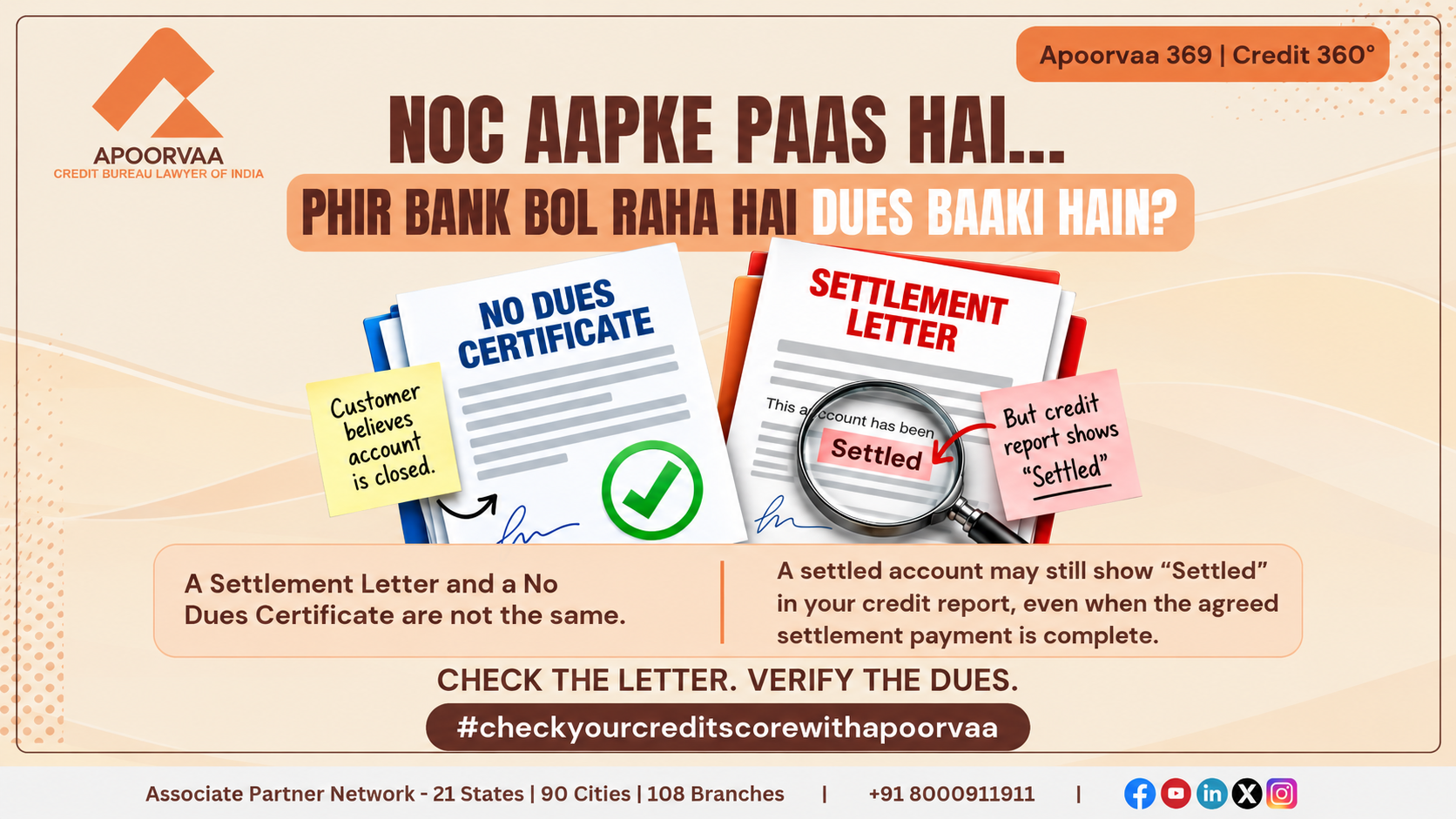
“I have an NOC, but CIBIL still shows Settled. Is the bank reporting incorrectly?”
This is a question I frequently encounter during discussions involving loan closure, settlement documentation and credit-reporting discrepancies.
A borrower approaches us with a bank letter and explains:
“Sir, I have already paid the agreed amount. The bank issued a letter. Why does my CIBIL Report still show Settled?”
Another borrower raises a different concern:
“The bank has confirmed that my account is closed, but now somebody is demanding an additional payment.”
At first glance, both situations appear to involve the same problem.
However, they raise three legally and factually distinct questions:
- What payment obligation, if any, remains under the loan or settlement arrangement?
- What exactly does the document issued by the lender confirm?
- What account status accurately represents the transaction in the Credit Report?
These questions must be examined separately.
A borrower may have no further amount payable under a valid completed settlement while the Credit Report continues to reflect a historical Settled classification.
Equally, a document described by the borrower as an NOC may actually be a conditional settlement offer that does not establish completion of the arrangement.
The correct interpretation depends on the documents, their conditions, payment records and the underlying loan history.
1. NOC vs Settlement Letter: What Is the Difference?
The expression NOC vs Settlement Letter is frequently misunderstood because borrowers often use the terms interchangeably.
However, a settlement offer, settlement-completion confirmation, No Objection Certificate and No Dues Certificate may serve different purposes.
A. Settlement Offer Letter
A settlement offer generally records a lender’s willingness to resolve an outstanding obligation on specified terms.
For example:
Original outstanding claimed: ₹2,00,000
Agreed settlement amount: ₹1,20,000
Payment deadline: 30 days
The lender may agree to accept ₹1,20,000 towards a full-and-final compromise, subject to the conditions stated in the offer.
But the offer itself does not necessarily establish that the settlement has been completed.
The borrower must examine whether the agreed amount was paid within the prescribed time and whether all applicable conditions were satisfied.
A conditional offer and a completed settlement are not identical.
B. Settlement-Completion Confirmation
Once the borrower has fulfilled the settlement terms, the lender may issue a letter confirming receipt of the agreed amount and completion of the arrangement.
Such a letter can provide important evidence of compliance with the settlement.
However, the exact wording matters.
Does the letter confirm full-and-final settlement of the lender’s claims?
Does it refer only to receipt of a particular payment?
Does it identify the relevant loan account?
Are any conditions or reservations recorded?
These details may determine what the document establishes.
C. No Objection Certificate (NOC)
An NOC generally communicates that the issuing institution has no objection in relation to the specific matter described in the document.
But the expression No Objection Certificate does not automatically establish every possible fact about the loan.
For example, an NOC may relate to closure formalities, release of security, removal of a charge or another specified purpose.
Its legal significance depends on its actual wording and context.
Therefore, the document title alone should not be treated as conclusive proof that every financial obligation has been discharged.
D. No Dues Certificate
A No Dues Certificate generally confirms that no amount remains payable in relation to the specified account or obligation, according to the terms and scope of the certificate.
This can be important documentary evidence when a lender subsequently reports an outstanding balance or raises a payment demand.
However, a No Dues Certificate does not automatically establish that the borrower repaid the original loan in full without any compromise.
A lender may confirm that no further amount remains payable following a valid full-and-final settlement.
In that situation, the account may have no remaining dues while its historical settlement classification remains relevant.
The central principle is that the contents of the document matter more than the name used by the borrower.
2. Does a Settlement Letter Mean the Loan Is Fully Closed?
Not necessarily.
The answer depends on whether the document is merely an offer or confirms a completed arrangement.
Consider two situations.
Situation A: Settlement Offered but Not Completed
A lender agrees to accept ₹90,000 against an outstanding claim of ₹1,50,000, provided payment is received by the specified deadline.
The borrower pays only ₹50,000.
The borrower then produces the original settlement offer and claims:
“I have a settlement letter, so nothing more is payable.”
That conclusion may be incorrect.
The borrower has not necessarily fulfilled the agreed settlement conditions.
The legal consequences would depend on the offer terms, payment history, any subsequent agreement and applicable law.
Situation B: Full-and-Final Settlement Completed
The lender agrees in writing to accept ₹90,000 in full-and-final settlement of the specified loan obligation.
The borrower pays ₹90,000 within the agreed period.
The lender acknowledges completion of the settlement.
In this situation, the lender’s ability to demand additional amounts must be examined against the settlement terms, the scope of the release, the lender’s records and applicable law.
The borrower should not automatically be told to repay the entire amount originally waived merely because the Credit Report continues to display Settled.
A completed compromise settlement may extinguish the lender’s specified claims to the extent agreed.
This is consistent with the distinction recognised in the Reserve Bank of India’s framework governing compromise settlements and technical write-offs.
RBI recognises compromise settlement as a negotiated arrangement intended to fully settle the lender’s claims, potentially involving a sacrifice or waiver of part of the amount due.
However, the framework also recognises that certain mutually agreed contractual provisions concerning future contingent recoveries may require separate consideration.
Therefore, the precise agreement remains critical.
3. Why Does CIBIL Show Settled Even When the Balance Is Zero?
This is the central credit-reporting issue.
Many borrowers assume:
“If I owe nothing today, my Credit Report must show Closed instead of Settled.”
That assumption is not necessarily correct.
Two separate pieces of information may exist within a Credit Report:
Current Outstanding Balance
and
Historical Account Classification
They answer different questions.
Current Outstanding Balance
This reflects the amount reported as outstanding for the account at the relevant reporting point.
Following a properly completed settlement, the reported current balance may be zero.
Settled Classification
The Settled classification can reflect that the account was resolved through a settlement arrangement rather than ordinary repayment of the full contractual obligation.
Therefore, an account may legitimately reflect:
| Credit-report field | Illustrative information |
| Account status | Settled |
| Current balance | ₹0 |
| Settlement amount | As reported, where applicable |
| Account closure | Reflected according to applicable reporting fields |
This combination is not automatically contradictory.
The zero balance addresses what remains outstanding.
The Settled classification may describe how the obligation was historically resolved.
A borrower should therefore not conclude that the reporting is inaccurate merely because both appear together.
Does Every Waiver Mean the Account Must Show Settled?
No.
Not every interest concession, fee reversal, penal-charge waiver or administrative adjustment necessarily constitutes a compromise settlement.
The character of the transaction matters.
For example, a lender reversing an incorrectly levied charge is not necessarily compromising the underlying loan obligation.
Similarly, a negotiated full-and-final settlement involving a genuine sacrifice of recoverable claims may have different reporting implications.
The correct classification must be established from the actual transaction and applicable reporting requirements—not merely from the word waiver.
4. Can a Bank Demand More Money After a Full-and-Final Settlement?
This is where legal interpretation becomes particularly important.
A borrower may say:
“The settlement is complete. Why is the bank asking for another ₹10,000?”
The answer cannot responsibly be determined without examining the underlying documents.
Several possibilities exist.
The Settlement Conditions Were Not Fully Satisfied
Perhaps the borrower paid after the deadline.
Perhaps an instalment was missed.
Perhaps the lender’s offer contained conditions that were not fulfilled.
In such circumstances, the lender may contend that the settlement did not become effective or was breached.
Whether that contention is legally sustainable depends on the actual agreement and subsequent conduct.
The Settlement Was Properly Completed
If the lender agreed to a valid full-and-final settlement, the borrower complied with its terms, and the relevant claims were discharged, an additional demand may be inconsistent with the settlement.
The lender cannot simply disregard the agreement without a legally sustainable basis.
However, the specific contractual terms and applicable law must be examined before reaching a conclusion.
The Demand Relates to a Different Obligation
Sometimes the amount being demanded relates to another account, a separate contractual obligation or a matter not covered by the original settlement.
That distinction must also be verified.
The Lender’s Records May Be Incorrect
An additional demand may arise because payment records, settlement completion or account information have not been accurately updated.
In such a situation, documentary reconciliation becomes important.
A payment demand is not automatically valid simply because the lender makes it.
Equally, the existence of a bank letter does not automatically invalidate every subsequent demand.
The legal position must be established from the evidence.
5. What If I Have a Genuine No Dues Certificate?
A genuine No Dues Certificate can be significant evidence.
Suppose a lender issues a certificate confirming that no dues remain outstanding against a specified loan account.
However, the borrower’s Credit Report continues to show an overdue or outstanding amount.
This raises a legitimate question:
Does the reported balance accurately reflect the lender’s own records and the account’s legal position?
The analysis should consider:
- The account identified in the certificate.
- The scope and conditions of the certificate.
- The date on which the certificate was issued.
- The payments made before its issuance.
- The account statement and closure records.
- The outstanding amount and reporting date appearing in the Credit Report.
If the lender’s records establish that no amount remains payable but an incorrect current outstanding balance continues to be reported, the information may require correction.
However, the No Dues Certificate does not necessarily establish that a historical Settled classification must also disappear.
This distinction is fundamental.
No Dues may establish that nothing further is payable.
Settled may accurately describe how the original obligation was resolved.
Both statements can be true.
6. Why Legal Closure and Credit-Report Classification Must Be Examined Separately
A loan account has a contractual history.
It also has a credit-reporting history.
These histories are connected, but they are not identical.
For example, a borrower may complete a valid compromise settlement and obtain confirmation that no further amount remains payable.
That establishes an important position regarding the underlying obligation.
However, the credit-information system may still accurately preserve the fact that the loan was resolved through a settlement.
The purpose of credit reporting is not limited to recording whether money remains payable today.
It also communicates relevant aspects of the account’s credit history.
Consequently:
Loan Obligation Discharged ≠ Historical Settlement Never Occurred
This is why the correct professional approach is not to demand that every Settled account be converted into Closed.
Instead, the question should be:
Does the reported account status accurately reflect the documented transaction and applicable credit-reporting requirements?
Where the answer is yes, the historical information should not be represented as automatically removable.
Where the answer is no, the discrepancy may require investigation and rectification.
7. What Does RBI’s Framework Tell Us About Compromise Settlements?
The Reserve Bank of India’s Framework for Compromise Settlements and Technical Write-offs provides an important regulatory foundation for understanding compromise settlements.
The framework recognises that regulated lenders may enter into negotiated arrangements to settle claims against borrowers.
Such arrangements may involve the lender accepting less than the total amount originally due.
The framework also distinguishes a compromise settlement from a technical write-off.
A technical write-off is an accounting treatment that does not, by itself, waive the lender’s claim against the borrower.
This distinction is important because consumers sometimes confuse:
Settlement
Write-off
Loan Closure
No Dues
and
Credit-Report Status
These expressions do not necessarily describe the same legal or financial event.
The existence of an RBI-recognised settlement framework does not mean that every settlement must be reported as an ordinary fully repaid loan.
Nor does it mean that every payment concession automatically constitutes a compromise settlement.
The actual transaction, governing agreement and reporting requirements remain decisive.
8. Why the Borrower’s Document and CIBIL Report May Tell Different Parts of the Same Story
Consider this example.
A borrower originally owed ₹3,00,000.
Following financial difficulties, the lender agreed to accept ₹1,90,000 as full-and-final settlement.
The borrower paid the agreed amount and received written confirmation that the settlement was completed.
Later, the Credit Report showed:
Current Balance: ₹0
Account Status: Settled
The borrower complains:
“My letter says the matter is closed. Why is CIBIL showing Settled?”
There may be no contradiction.
The settlement confirmation may establish that the lender’s specified financial claim has been resolved.
The Credit Report may accurately describe the historical method through which the obligation was resolved.
Now consider a different situation.
The borrower pays the full contractual dues without any compromise.
The lender issues a genuine No Dues Certificate confirming ordinary closure.
However, the Credit Report displays Settled.
In that situation, the classification may require investigation because the reported status could be inconsistent with the actual transaction.
The distinction cannot be resolved merely by looking at the document title.
It requires examining what happened financially and what the lender reported.
9. Does Paying the Waived Amount Automatically Remove Settled Status?
This is one of the most important questions borrowers ask after completing a loan settlement.
A borrower may say:
“Sir, my loan was settled for ₹80,000 against an outstanding amount of ₹1,20,000. If I now pay the remaining ₹40,000, will CIBIL remove the Settled status?”
The answer is:
Not automatically.
A payment made after settlement does not, by itself, guarantee that the lender will change the historical account classification from Settled to Closed.
Three matters must be examined.
A. What Did the Original Settlement Agreement Provide?
The original agreement may have established that the lender accepted a reduced amount in full-and-final settlement.
Once the borrower has fulfilled those terms, the legal status of the original obligation must be interpreted according to that agreement.
The amount previously waived should not automatically be treated as an existing enforceable debt merely because the borrower wants to improve the Credit Report.
B. What Is the Purpose of the Additional Payment?
An additional payment may be proposed in connection with a fresh arrangement, reconciliation of an outstanding obligation or another documented understanding with the lender.
Before any payment is made, its purpose and consequences should be clear.
A borrower should not assume that paying an amount described as a historical waiver will necessarily reverse the original settlement classification.
C. What Will the Lender Actually Report?
Credit Information Companies receive account information from reporting credit institutions.
Any subsequent reporting change must accurately reflect the lender’s records, the underlying transaction and applicable reporting requirements.
Therefore, the borrower should distinguish between:
Payment Acceptance
Account Reconciliation
Modification of Settlement Terms
Credit-Report Status Correction
These are related but separate matters.
A lender accepting an additional payment does not automatically establish that the original historical settlement can or must be reported as an ordinary full repayment.
Professional guidance should focus on the documentary and reporting basis for any proposed change—not on promising automatic removal of Settled status.
10. When Can Incorrect Settlement or Outstanding Information Be Corrected?
Not every Settled classification is inaccurate.
But neither should every settlement-related entry be assumed correct.
The important question is whether the reported information corresponds with the actual account history.
Consider three situations.
Situation 1: Settlement Correctly Completed and Reported
A borrower agreed to pay a reduced amount under a valid full-and-final settlement.
The borrower fulfilled the agreement.
The lender reported:
- Current Balance: ₹0
- Account Status: Settled
Where the reported classification accurately reflects the compromise arrangement, there may be no reporting error merely because the borrower wants the account to display Closed.
Situation 2: Full Contractual Dues Paid but Settled Reported
A borrower repaid the full amount contractually payable without entering into a compromise settlement.
The lender issued closure documentation.
However, the Credit Report reflects Settled.
This may indicate a reporting discrepancy requiring investigation.
The actual payment history, contractual terms and lender records would need to establish whether the classification is inaccurate.
Situation 3: Settlement Completed but Incorrect Outstanding Remains
A borrower fulfilled a valid full-and-final settlement.
The lender acknowledged completion.
However, the Credit Report continues to show an outstanding amount inconsistent with the completed arrangement.
This may raise a genuine credit-information accuracy issue.
The reported balance and account status must be assessed separately.
Correcting an inaccurate outstanding balance does not necessarily require deleting an accurate historical Settled classification.
That distinction is essential to responsible Credit Rectification.
11. What If the Bank Continues Demanding Payment Despite a No Dues Certificate?
A genuine No Dues Certificate or full-and-final settlement confirmation can provide important evidence when a lender subsequently raises an apparently inconsistent payment demand.
However, the document should not be interpreted in isolation.
For example:
A lender issues a letter stating:
“The agreed settlement amount has been received in full-and-final settlement of Loan Account XXXXX.”
Several months later, the borrower receives a demand for an additional amount against the same account.
The demand raises legitimate questions.
Does the additional amount relate to the obligation covered by the settlement?
Were all settlement conditions fulfilled?
Did the agreement contain any relevant reservations or contingent recovery provisions?
Is the demand based on an accounting discrepancy?
Has the lender recognised the completed settlement in its records?
These matters must be established before determining whether the additional demand is justified.
Does a No Dues Certificate Mean the Bank Can Never Contact You Again?
No.
A lender may contact a borrower for administrative, compliance, reconciliation or other legitimate reasons.
The fact of contact alone does not establish that an additional debt is payable.
Similarly, a lender’s demand does not automatically prove that the borrower owes the amount claimed.
The correct approach is to examine the basis of the demand against the documentary record.
What If the Demand Is Inconsistent With the Agreement?
If the borrower has complied with a valid settlement and the additional demand contradicts the agreement, the borrower may have grounds to challenge the demand.
The available remedies depend on the facts, applicable contractual terms, the nature of the lender and the relevant legal framework.
A credit-reporting dispute may also arise if the lender continues furnishing inaccurate outstanding information.
However, a dispute about credit reporting and a dispute about the enforceability of a payment demand are not necessarily the same legal issue.
12. What Role Do the Lender and Credit Information Company Play?
Credit reporting in India operates under the Credit Information Companies (Regulation) Act, 2005, the applicable Rules and Regulations, and RBI directions.
Credit institutions furnish account information to Credit Information Companies.
The CICs process and maintain credit information within the applicable framework.
Therefore, when a borrower identifies a potentially incorrect account classification or outstanding amount, the reporting lender’s underlying records become particularly important.
For example, if the borrower claims:
“My account was fully closed, but CIBIL still shows an outstanding balance.”
The issue may require examining whether the lender’s records support that outstanding amount and whether the information furnished to the CIC is accurate.
The CIC dispute mechanism can facilitate verification and correction of inaccurate information.
But it should not be represented as a facility through which consumers can demand deletion of accurate historical settlement information merely because it is unfavourable.
RBI’s Credit-Information Correction Framework
RBI’s framework for credit-information correction and compensation addresses the timely resolution of complaints relating to credit information.
Under the applicable framework, a complainant may become entitled to compensation of ₹100 per calendar day where a qualifying credit-information correction complaint remains unresolved beyond 30 calendar days, subject to the prescribed conditions and responsibility-allocation rules.
This does not mean that every request to change Settled to Closed must be accepted within 30 days.
The underlying complaint must concern information requiring correction, and the applicable regulatory conditions must be satisfied.
A correction mechanism protects credit-information accuracy. It does not create a right to erase accurately reported settlement history.
13. Why Document Verification Matters Before Credit Rectification
A borrower may possess several documents relating to the same loan.
For example:
- Original loan agreement
- Settlement offer
- Payment receipts
- Loan Account Statement
- Settlement-completion confirmation
- NOC
- No Dues Certificate
- Credit Report
These documents may have been issued at different stages of the account’s history.
Their contents must be read together.
The Settlement Offer
What amount did the lender agree to accept?
What conditions applied?
Was the offer conditional on payment by a particular date?
The Payment Records
Was the agreed amount paid?
Were payments made within the required period?
Were they credited to the relevant account?
The Completion Documentation
Did the lender acknowledge full-and-final settlement?
Or did it merely acknowledge receipt of a payment?
The Loan Account Statement
What transactions, adjustments and balances are reflected?
Do they correspond with the settlement arrangement?
The Credit Report
What account status, current balance, overdue amount and other relevant information have been reported?
The objective is to determine whether these records tell a consistent story.
If they do not, the inconsistency may require further investigation.
This is where professional document interpretation and Credit Report analysis can become valuable.
14. Credit Rectification Should Correct Inaccuracies, Not Rewrite History
The distinction between a reporting error and an unfavourable but accurate entry is central to Credit Rectification.
Consider two borrowers.
Borrower A
Entered into a valid compromise settlement.
Paid the agreed settlement amount.
Received completion confirmation.
Credit Report accurately reflects Settled with no remaining outstanding balance.
Borrower B
Paid the full contractual obligation.
Never entered into a compromise settlement.
Received a genuine loan-closure confirmation.
Credit Report incorrectly reflects Settled.
Although both borrowers may complain about the same word appearing in their Credit Reports, their cases are materially different.
Borrower A may have an accurately reported historical settlement.
Borrower B may have a genuine classification discrepancy.
Therefore, professional Credit Rectification must be based on the actual transaction.
It should not begin with the assumption that every negative classification is wrong.
Equally, a borrower should not be discouraged from pursuing correction where documentary evidence establishes a legitimate reporting error.
The objective is accurate credit information—not cosmetic improvement of the Credit Report.
15. Can Settled Status Affect Future Loan Applications?
A historical Settled classification may be relevant when a lender evaluates a future credit application.
This is because the classification may indicate that the earlier credit obligation was resolved through a compromise rather than ordinary repayment of the full contractual amount.
However, it would be incorrect to say that every borrower with a Settled account will automatically be rejected for future credit.
Lenders may consider several factors, including:
- Repayment history
- Existing credit obligations
- Income or business cash flow
- Credit utilisation
- Security or collateral
- Loan amount
- Overall credit profile
- Internal underwriting policies
Therefore, borrowers should understand the reported settlement history without assuming that a single classification determines every future lending decision.
Likewise, even where an inaccurate entry is corrected, no particular credit-score increase or loan approval can be guaranteed.
Frequently Asked Questions
1. I have an NOC. Why does CIBIL still show Settled?
An NOC does not necessarily establish that the loan was repaid in full without compromise.
If the account was resolved through a valid settlement, the historical Settled classification may remain accurate even when no further amount is payable.
The document’s actual wording and the account history must be examined.
2. Is a Settlement Letter the same as a No Dues Certificate?
Not necessarily.
A settlement offer may record proposed payment terms, while a settlement-completion confirmation may establish that those terms were fulfilled.
A No Dues Certificate generally addresses whether any amount remains payable for the specified obligation.
The documents should be interpreted according to their contents rather than their titles alone.
3. Can CIBIL show Settled with a zero balance?
Yes.
A zero current balance and a historical Settled classification can coexist.
They describe different aspects of the account.
4. Can a bank demand additional money after full-and-final settlement?
The validity of an additional demand depends on the settlement agreement, compliance with its terms, the scope of the release, lender records and applicable law.
A borrower should not automatically assume that the original waived amount remains payable after a properly completed settlement.
5. Will paying the waived amount automatically change Settled to Closed?
No.
An additional payment does not automatically guarantee a change in credit-report classification.
Any change must have an appropriate factual and reporting basis.
6. What if I repaid my entire loan but CIBIL incorrectly shows Settled?
If the documentary record establishes that the loan was repaid in full without a compromise settlement, the classification may require investigation and correction through the relevant lender/CIC framework.
7. What if my No Dues Certificate says zero outstanding but CIBIL shows an overdue amount?
This may indicate a discrepancy requiring verification.
The certificate, account statement, relevant dates and reported credit information should be examined together.
8. Does every interest waiver or charge reversal mean the loan was settled?
No.
An administrative adjustment, reversal of an incorrect charge or ordinary concession does not automatically establish that the account was resolved through a compromise settlement.
The nature of the transaction and applicable reporting requirements matter.
9. Can professional Credit Rectification remove every Settled status?
No.
Professional Credit Rectification should focus on identifying and pursuing correction of inaccurate credit information.
Accurately reported historical settlement information should not be represented as automatically removable.
My Perspective
In my experience, one of the most common misunderstandings in credit-related counselling begins with a simple statement:
“Sir, I have an NOC.”
But when the document is examined, it may actually be a settlement offer, a payment acknowledgment or a settlement-completion letter.
Each document can have a different meaning.
I believe borrowers should never assume that a bank letter establishes more than its actual wording confirms.
At the same time, lenders’ payment demands and credit-reporting entries should not be accepted without examination when they appear inconsistent with genuine closure documentation.
For me, three questions should always remain separate:
What does the borrower legally owe?
What does the document actually establish?
What does the Credit Report accurately need to reflect?
A borrower who has completed a valid full-and-final settlement should not automatically be told to repay the original waived amount merely to obtain a cleaner Credit Report.
Similarly, a borrower who genuinely repaid the full contractual dues should not be expected to accept an inaccurate Settled classification without investigation.
The difference lies in the facts.
And those facts must be established through the underlying account records.
Document Interpretation First. Account Verification Second. Credit Rectification Where Justified.
That is the approach I believe responsible credit-bureau practice requires.
Final Takeaway
The presence of an NOC, Settlement Letter or No Dues Certificate does not, by itself, answer every question about a loan’s legal and credit-reporting status.
Remember these distinctions:
Settlement Offer ≠ Completed Settlement
Completed Settlement ≠ Ordinary Full Repayment
Zero Outstanding ≠ No Historical Settlement
No Dues Certificate ≠ Automatic Removal of Settled Status
Additional Payment ≠ Guaranteed Status Change
Accurate Settled Classification ≠ Reporting Error
Incorrect Outstanding or Classification = Potential Credit Rectification Issue
Before challenging the lender or requesting a change in CIBIL, establish what the documents actually confirm.
The right objective is not simply to make the Credit Report look better.
It is to ensure that the Credit Report accurately reflects the account’s documented history.
Have an NOC but Your Credit Report Still Shows Settled or Outstanding Dues?
If you have a Settlement Letter, No Dues Certificate, NOC or loan-closure confirmation but your Credit Report shows an apparently inconsistent account status or outstanding amount, professional verification may help establish the nature of the discrepancy.
Apoorvaa assists individuals and businesses with Credit Report analysis, document verification and Credit Rectification where inaccurate credit information requires investigation and correction.
Our approach is:
Document Review → Account Verification → Reporting Accuracy → Rectification Where Justified
📞 8000 911 911
Apoorvaa – Credit Bureau Lawyer of India
Credit Rectification does not guarantee deletion of accurately reported settlement history, waiver of legally payable dues, any particular credit-score increase or approval of a future loan.
Related Credit Education
- Loan Settlement or No Due Certificate? Know the Difference Before Paying Less
- Post Write-Off Settled in CIBIL Report After Loan Closure: What Does It Mean?
- Loan Closed but CIBIL Report Shows Restructured: What Does It Mean?
About the Author
Advocate Apurva Bhagat is the Founder of Apoorvaa – Credit Bureau Lawyer of India. Through his articles and educational initiatives, he helps borrowers understand credit reports, banking practices, and informed financial decision-making. His objective is to promote financial awareness through practical and responsible guidance.

Comments are closed