





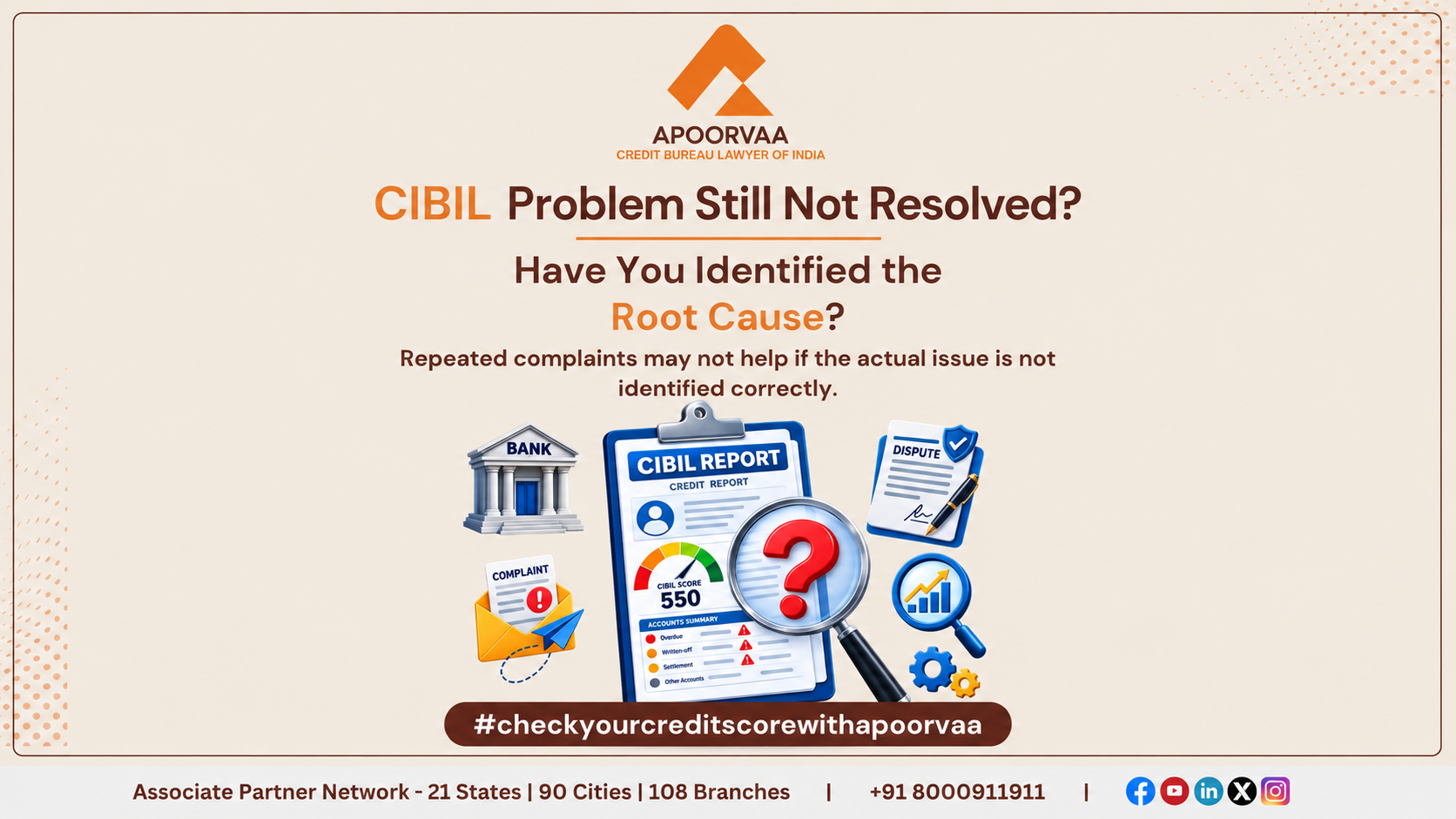
Some of the most complicated Credit Rectification cases do not begin with a new problem.
They begin with a customer saying:
“I have already tried everything, but my CIBIL problem is still not resolved.”
The customer may already have:
Contacted the bank.
Raised disputes.
Sent emails.
Escalated complaints.
Approached different professionals.
Posted the issue on social media.
Or spent several months trying to get the credit report corrected.
Yet the same problem continues.
Naturally, frustration increases.
The customer may conclude:
“Nobody is able to solve my CIBIL problem.”
But sometimes the real question is different:
Has the actual root cause of the problem been identified correctly?
Because if the diagnosis is incomplete, repeating complaints through different channels may not necessarily address the real issue.
More Complaints Do Not Automatically Mean Better Credit Rectification
When a credit-report issue remains unresolved, customers naturally escalate.
First, they contact the lender.
Then perhaps the credit bureau.
Then another complaint is raised.
Then emails are sent.
Then another professional is consulted.
Escalation can absolutely be appropriate in the right circumstances.
But there is an important distinction between:
Escalating a correctly identified problem
and
Repeatedly escalating a problem whose underlying cause has not yet been understood.
If the actual issue has been misunderstood, ten complaints may simply repeat the same assumption ten times.
That is why effective Credit Rectification should begin with:
What exactly is wrong?
Not merely:
Where should we complain next?
A Credit Report Problem May Be Different From What It First Appears
Consider a customer who says:
“There are loans appearing in my CIBIL Report that I never took.”
At first glance, the obvious conclusion may be:
These loans don’t belong to the customer, so dispute all of them.
But that may not always reveal the complete problem.
There could potentially be an issue involving:
- Personal information
- Account ownership
- Identification details
- Duplicate or mixed information
- Incorrect account-level data
- Other inconsistencies requiring examination
TransUnion CIBIL’s dispute framework allows consumers to raise disputes concerning inaccuracies in personal information and account information in the credit report. It also provides for ownership-related disputes where an account or enquiry does not belong to the consumer.
Therefore, identifying the type of discrepancy can be as important as identifying the negative account itself.
A Real-World Type of Situation: When the Visible Problem Was Not the Root Problem
Consider a situation similar to one we have encountered in Credit Rectification.
A customer repeatedly found loan accounts in the credit report that he said did not belong to him.
Naturally, the customer’s entire attention was focused on those accounts.
The thinking was:
“These are not my loans. Remove them.”
The customer had already explored different avenues for assistance.
But when the credit profile was examined more deeply, there were inconsistencies involving fundamental identification information, including details such as the PAN, date of birth and name.
That changed the nature of the problem.
The unwanted accounts were the visible symptom.
The underlying identification mismatch required attention because the question was no longer simply:
“Which loans are mine?”
It also became:
“Why is unrelated credit information becoming associated with this profile?”
This is exactly why root-cause analysis matters.
Symptom vs Root Cause in Credit Rectification
This distinction can be understood very simply.
Suppose the customer sees:
Unknown Loan Accounts
That is the visible problem.
But underneath it, there may be a different issue requiring investigation.
Likewise:
Low CIBIL Score may be the visible problem.
But the underlying cause could involve repayment behaviour, outstanding obligations or another aspect of the credit profile.
Write-Off may be the visible problem.
But the account history behind that status needs to be understood.
Incorrect Current Balance may be the visible problem.
But the question is why the information is being reported that way.
This gives us an important principle:
The visible credit-report problem and the root cause of that problem are not always the same thing.
A good Credit Rectification assessment should try to understand both.
Why a Standard Dispute May Not Solve Every Problem
A dispute is an important mechanism when credit information appears inaccurate.
But a dispute is not a universal solution for every credit problem.
CIBIL explains that when a dispute concerns credit information supplied by a credit institution, the relevant information is taken up with the concerned credit institution for verification. CIBIL itself cannot independently modify lender-reported information without confirmation from the concerned institution.
This is important because a customer may think:
“I raised a dispute, so why is my problem still there?”
The answer depends on what the actual problem is.
Was the correct information disputed?
Was the issue one of account ownership?
Was there a personal-data discrepancy?
Was the lender-reported information itself being challenged?
Is there another underlying account issue?
The purpose is not to raise the maximum number of disputes.
The purpose is to understand what needs to be addressed.
Why Customers Can Lose Months Without Reaching the Actual Problem
This is where unresolved credit issues become expensive—not only financially, but in terms of time.
A customer may spend six months moving from one solution to another.
One complaint.
Another email.
Another dispute.
Another professional.
Another escalation.
Meanwhile, an important financial requirement may remain pending.
A business owner may need funding.
A family may be planning a home loan.
An individual may need a vehicle or personal loan.
The credit problem becomes more urgent, but the underlying issue remains unresolved.
This is why correct diagnosis at an early stage can be extremely valuable.
It can help prevent customers from repeatedly spending time and money on actions that may not be addressing the actual issue.
This Does Not Mean the Earlier Professional Was Wrong
There is another point I consider important.
If a customer has already consulted:
A bank official, an advocate, a Chartered Accountant, a financial professional or another Credit Rectification service,
it would be unfair to automatically conclude:
“They handled the case incorrectly.”
Every professional works on the information available to them and applies their own expertise and understanding.
Complicated credit-report cases can also involve information that is not immediately obvious.
The more useful question is:
“Is there another way of looking at this problem?”
That is where a second opinion can become valuable.
Not because the first professional must necessarily be wrong.
But because a fresh assessment may identify something that was previously overlooked.
Why a Second Opinion Can Matter in Credit Rectification
We routinely seek second opinions in important areas of life.
When a major financial decision is involved, we compare professional advice.
When a complicated legal issue arises, another legal opinion may sometimes provide additional perspective.
Similarly, when a credit-report problem has remained unresolved despite repeated efforts, obtaining a second expert opinion can be sensible.
The purpose is not to restart everything.
It is to ask:
Has the problem been identified correctly?
Are we treating the symptom or the underlying cause?
Is there information in the credit report that deserves closer examination?
Could a different interpretation of the credit data change the direction of the case?
Sometimes, confirming that the existing approach is correct is itself valuable.
In other cases, the second assessment may reveal a completely different issue.
Credit Rectification Should Begin With Diagnosis, Not Action
There is a tendency today to search for an instant action:
“Raise this dispute.”
“Send this email.”
“Complain here.”
“Use this format.”
But professional Credit Rectification should not begin with a predetermined action.
It should begin with understanding the problem.
Because:
Wrong diagnosis + Correct procedure = Wrong direction
Whereas:
Correct diagnosis → Appropriate course of action
creates a much stronger foundation for resolving the issue.
This is especially important when the customer has already spent months trying different solutions.
At that stage, doing more of the same may be less useful than understanding whether the original assumption was correct.
When a CIBIL Problem Remains Unresolved, Reconsider the Diagnosis
When a customer has already spent six months or even a year trying to resolve a credit-report problem, the natural reaction is:
“What else can I do?”
But before adding another complaint, dispute or escalation, there is a more important question:
“Are we sure we have correctly identified the actual problem?”
This is particularly important when several attempts have already failed.
The objective should not simply be to find another channel through which the same complaint can be repeated.
The objective should be to understand whether the original diagnosis itself needs to be reconsidered.
A Credit Report Should Be Read as a Connected Profile
One of the difficulties in complicated Credit Rectification cases is that customers naturally focus on the most visible negative information.
For example:
“These loans don’t belong to me.”
“This account is showing Write-Off.”
“My Current Balance is incorrect.”
“My score is too low.”
These observations are important, but sometimes looking at one field or one account in isolation can hide the larger problem.
A credit report contains interconnected information relating to the customer’s identity and credit accounts.
When a case has remained unresolved for a long period, an experienced assessment may therefore look beyond the obvious negative entry and consider whether there are broader inconsistencies in the profile.
The purpose is not to make the case more complicated.
It is to ensure that the right problem is being addressed.
Why Personal Information Can Matter in an Unresolved Credit Case
Customers generally associate Credit Rectification only with loan-account information.
But personal identification information can also deserve attention when something appears inconsistent.
For example, issues involving:
Name
PAN
Date of birth
or other identifying information may become relevant when trying to understand why a credit profile is behaving unexpectedly.
This does not mean every spelling difference or personal-data variation causes another person’s loan to appear in a report.
That conclusion should not be assumed.
But where there are unexplained accounts together with inconsistencies in identifying information, the complete profile deserves careful examination rather than focusing only on individual loan entries.
This is one reason why the root cause can sometimes be different from the customer’s initial assumption.
The Visible Problem May Only Be a Symptom
Consider the example from Part 1.
A customer sees multiple loan accounts that he says do not belong to him.
The immediate problem appears to be:
Unknown Loans
So the obvious action appears to be:
Dispute the Unknown Loans
But if those accounts repeatedly continue to become associated with the customer’s credit profile, merely repeating the same action may not answer the bigger question:
Why is this happening?
That is the difference between addressing a symptom and investigating a root cause.
The same principle can apply elsewhere.
A low score is a symptom.
An unresolved Write-Off may be a symptom of an underlying historical account issue.
An unexpected Current Balance may require understanding what the lender is presently reporting.
An unknown account may require looking beyond the account itself.
Good Credit Rectification therefore requires the ability to ask:
“Why is this information appearing?”
rather than only:
“How do we remove it?”
Repeated Escalation and Correct Escalation Are Different
Escalation has an important role in resolving genuine credit-report grievances.
But escalation works best when the issue being escalated is clearly understood.
Imagine repeatedly escalating:
“Remove these 20 accounts.”
when the underlying issue requiring examination is broader than those 20 account entries.
The complaint may become louder.
More authorities may become involved.
More emails may be sent.
But the underlying diagnosis remains unchanged.
This is why customers should distinguish between:
Repeated escalation
and
Correctly directed escalation.
The purpose of professional assessment is not necessarily to complain more aggressively.
Sometimes its greatest value is determining what the complaint or rectification effort should actually be about.
More Action Is Not Always Better Action
Today, customers have access to enormous amounts of information online.
A reel may explain how to raise a CIBIL dispute.
A video may provide an email format.
A post may tell customers where to escalate.
Templates may be available for complaints.
This information can create awareness.
But complicated Credit Rectification cannot always be reduced to:
Copy → Paste → Submit → Problem Solved
A procedure that is appropriate for one customer may be irrelevant to another.
If the issue is genuine outstanding dues, one type of assessment may be required.
If it is an unknown account, another question arises.
If personal information appears inconsistent, that may require examination from another perspective.
If an earlier resolution is not reflecting as expected, the issue may again be different.
Knowing which action applies to which problem is where expertise becomes important.
When Should You Consider Taking a Second Opinion?
A second opinion does not need to be taken for every minor credit-report query.
But it can become useful when:
- The problem has continued for several months
- Multiple disputes have already been raised without resolving the issue
- Different professionals are giving significantly different explanations
- You have spent money but still do not understand what the actual problem is
- Unknown accounts repeatedly appear
- Your identification information appears inconsistent
- An important account continues to reflect differently from what you expected
- You are being advised to take another major financial or legal step without clearly understanding why
- Your loan or business-funding plans are being repeatedly affected
The purpose of taking a second opinion is not to keep searching until someone tells you what you want to hear.
It is to obtain another informed assessment of the same facts.
Sometimes that second opinion may confirm that the first approach was appropriate.
Sometimes it may identify an issue that deserves further investigation.
Both outcomes can be valuable.
A Second Opinion Should Not Mean Starting Everything Again
Customers sometimes hesitate to seek another opinion because they think:
“I have already spent six months on this. I don’t want to start from zero.”
A second opinion should not automatically mean discarding everything already done.
Previous work can itself provide useful information.
The customer’s earlier report, latest report, bank communications, dispute history, responses received and other relevant documents can help explain how the issue has developed.
In fact, when a case has been unresolved for a long time, understanding what has already been attempted can be important in determining why the problem remains.
The objective is not:
“Forget everything and start again.”
It is:
“Review the situation with fresh eyes and determine whether the problem has been understood correctly.”
What Should You Have Available When Seeking a Second Opinion?
You do not need to become a Credit Rectification expert yourself.
But providing the professional with the relevant information can make the assessment more meaningful.
Where available, keep:
- Your latest detailed credit report
- An earlier report showing the original issue
- Relevant lender communications
- Responses received to earlier disputes or complaints
- Relevant payment or closure documentation, where applicable
- A brief history of what has already been attempted
The purpose is not for the customer to decide the technical solution.
It is to help the person reviewing the case understand the complete history instead of seeing only one screenshot or one score.
What a Second Opinion Should Ideally Tell You
A useful second opinion should provide clarity.
After the discussion, you should have a better understanding of questions such as:
What appears to be the actual issue?
Is the visible problem likely to be the root problem or only part of it?
Does the earlier approach appear relevant to the issue?
Is there another aspect of the credit profile that deserves examination?
Is further professional Credit Rectification genuinely required?
The second opinion should not automatically become another sales pitch.
Sometimes the conclusion may simply be that the customer is already following the appropriate route and needs to allow that process to continue.
That is also a legitimate professional opinion.
How We Look at Unresolved Credit Problems at Apoorvaa
At Apoorvaa – Credit Bureau Lawyer of India, customers sometimes approach us only after trying several other routes.
By that stage, frustration is understandable.
But our first objective should not be to tell the customer:
“Everyone before us was wrong.”
Nor should it be:
“Give us the case and we will definitely solve it.”
The more useful starting point is:
“Let us understand why this problem is still unresolved.”
That means looking at the credit issue from the perspective of its underlying cause, rather than immediately repeating whatever action has already been attempted.
Sometimes the issue may be straightforward.
Sometimes the visible problem may require deeper examination.
And sometimes our assessment may confirm that the customer is already pursuing an appropriate course of action.
This is the value of a genuine second opinion.
Free Second Opinion for an Unresolved Credit-Report Problem
If you have already:
Approached the bank,
raised disputes,
sent complaints,
consulted another professional,
or spent several months trying to resolve a credit-report issue—
but you still do not clearly understand why the problem remains unresolved, you can seek a second opinion before spending more time or money.
At Apoorvaa – Credit Bureau Lawyer of India, the initial second opinion for such a credit-report issue is provided without consultation fees.
The purpose is first to understand the problem and help you gain clarity about what may actually be affecting your credit profile.
A second opinion does not mean that your earlier professional was wrong.
It simply gives you another expert perspective before you decide what to do next.
Helpline: +91 8000 911 911
Frequently Asked Questions
I have raised several CIBIL disputes, but my problem is still not resolved. What should I do?
Instead of automatically raising the same dispute again, consider whether the underlying issue has been correctly identified. An unresolved problem may require a broader examination of the credit profile.
Does an unsuccessful dispute mean CIBIL is refusing to correct my report?
Not necessarily. The reason depends on the nature of the dispute, the information supplied by the concerned credit institution and the actual issue being challenged.
Can incorrect PAN or date of birth create credit-report problems?
Inconsistencies in identification information can be relevant when examining an unusual credit profile. However, the effect should be assessed from the actual report rather than assuming that every personal-data mismatch produces the same result.
What if multiple loans appear that I never took?
Unknown accounts deserve proper verification. When several unexplained accounts are involved, it can also be useful to examine the broader credit profile rather than considering each entry only in isolation.
Should I keep raising complaints until the problem is solved?
Complaints and escalation can be appropriate, but repeatedly escalating an incorrectly understood issue may not resolve the root cause. First make sure you understand what is actually being challenged.
Does taking a second opinion mean changing my existing professional?
No. A second opinion is simply another professional assessment. It may confirm the existing approach or identify another issue worth examining.
When is a second opinion particularly useful?
It can be valuable when a credit-report issue has continued for months, multiple attempts have failed, explanations are conflicting or you still do not understand why the problem exists.
Does Apoorvaa charge for the initial second opinion?
For the second-opinion consultation described here, Apoorvaa provides the initial opinion without consultation fees. If further professional Credit Rectification work is required, the applicable scope can be discussed separately.
Final Takeaway
When a CIBIL problem remains unresolved after repeated attempts, doing more is not always the answer.
Sometimes the better decision is to reconsider the question itself:
Have we identified the actual root cause?
An unknown loan may be the visible problem.
A low score may be the visible problem.
A Write-Off may be the visible problem.
An incorrect balance may be the visible problem.
But effective Credit Rectification requires understanding why that information is appearing and what the actual issue is.
And if you have already spent months, money and effort without getting clarity, a second expert opinion can be a sensible next step.
Not because the first professional was necessarily wrong.
But because a fresh assessment may help confirm—or reconsider—the diagnosis before you invest further time and money.
Related Credit Education
- Low CIBIL Score: 5 Common Reasons Behind It
- How to Improve CIBIL Score: Fix Credit Issues First
- CIBIL Rectification: How to Verify Your Report Is Corrected
About the Author
Advocate Apurva Bhagat is the Founder of Apoorvaa – Credit Bureau Lawyer of India and works in Credit Rectification, credit-report analysis and credit-related borrower guidance.
His approach focuses on an important principle:
Before deciding the remedy, understand the root cause.
When a credit-report problem remains unresolved despite repeated attempts, another complaint is not always the first answer. A careful reassessment of the underlying credit issue can sometimes provide the clarity required to determine the appropriate next direction.
CIBIL Problem Not Resolved? Find the Root Cause First
Some of the most complicated Credit Rectification cases do not begin with a new problem.
They begin with a customer saying:
“I have already tried everything, but my CIBIL problem is still not resolved.”
The customer may already have:
Contacted the bank.
Raised disputes.
Sent emails.
Escalated complaints.
Approached different professionals.
Posted the issue on social media.
Or spent several months trying to get the credit report corrected.
Yet the same problem continues.
Naturally, frustration increases.
The customer may conclude:
“Nobody is able to solve my CIBIL problem.”
But sometimes the real question is different:
Has the actual root cause of the problem been identified correctly?
Because if the diagnosis is incomplete, repeating complaints through different channels may not necessarily address the real issue.
More Complaints Do Not Automatically Mean Better Credit Rectification
When a credit-report issue remains unresolved, customers naturally escalate.
First, they contact the lender.
Then perhaps the credit bureau.
Then another complaint is raised.
Then emails are sent.
Then another professional is consulted.
Escalation can absolutely be appropriate in the right circumstances.
But there is an important distinction between:
Escalating a correctly identified problem
and
Repeatedly escalating a problem whose underlying cause has not yet been understood.
If the actual issue has been misunderstood, ten complaints may simply repeat the same assumption ten times.
That is why effective Credit Rectification should begin with:
What exactly is wrong?
Not merely:
Where should we complain next?
A Credit Report Problem May Be Different From What It First Appears
Consider a customer who says:
“There are loans appearing in my CIBIL Report that I never took.”
At first glance, the obvious conclusion may be:
These loans don’t belong to the customer, so dispute all of them.
But that may not always reveal the complete problem.
There could potentially be an issue involving:
- Personal information
- Account ownership
- Identification details
- Duplicate or mixed information
- Incorrect account-level data
- Other inconsistencies requiring examination
TransUnion CIBIL’s dispute framework allows consumers to raise disputes concerning inaccuracies in personal information and account information in the credit report. It also provides for ownership-related disputes where an account or enquiry does not belong to the consumer.
Therefore, identifying the type of discrepancy can be as important as identifying the negative account itself.
A Real-World Type of Situation: When the Visible Problem Was Not the Root Problem
Consider a situation similar to one we have encountered in Credit Rectification.
A customer repeatedly found loan accounts in the credit report that he said did not belong to him.
Naturally, the customer’s entire attention was focused on those accounts.
The thinking was:
“These are not my loans. Remove them.”
The customer had already explored different avenues for assistance.
But when the credit profile was examined more deeply, there were inconsistencies involving fundamental identification information, including details such as the PAN, date of birth and name.
That changed the nature of the problem.
The unwanted accounts were the visible symptom.
The underlying identification mismatch required attention because the question was no longer simply:
“Which loans are mine?”
It also became:
“Why is unrelated credit information becoming associated with this profile?”
This is exactly why root-cause analysis matters.
Symptom vs Root Cause in Credit Rectification
This distinction can be understood very simply.
Suppose the customer sees:
Unknown Loan Accounts
That is the visible problem.
But underneath it, there may be a different issue requiring investigation.
Likewise:
Low CIBIL Score may be the visible problem.
But the underlying cause could involve repayment behaviour, outstanding obligations or another aspect of the credit profile.
Write-Off may be the visible problem.
But the account history behind that status needs to be understood.
Incorrect Current Balance may be the visible problem.
But the question is why the information is being reported that way.
This gives us an important principle:
The visible credit-report problem and the root cause of that problem are not always the same thing.
A good Credit Rectification assessment should try to understand both.
Why a Standard Dispute May Not Solve Every Problem
A dispute is an important mechanism when credit information appears inaccurate.
But a dispute is not a universal solution for every credit problem.
CIBIL explains that when a dispute concerns credit information supplied by a credit institution, the relevant information is taken up with the concerned credit institution for verification. CIBIL itself cannot independently modify lender-reported information without confirmation from the concerned institution.
This is important because a customer may think:
“I raised a dispute, so why is my problem still there?”
The answer depends on what the actual problem is.
Was the correct information disputed?
Was the issue one of account ownership?
Was there a personal-data discrepancy?
Was the lender-reported information itself being challenged?
Is there another underlying account issue?
The purpose is not to raise the maximum number of disputes.
The purpose is to understand what needs to be addressed.
Why Customers Can Lose Months Without Reaching the Actual Problem
This is where unresolved credit issues become expensive—not only financially, but in terms of time.
A customer may spend six months moving from one solution to another.
One complaint.
Another email.
Another dispute.
Another professional.
Another escalation.
Meanwhile, an important financial requirement may remain pending.
A business owner may need funding.
A family may be planning a home loan.
An individual may need a vehicle or personal loan.
The credit problem becomes more urgent, but the underlying issue remains unresolved.
This is why correct diagnosis at an early stage can be extremely valuable.
It can help prevent customers from repeatedly spending time and money on actions that may not be addressing the actual issue.
This Does Not Mean the Earlier Professional Was Wrong
There is another point I consider important.
If a customer has already consulted:
A bank official, an advocate, a Chartered Accountant, a financial professional or another Credit Rectification service,
it would be unfair to automatically conclude:
“They handled the case incorrectly.”
Every professional works on the information available to them and applies their own expertise and understanding.
Complicated credit-report cases can also involve information that is not immediately obvious.
The more useful question is:
“Is there another way of looking at this problem?”
That is where a second opinion can become valuable.
Not because the first professional must necessarily be wrong.
But because a fresh assessment may identify something that was previously overlooked.
Why a Second Opinion Can Matter in Credit Rectification
We routinely seek second opinions in important areas of life.
When a major financial decision is involved, we compare professional advice.
When a complicated legal issue arises, another legal opinion may sometimes provide additional perspective.
Similarly, when a credit-report problem has remained unresolved despite repeated efforts, obtaining a second expert opinion can be sensible.
The purpose is not to restart everything.
It is to ask:
Has the problem been identified correctly?
Are we treating the symptom or the underlying cause?
Is there information in the credit report that deserves closer examination?
Could a different interpretation of the credit data change the direction of the case?
Sometimes, confirming that the existing approach is correct is itself valuable.
In other cases, the second assessment may reveal a completely different issue.
Credit Rectification Should Begin With Diagnosis, Not Action
There is a tendency today to search for an instant action:
“Raise this dispute.”
“Send this email.”
“Complain here.”
“Use this format.”
But professional Credit Rectification should not begin with a predetermined action.
It should begin with understanding the problem.
Because:
Wrong diagnosis + Correct procedure = Wrong direction
Whereas:
Correct diagnosis → Appropriate course of action
creates a much stronger foundation for resolving the issue.
This is especially important when the customer has already spent months trying different solutions.
At that stage, doing more of the same may be less useful than understanding whether the original assumption was correct.
When a CIBIL Problem Remains Unresolved, Reconsider the Diagnosis
When a customer has already spent six months or even a year trying to resolve a credit-report problem, the natural reaction is:
“What else can I do?”
But before adding another complaint, dispute or escalation, there is a more important question:
“Are we sure we have correctly identified the actual problem?”
This is particularly important when several attempts have already failed.
The objective should not simply be to find another channel through which the same complaint can be repeated.
The objective should be to understand whether the original diagnosis itself needs to be reconsidered.
A Credit Report Should Be Read as a Connected Profile
One of the difficulties in complicated Credit Rectification cases is that customers naturally focus on the most visible negative information.
For example:
“These loans don’t belong to me.”
“This account is showing Write-Off.”
“My Current Balance is incorrect.”
“My score is too low.”
These observations are important, but sometimes looking at one field or one account in isolation can hide the larger problem.
A credit report contains interconnected information relating to the customer’s identity and credit accounts.
When a case has remained unresolved for a long period, an experienced assessment may therefore look beyond the obvious negative entry and consider whether there are broader inconsistencies in the profile.
The purpose is not to make the case more complicated.
It is to ensure that the right problem is being addressed.
Why Personal Information Can Matter in an Unresolved Credit Case
Customers generally associate Credit Rectification only with loan-account information.
But personal identification information can also deserve attention when something appears inconsistent.
For example, issues involving:
Name
PAN
Date of birth
or other identifying information may become relevant when trying to understand why a credit profile is behaving unexpectedly.
This does not mean every spelling difference or personal-data variation causes another person’s loan to appear in a report.
That conclusion should not be assumed.
But where there are unexplained accounts together with inconsistencies in identifying information, the complete profile deserves careful examination rather than focusing only on individual loan entries.
This is one reason why the root cause can sometimes be different from the customer’s initial assumption.
The Visible Problem May Only Be a Symptom
Consider the example from Part 1.
A customer sees multiple loan accounts that he says do not belong to him.
The immediate problem appears to be:
Unknown Loans
So the obvious action appears to be:
Dispute the Unknown Loans
But if those accounts repeatedly continue to become associated with the customer’s credit profile, merely repeating the same action may not answer the bigger question:
Why is this happening?
That is the difference between addressing a symptom and investigating a root cause.
The same principle can apply elsewhere.
A low score is a symptom.
An unresolved Write-Off may be a symptom of an underlying historical account issue.
An unexpected Current Balance may require understanding what the lender is presently reporting.
An unknown account may require looking beyond the account itself.
Good Credit Rectification therefore requires the ability to ask:
“Why is this information appearing?”
rather than only:
“How do we remove it?”
Repeated Escalation and Correct Escalation Are Different
Escalation has an important role in resolving genuine credit-report grievances.
But escalation works best when the issue being escalated is clearly understood.
Imagine repeatedly escalating:
“Remove these 20 accounts.”
when the underlying issue requiring examination is broader than those 20 account entries.
The complaint may become louder.
More authorities may become involved.
More emails may be sent.
But the underlying diagnosis remains unchanged.
This is why customers should distinguish between:
Repeated escalation
and
Correctly directed escalation.
The purpose of professional assessment is not necessarily to complain more aggressively.
Sometimes its greatest value is determining what the complaint or rectification effort should actually be about.
More Action Is Not Always Better Action
Today, customers have access to enormous amounts of information online.
A reel may explain how to raise a CIBIL dispute.
A video may provide an email format.
A post may tell customers where to escalate.
Templates may be available for complaints.
This information can create awareness.
But complicated Credit Rectification cannot always be reduced to:
Copy → Paste → Submit → Problem Solved
A procedure that is appropriate for one customer may be irrelevant to another.
If the issue is genuine outstanding dues, one type of assessment may be required.
If it is an unknown account, another question arises.
If personal information appears inconsistent, that may require examination from another perspective.
If an earlier resolution is not reflecting as expected, the issue may again be different.
Knowing which action applies to which problem is where expertise becomes important.
When Should You Consider Taking a Second Opinion?
A second opinion does not need to be taken for every minor credit-report query.
But it can become useful when:
- The problem has continued for several months
- Multiple disputes have already been raised without resolving the issue
- Different professionals are giving significantly different explanations
- You have spent money but still do not understand what the actual problem is
- Unknown accounts repeatedly appear
- Your identification information appears inconsistent
- An important account continues to reflect differently from what you expected
- You are being advised to take another major financial or legal step without clearly understanding why
- Your loan or business-funding plans are being repeatedly affected
The purpose of taking a second opinion is not to keep searching until someone tells you what you want to hear.
It is to obtain another informed assessment of the same facts.
Sometimes that second opinion may confirm that the first approach was appropriate.
Sometimes it may identify an issue that deserves further investigation.
Both outcomes can be valuable.
A Second Opinion Should Not Mean Starting Everything Again
Customers sometimes hesitate to seek another opinion because they think:
“I have already spent six months on this. I don’t want to start from zero.”
A second opinion should not automatically mean discarding everything already done.
Previous work can itself provide useful information.
The customer’s earlier report, latest report, bank communications, dispute history, responses received and other relevant documents can help explain how the issue has developed.
In fact, when a case has been unresolved for a long time, understanding what has already been attempted can be important in determining why the problem remains.
The objective is not:
“Forget everything and start again.”
It is:
“Review the situation with fresh eyes and determine whether the problem has been understood correctly.”
What Should You Have Available When Seeking a Second Opinion?
You do not need to become a Credit Rectification expert yourself.
But providing the professional with the relevant information can make the assessment more meaningful.
Where available, keep:
- Your latest detailed credit report
- An earlier report showing the original issue
- Relevant lender communications
- Responses received to earlier disputes or complaints
- Relevant payment or closure documentation, where applicable
- A brief history of what has already been attempted
The purpose is not for the customer to decide the technical solution.
It is to help the person reviewing the case understand the complete history instead of seeing only one screenshot or one score.
What a Second Opinion Should Ideally Tell You
A useful second opinion should provide clarity.
After the discussion, you should have a better understanding of questions such as:
What appears to be the actual issue?
Is the visible problem likely to be the root problem or only part of it?
Does the earlier approach appear relevant to the issue?
Is there another aspect of the credit profile that deserves examination?
Is further professional Credit Rectification genuinely required?
The second opinion should not automatically become another sales pitch.
Sometimes the conclusion may simply be that the customer is already following the appropriate route and needs to allow that process to continue.
That is also a legitimate professional opinion.
How We Look at Unresolved Credit Problems at Apoorvaa
At Apoorvaa – Credit Bureau Lawyer of India, customers sometimes approach us only after trying several other routes.
By that stage, frustration is understandable.
But our first objective should not be to tell the customer:
“Everyone before us was wrong.”
Nor should it be:
“Give us the case and we will definitely solve it.”
The more useful starting point is:
“Let us understand why this problem is still unresolved.”
That means looking at the credit issue from the perspective of its underlying cause, rather than immediately repeating whatever action has already been attempted.
Sometimes the issue may be straightforward.
Sometimes the visible problem may require deeper examination.
And sometimes our assessment may confirm that the customer is already pursuing an appropriate course of action.
This is the value of a genuine second opinion.
Free Second Opinion for an Unresolved Credit-Report Problem
If you have already:
Approached the bank,
raised disputes,
sent complaints,
consulted another professional,
or spent several months trying to resolve a credit-report issue—
but you still do not clearly understand why the problem remains unresolved, you can seek a second opinion before spending more time or money.
At Apoorvaa – Credit Bureau Lawyer of India, the initial second opinion for such a credit-report issue is provided without consultation fees.
The purpose is first to understand the problem and help you gain clarity about what may actually be affecting your credit profile.
A second opinion does not mean that your earlier professional was wrong.
It simply gives you another expert perspective before you decide what to do next.
Helpline: +91 8000 911 911
Frequently Asked Questions
I have raised several CIBIL disputes, but my problem is still not resolved. What should I do?
Instead of automatically raising the same dispute again, consider whether the underlying issue has been correctly identified. An unresolved problem may require a broader examination of the credit profile.
Does an unsuccessful dispute mean CIBIL is refusing to correct my report?
Not necessarily. The reason depends on the nature of the dispute, the information supplied by the concerned credit institution and the actual issue being challenged.
Can incorrect PAN or date of birth create credit-report problems?
Inconsistencies in identification information can be relevant when examining an unusual credit profile. However, the effect should be assessed from the actual report rather than assuming that every personal-data mismatch produces the same result.
What if multiple loans appear that I never took?
Unknown accounts deserve proper verification. When several unexplained accounts are involved, it can also be useful to examine the broader credit profile rather than considering each entry only in isolation.
Should I keep raising complaints until the problem is solved?
Complaints and escalation can be appropriate, but repeatedly escalating an incorrectly understood issue may not resolve the root cause. First make sure you understand what is actually being challenged.
Does taking a second opinion mean changing my existing professional?
No. A second opinion is simply another professional assessment. It may confirm the existing approach or identify another issue worth examining.
When is a second opinion particularly useful?
It can be valuable when a credit-report issue has continued for months, multiple attempts have failed, explanations are conflicting or you still do not understand why the problem exists.
Does Apoorvaa charge for the initial second opinion?
For the second-opinion consultation described here, Apoorvaa provides the initial opinion without consultation fees. If further professional Credit Rectification work is required, the applicable scope can be discussed separately.
Final Takeaway
When a CIBIL problem remains unresolved after repeated attempts, doing more is not always the answer.
Sometimes the better decision is to reconsider the question itself:
Have we identified the actual root cause?
An unknown loan may be the visible problem.
A low score may be the visible problem.
A Write-Off may be the visible problem.
An incorrect balance may be the visible problem.
But effective Credit Rectification requires understanding why that information is appearing and what the actual issue is.
And if you have already spent months, money and effort without getting clarity, a second expert opinion can be a sensible next step.
Not because the first professional was necessarily wrong.
But because a fresh assessment may help confirm—or reconsider—the diagnosis before you invest further time and money.
Related Credit Education
- Low CIBIL Score: 5 Common Reasons Behind It
- How to Improve CIBIL Score: Fix Credit Issues First
- CIBIL Rectification: How to Verify Your Report Is Corrected
About the Author
Advocate Apurva Bhagat is the Founder of Apoorvaa – Credit Bureau Lawyer of India and works in Credit Rectification, credit-report analysis and credit-related borrower guidance.
His approach focuses on an important principle:
Before deciding the remedy, understand the root cause.
When a credit-report problem remains unresolved despite repeated attempts, another complaint is not always the first answer. A careful reassessment of the underlying credit issue can sometimes provide the clarity required to determine the appropriate next direction.

Good CIBIL Score But Loan Rejected? Understand Why
[…] CIBIL Problem Not Resolved? Find the […]
Four Credit Bureaus In India: Is CIBIL Alone Enough?
[…] CIBIL Problem Not Resolved? Find the […]
CIBIL Rectification: Why Choosing The Right Expert Matters
[…] CIBIL Problem Not Resolved? Find the Root Cause First […]
CIBIL Score Improvement: Can Your Score Increase In 24 Hours?
[…] CIBIL Problem Not Resolved? Find the Root Cause First […]
Why Is Your CIBIL Report Bad? 10 Factors That May Be Affecting Your Credit Profile
[…] CIBIL Problem Not Resolved? Find the Root Cause First […]