




Every few months, we come across borrowers who share a surprising claim.
“Someone is offering to fix my credit report for just ₹2,000.”
When we ask how they plan to do it, the explanation is often alarming.
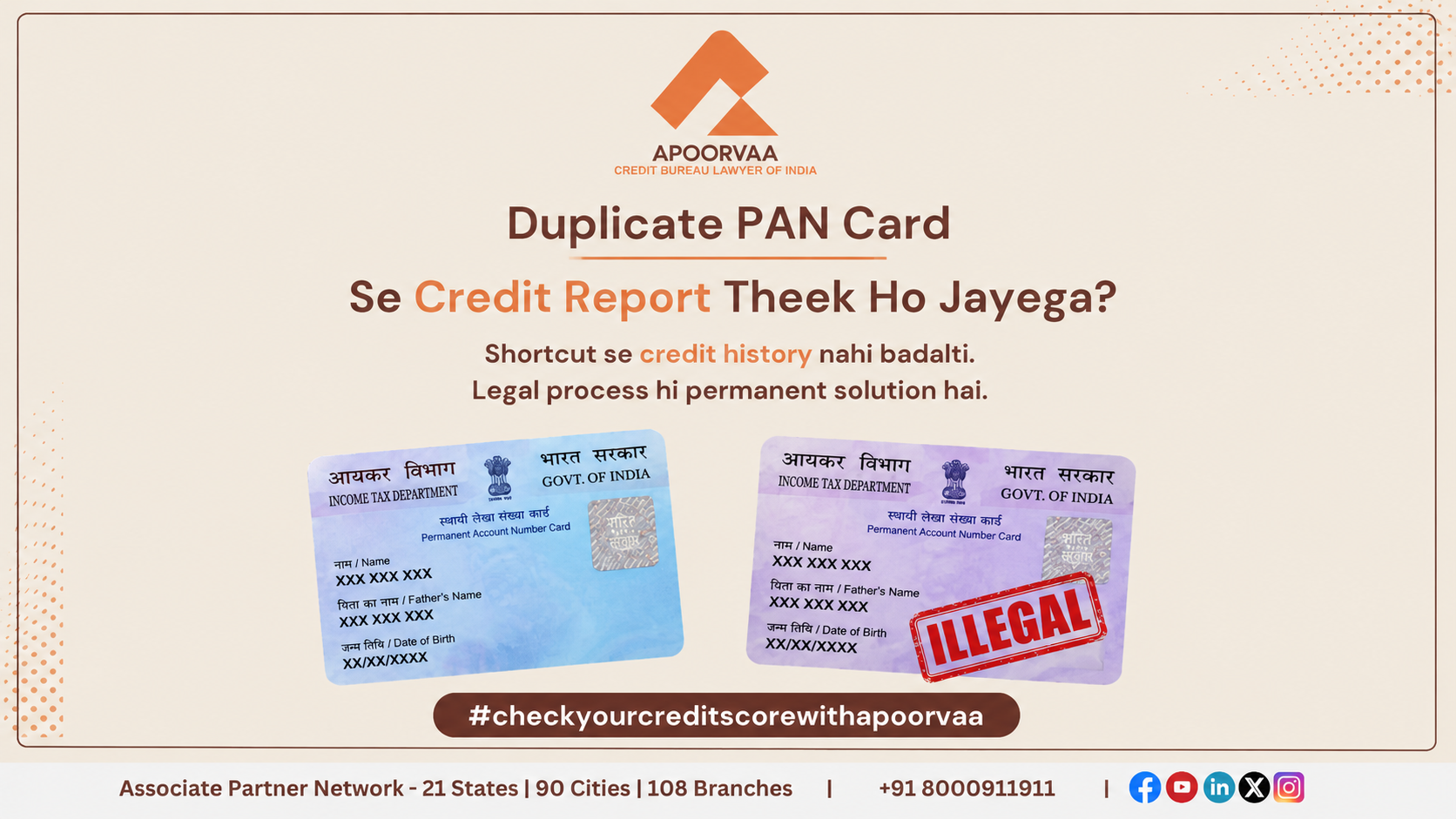
The borrower is told that a new or duplicate PAN card can be created by changing personal details such as the surname, father’s name, address, or date of birth. Once the new PAN is generated, a fresh credit report with “No History (NH)” will appear, making it easier to obtain a loan.
At first glance, this may sound like an easy solution for someone struggling with a poor credit history.
In reality, it is neither a solution nor a legitimate way to improve your credit profile.
More importantly, attempting to obtain credit by using incorrect identity information can expose a borrower to serious financial and legal consequences.
Understanding why this shortcut fails is essential before making a decision that could create far bigger problems than a low credit score.
Why Do Such Offers Exist?
Borrowers facing repeated loan rejections often become desperate for a solution.
Unfortunately, desperation creates opportunities for unethical individuals to exploit that situation.
These agents usually make attractive promises such as:
- Your CIBIL will become clean within 30 days.
- A new PAN means a new credit history.
- Banks will not know your previous records.
- You can easily get a loan with a fresh identity.
- No need to repay old liabilities.
For a borrower who urgently needs finance, these promises may appear convincing.
However, financial systems today are significantly more sophisticated than many people realise.
Modern banking relies on multiple verification mechanisms that go far beyond a single identity document.
Can a New PAN Really Create a Fresh Credit History?
This is where the biggest misconception begins.
Many people believe that because a different PAN number generates a report showing “No History”, their previous financial records have disappeared forever.
That assumption is incorrect.
A newly generated credit report showing NH (No History) does not automatically mean previous financial records have ceased to exist.
Financial institutions verify borrower identities through multiple parameters and internal risk assessment systems. Identity verification is not limited to only one document or one database.
Over time, information may be reviewed, verified, reconciled, or linked through various prescribed processes followed by institutions.
Therefore, assuming that changing identity details permanently separates an individual from previous financial records is an extremely risky assumption.
Even if someone initially believes they have created a fresh financial identity, that does not guarantee the previous information will remain permanently disconnected.
Why This Is Not a Credit Improvement Strategy
Improving a credit profile and avoiding a poor credit history are two completely different concepts.
A genuine improvement in a credit report happens through lawful financial behaviour, such as:
- Maintaining repayment discipline.
- Resolving genuine outstanding dues.
- Correcting verified reporting errors.
- Completing lender-prescribed processes.
- Building a positive repayment track record over time.
Creating or attempting to use incorrect identity information does not improve creditworthiness.
Instead, it attempts to avoid the existing financial history altogether.
That is not credit improvement.
It is an attempt to bypass the normal lending and verification process, and such shortcuts often create greater complications than the original problem.
Why Shortcuts Usually Become Expensive
One of the most common characteristics of financial fraud is that it appears inexpensive at the beginning.
A borrower may think:
“It’s only ₹2,000. If it works, I’ll finally get my loan.”
But the real cost may not be the amount paid to the agent.
The real risk lies in relying on an approach that is not designed to solve the underlying issue.
Even if a borrower temporarily believes the shortcut has worked, future verification, documentation requirements, or identity checks can create unexpected complications.
For this reason, financial decisions should never be based on quick promises.
They should always be based on lawful procedures and transparent documentation.
What Are the Risks of Following Such Shortcuts?
Many borrowers focus only on one objective—getting a loan approved.
In that urgency, they sometimes overlook the consequences of using incorrect identity information.
Using inaccurate personal details or relying on documents that do not correctly represent your identity can create complications far beyond a loan application. Financial institutions are continuously strengthening their verification processes, and inconsistencies in borrower information may result in additional scrutiny, delays, or even rejection of applications.
Depending on the facts and circumstances of a particular case, providing incorrect information to obtain financial benefits may also have legal implications under applicable laws.
For this reason, borrowers should never rely on agents who promise instant solutions through identity manipulation.
Banks Verify More Than Just Your PAN Card
A common misconception is that lenders rely only on the PAN number while evaluating a loan application.
In reality, lending decisions are based on multiple layers of verification and risk assessment.
Depending on the institution and the type of loan, banks may verify information such as:
- Identity documents.
- Address records.
- KYC information.
- Banking relationship.
- Existing loan obligations.
- Credit bureau data.
- Income documents.
- Employment or business details.
- Internal risk assessment parameters.
Each financial institution follows its own policies and verification procedures.
Therefore, assuming that changing a single document will permanently create a new financial identity is a serious misunderstanding of how modern banking systems operate.
The Difference Between Credit Rectification and Credit Manipulation
These two concepts are often confused.
Credit Rectification
Credit rectification focuses on resolving genuine issues through lawful procedures.
Examples include:
- Correcting reporting errors.
- Updating inaccurate borrower information.
- Completing lender-prescribed formalities.
- Resolving eligible credit report discrepancies.
- Maintaining proper documentation.
The objective is to ensure that the credit report accurately reflects the borrower’s financial history.
Credit Manipulation
Credit manipulation attempts to avoid an existing financial history rather than resolve it.
Examples may include:
- Using incorrect identity information.
- Creating false documentation.
- Concealing existing liabilities.
- Attempting to obtain credit using misleading information.
While such methods are often marketed as “quick solutions,” they do not resolve the underlying financial issue.
Why Legal Solutions Take More Time
One question borrowers frequently ask is:
“If illegal methods work quickly, why should I follow the legal process?”
The answer is simple.
A legal process is designed to create a sustainable outcome.
Whether the issue involves correcting inaccurate reporting, resolving an outstanding account, or updating lender records, every stage follows a structured verification process.
Although this may require patience, the result is based on legitimate documentation and recognised procedures.
Quick shortcuts may appear attractive, but they often leave the original issue unresolved.
In financial matters, a slower but lawful process is usually far more valuable than a fast solution that creates additional complications later.
Warning Signs That an Agent’s Promise May Be Misleading
Borrowers should exercise caution whenever someone makes claims such as:
- “Your CIBIL will become new.”
- “We will remove your entire credit history.”
- “Banks will never know.”
- “No repayment is required.”
- “Everything will be completed within a few days.”
- “No documents are necessary.”
Whenever an offer sounds too good to be true, it deserves careful scrutiny.
Before making any financial decision, verify the facts, ask questions, and understand the prescribed process instead of relying solely on verbal assurances.
How to Improve Your Credit Profile the Right Way
If your credit history requires improvement, focus on genuine corrective measures.
Some practical steps include:
- Obtain your latest credit report.
- Identify the exact issue affecting your credit profile.
- Verify whether the information is accurate.
- Contact the reporting lender where necessary.
- Resolve genuine outstanding obligations.
- Preserve all official records and acknowledgements.
- Monitor updates after the prescribed reporting cycle.
These steps may require time, but they contribute to building a stronger and more reliable credit profile.
Frequently Asked Questions
Can a duplicate PAN card permanently remove my old credit history?
A new PAN number should not be viewed as a legitimate method of eliminating an existing credit history. Financial institutions use multiple verification mechanisms while assessing borrowers.
Can changing my personal details guarantee loan approval?
No. Loan approval depends on several factors, including the lender’s eligibility criteria, verification process, credit assessment, and internal policies.
Why do some agents claim this method works?
Some individuals may make exaggerated or misleading claims to attract borrowers seeking quick solutions. Borrowers should verify such claims carefully before acting upon them.
What is the safest way to improve my credit profile?
The safest approach is to resolve genuine issues through lawful procedures, maintain repayment discipline, preserve documentation, and follow the processes prescribed by the concerned lender and applicable credit reporting framework.
Is a legal solution better than a shortcut?
A lawful approach is generally more sustainable because it addresses the underlying issue rather than attempting to bypass it.
Final Thoughts
A Duplicate PAN Card is not a solution for a poor credit history.
Borrowers facing financial difficulties are often vulnerable to promises of quick results. However, decisions involving identity documents and credit records should never be based on shortcuts or misleading assurances.
A healthy credit profile is built through responsible financial behaviour, accurate reporting, proper documentation, and compliance with prescribed procedures—not by attempting to create a new identity.
If a credit report contains an error, follow the appropriate correction process. If the issue relates to outstanding obligations, work with the concerned lender to resolve it. Taking the legal and transparent route may take longer, but it offers a far stronger and more reliable foundation for future financial opportunities.
Need Professional Guidance?
Every credit-related issue is different. While some cases involve genuine reporting errors, others require communication with the lender, proper documentation, or following the prescribed legal process. Relying on shortcuts such as duplicate PAN cards or misleading promises can create unnecessary financial and legal complications.
If you are facing difficulties because of your credit report, understand the actual issue before taking any action. A lawful and transparent approach not only protects your interests but also helps build a stronger financial future.
At Apoorvaa – Credit Bureau Lawyer of India, our objective is to spread financial awareness and help borrowers understand the prescribed credit reporting process. Every case should be evaluated on its own facts, and the appropriate course of action should always be based on legal procedures rather than shortcuts.
About the Author
Advocate Apurva Bhagat is the Founder of Apoorvaa – Credit Bureau Lawyer of India. Through educational articles, awareness initiatives, and practical guidance, he helps borrowers understand credit reporting, banking procedures, and responsible financial decision-making. His mission is to promote financial literacy and encourage borrowers to follow lawful, ethical, and sustainable solutions while dealing with credit-related issues.

Comments are closed