




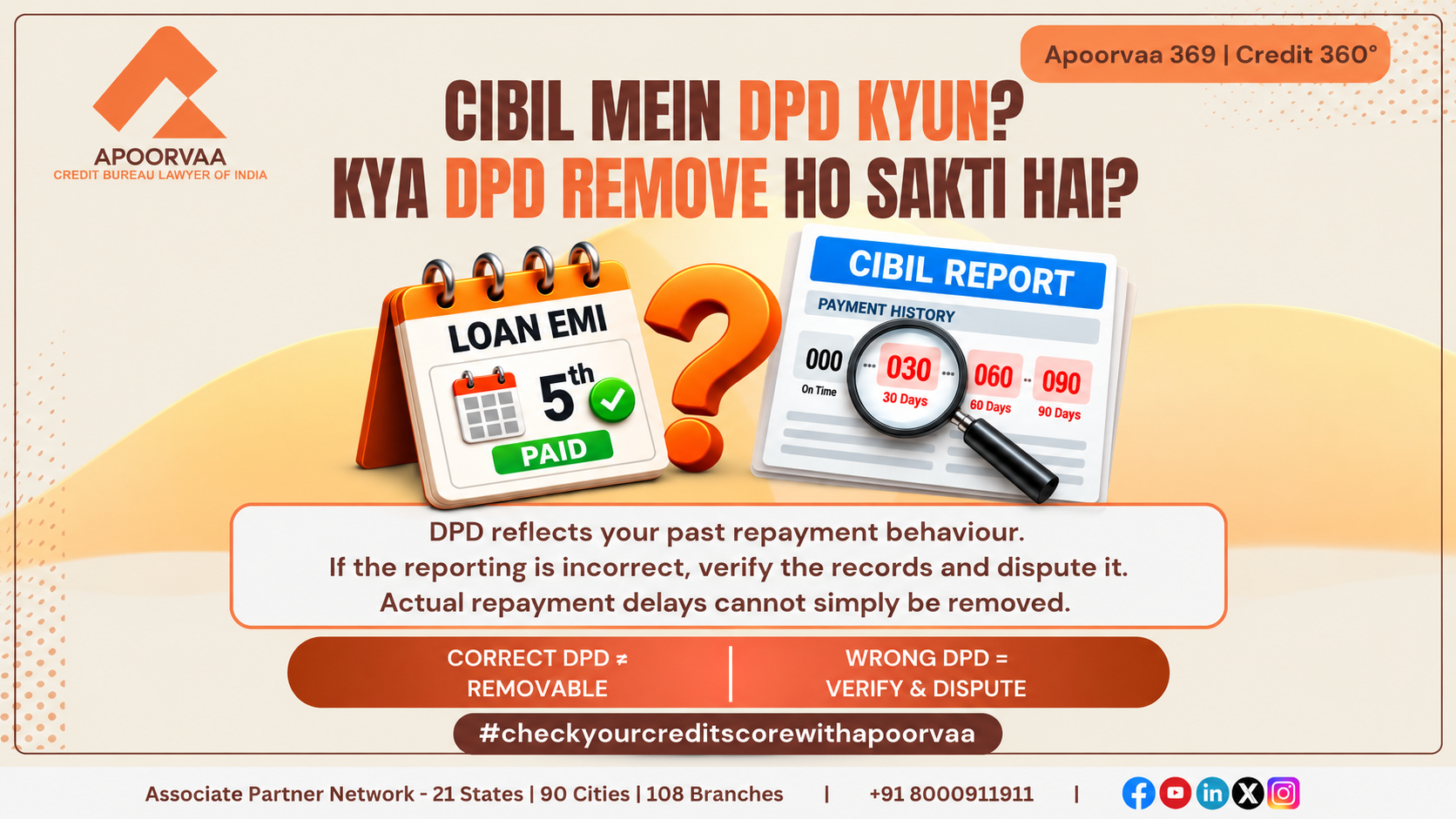
“I have never paid an EMI late, so why does my CIBIL Report show 30, 60 or 90 DPD?”
This is one of those Credit Report situations where neither assumption is safe.
A borrower should not immediately assume:
“The bank must have reported incorrectly.”
But the borrower should also not assume:
“If it appears in my CIBIL Report, it must be correct.”
The right approach is to establish what actually happened through documentary records.
A borrower may genuinely remember making every EMI. But the relevant question for repayment-history reporting is not simply whether an EMI was eventually paid.
We need to understand:
What was the contractual due date?
What happened to the payment around that due date?
When and how was the payment treated in the loan account?
What repayment history did the lender report to the Credit Information Company?
That leads to the central verification framework for this issue:
Loan/Sanction Terms → Bank & Loan Account Statement (SOA) → Credit Report Repayment History
Only after these records are compared can we properly assess whether the DPD is accurate or potentially incorrect.
1. What Does 30, 60 or 90 DPD Actually Mean?
DPD means Days Past Due.
In its consumer Credit Report guidance, TransUnion CIBIL explains DPD as indicating how many days a payment on an account was late for the relevant month.
Therefore, a numerical DPD should not simply be read as a general warning symbol.
It represents repayment-history information.
For example:
| DPD shown | General interpretation |
| 000 | Payment reported as per the due date |
| 030 | Payment reported 30 days past due |
| 060 | Payment reported 60 days past due |
| 090 | Payment reported 90 days past due |
If another numerical value appears—for example, 050—CIBIL’s guidance explains that it indicates the payment was reported 50 days late.
A Credit Report may also contain asset-classification indicators rather than a simple numerical DPD.
These should be interpreted according to the applicable reporting terminology and should not be casually treated as interchangeable with numerical DPD.
For example, CIBIL’s report guidance identifies:
STD — Standard
SMA — Special Mention Account
SUB — Sub-Standard
DBT — Doubtful
LSS — Loss
You may also encounter XXX, which CIBIL explains as indicating that information for those months was not reported to CIBIL by the bank.
Therefore, before discussing “DPD removal,” the first step is to identify exactly what the Credit Report is showing.
2. “I Paid Every EMI” — Why Can DPD Still Appear?
Because “I paid every EMI” and “every EMI was serviced on its contractual due date” are not necessarily the same statement.
Consider a simple example.
Your EMI is due on the 5th of every month.
You remember paying every EMI during the loan.
But one month, the scheduled debit on the 5th does not succeed.
Perhaps the payment is subsequently made a few days later.
From the borrower’s perspective:
“I paid that month’s EMI.”
That may be true.
But for repayment-history analysis, another question matters:
Was the contractual payment obligation actually serviced on the due date, or did it become past due before payment was made?
That distinction is important.
A later payment can clear an outstanding instalment, but it does not automatically prove that there was never a delay.
Conversely, if the documentary records establish that the payment was properly serviced in accordance with the contractual due date but the Credit Report nevertheless contains an inconsistent DPD, the reporting may require investigation.
This is why memory alone cannot resolve a disputed DPD.
Documents have to establish the timeline.
3. EMI Due Date vs Actual Payment: Why the Difference Matters
The contractual EMI due date is one of the most important reference points when examining disputed repayment history.
Suppose your sanction terms establish that your EMI is payable on the 5th.
Now compare three different situations.
Situation A — Payment Successfully Serviced on the Due Date
The relevant account records support that the EMI due on the 5th was properly serviced according to the contractual obligation.
If the corresponding Credit Report repayment history nevertheless shows a material numerical DPD, the inconsistency deserves examination.
Situation B — Scheduled Debit Failed, Payment Made Later
The EMI was due on the 5th.
The scheduled debit did not succeed.
The borrower subsequently paid the instalment.
The borrower may remember:
“I paid my EMI.”
But the records may establish that the contractual payment was not serviced on its original due date.
The later payment does not automatically make the earlier delay disappear from the historical repayment position.
Situation C — Money Left One Account but the Loan Records Tell a Different Story
Sometimes a borrower focuses only on the debit visible in a savings or current account.
That transaction is important evidence, but repayment-history verification may require comparison with the loan account statement as well.
The analysis should establish how the payment relates to the contractual obligation and how it was reflected against the loan facility.
This is why a bank-account debit entry alone should not automatically be treated as conclusive proof that every element of the lender’s reported repayment history is wrong.
The complete transaction trail matters.
4. How to Compare Your Loan Statement and CIBIL Repayment History
When a borrower says, “I never paid late,” I believe the most useful approach is to reconstruct the relevant repayment timeline.
Start with the contractual terms.
Step 1: Establish the Due Date
The sanction letter, repayment schedule or applicable loan documentation should establish when the EMI was contractually payable.
For example:
EMI Due Date: 5th of every month
This creates the reference point.
Step 2: Examine the Payment Records
The relevant bank statement can help establish what happened around each disputed payment date.
Was the scheduled amount debited?
Did a debit fail and get paid later?
Was there another payment transaction?
The objective is to establish facts—not assumptions.
Step 3: Examine the Loan Account Statement / SOA
The loan account statement helps establish the corresponding activity in the loan account.
This should be examined alongside the bank statement rather than treating either document in isolation.
Step 4: Match the Relevant Month to the Credit Report
Now examine the repayment-history section of the CIBIL Report.
If the report shows 030, 060 or 090, identify the corresponding period and compare it with the documented payment timeline.
The question becomes much more precise:
Does the lender-reported repayment history correspond with the contractual due date and the actual account records for that period?
This is substantially different from simply asking:
“Did I pay all my EMIs?”
5. What About an Old EMI Delay That I No Longer Remember?
This is another common source of confusion.
A borrower may have a five-year loan and say:
“I have been paying regularly for the last two years. Why is my Credit Report showing DPD?”
Both statements may be true.
TransUnion CIBIL’s consumer guidance explains that a CIBIL Report can show repayment history for up to the previous 36 months.
Therefore, an older delay that still falls within the displayed repayment-history period may remain visible even though the borrower has subsequently maintained regular payments.
Consider this sequence:
Year 1: Regular payments
Year 2: One payment becomes past due
Years 3–4: Regular payments
Today: Borrower remembers being consistently regular in recent years
The later regular repayment does not automatically rewrite the historical position of the earlier month.
This is why repayment history should be checked month by month rather than relying entirely on present payment behaviour.
6. What If the Bank Statement Proves the EMI Was Paid on Time?
This is where the issue changes from general DPD education to potential credit-information inaccuracy.
Suppose:
- The contractual EMI due date is established.
- The relevant payment records support timely servicing.
- The loan account statement supports the payment position.
- But the corresponding CIBIL repayment history shows 30, 60 or 90 DPD.
There may then be a factual inconsistency requiring investigation.
Credit Information Companies compile credit information using data furnished by Credit Institutions.
TransUnion CIBIL itself states that it cannot alter credit information in its database without confirmation from the relevant Credit Institution.
Therefore, where the documentary evidence and reported repayment history do not align, the matter may require verification through the concerned lender and the applicable CIC dispute/correction framework.
The important point is:
DPD is not “uncorrectable.”
An accurately reported historical DPD should not be presented as something that can simply be deleted.
But an incorrectly reported DPD is a credit-information accuracy issue and can legitimately require investigation and correction.
That distinction is at the heart of professional Credit Rectification.
7. What If the DPD Is Actually Correct?
After comparing the sanction terms, due dates, bank statement, loan account statement and Credit Report, sometimes the conclusion is straightforward:
The payment was actually late.
This can happen even when the borrower genuinely believes:
“I have always paid my EMIs.”
For example, suppose the EMI was due on the 5th.
The scheduled debit failed on the due date, but the borrower made the payment a few days later.
The borrower may remember that the EMI was paid during the month.
However, from a repayment-history perspective, the important question is whether the contractual payment obligation became past due before it was subsequently cleared.
Similarly, a borrower may have been completely regular for the last two years but had one or more delayed payments earlier within the repayment history displayed in the Credit Report.
Current regularity does not automatically make an earlier accurate delay incorrect.
That is why the objective of verification is not always to find a reporting error.
Sometimes verification confirms that the historical information is accurate.
8. Can Correct DPD History Simply Be Removed from CIBIL?
This is one of the most important distinctions borrowers need to understand.
There is a difference between:
Correcting inaccurate credit information
and
trying to delete accurate but unfavourable credit history.
If the lender’s records establish that a payment genuinely became past due and the corresponding repayment history has been accurately furnished, the information should not be represented as something that can simply be removed because:
- The EMI was eventually paid.
- The account is now regular.
- The loan has subsequently been closed.
- The borrower wants to apply for another loan.
- The historical DPD is affecting how a lender views the Credit Report.
Credit Rectification should be based on accuracy.
It should not be presented as a mechanism for rewriting legitimate repayment history.
This is also why borrowers should be cautious about anyone promising:
“Every DPD can be removed.”
A professional assessment should first determine whether there is a factual basis for correction.
If the DPD accurately represents what happened, the appropriate focus is generally on maintaining good repayment behaviour going forward rather than treating accurate history as a reporting error.
9. When Should Incorrect DPD Be Investigated and Corrected?
The situation is different where the documentary evidence does not support the reported DPD.
Consider this example:
Contractual EMI Due Date: 5th
Payment Records: Payment properly serviced in accordance with the due date
Loan Account Records: Consistent with timely servicing
CIBIL Repayment History: Shows 30 DPD for the corresponding period
This creates a material question:
Why does the reported repayment history differ from the underlying account records?
Other situations may also require examination, such as:
- DPD appearing for a month where records indicate timely servicing.
- Repayment history inconsistent with the lender’s own loan account statement.
- Incorrect historical information continuing after the lender has acknowledged a reporting discrepancy.
- Different account-level information creating uncertainty about the actual repayment position.
- A borrower disputing DPD with credible documentary evidence supporting a different repayment timeline.
In these situations, professional Credit Rectification can legitimately involve identifying the inconsistency and pursuing correction through the appropriate lender/CIC framework.
The objective remains:
Make the Credit Report reflect the verified facts.
10. Why the Lender and Credit Information Company Both Matter
A CIBIL Report should not be viewed as an independently created repayment ledger.
Credit Institutions furnish credit information to Credit Information Companies, and that information becomes part of the consumer’s credit record.
This has an important practical consequence.
If the borrower disputes a repayment-history entry, the underlying lender records become central to verification.
TransUnion CIBIL provides a dispute mechanism for potentially inaccurate information. However, lender-furnished credit information is not simply changed because a borrower requests deletion.
The concerned information generally requires verification with the Credit Institution.
Therefore, when DPD appears incorrect, the question is not merely:
“How do I remove this from CIBIL?”
The better question is:
“What do the lender’s records establish, what was furnished to the Credit Information Company, and where exactly is the inconsistency?”
That is a much stronger basis for rectification.
11. Why Documentary Evidence Is More Important Than Memory
Credit Report disputes frequently involve events that happened months or years earlier.
Human memory is not an account statement.
A borrower may sincerely remember being regular while forgetting:
- One failed auto-debit.
- A payment made after the contractual due date.
- A temporary shortage of funds.
- A delayed manual payment after an unsuccessful debit.
- An older repayment issue from a previous year.
On the other hand, a Credit Report is not beyond error merely because it contains a numerical DPD.
This is why neither side should be accepted purely on assumption.
The most reliable approach is documentary comparison:
Contractual Due Date
↓
Actual Payment Transaction
↓
Loan Account Treatment
↓
Reported Repayment History
If these records align, the DPD may be supported.
If they materially conflict, further investigation may be justified.
12. Can Incorrect DPD Affect a Credit Score?
Repayment history is an important part of a consumer’s overall credit profile, and delayed-payment information may be relevant to credit assessment.
However, borrowers should avoid assuming that one particular DPD entry has produced a specific number of points of change in their credit score.
Credit scores are calculated using multiple elements of the credit profile.
Similarly, if inaccurate information is subsequently corrected, no professional should promise:
“Your score will increase by exactly X points.”
The appropriate objective of rectification is to ensure that the information used in the credit ecosystem is accurate.
Any subsequent score movement depends on the consumer’s overall credit information and the applicable scoring model.
13. Does DPD Automatically Mean Your Next Loan Will Be Rejected?
No.
Banks and other lenders evaluate credit applications according to their underwriting policies.
Repayment history can be an important consideration, but a lending decision may also involve:
- Current income or business cash flow
- Existing debt obligations
- Overall repayment behaviour
- Loan amount requested
- Type of credit facility
- Recent credit enquiries
- Security or collateral, where applicable
- Banking conduct
- Other information in the Credit Report
- The lender’s internal risk policy
Therefore:
DPD ≠ Automatic Loan Rejection
At the same time:
A good current score ≠ Historical repayment behaviour becomes irrelevant
A lender may examine the broader credit profile rather than relying solely on the headline score.
This is another reason borrowers should understand the repayment-history section of their Credit Report before making an important new credit application.
14. Verification First → Documentary Facts → Rectification Where Inaccurate
For me, this is the most important framework for today’s topic.
When somebody approaches us saying:
“Sir, I never paid late. Please remove this DPD.”
the first professional response should not be:
“Yes, we will remove it.”
The first response should be:
“Let us establish what actually happened.”
That requires understanding the contractual repayment obligation and comparing the relevant records.
The Correct Sequence
1. Establish the contractual EMI due date
↓
2. Examine the relevant payment records
↓
3. Examine the Loan Account Statement / SOA
↓
4. Compare the same period with the Credit Report repayment history
↓
5. Identify whether there is an actual reporting discrepancy
↓
6. Consider rectification only where the information is inaccurate
This approach protects the borrower from carrying incorrect adverse information.
It also protects the integrity of Credit Rectification by not presenting accurate historical information as something that can simply be erased.
Frequently Asked Questions
1. I never paid an EMI late. Why does my CIBIL Report show 30 DPD?
First establish the contractual due date and compare the relevant bank/payment records, Loan Account Statement and Credit Report repayment history. If the records support timely servicing but the corresponding repayment history shows 30 DPD, the discrepancy may require investigation.
2. What does 30 DPD mean in a CIBIL Report?
DPD means Days Past Due. A numerical DPD indicates the number of days the payment was reported past due for the relevant period.
3. If my EMI bounced but I paid it later, should the DPD disappear?
A subsequent payment can clear the outstanding instalment, but it does not automatically mean there was never a historical delay. The contractual due date and actual repayment timeline need to be examined.
4. I have paid regularly for the last two years. Why can an old DPD still appear?
Because repayment history can contain information relating to earlier months. Recent regular payments do not automatically rewrite an accurate delay that occurred during an earlier reported period.
5. Can incorrect DPD be corrected?
Yes. If documentary evidence establishes that the reported repayment history is inaccurate, the discrepancy can be pursued through the applicable lender/CIC verification and correction framework.
6. Can accurate DPD be removed because I need a new loan?
An accurately reported historical delay should not be presented as something that can simply be deleted because a borrower is seeking new credit.
7. Does 30, 60 or 90 DPD automatically mean my loan will be rejected?
No. Repayment history may influence underwriting, but lenders can consider multiple factors and apply their own credit and risk policies.
8. Will correcting an incorrect DPD definitely increase my CIBIL Score?
No particular score increase should be guaranteed. The objective of rectification is accurate credit information. The resulting score depends on the overall credit profile and applicable scoring model.
My Perspective
When a borrower says:
“I have never paid an EMI late, but my CIBIL Report shows 30, 60 or 90 DPD,”
I believe we should neither blame the lender immediately nor assume that the Credit Report must be correct.
We should examine the evidence.
What was the contractual due date?
What happened to the EMI on that date?
What does the bank statement show?
What does the Loan Account Statement show?
And what was finally reported in the Credit Report?
Sometimes the documents establish that an older payment was genuinely delayed, even though the borrower has been regular for a long period afterward.
In other cases, the records may establish that the repayment was timely but the reported history does not correspond with those records.
Those are two completely different situations.
The first is accurate historical repayment information.
The second may be an accuracy and rectification issue.
That distinction is why I always believe in:
Verification First. Documentary Facts Second. Rectification Only Where Reporting Is Inaccurate.
Final Takeaway
If your CIBIL Report shows 30, 60 or 90 DPD even though you believe you have never paid an EMI late, do not start by asking:
“How can I remove the DPD?”
Start by asking:
“Is this DPD factually correct?”
Then compare:
Loan/Sanction Terms → Due Date → Payment Records → Loan Account Statement → Credit Report Repayment History
Remember:
EMI Eventually Paid ≠ Automatically Paid on Due Date
Recent Regular Payments ≠ Older Delay Never Happened
DPD Appearing in CIBIL ≠ Automatically Correct
Accurate Historical DPD ≠ Something That Can Simply Be Deleted
Incorrect DPD = Legitimate Credit-Information Accuracy Issue
The purpose of Credit Rectification is not to create a cleaner-looking history.
The purpose is to ensure that your Credit Report accurately represents your documented credit history.
Professional Credit Report Assessment & Credit Rectification
If your CIBIL Report shows 30, 60 or 90 DPD and you believe your EMIs were serviced on time, the first requirement is to establish the facts through the relevant credit and repayment records.
Apoorvaa provides professional Credit Report assessment and Credit Rectification assistance where reported credit information requires verification and, where justified, correction.
📞 8000 911 911
Apoorvaa – Credit Bureau Lawyer of India
Credit Rectification does not guarantee deletion of accurately reported repayment history, any particular increase in a credit score or approval of a future loan application.
Related Credit Education
- Loan Closed but CIBIL Report Shows ‘Restructured’? What Does It Mean?
- Loan ₹5 Lakh but CIBIL Shows ₹50 Lakh? Check Your Guarantor Status
- Post Write-Off Settled in CIBIL Report After Loan Closure: What Does It Mean?
About the Author
Advocate Apurva Bhagat is the Founder of Apoorvaa – Credit Bureau Lawyer of India. Through his articles and educational initiatives, he helps borrowers understand credit reports, banking practices, and informed financial decision-making. His objective is to promote financial awareness through practical and responsible guidance.

Comments are closed