





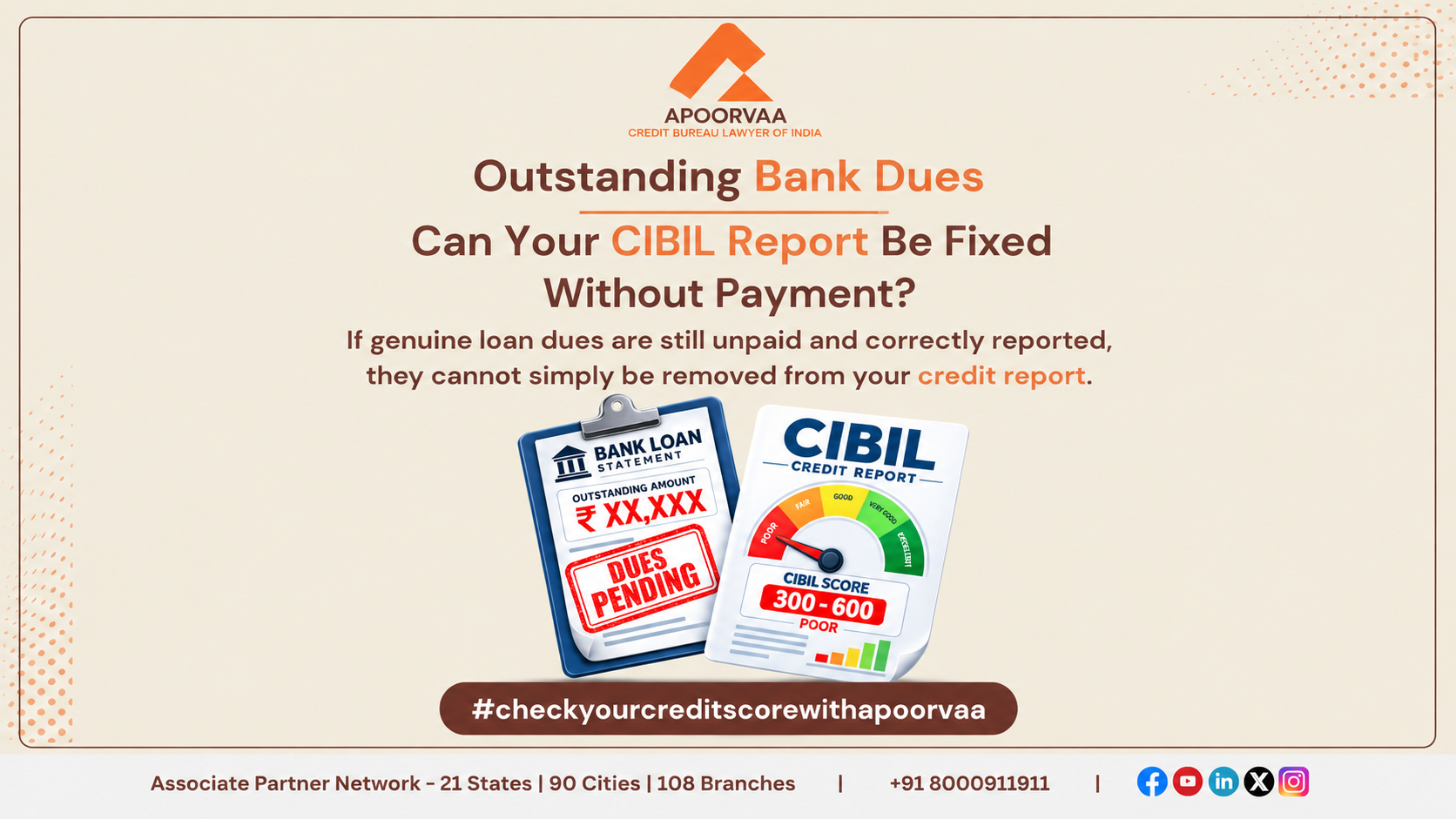
Outstanding Bank Dues are one of the most important issues to understand before trying to rectify a CIBIL Report. If genuine loan dues remain unpaid and the lender is accurately reporting those dues, you cannot simply make that liability disappear from your credit report through a dispute or a so-called CIBIL correction.
A question we frequently receive is:
“I currently don’t have the money to pay my outstanding bank loan. Can my CIBIL Report still be fixed without making the payment?”
This question often comes from someone facing genuine financial difficulty.
Perhaps a business suffered losses.
Perhaps income stopped unexpectedly.
Perhaps several EMIs accumulated.
Or perhaps an old loan has remained unpaid for years and the borrower now wants to improve the credit profile before applying for another loan.
Whatever the reason, one principle needs to be understood:
Credit-report rectification and repayment of a genuine financial liability are two different things.
If the bank is reporting information incorrectly, that reporting issue can be examined.
But if the underlying dues are genuine and remain unpaid, simply raising a credit-bureau dispute does not extinguish the repayment obligation.
What Are Outstanding Bank Dues?
Suppose you took a loan of ₹10 lakh from a bank.
You repaid the loan regularly for some time, but later stopped paying the EMIs.
An amount consequently remains payable under the loan account.
That outstanding amount is not merely a “CIBIL problem.”
There is an underlying borrower-lender relationship and repayment obligation.
The credit report reflects information relating to that credit facility as reported by the lender.
Depending on the account and its history, the report may contain information relating to:
- Current balance
- Amount overdue
- Payment history
- DPD
- Account status
- Date of last payment
- Written-off or settled status, where applicable
- Other account-related information
Therefore, when someone says:
“Mera CIBIL kharab hai,”
the first question should not always be:
“How do we increase the score?”
The better question is:
“What exactly is being reported in the credit account, and why?”
Credit Rectification Cannot Erase a Genuine Debt
This distinction is fundamental.
Suppose your credit report accurately shows:
Outstanding balance: ₹2,00,000
and you genuinely owe ₹2,00,000 to the lender under the loan account.
You cannot convert that accurate information into an error simply because the outstanding balance is affecting your credit profile.
Credit Rectification is appropriate when reported information genuinely requires verification or correction.
For example:
Situation A: The lender’s records show ₹2,00,000 genuinely remains outstanding.
That is an underlying repayment issue.
Situation B: You have already paid the amount, but the report continues to show an incorrect outstanding balance.
That may be a reporting issue requiring verification and appropriate updating.
These two situations should never be treated as the same problem.
The objective of credit rectification should be:
Correct inaccurate information—not delete accurate financial history.
“Someone Told Me They Can Fix My CIBIL Without Paying the Bank”
This is where borrowers need to be particularly cautious.
You may come across claims such as:
“Bank ka payment karne ki zaroorat nahi.”
“Outstanding amount rehne do, CIBIL se account hata denge.”
“Bank ko kuch mat do; hum negative entry remove karwa denge.”
Before relying on such a promise, ask a very simple question:
“If I genuinely owe this money to the lender, on what factual basis will the accurately reported outstanding liability be treated as incorrect?”
A dispute mechanism exists to address inaccuracies.
It should not be presented as a method for escaping a genuine repayment obligation.
If the debt itself is genuine, the borrower needs to address the underlying position with the concerned lender.
What If You Currently Don’t Have Money to Pay the Dues?
This is the practical difficulty behind today’s question.
A borrower may understand that the dues are genuine but simply not have sufficient funds available today.
In that situation, the answer should not be to create a false dispute.
Instead, the borrower needs to understand the actual financial position and communicate appropriately with the lender.
Depending on the facts and the lender’s policies, the borrower may need to explore the available legitimate course of action and determine how the outstanding obligation can eventually be resolved.
What should be avoided is the belief:
“Until I have money, I will somehow get the dues deleted from CIBIL first.”
If the outstanding information is genuine and accurately reported, credit-report correction cannot legitimately be used as a substitute for resolving the underlying dues.
Should You Wait Until You Have the Money?
If you genuinely cannot pay the required amount immediately, do not borrow irresponsibly from multiple new sources merely to create the appearance of resolving the old problem.
At the same time, do not ignore the account indefinitely.
Understand:
- How much is actually outstanding
- How the lender has calculated the amount
- Current account status
- Interest and applicable charges
- Whether recovery proceedings exist
- What repayment or resolution options the lender is willing to consider
- How any proposed resolution may subsequently be reported to credit bureaus
This is particularly important because not every method of resolving an outstanding loan has the same credit-reporting consequence.
For example, paying the contractual dues and closing an account is not necessarily the same as accepting a settlement for less than the amount contractually payable.
Borrowers should understand that distinction before agreeing to any proposal.
Payment and Credit-Report Update Are Two Separate Steps
Another important misconception is:
“Bank ko payment kar diya, ab CIBIL automatically perfect ho jayega.”
Payment addresses the financial obligation.
Credit-report updating is the subsequent reporting process.
Suppose you resolve the amount payable to the lender.
You should then maintain the appropriate documentation relating to the account, which may include, depending on the facility and circumstances:
- Payment receipts
- Loan closure confirmation
- No-dues / no-objection documentation, where applicable
- Account statement
- Settlement or closure correspondence
- Other relevant lender records
The updated information subsequently reported by the lender should then be reviewed in the credit report.
This is why the correct process is not simply:
Pay → Forget.
A more responsible approach is:
Understand dues → Resolve appropriately → Obtain documentation → Check subsequent credit reporting.
Does a No-Due Certificate Automatically Delete Past History?
No.
This is another important distinction.
A no-dues or closure document can establish that the relevant obligation has been addressed according to the lender’s records.
But it should not be interpreted as a document that automatically erases every historical fact relating to the account.
For example, if there were genuine payment delays in the past, those historical delays do not necessarily become inaccurate merely because the account is subsequently paid or closed.
The objective after resolving the dues should be to ensure that the current account information is appropriately and accurately reported.
Credit history and current outstanding liability are related—but they are not identical.
Genuine Dues vs Incorrect Outstanding Balance
This is the distinction every borrower should understand.
Genuine Outstanding Dues
You borrowed the money.
The amount remains payable.
The lender’s reporting accurately reflects the outstanding position.
This is primarily a repayment/liability issue.
Incorrect Outstanding Balance
You have already made the required payment or the lender’s own records support a different balance, but the credit report continues to show inaccurate information.
This may be a credit-reporting issue requiring verification and correction.
Unknown Loan Account
A loan appears in your report that you genuinely never took.
This is an ownership/reporting issue and requires a different investigation.
Putting all three situations under the label “CIBIL problem” leads to incorrect solutions.
The nature of the problem must first be identified.
Can You Dispute Genuine Outstanding Bank Dues?
A dispute should not be raised merely because accurate information is negatively affecting your score.
If the reported outstanding amount is genuinely incorrect, there can be a legitimate reason to seek verification.
But if the amount is accurate and remains payable, repeatedly disputing it does not transform the debt into incorrect information.
The correct question is therefore not:
“Can this negative entry be removed?”
It is:
“Is this information accurate?”
If yes, address the underlying obligation.
If no, identify the discrepancy and follow the appropriate rectification process.
Settlement and Full Payment Are Not the Same
When Outstanding Bank Dues remain unpaid, borrowers sometimes consider settlement because the amount offered by the lender may be lower than the total amount payable.
For example, suppose a borrower has a substantial outstanding amount and the lender agrees to accept a lower amount as settlement.
From an immediate cash-flow perspective, this may appear attractive.
But borrowers should understand that:
Settlement and full repayment/closure are not the same thing.
If the lender accepts less than the contractual amount payable and reports the account accordingly, a settlement-related status may become part of the credit history.
Therefore, a borrower should not agree to settlement only because:
“Kam amount bharna padega aur CIBIL bhi theek ho jayega.”
Before accepting any settlement proposal, understand:
- Total contractual dues
- Amount being waived
- Amount required under the settlement
- How the lender proposes to close the account
- How the account will subsequently be reported
- Documentation that will be issued after payment
A short-term reduction in payment should be evaluated along with its possible longer-term credit implications.
What Should Happen After the Outstanding Dues Are Paid?
Once the genuine dues have been appropriately resolved with the lender, the process should not end with making the payment.
The borrower should preserve documentary evidence.
Depending on the account, this may include:
- Final payment receipt
- Loan account statement
- Closure letter
- No Due Certificate / NOC, where applicable
- Relevant correspondence with the lender
After that, the borrower should review the credit report after the lender’s reporting process has had an opportunity to reflect the updated account information.
Check whether:
- Current balance has been appropriately updated
- Overdue amount has been updated
- Account status reflects the lender’s records
- Closure information is accurate
- Payment history is correctly associated with the account
The objective is not to erase genuine historical information.
The objective is to ensure that the report accurately reflects the current position after resolution of the dues.
“I Have Paid the Bank, But My CIBIL Report Still Shows Outstanding”
This is fundamentally different from:
“I haven’t paid the bank, but I want the outstanding removed.”
Suppose the borrower has made the required payment and possesses the relevant lender documentation, but the credit report continues to show an outstanding balance inconsistent with the lender’s records.
Now there may be a genuine reporting issue requiring verification.
The borrower should first compare:
Lender records
vs.
Credit-report information
If there is a discrepancy, it can be taken up with the concerned lender and through the appropriate credit-bureau dispute/grievance process.
This is where genuine Credit Rectification becomes relevant.
The distinction remains:
Unpaid genuine dues → underlying liability must be addressed.
Paid dues but inaccurate reporting → reporting discrepancy may require rectification.
Don’t Expect Payment to Erase Genuine DPD
Suppose you had several delayed EMIs before eventually paying the entire outstanding amount.
After closure, you may ask:
“Ab maine pura payment kar diya. Purana 30, 60, 90 DPD bhi zero ho jayega?”
Not necessarily.
DPD reflects payment behaviour reported for particular historical periods.
If you genuinely paid an EMI 90 days late, subsequently clearing the loan does not make that historical delay factually incorrect.
What should change appropriately is the current position of the account after payment.
This distinction matters because many borrowers expect:
Full payment = complete deletion of all negative history.
That should not be promised.
Payment resolves the outstanding financial obligation. Accurate historical repayment information is a separate matter.
Can an Old Written-Off Account Be Fixed Simply by Paying Something?
Not automatically.
If an account has previously been reported with a written-off, settled or other adverse status, the borrower first needs to understand the lender’s current records and what amount, if any, the lender requires for further resolution.
Do not assume:
“Original outstanding amount was ₹1 lakh, I paid ₹40,000 years ago, so only ₹60,000 will always be required now.”
The amount claimed by the lender may depend on the account terms, previous settlement, applicable interest or charges and the lender’s records.
Before making payment:
- Obtain clarity from the lender.
- Understand the amount being demanded.
- Understand the proposed account treatment.
- Obtain the terms in writing wherever possible.
- Preserve proof of payment and closure documentation.
Do not make a payment solely because someone promises that a particular CIBIL status will disappear immediately afterwards.
What If You Cannot Pay the Entire Outstanding Amount Today?
Financial difficulty is real, and not every borrower can immediately arrange the entire amount demanded by the lender.
But inability to pay today does not turn genuine dues into a credit-reporting error.
If you are unable to clear the amount immediately, the practical approach is to understand your position with the lender rather than trying to artificially alter the credit report.
Depending on the facts and the lender’s policies, communication may involve understanding possible repayment arrangements or other legitimate resolution options.
However, carefully understand the credit-reporting consequences of any arrangement before accepting it.
The objective should be to make an informed financial decision, not merely to obtain a quick change in the CIBIL Report.
How Apoorvaa Analyses Outstanding Bank Dues Cases
When someone approaches Apoorvaa – Credit Bureau Lawyer of India regarding Outstanding Bank Dues, the first question should not be:
“How quickly can this negative account be removed?”
The case first needs to be classified correctly.
Step 1: Review the Credit Report
We examine the relevant credit facility and understand:
- Account ownership
- Account type
- Current balance
- Amount overdue
- Payment history
- DPD
- Account status
- Reporting dates
- Other relevant observations
Step 2: Establish Whether the Liability Is Genuine
Did the borrower actually take the loan?
Does the borrower acknowledge that an amount remains payable?
Does the lender’s documentation support the outstanding position?
This determines whether the matter primarily concerns repayment or reporting accuracy.
Step 3: Compare Lender Records With Credit-Bureau Reporting
If payment has already been made, the next question becomes:
Does the credit report accurately reflect the lender’s current records?
For example:
Lender says the account has been closed, but the report continues to show an incorrect current balance.
That deserves investigation.
Step 4: Identify the Correct Course of Action
Depending on the facts, the matter may require:
- Resolution of genuine outstanding dues
- Obtaining lender documentation
- Verification of the amount claimed
- Correction of inaccurate account information
- Communication with the concerned lender
- Credit-bureau dispute where justified
- Follow-up after subsequent reporting
There is no responsible one-line solution for every case.
Credit Rectification Is Not Debt Waiver
This deserves to be stated clearly.
Credit Rectification does not mean that a genuine debt disappears.
Suppose a borrower genuinely owes a bank ₹3 lakh.
The credit report accurately reflects the unpaid loan.
The borrower cannot use the credit-bureau dispute mechanism simply to convert ₹3 lakh outstanding into ₹0 without an underlying factual basis.
Now suppose the borrower has already cleared the required amount and the lender’s records confirm closure, but the credit report incorrectly continues to show ₹3 lakh outstanding.
That is different.
There is now a potential discrepancy between the lender’s actual records and the credit information being displayed.
That distinction is central to responsible Credit Rectification.
Be Careful With “CIBIL Fix Without Bank Payment” Claims
Borrowers facing financial difficulty can be particularly vulnerable to unrealistic promises.
Be cautious if someone guarantees:
“Bank ko paisa mat do.”
“Hum outstanding hata denge.”
“Payment ke bina CIBIL clean ho jayega.”
“Negative account delete karwa denge.”
Before paying anyone for such a service, determine whether the reported information is actually inaccurate.
If the information is accurate, simply calling it a “CIBIL error” does not make it one.
A legitimate rectification process begins with evidence and verification, not a guaranteed promise to delete negative information.
Common Mistakes to Avoid
1. Treating Genuine Dues as a CIBIL Error
An unpaid genuine liability and an inaccurate credit-report entry are different issues.
2. Raising Repeated Disputes Without a Factual Basis
A dispute mechanism is intended to address information requiring verification or correction.
3. Paying Without Understanding the Account Status
Before making a substantial payment, understand the lender’s demand and the proposed treatment of the account.
4. Accepting Settlement Only to Improve CIBIL
Understand the difference between settlement and full repayment before making the decision.
5. Not Collecting Closure Documents
Always preserve relevant payment and account-resolution records.
6. Assuming Payment Deletes Historical DPD
Genuine historical payment delays do not automatically become inaccurate after the account is paid.
7. Not Checking the Report After Resolution
After resolving the account, review subsequent credit reporting to ensure that the updated position is reflected accurately.
Practical Checklist for Outstanding Bank Dues
If your CIBIL Report shows unpaid bank dues:
✔ Obtain your latest complete credit report.
✔ Identify the relevant loan account.
✔ Confirm whether the account belongs to you.
✔ Check the current balance and overdue amount.
✔ Compare the report with lender statements and records.
✔ Understand how much the lender currently claims is payable.
✔ Do not assume an accurate outstanding balance can simply be deleted.
✔ Understand settlement consequences before accepting any offer.
✔ Obtain appropriate documentation after resolving the dues.
✔ Review the credit report after subsequent lender reporting.
✔ If paid information remains inaccurate, take up the discrepancy with the lender and credit bureau.
The sequence should be:
Identify → Verify → Resolve Genuine Dues → Document → Check Reporting → Rectify Inaccuracies
Frequently Asked Questions
Can my CIBIL Report be fixed without paying outstanding bank dues?
If genuine dues remain unpaid and are accurately reported, they cannot simply be treated as an error and removed through credit rectification. The underlying liability needs to be appropriately addressed with the lender.
Can someone delete my outstanding loan without payment?
Be cautious of such claims. If the loan and outstanding amount are genuine and accurately reported, there must be a legitimate factual basis for any correction.
What if I don’t have money to pay right now?
Understand the exact outstanding position and communicate with the lender regarding legitimate available options. Do not create a false credit-report dispute merely because immediate repayment is difficult.
Will my CIBIL Score immediately become good after payment?
Payment can resolve the outstanding liability, but the credit score depends on the overall credit profile. No responsible professional should guarantee a particular score or an immediate fixed increase merely because one account has been paid.
Should I take a settlement if I cannot pay the full amount?
Settlement may have credit-reporting consequences. Understand the lender’s terms, amount waived and proposed account reporting before accepting it.
What if I have already paid but my report still shows outstanding?
Compare your lender documents with the credit report. If the reported balance or account status is genuinely inaccurate, take the matter up with the lender and use the appropriate credit-bureau dispute process where required.
Does a No Due Certificate remove old DPD?
A No Due Certificate or closure documentation does not automatically make genuine historical payment delays inaccurate. It primarily helps establish the resolved position of the account.
What if the outstanding loan is not mine?
That is a different issue. An unknown loan account requires verification of ownership and appropriate action with the concerned lender and credit bureau.
Final Thoughts
The most important lesson about Outstanding Bank Dues is simple:
A credit-report problem cannot be separated from the underlying financial reality.
If you genuinely borrowed money and genuine dues remain unpaid, the solution is not to search for a way to make the account disappear from the CIBIL Report.
The underlying obligation must first be understood and appropriately addressed.
At the same time, borrowers have every reason to expect accurate credit reporting.
If the dues have already been resolved but the credit report continues to display incorrect information, that is a different matter and may require verification and rectification.
So always separate:
Genuine unpaid dues → resolve the underlying liability.
Incorrect reporting → verify and rectify the discrepancy.
Paid/closed account → preserve documentation and verify subsequent reporting.
Credit Rectification should correct inaccurate information. It should never be presented as a shortcut for eliminating a genuine financial obligation.
About the Author
Advocate Apurva Bhagat is the Founder of Apoorvaa – Credit Bureau Lawyer of India and works in the field of Credit Rectification, Credit Report analysis and credit-related borrower guidance.
Through his professional practice and credit-awareness initiatives, he focuses on helping individuals and businesses understand the difference between genuine financial obligations and genuine credit-reporting discrepancies, so that credit issues are approached through the appropriate process rather than shortcuts or unrealistic promises.

CIBIL Rectification: How To Verify Your Report Is Corrected
[…] Outstanding Bank Dues: Can CIBIL Be […]
Good CIBIL Score But Loan Rejected? Understand Why
[…] Outstanding Bank Dues: Can CIBIL Be Fixed Without Payment? […]
CIBIL Rectification: Why Choosing The Right Expert Matters
[…] Outstanding Bank Dues: Can CIBIL Be Fixed Without Payment? […]
Why Is Your CIBIL Report Bad? 10 Factors That May Be Affecting Your Credit Profile
[…] Outstanding Bank Dues: Can CIBIL Be Fixed Without Payment? […]
Write-Off In CIBIL Report: Does It Mean Your Loan Is Waived?
[…] Outstanding Bank Dues: Can CIBIL Be Fixed Without Payment? […]