




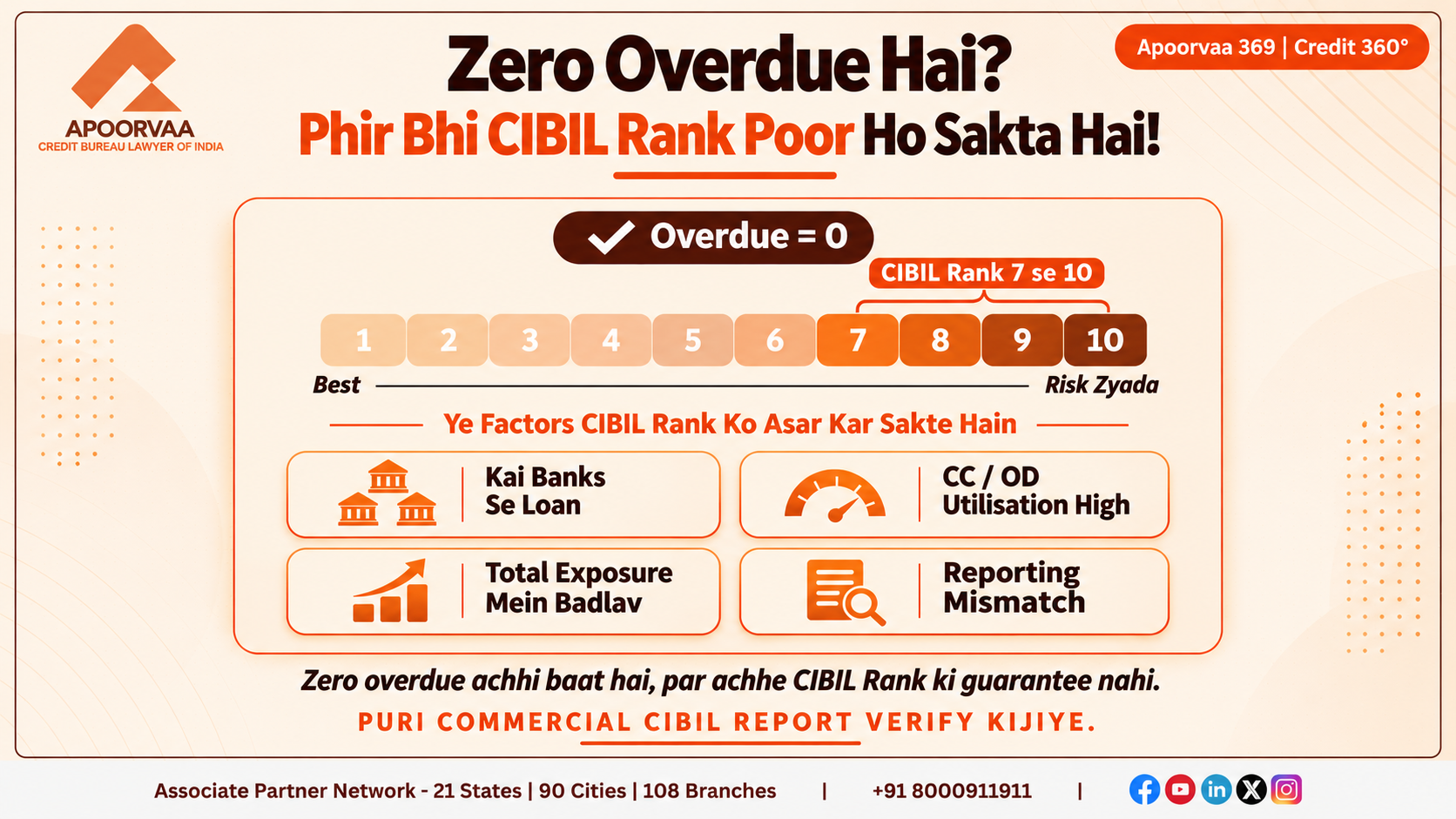
“My company has no overdue payments, so why is its CIBIL Rank still 7?”
This question reflects a common misunderstanding among business owners.
A company may be servicing its loan instalments and working-capital interest regularly, with no current overdue amount appearing in its Commercial Credit Report.
Yet its CIBIL MSME Rank may be 7.
Does this indicate an error in the report?
Not necessarily.
A company’s commercial credit-risk assessment is broader than its current overdue position. Understanding this distinction is essential before concluding that the Rank is incorrect or that rectification is required.
1. Why Is My Company’s CIBIL Rank 7 Despite Zero Overdue?
A zero overdue amount indicates that no amount is currently reported as overdue in the relevant account information.
However, it does not establish that the company’s entire credit-risk profile falls within the lowest-risk category.
Commercial credit assessment may consider repayment behaviour, credit utilisation, outstanding borrowing and other characteristics of the company’s credit history.
For example, a business may have no overdue payments while operating several credit facilities close to their sanctioned limits.
Another company may have cleared earlier payment delays but still have historical repayment information reflected in its report.
Neither situation automatically establishes that Rank 7 is incorrect.
The exact ranking methodology is proprietary, and the Rank cannot reliably be explained by examining only one field.
2. What Does CIBIL Rank 7 Mean for a Business?
The CIBIL MSME Rank, commonly referred to as CMR, is a credit-risk indicator issued by TransUnion CIBIL for eligible MSMEs.
It ranges from 1 to 10.
CMR-1 represents the lowest relative credit risk, while CMR-10 represents the highest.
A Rank of 7 indicates a relatively higher assessed risk than lower-numbered ranks.
However, CMR-7 does not independently establish that a company has defaulted, that its accounts contain errors or that a lender must reject its loan application.
Lending decisions also depend on financial performance, repayment capacity, security, facility structure and the lender’s applicable credit policies.
Likewise, CMR-1, CMR-2 or CMR-3 does not guarantee approval or preferential interest rates.
3. Does Zero Overdue Guarantee CIBIL Rank 1–3?
No.
Current overdue and overall commercial credit risk are different concepts.
Current overdue represents a reported unpaid amount as of a particular reporting position.
Commercial credit-risk assessment evaluates a broader set of information.
Relevant characteristics may include:
- Past repayment behaviour.
- Utilisation of available credit facilities.
- Total outstanding credit exposure.
- Changes in borrowing patterns.
- Other information considered under the applicable ranking methodology.
These factors should not be interpreted as a fixed formula for determining Rank 7.
A company can maintain zero current overdue while still having credit characteristics associated with a higher assessed risk.
4. How Can Working-Capital Utilisation Affect Commercial Credit Assessment?
Cash-credit and overdraft facilities are widely used by MSMEs to finance working-capital requirements.
Consider a company with a sanctioned cash-credit limit of ₹1 crore.
If the outstanding balance consistently remains around ₹95 lakh, the facility operates at approximately 95% utilisation.
The company may still be servicing interest in accordance with the sanctioned terms and have no overdue amount.
Nevertheless, sustained high utilisation may be relevant to an assessment of available financial flexibility and overall borrowing exposure.
The same consideration may arise where several revolving facilities are being utilised heavily.
However, high utilisation does not automatically produce CMR-7 or any other specific Rank.
The full commercial credit profile must be considered.
Is Paying Only Interest on a Cash-Credit Facility Irregular?
Not necessarily.
Working-capital facilities may permit interest servicing without fixed monthly principal instalments.
Where such arrangements are authorised under the facility terms and the account is operated accordingly, interest-only servicing is not inherently a repayment irregularity.
The contractual conditions, account operation and reported information must be examined before drawing conclusions.
5. Can New Borrowing and Increased Credit Exposure Matter?
A growing company may obtain new term loans, equipment finance or additional working-capital facilities within a short period.
Such borrowing may support legitimate business expansion.
However, the company’s total credit exposure and borrowing structure may change.
These changes can be relevant to commercial credit-risk assessment, even when all current payments are regular.
It would be incorrect to conclude that every newly opened loan negatively affects CIBIL Rank.
Equally, zero overdue alone does not establish that increased borrowing exposure has no relevance to the overall credit profile.
A responsible interpretation requires analysis of the company’s complete reported credit information.
6. Why Historical DPD May Matter Even When Current Overdue Is Zero
One important distinction in commercial credit reporting is the difference between current overdue amounts and historical repayment behaviour.
DPD stands for Days Past Due. It reflects how many days a payment was overdue according to the relevant repayment obligations and reported account information.
A company may have cleared all outstanding overdue amounts today, but its Commercial Credit Report may still contain historical repayment delays.
For example, an earlier instalment may have been paid after its contractual due date. Even after the payment is cleared, the historical repayment information may remain relevant to the company’s credit profile.
However, historical DPD should not automatically be assumed to be the reason for CIBIL Rank 7.
The complete report and underlying account records must be examined.
7. Standing Instructions, Interest Payments and Reporting Accuracy
Many MSMEs rely on standing instructions for loan instalments and interest payments.
Sometimes, the actual debit date may differ from the expected payment date.
However, a delayed debit does not automatically establish a bank error or incorrect DPD reporting.
The following information may be relevant:
- Contractual repayment or interest due dates.
- Actual payment and debit dates.
- Availability of sufficient funds.
- Standing-instruction terms.
- Applicable sanction conditions.
- The lender’s account records.
Similarly, interest-only servicing of a cash-credit or overdraft facility is not inherently irregular when permitted under the sanctioned facility terms.
A reporting discrepancy can only be established by examining the relevant facts.
8. When Should a Company Investigate Incorrect Credit Information?
A relatively high CIBIL Rank does not, by itself, establish that a Commercial Credit Report contains an error.
However, investigation may be appropriate when the report contains information inconsistent with verified records.
Examples include an incorrect outstanding balance, inaccurate overdue amount, wrongly reported repayment history or incorrect account status.
Under India’s credit-information regulatory framework, credit institutions and credit information companies have responsibilities concerning credit-information accuracy and dispute resolution.
Where a genuine discrepancy exists, the concerned lender and credit information company may need to verify and correct the information through the applicable process.
The objective is accurate reporting, not obtaining a predetermined CIBIL Rank.
Even after a legitimate correction, improvement to a particular Rank cannot be guaranteed.
9. Why Regular Commercial Credit-Report Analysis Matters
Commercial credit information can be relevant when MSMEs seek business loans, renew cash-credit limits or apply for additional working capital.
Regular analysis helps business owners understand their reported borrowing facilities, outstanding balances, repayment history and account statuses.
It also helps distinguish genuine credit-risk characteristics from possible reporting discrepancies.
A company should not assume that zero overdue guarantees CMR-1, CMR-2 or CMR-3.
Equally, CMR-7 should not automatically be treated as evidence of a reporting error.
Professional Perspective
As a professional working in credit-information matters, I believe commercial credit reports should be understood in their entirety.
Business owners often concentrate on whether an overdue amount is currently visible.
However, repayment history, utilisation of working-capital facilities and overall borrowing exposure deserve equal attention.
Where information is inaccurate, appropriate verification and rectification may be necessary.
Where the information is accurate, the company must understand its broader credit-risk position rather than seek unsupported guarantees of Rank improvement.
Conclusion
Zero overdue is a positive indicator, but it does not guarantee a CIBIL Rank between 1 and 3.
A company may have CIBIL Rank 7 despite having no current overdue because commercial credit-risk assessment extends beyond one reporting field.
The exact reason for a particular Rank cannot necessarily be identified from a single factor, especially because TransUnion CIBIL’s detailed ranking methodology is proprietary.
Before assuming that a Rank is incorrect, business owners should examine their complete Commercial Credit Report.
The purpose of genuine credit rectification is accurate credit information—not a guaranteed Rank or loan approval.
Professional Company Credit Report Analysis — Apoorvaa
Is your company’s CIBIL Rank unexpectedly high despite zero current overdue?
Apoorvaa provides professional Commercial Credit Report analysis and rectification assistance for MSMEs and companies.
Our services focus on understanding the company’s reported credit profile and identifying genuine reporting discrepancies that may require verification.
Get your Company Credit Report professionally analysed by Apoorvaa.
📞 8000 911 911
Apoorvaa – Credit Bureau Lawyer of India
Related Credit Education
- Wrong Mobile Number or Address in CIBIL Report: Is It Fraud?
- Director’s CIBIL Is Poor: Will the Company’s CIBIL Rank Be Affected?
- Temporary CIBIL Rectification: Can CIBIL Be Fixed for Just 2 Months?
About the Author
Advocate Apurva Bhagat is the Founder of Apoorvaa – Credit Bureau Lawyer of India. Through his articles and educational initiatives, he helps borrowers understand credit reports, banking practices, and informed financial decision-making. His objective is to promote financial awareness through practical and responsible guidance.

Comments are closed