




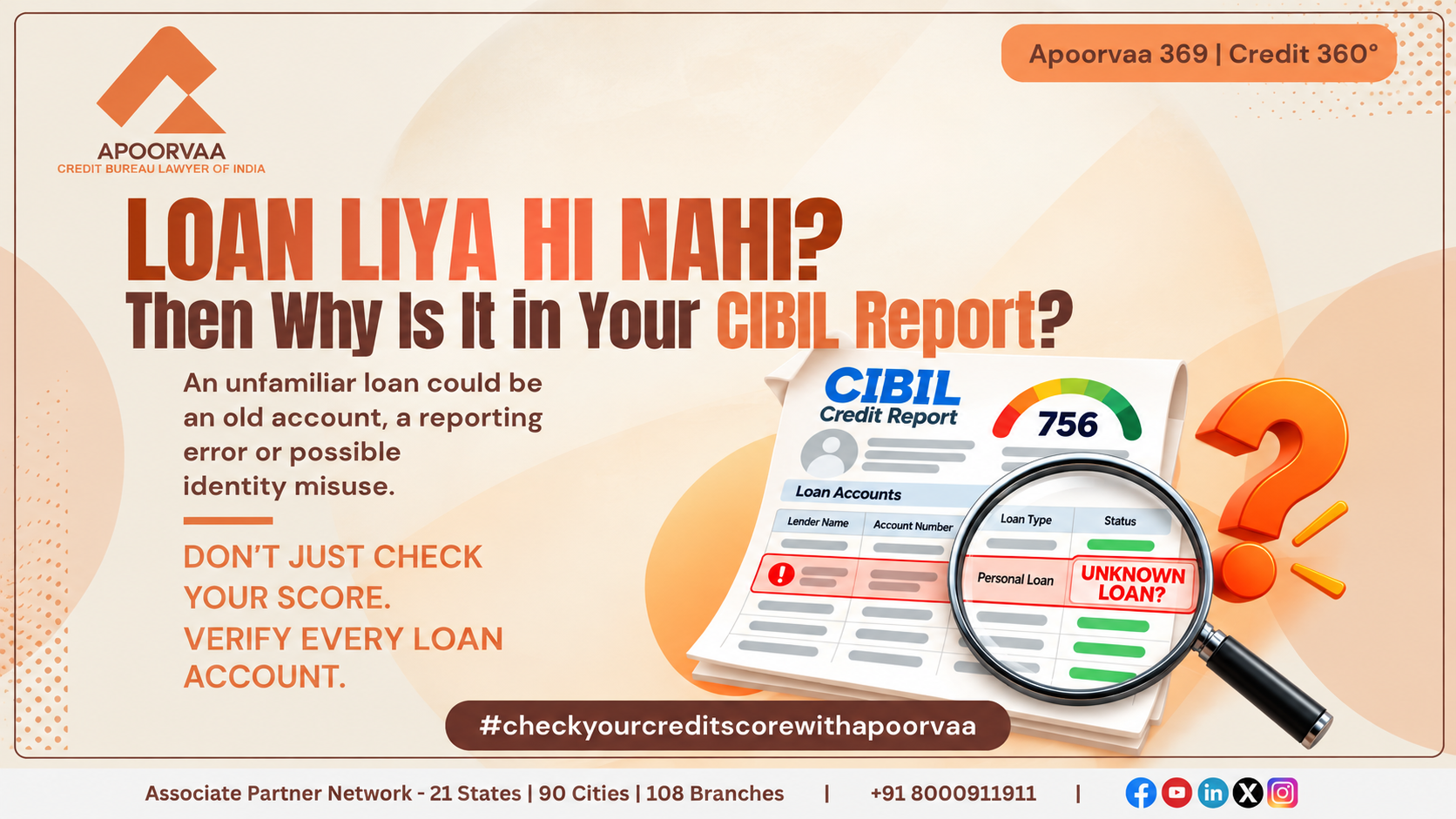
“I never took this loan. Why is it appearing in my CIBIL Report?”
This is a concern we frequently hear from customers who contact Apoorvaa’s helpline.
A customer checks the CIBIL Report and discovers a personal loan, business loan, credit card or another credit facility that they do not recognise.
Sometimes, the customer is certain that the loan does not belong to them.
In other cases, the customer simply cannot remember taking the loan.
The concern becomes more serious when the unfamiliar account carries an outstanding balance, overdue amount, settlement classification or write-off-related information.
The customer may ask:
“If I have never taken this loan, why should it affect my credit profile?”
It is a reasonable question.
However, before concluding that the account is incorrectly reported, the first requirement is to establish what the entry represents and whether the credit facility genuinely belongs to the customer.
An unfamiliar loan in a CIBIL Report should not be ignored.
Equally, it should not automatically be described as fraud.
There are several possible explanations, and each requires a different interpretation.
Why Is a Loan You Do Not Recognise Showing in Your CIBIL Report?
A CIBIL Report contains information about credit facilities reported against an individual’s credit profile.
These may include personal loans, home loans, vehicle loans, credit cards and other credit arrangements.
The report may also contain information relating to the individual’s role in a credit facility, such as individual borrower, joint borrower or guarantor.
TransUnion CIBIL’s official guidance explains that the Account Information section contains details including the lender’s name, account number, account type, ownership information, opening date, current balance and payment history.
When a customer discovers an unfamiliar loan, three possibilities deserve consideration.
1. The Loan May Be Genuine but Forgotten
The customer may have taken the loan several years earlier and no longer remember the account details.
2. The Loan May Be Incorrectly Attributed to the Customer
The credit facility may belong to another individual but appear against the customer’s credit profile because of an account-association or reporting discrepancy.
3. The Loan May Involve Possible Identity Misuse
Someone may have obtained or attempted to obtain credit using the customer’s personal information without authorisation.
These situations are not interchangeable.
The correct response depends on establishing which situation actually applies.
Situation 1: The Unknown Loan Is Actually an Old or Forgotten Account
A customer may say:
“I have never taken a loan from this bank.”
However, after examining the account information, the customer may recognise an earlier credit facility.
The account could relate to a loan taken 10 or 15 years ago.
It may have been associated with an earlier residence, business, employer or financial requirement.
The customer may also remember the loan by the name of a dealer, finance company or original lender rather than the institution currently appearing in the report.
For example, an individual may have financed a vehicle many years ago but no longer remember the account number or the precise name of the financing institution.
Another customer may have acted as a joint borrower or guarantor and may not initially associate that obligation with a loan appearing in the Credit Report.
The fact that an account is unfamiliar does not establish that it belongs to someone else.
Why Account Ownership Matters
TransUnion CIBIL identifies ownership information as part of the Account Information section of the Credit Report.
The ownership field helps explain the capacity in which an individual is associated with a credit facility.
An individual borrower, joint borrower and guarantor do not necessarily have the same role.
Therefore, a customer should not conclude that a credit facility is incorrectly attributed merely because they do not remember receiving the loan amount directly.
The actual relationship with the credit facility matters.
What If the Old Loan Is Genuine but Contains Negative Information?
This creates a different credit-reporting concern.
Suppose the customer recognises an old loan but discovers that it contains an overdue amount or an adverse account classification.
The question is no longer whether the loan belongs to the customer.
The question becomes whether the reported account information accurately reflects what happened.
For example:
- Was the loan repaid?
- Does the current balance reflect the actual account position?
- Is the reported overdue amount accurate?
- Does the account status correctly reflect how the facility was resolved?
An account can genuinely belong to a customer and still contain information that requires examination.
An account-ownership concern and an account-status concern are two different issues.
Situation 2: The Loan Does Not Belong to the Customer
Now consider a different situation.
A customer examines the CIBIL Report and identifies a loan account that cannot be connected to any credit facility they obtained, jointly held or guaranteed.
The lender name is unfamiliar.
The account details do not correspond with the customer’s credit history.
The customer maintains that the facility does not belong to them.
This may indicate an account-attribution concern.
TransUnion CIBIL expressly recognises ownership-related inaccuracies, including accounts or enquiries that do not belong to the individual, as a category of Credit Report dispute.
However, an unfamiliar lender name alone is not sufficient to establish incorrect attribution.
The underlying account relationship must be examined.
What Is an Incorrectly Attributed Loan Account?
An incorrectly attributed account is a credit facility that is associated with an individual’s Credit Report even though the reported relationship does not accurately reflect that individual’s credit history.
For example, a personal loan belonging to another borrower may appear in the customer’s report.
If the account also contains overdue balances or adverse repayment information, the customer may discover an apparent credit-profile concern that has no connection with their actual borrowing history.
This is why account ownership deserves attention independently of the numerical CIBIL Score.
A customer’s Credit Report should accurately represent the credit facilities associated with that customer.
Situation 3: Could an Unknown Loan Indicate Identity Misuse?
A third possibility requires particular care.
A customer may discover a loan that they did not apply for, authorise or receive.
The account may have been opened using personal information associated with the customer.
In some circumstances, this may raise concerns about possible identity misuse or unauthorised borrowing.
However, the presence of an unfamiliar account does not, by itself, prove identity theft.
The distinction matters because an ordinary credit-reporting discrepancy and suspected identity misuse may require different forms of investigation.
An Incorrectly Attributed Account
The credit facility may genuinely belong to another borrower but be incorrectly associated with the customer’s Credit Report.
The principal concern is the accuracy of the reported account association.
Possible Identity Misuse
The credit facility may have been obtained or attempted without the customer’s authorisation using their personal information.
The concern may extend beyond the Credit Report to the circumstances in which the credit facility was originated.
In suspected identity-misuse cases, a bureau dispute alone should not automatically be treated as a complete response. The lending institution’s investigation and, where appropriate, reporting to the relevant authorities may also matter.
India’s National Cyber Crime Reporting Portal provides an official mechanism for reporting cybercrime, including financial cyber fraud, and identifies 1930 as the national helpline for immediate reporting of cyber financial fraud.
The purpose of examining an unfamiliar loan is to establish the actual problem—not to label every unknown account as fraud.
Why Checking Only Your CIBIL Score Is Not Enough
Many customers check their CIBIL Score before applying for a home loan, car loan or business loan.
If the score appears satisfactory, they assume that their Credit Report does not contain any significant concern.
However, the CIBIL Score is a numerical summary derived from credit information.
It does not replace the detailed account-level information contained in the Credit Report.
A customer may focus on whether the score has increased or decreased without noticing an unfamiliar credit facility.
For example, the report may contain an account with:
| Account Field | Illustrative Information |
| Lender Name | An unfamiliar lending institution |
| Account Type | Personal Loan |
| Account Number | A number the customer does not recognize |
| Ownership | Individual |
| Current Balance | ₹1,85,000 |
| Amount Overdue | ₹24,000 |
| Account Status | Active |
This is an illustrative example, not an actual customer record.
The customer may be concerned about the CIBIL Score.
However, the more immediate question is:
“Why is this particular loan account associated with my credit profile?”
The score alone cannot answer that question.
Why Reviewing the Complete CIBIL Report Matters
When a customer identifies an unfamiliar loan, the complete Credit Report provides more context than a score-only display or summary.
TransUnion CIBIL’s official guidance identifies the Account Information section as the place to examine details of reported credit facilities.
Several fields are particularly relevant.
1. Lender Name
The reported lending institution may help the customer recognise an earlier credit facility.
However, an unfamiliar lender name is not conclusive evidence that the loan belongs to someone else.
2. Account Number
The account number can help distinguish one credit facility from another.
It is particularly relevant where a customer has held several loans or credit cards over time.
3. Account Type
The customer should understand whether the entry relates to a personal loan, vehicle loan, home loan, credit card or another credit facility.
This may help establish whether the account corresponds with a past borrowing arrangement.
4. Ownership Information
The ownership field is relevant to understanding whether the customer is reported as an individual borrower, joint borrower or guarantor.
An account may be unfamiliar because the customer does not immediately recognise the capacity in which they were associated with it.
5. Account Opening and Reporting Dates
The dates may help establish whether the account relates to an earlier period in the customer’s financial history.
The last reported date may also be relevant when examining whether information reflects a recent or older account position.
6. Current Balance and Amount Overdue
These fields help identify the reported financial position of the account.
An unfamiliar loan with a current balance or overdue amount may require closer attention than a customer would give to the numerical score alone.
7. Repayment History and Account Status
The reported repayment history and account classification may indicate whether the entry contains adverse information.
However, an adverse classification should not automatically be treated as incorrect merely because the customer does not recognise the account.
The ownership and underlying account facts must first be established.
The Complete Report Helps Identify the Right Question
After examining the account information, the customer may discover that:
- The account is genuine and correctly reported.
- The account is genuine, but some information appears inaccurate.
- The account does not appear to belong to the customer.
- The account raises concerns about possible unauthorised borrowing.
These findings lead to different credit-information concerns.
The objective of reviewing the complete report is to identify what requires examination—not simply to locate a negative remark and request its removal.
Does Checking Your Own CIBIL Report Reduce Your Credit Score?
Customers sometimes hesitate to obtain a detailed Credit Report because they believe every report request will create a credit enquiry and reduce their score.
This concern can prevent them from examining unfamiliar accounts promptly.
There is an important distinction between a consumer checking their own Credit Report and a lender accessing credit information during a credit application.
Checking your own CIBIL Report is not a lender-initiated hard credit enquiry and does not reduce your CIBIL Score merely because you checked it.
The customer should therefore not avoid reviewing their own detailed report out of fear that the self-check itself will harm the score.
The purpose of the review is to understand the credit information associated with the customer.
For someone who has discovered an unfamiliar loan, this is considerably more important than repeatedly checking only the numerical score.
Unknown Loan Account vs Unknown Credit Enquiry: Are They the Same?
No. An unfamiliar loan account and an unfamiliar credit enquiry are different concerns.
A loan account appears in the Account Information section and represents a reported credit facility.
A credit enquiry generally reflects an access to credit information associated with a credit application or assessment.
TransUnion CIBIL identifies Accounts and Enquiries as distinct sections of the Credit Information Report and recognises ownership disputes involving either accounts or enquiries.
Consider the difference:
| Unknown Loan Account | Unknown Credit Enquiry |
| A credit facility is reported against the customer | An enquiry is recorded against the customer |
| May contain a loan amount and outstanding balance | Does not itself establish that a loan was disbursed |
| May contain repayment history or overdue information | Relates to an access or credit-application event |
| Raises questions about the reported credit facility and ownership | Raises questions about the reported credit facility and ownership |
An unfamiliar enquiry should not automatically be described as proof that someone obtained a loan.
Likewise, an unfamiliar loan account should not be treated as merely an enquiry-related issue.
Correctly identifying the type of entry is essential to understanding the actual credit-reporting concern.
Why an Unknown Loan in Your CIBIL Report Should Not Be Ignored
An unfamiliar loan account is not merely an unexpected entry in a financial document.
It may represent a credit facility that is being associated with your credit profile, even though you do not recognise it.
The concern becomes particularly important when the account contains an outstanding balance, overdue amount or adverse repayment history.
Consider a customer who is preparing to apply for a home loan.
The customer believes all previous loans have been repaid. However, the CIBIL Report contains an unfamiliar personal loan with an outstanding balance and overdue information.
The customer may not discover this concern until the bank examines the Credit Report during the new loan application.
At that stage, the customer may face two separate questions:
Does this loan actually belong to me?
If it does not belong to me, why is its repayment information appearing against my credit profile?
These questions should be addressed before the customer assumes that the issue can be resolved simply by requesting removal of a negative remark.
How Can an Unknown Loan Affect Your Credit Profile?
An unfamiliar account may contain information that is relevant to the reported credit profile.
The potential concern depends on what the account shows.
| Information in the Unknown Loan | Why It May Matter |
| Outstanding balance | May appear as an existing credit obligation |
| Amount overdue | May indicate an unpaid amount |
| Adverse repayment history | May affect how the reported repayment record is assessed |
| Settlement classification | May indicate that a credit facility was resolved through settlement |
| Write-off information | May reflect an adverse account history |
| Incorrect ownership | May associate another person’s credit facility with the consumer |
TransUnion CIBIL explains that repayment history, credit utilisation and other aspects of a consumer’s credit behaviour are relevant to the CIBIL Score. Its guidance also encourages consumers to identify inaccurate information and unfamiliar loan accounts in their reports.
However, the presence of an unfamiliar account does not establish that it has already caused a particular loan rejection.
A lender may consider other information and eligibility criteria.
The immediate objective is to establish whether the account is correctly associated with the consumer and whether its reported information is accurate.
What If the Loan Is Yours but the Negative Information Is Incorrect?
Sometimes, the customer initially believes the loan does not belong to them.
After examining the lender name, account number, account type and earlier borrowing history, the customer recognises the credit facility.
However, the report may still contain a concern.
For example:
A customer took a vehicle loan several years ago.
The customer repaid the applicable amount and received closure confirmation.
The account is genuinely theirs, but the CIBIL Report continues to show an outstanding balance that appears inconsistent with the actual loan records.
In this situation, the issue is not incorrect account ownership.
The issue concerns the accuracy of the reported account information.
The same distinction applies where an account belongs to the consumer but contains an apparently incorrect overdue amount, repayment record or account status.
A Genuine Loan Can Still Contain a Genuine Reporting Discrepancy
It is important not to confuse these two questions:
Account ownership: Does the credit facility belong to the consumer?
Account accuracy: Does the information reported against that facility reflect the actual account history?
A customer may need professional Credit Report assessment even after confirming that the account is genuine.
What If the Loan Definitely Does Not Belong to You?
If the account does not belong to the consumer, the concern shifts to account attribution.
The consumer may have no borrowing relationship with the reported lender and no recognised connection with the credit facility.
This requires attention to the source and accuracy of the reported information.
An incorrectly attributed account is different from a genuine account carrying an incorrect outstanding balance.
In the first situation, the association between the consumer and the credit facility is disputed.
In the second, the credit facility belongs to the consumer, but one or more reported details may be inaccurate.
The distinction matters because the appropriate correction must address the actual reporting problem.
A customer who disputes ownership of a loan should not automatically be treated as someone who is merely disputing the amount overdue on their own account.
TransUnion CIBIL’s official dispute guidance distinguishes an ownership dispute—where an account does not belong to the consumer—from a dispute about individual fields of an account that does belong to the consumer.
Why the Lending Institution Matters in Credit Report Correction
Customers sometimes assume that TransUnion CIBIL can independently remove any entry they identify as incorrect.
However, the relationship between the lending institution and the credit bureau is important.
Credit institutions furnish account information to credit information companies.
When the accuracy of that information is disputed, the relevant lending institution may need to verify the underlying account position.
TransUnion CIBIL explains that it cannot make changes to a consumer’s Credit Report without confirmation from the concerned credit institution. Its dispute process involves referring the disputed information to the relevant institution and updating the report where applicable after receiving the institution’s response.
This is particularly relevant when the consumer states:
“I never took this loan. Why is the bank reporting it against my name?”
The issue may require examination of the actual credit facility and the basis on which it has been associated with the consumer.
A correction should accurately address that association rather than merely conceal an adverse remark.
Incorrect Credit Reporting and Suspected Identity Misuse Are Different Concerns
An unfamiliar loan may indicate an account-attribution discrepancy.
In some circumstances, it may also raise concerns about possible identity misuse.
These situations should not be treated as identical.
Where the Concern Is Incorrect Credit Reporting
The credit facility may belong to another individual but have been incorrectly associated with the consumer’s report.
The central concern is whether the reported account association is accurate.
Where the Concern Is Possible Identity Misuse
The consumer may have reason to believe that a credit facility was obtained without their authorisation using their personal information.
In that situation, the concern may extend to the circumstances in which the loan was applied for, approved or disbursed.
A Credit Report dispute may be relevant, but it should not automatically be assumed to address every aspect of suspected unauthorised borrowing.
The lending institution’s investigation and, where appropriate, reporting to the relevant authorities may also be necessary.
The Government of India’s National Cyber Crime Reporting Portal provides a mechanism for reporting cybercrime. Its official financial cyber fraud helpline is 1930.
An unfamiliar loan deserves investigation. It should not be labelled fraud without establishing the underlying facts.
What Rights Do Consumers Have When Credit Information Is Incorrect?
Credit-information accuracy is not merely a matter of customer convenience.
Incorrectly reported information may affect how a consumer’s credit profile is represented to lenders.
India’s regulatory framework recognises the importance of resolving complaints relating to credit information.
The Reserve Bank of India introduced a framework for compensation to customers for delayed updation or rectification of credit information.
Under that framework, eligible complainants may be entitled to compensation of ₹100 per calendar day where a qualifying complaint remains unresolved beyond 30 calendar days from the date of initial filing with a credit institution or credit information company. The applicability and responsibility for compensation depend on the framework’s conditions.
Does the 30-Day Framework Mean Every Unknown Loan Must Be Removed Within 30 Days?
No.
The existence of a complaint-resolution and compensation framework does not establish that every unfamiliar account is incorrect or must be deleted.
The reported account information still requires verification.
A genuine loan cannot properly be removed merely because the consumer does not remember it.
Similarly, an accurately reported adverse account status should not be changed solely because it is unfavourable.
The consumer’s interest is in timely, accurate and properly examined credit information—not an unsupported promise of account deletion.
Why Credit Report Rectification May Not Happen Overnight
Customers often discover unfamiliar loan entries when they urgently need a new credit facility.
They may be preparing to purchase a home, finance a vehicle, obtain business funding or apply for a shop loan.
The customer may explain:
“The bank has asked me to resolve this issue immediately. Can it be corrected by tomorrow?”
However, account-level Credit Rectification may involve more than changing information displayed on a report.
The actual concern may need to be established through the relevant account records and the reporting institution’s response.
Where possible identity misuse is suspected, the circumstances may require additional investigation.
The time required can therefore vary according to the nature of the concern, the available records and the response of the relevant institution.
It would be inappropriate to promise overnight correction or one fixed resolution period for every case.
An urgent loan requirement does not eliminate the need to establish the correct account facts.
Does Removing an Incorrectly Attributed Loan Guarantee Future Loan Approval?
No.
Suppose an account is established to have been incorrectly attributed to a consumer and the relevant Credit Report is corrected.
The correction may improve the accuracy of the information available for future credit assessment.
However, loan approval remains the lender’s decision.
The lender may also consider:
- Income and repayment capacity.
- Existing financial obligations.
- Employment or business profile.
- The requested loan amount.
- Accurately reported credit history.
- Its internal credit policy and eligibility requirements.
TransUnion CIBIL also clarifies that it does not approve or reject loan applications; that decision belongs to the lender.
The objective of Credit Rectification is accurate credit reporting—not guaranteed loan approval.
Why Regular Credit Report Monitoring Matters
A customer may check the CIBIL Score frequently without examining the underlying accounts.
That approach can leave an unfamiliar loan unnoticed.
Regularly reviewing the complete Credit Report helps consumers remain aware of the credit facilities associated with their profile.
This is particularly relevant before a significant financial requirement arises.
For example, a customer planning to purchase a home may benefit from understanding the reported credit profile before submitting a loan application.
If an unfamiliar account appears, there may be time to establish whether it is genuine, incorrectly attributed or potentially connected with unauthorised borrowing.
TransUnion CIBIL encourages consumers to review their Credit Reports regularly and identifies unfamiliar loan accounts as information that deserves attention. It also confirms that checking one’s own CIBIL Score and Report does not negatively affect the score merely because of the self-check.
Do Not Monitor Only the Score. Understand the Accounts Behind It.
A CIBIL Score cannot tell the complete story of why a particular loan is appearing.
The lender name, account number, ownership information, account dates, balance and repayment history provide essential context.
For an unfamiliar loan, those details are central to understanding the concern.
Frequently Asked Questions
1. Why is a loan I never took showing in my CIBIL Report?
The account may be an old or forgotten genuine loan, an incorrectly attributed credit facility or, in some circumstances, a possible case of unauthorised borrowing. The actual account relationship must be established before drawing a conclusion.
2. Does every unknown loan in CIBIL mean identity theft?
No. An unfamiliar loan does not automatically establish fraud or identity misuse.
3. Can an old loan appear in my CIBIL Report even if I no longer remember it?
Yes. A customer may not immediately recognise an older credit facility, its lender name or the capacity in which they were associated with it.
4. What if the loan belongs to me but the outstanding balance is wrong?
That is an account-information accuracy concern rather than an account-ownership concern. The reported balance should be considered against the actual account position.
5. Can an unknown loan affect my CIBIL Score?
The information associated with a reported account may be relevant to the credit profile and score. Its effect depends on the reported information and applicable scoring methodology.
6. Is an unknown credit enquiry the same as an unknown loan?
No. An enquiry does not itself establish that a loan was disbursed. A reported loan account and a reported enquiry are different entries.
7. Will checking my detailed CIBIL Report reduce my score?
No. Checking your own CIBIL Report does not constitute a lender-initiated hard credit enquiry or reduce your score merely because you checked it.
8. Can CIBIL remove an account immediately if I say it does not belong to me?
CIBIL cannot independently change reported account information without the relevant credit institution’s confirmation. The account concern requires examination through the applicable process.
9. Can an unknown loan be corrected overnight?
A fixed or overnight resolution should not be assumed. The time required depends on the nature of the concern and the necessary verification.
10. Will correcting an unknown loan guarantee my next loan application?
No. Accurate credit reporting supports informed assessment, but loan approval remains subject to the lender’s eligibility requirements and credit decision.
My Perspective: First Establish Whether the Loan Is Yours
When a customer tells me:
“Sir, I never took this loan. Why is it appearing in my CIBIL Report?”
My first concern is not simply whether the entry is negative.
I want to understand why that particular account is associated with the customer’s credit profile.
Sometimes, the customer recognises an old loan after examining the account details.
Sometimes, the loan is genuine, but its reported balance or status appears inconsistent with the actual records.
In other cases, the customer cannot establish any connection with the credit facility.
And in some circumstances, the facts may raise concerns about possible identity misuse.
These are different situations.
They should not all be described as fraud, and they should not all be treated as requests to remove a negative remark.
Before deciding what needs correction, establish what the account actually represents.
I also encourage consumers not to wait until a bank identifies the problem during an urgent loan application.
A home loan, car loan or business loan requirement may arise at an important stage of life.
Discovering an unfamiliar account only at that moment can create avoidable uncertainty.
Review your complete Credit Report regularly.
Understand the accounts associated with your credit profile.
And where the information appears inaccurate or the account relationship cannot be established, seek appropriate assistance.
Final Takeaway
Unknown Loan in CIBIL Report: What If You Never Took That Loan?
Do not ignore it.
But do not automatically assume that every unfamiliar account is fraudulent or incorrectly reported.
The loan may be genuine but forgotten.
It may belong to you while containing inaccurate account information.
It may be incorrectly attributed to your credit profile.
Or the circumstances may raise concerns about possible identity misuse.
The important first question is:
“Does this credit facility genuinely belong to me?”
Once the account relationship is understood, the actual reporting concern can be identified.
Your CIBIL Score is only one part of your credit profile. The accuracy of the accounts appearing behind that score matters just as much.
Professional Credit Report Assessment & Rectification
Found a loan in your CIBIL Report that you do not recognise?
An unfamiliar account with an outstanding balance, overdue amount or adverse status deserves attention—particularly when you are planning a home loan, car loan or business loan.
If you cannot establish why the account is appearing, or believe that genuine account information has been incorrectly reported, professional Credit Report assessment may help identify the nature of the concern.
Apoorvaa – Credit Bureau Lawyer of India provides professional Credit Report assessment and Credit Rectification services for individuals and businesses.
📞 8000 911 911
Apoorvaa – Credit Bureau Lawyer of India
Credit Rectification addresses genuine reporting concerns. It does not guarantee deletion of accurately reported information, overnight resolution or future loan approval.
Related Credit Education
- CIBIL Score 756 but Loan Rejected? Check All Four Credit Bureau Reports
- Hard Inquiry vs Soft Inquiry: What Is the Difference and How Do Credit Enquiries Affect Your CIBIL Report?
- Loan Closed but CIBIL Shows Settled? Understand the Difference
About the Author
Advocate Apurva Bhagat is the Founder of Apoorvaa – Credit Bureau Lawyer of India and works in the field of Credit Rectification, Credit Report analysis and credit-related borrower guidance.
Advocate Apurva Bhagat focuses on credit-bureau law, and helping individuals and businesses understand the distinction between contractual loan obligations, lender-reported account status and genuine credit-reporting discrepancies.

Comments are closed