




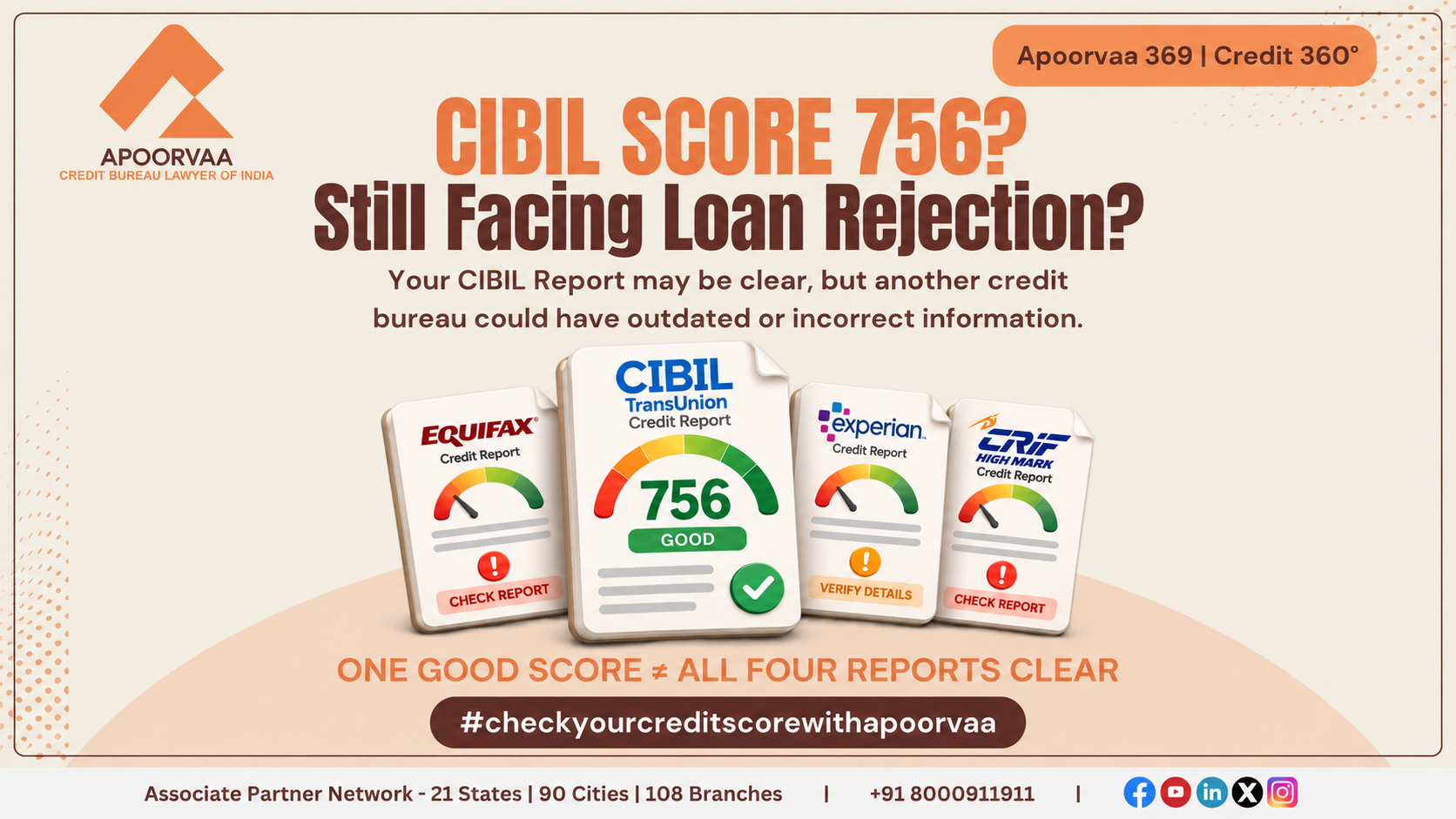
“My CIBIL Score is 756 and my CIBIL Report looks fine. Why is the bank still rejecting my loan?”
A customer recently contacted us with this question.
The customer had checked the CIBIL Report and could not identify an obvious problem. The CIBIL Score was 756, and the customer believed the credit profile was satisfactory.
However, the bank was not approving the loan.
The bank indicated that there was a concern relating to the customer’s credit information.
The customer was confused.
“If there is no problem in my CIBIL Report, what is the bank seeing?”
When we examined the concern in greater detail and discussed the matter with the bank manager, an important distinction emerged.
The customer was concentrating on one Credit Report.
The bank’s assessment was not necessarily limited to that report.
This is a situation many borrowers do not anticipate.
A satisfactory CIBIL Report does not necessarily mean that every other credit bureau holds identical information about the borrower.
India has four credit information companies, and lenders may use information from more than one bureau as part of their credit assessment.
The Reserve Bank of India identifies TransUnion CIBIL, Experian, Equifax and CRIF High Mark as India’s four credit information companies. RBI’s credit-reporting framework also addresses the use of Credit Information Reports in lending decisions.
For this customer, the important question was no longer simply whether the CIBIL Score was satisfactory.
It was:
Could another credit bureau contain account information that was relevant to the bank’s decision?
Why Can a Loan Be Rejected Despite a Good CIBIL Score?
A borrower may believe that a CIBIL Score of 756 should be sufficient for a bank to approve a loan.
However, the CIBIL Score is only one input in the lending process.
A lender may examine the underlying Credit Report, including individual loan accounts, repayment history, outstanding obligations and adverse account information.
Depending on its assessment practices and applicable requirements, the lender may also obtain information from another credit bureau.
For example, the borrower may have checked TransUnion CIBIL, while the lender also considers an Experian Credit Report or information from Equifax or CRIF High Mark.
If another bureau contains an account-level concern that is not visible in the customer’s CIBIL Report, the borrower and lender may be looking at different information.
This does not automatically establish that the other bureau is wrong.
It establishes that the customer’s review of one bureau may not have revealed everything relevant to the lender’s assessment.
The real concern may be a difference in the underlying credit information—not merely a difference between credit scores.
India Has Four Credit Bureaus, Not Just CIBIL
In everyday conversation, borrowers often use the word CIBIL to refer to their entire credit history.
However, CIBIL is the name of one credit information company.
India’s four credit bureaus are:
- TransUnion CIBIL
- Experian India
- Equifax India
- CRIF High Mark
Each maintains credit information and provides credit-reporting products that may be used in lending assessments.
For the customer whose CIBIL Score was 756, understanding these four bureaus was important because the bank’s concern might have involved information beyond the CIBIL Report.
TransUnion CIBIL
TransUnion CIBIL provides the CIBIL Score and CIBIL Report used by individuals to understand their credit profile.
Its report contains information relating to credit facilities and repayment history reported by credit institutions.
In our customer’s case, the CIBIL Score was 756, and the customer believed the underlying report did not contain a problem.
However, that report represented information held by TransUnion CIBIL. It did not automatically establish what Experian, Equifax or CRIF High Mark showed for the same customer.
A satisfactory CIBIL Report is relevant, but it should not be mistaken for confirmation that every bureau holds the same account information.
Experian India
Experian India provides credit-reporting and credit-score products used in credit assessment.
An Experian Credit Report may contain information about the borrower’s loans, credit cards and repayment history.
For example, a loan may appear correctly closed in CIBIL, while its position in Experian requires examination.
If a lender considers the Experian Credit Report, that difference may become relevant to the application.
The important issue is not whether the Experian Credit Score is numerically identical to the CIBIL Score.
It is whether the underlying account information accurately reflects the borrower’s credit history.
Equifax India
Equifax India is another RBI-registered credit information company.
Its Credit Report and Credit Score may be relevant when a lender assesses a customer’s creditworthiness.
Suppose the borrower has no reported overdue amount in CIBIL but an Equifax Credit Report shows an outstanding balance against a previously resolved account.
That difference deserves examination.
The customer should not assume that CIBIL is necessarily correct or Equifax is necessarily incorrect.
The relevant question is which information accurately reflects the actual loan records.
CRIF High Mark
CRIF High Mark is also one of India’s four credit information companies.
A lender may consider information from a CRIF High Mark Credit Report as part of its assessment practices.
A borrower may have a satisfactory CIBIL Report while CRIF High Mark contains a different account status, balance or repayment record.
Where the difference concerns an actual loan account, it may be more important than a simple variation between the two credit scores.
For the customer facing loan rejection, the purpose of reviewing CRIF High Mark is to understand whether it contains relevant account information that the CIBIL Report alone did not reveal.
Does Every Bank Check All Four Credit Bureaus?
No. It would be incorrect to claim that every bank checks all four credit bureaus for every loan application.
Lenders have their own credit-assessment practices, subject to applicable regulatory requirements.
A lender may use a Credit Information Report from one bureau or consider information from more than one bureau.
The selection may depend on the lender’s credit policy, lending product, assessment process and available credit-information solutions.
RBI’s published guidance identifies the use of Credit Information Reports as an input in credit appraisal. It does not establish that every individual loan application must be assessed through an identical four-bureau report.
For a borrower, this creates an important practical distinction.
The bureau whose report you checked may not be the only bureau whose information the lender considered.
A customer who repeatedly presents the same satisfactory CIBIL Report may therefore fail to address the particular concern identified during the lender’s assessment.
What Is a Multi-Bureau or Consolidated Credit Report?
Some lenders use credit-information solutions that help them consider information from multiple credit bureaus within their assessment workflow.
Depending on the solution, information from different bureaus may be presented together or made available for comparison.
For example, a lender may be able to examine how a particular credit facility appears in information obtained from different bureaus.
Consider an illustrative personal loan:
| Credit Bureau | Information Shown for the Same Loan |
| TransUnion CIBIL | Closed; Current Balance ₹0 |
| Experian | Closed; Current Balance ₹0 |
| Equifax | Account appears active with a reported balance |
| CRIF High Mark | Closure information requires verification |
This table is illustrative, not an actual customer report.
If a lender has access to information showing these differences, the customer’s satisfactory CIBIL Report may not resolve the bank’s concern.
However, the term consolidated report should not be interpreted as one universal report that every bank uses in the same format.
Different lenders may use different bureau combinations, products and internal assessment systems.
The significance of multi-bureau assessment is that one account may need to be understood across more than one source of credit information.
Can One Credit Bureau Show a Closed Loan While Another Shows an Outstanding or Adverse Status?
Yes. A borrower may encounter different reported positions for the same credit facility across bureau reports.
For example, one bureau may show a loan as Closed with a zero current balance.
Another bureau may show the account as active or reflect an outstanding amount.
A third may contain a different repayment-history entry or account classification.
Possible differences include:
| Account Information | Example of a Difference |
| Account Status | Closed in one bureau; active in another |
| Current Balance | ₹0 in one bureau; a balance in another |
| Amount Overdue | No overdue in one bureau; overdue reported in another |
| Repayment History | Different reported payment information |
| Settlement | Settled in one bureau; different classification in another |
| Write-Off | Write-off information appears differently |
| Account Ownership | A credit facility appears against the wrong borrower |
These differences may arise for several reasons, including different reporting dates, subsequent account developments or inaccurate information.
However, the presence of a difference does not automatically prove that a reporting error has occurred.
The reports may reflect different reporting dates or other circumstances that require interpretation.
A genuinely inaccurate or outdated entry is different from correctly reported adverse credit history.
That distinction becomes especially important where the borrower believes the difference contributed to a loan rejection.
Why Can a Closed Loan Still Appear Outstanding in Another Bureau?
Consider a borrower who previously held a personal loan.
The borrower completes the repayment and receives closure confirmation.
The CIBIL Report subsequently reflects the account as Closed with a zero current balance.
However, another bureau’s report continues to show an outstanding amount.
The customer may believe that because CIBIL has been updated, the same information must already appear everywhere.
That assumption is not necessarily correct.
Credit information is reported and maintained through the relevant credit-reporting processes. A borrower may therefore need to distinguish a difference caused by the reporting dates from information that remains inaccurate or outdated.
RBI’s credit-information reporting directions require covered credit institutions and credit information companies to maintain updated, accurate and complete information. The reporting framework provides for regular fortnightly updates, effective from 1 January 2025, subject to the applicable directions.
This regulatory framework is relevant to the accuracy and timeliness of credit information.
However, it should not be interpreted as a guarantee that every bureau report will display identical information at every moment.
A loan being correctly reflected in CIBIL does not, by itself, establish that the same loan is correctly reflected in every other bureau.
Different Credit Scores vs Different Credit Information: An Important Distinction
This is where today’s article differs from a general discussion about why credit scores vary across bureaus.
A borrower may have different scores from TransUnion CIBIL, Experian, Equifax and CRIF High Mark.
That numerical variation does not automatically establish that any bureau has made an error.
Credit bureaus use their respective scoring methodologies. RBI has stated that it does not prescribe a single scoring methodology for credit information companies.
However, the customer’s present concern is different.
The customer has a CIBIL Score of 756 and an apparently satisfactory CIBIL Report, but the bank has identified a credit-information concern.
In that situation, the more relevant issue may be whether another bureau contains different information about an actual credit facility.
A different score is not the same as an incorrect loan account.
For example:
- CIBIL Score: 756
- Another bureau’s score: Different numerical value
This difference alone does not establish a reporting error.
But consider:
- CIBIL: Loan Closed; Current Balance ₹0
- Another bureau: Same loan appears outstanding despite completed closure
That is an account-level difference requiring examination of the actual circumstances.
Professional Credit Rectification should focus on the accuracy of the underlying information rather than treating every score variation as a defect.
Does a Good CIBIL Score Guarantee Loan Approval?
No. A good CIBIL Score does not guarantee loan approval.
A CIBIL Score of 756 may appear satisfactory to a borrower, but a lender does not necessarily make its decision based on that number alone.
The lender may consider the underlying Credit Report, information obtained from other credit bureaus and additional aspects of the applicant’s financial position.
These may include:
- Existing loan and credit card obligations.
- Repayment history and adverse account information.
- Income and repayment capacity.
- Employment or business stability.
- The amount and type of loan requested.
- The lender’s eligibility criteria and credit policy.
This distinction is important for the customer in our example.
The customer had a CIBIL Score of 756 and believed the CIBIL Report was satisfactory. However, the bank indicated that a credit-bureau-related concern remained.
The customer’s first assumption was that the bank must be mistaken because CIBIL appeared clear.
But the lender may have been considering information that the customer had not examined.
A satisfactory CIBIL Report is an important part of a credit profile. It is not a complete explanation of every lending decision.
What Happens When a Bank Finds Different Information Across Credit Bureaus?
Suppose a customer applies for a personal loan.
The customer provides a CIBIL Report showing that an earlier loan has been closed.
However, information considered by the bank from another bureau indicates an outstanding amount or adverse account status.
The bank may need to consider that information as part of its assessment.
From the customer’s perspective, the earlier loan has already been resolved.
From the lender’s perspective, the credit information available during assessment may indicate that the account requires closer examination.
This difference can create confusion.
The customer repeatedly explains:
“My CIBIL Report is clear. Please approve my loan.”
But the bank’s concern may relate to an Experian, Equifax or CRIF High Mark report rather than the CIBIL Report the customer is presenting.
The appropriate question is therefore not simply whether the customer’s CIBIL Score is satisfactory.
It is:
Which credit information is relevant to the bank’s concern, and does that information accurately reflect the customer’s account history?
This distinction helps separate a potential credit-reporting issue from a lender’s independent credit decision.
Can One Incorrect Bureau Entry Affect a Loan Application?
An inaccurate entry in a Credit Report considered by the lender may become relevant during credit assessment.
For example, a borrower may have completed repayment of a personal loan, but one bureau’s report continues to show an outstanding amount that does not reflect the actual account position.
If the lender considers that information, it may form part of the lender’s understanding of the borrower’s existing obligations.
Similarly, an incorrectly reported overdue amount, settlement classification or write-off status may create a materially different picture of an earlier credit facility.
However, the presence of a discrepancy does not establish that it was the sole reason for loan rejection.
The lender may have other reasons for declining the application.
An inaccurate bureau entry may be relevant to a lending decision, but correction of that entry does not guarantee approval.
That distinction is essential when discussing professional Credit Rectification.
Why Should Borrowers Understand Their Complete Credit Profile?
Many borrowers check their CIBIL Score immediately before applying for a loan.
If the score appears satisfactory, they assume the credit-reporting aspect of the application is complete.
However, a credit profile is broader than one score.
A borrower may have several credit facilities, including:
- Personal loans.
- Home loans.
- Vehicle loans.
- Credit cards.
- Business loans.
- Loans on which the borrower is a co-borrower or guarantor, where applicable.
The information associated with these facilities may be relevant to the lender’s assessment.
Where the lender uses information from more than one bureau, a satisfactory CIBIL Report alone may not reveal every account-level concern.
For the customer with a CIBIL Score of 756, this was the central issue.
The customer was evaluating the application from the perspective of one bureau.
The bank’s credit assessment could involve a broader information set.
Understanding your complete credit profile means looking beyond the score and examining whether the underlying account information accurately represents your credit obligations.
When Is a Difference Between Bureau Reports a Genuine Credit Rectification Concern?
Not every difference between Credit Reports is an error.
Different numerical scores may result from different scoring models.
Account information may also reflect different reporting dates or subsequent developments.
However, some differences may require examination against the actual loan records.
Consider the following situations.
Situation 1: A Closed Loan Still Shows an Outstanding Balance
The borrower has completed repayment, and the lender’s records confirm closure.
CIBIL shows the account as Closed with a zero current balance.
Another bureau continues to show an outstanding amount that appears inconsistent with the actual account position.
This may require examination of the relevant reporting dates and account records.
Situation 2: An Overdue Amount Appears Incorrectly
A borrower believes the applicable repayment obligations were fulfilled.
However, one bureau’s report contains an overdue amount that does not appear consistent with the lender’s records.
The concern may relate to the reported overdue amount or repayment history.
Situation 3: Settlement Information Differs
One bureau shows an account as Closed, while another shows Settled.
The borrower may assume that one classification must automatically be incorrect.
However, the actual circumstances of account resolution matter.
If the lender accepted a negotiated settlement, that history may be relevant.
If the borrower discharged the amount legitimately payable without a compromise settlement, a Settled classification may require closer examination.
The objective is to establish the correct account position—not simply select the more favourable status.
Situation 4: Write-Off Information Appears Differently
A customer may discover write-off-related information in one Credit Report that is absent or presented differently in another.
The account history and actual lender records become relevant.
A technical write-off should not be confused with a waiver of the borrower’s liability.
Likewise, the absence of a write-off entry from one report does not automatically establish that the entry appearing elsewhere is incorrect.
Situation 5: An Account Does Not Belong to the Borrower
A credit facility may appear in a report even though the borrower believes it does not belong to them.
This is a different type of concern from a score variation.
The issue relates to the accuracy of the reported account association.
Each of these situations requires interpretation of the actual account circumstances rather than an assumption that the bureau with the higher score must be correct.
Accurately Reported Negative History vs Incorrect Credit Reporting
This is one of the most important distinctions in Credit Rectification.
A borrower may discover an adverse account entry in Experian, Equifax or CRIF High Mark that is not visible in the CIBIL Report they previously examined.
The borrower may immediately request removal.
However, the first question should be whether the adverse information is accurate.
Consider two examples.
Example A: Accurately Reported Settlement
The borrower entered into an OTS, and the lender accepted a negotiated amount to resolve its claim.
One bureau reflects the settlement history.
The customer may dislike the entry, but that alone does not establish that it is incorrect.
Example B: Incorrectly Reported Outstanding Balance
The borrower discharged the applicable obligation, and the account records confirm closure.
Another bureau continues to show a balance that does not reflect the actual position.
That may present a genuine reporting concern.
These situations should not be treated identically.
Credit Rectification should address inaccurate, inconsistent or outdated information—not promise deletion of accurately reported adverse history.
This principle applies whether the information appears in CIBIL, Experian, Equifax or CRIF High Mark.
Does Correcting a Bureau Discrepancy Guarantee Loan Approval?
No.
Suppose the customer identifies a genuinely inaccurate account entry in another bureau’s report.
The information is subsequently corrected.
That correction may improve the accuracy of the credit information available for future assessment.
However, the lender may still consider income, repayment capacity, existing obligations and other eligibility requirements.
The lender may also assess accurately reported adverse history that remains relevant.
Therefore, the objective of professional Credit Rectification should not be presented as guaranteed loan approval.
The appropriate objective is to ensure that the borrower’s Credit Report accurately reflects the underlying credit information.
Accurate credit reporting supports an informed lending assessment. It does not replace the lender’s credit policy.
What About CIBIL Rank in Business Loan Applications?
Individual credit assessment and business-credit assessment should not be treated as identical.
A lender considering a business credit facility may examine the enterprise’s credit information, financial position and other relevant factors.
For eligible businesses, the CIBIL MSME Rank may form part of the available business-credit information.
However, CIBIL MSME Rank is not a universal requirement for every individual personal loan application.
It should not be confused with an individual’s CIBIL Score.
For the customer discussed in this article, the central concern was an individual loan application and the possibility that information from another credit bureau was relevant to the bank’s decision.
The correct credit-information analysis depends on the borrower, the type of credit facility and the lender’s assessment requirements.
Why Professional Multi-Bureau Credit Report Analysis Matters
A customer may approach Apoorvaa with a simple request:
“My CIBIL Score is 756. The bank says there is a bureau problem. Please help me understand why.”
The customer’s concern may involve a report they have not previously examined.
Alternatively, the reports may contain different account information that requires interpretation.
A professional assessment should distinguish between:
Normal differences in credit scores
Differences arising from reporting dates or subsequent account developments
Accurately reported adverse credit history
Genuinely inaccurate, inconsistent or outdated account information
These are different situations and should not be treated as one problem.
At Apoorvaa – Credit Bureau Lawyer of India, professional Credit Report assessment focuses on understanding the reported account information and identifying genuine Credit Rectification concerns.
The objective is not to promise that all four scores will become identical.
It is not to suggest that every adverse entry can be removed.
And it is not to guarantee that a bank will approve a loan after a correction.
The objective is accurate credit information across the relevant Credit Reports.
Frequently Asked Questions
1. My CIBIL Score is 756. Why was my loan rejected?
A lender may consider factors beyond your CIBIL Score, including information from another credit bureau, existing obligations, income, repayment capacity and its internal eligibility criteria.
2. Can a bank check Experian if my CIBIL Report is clear?
Yes. Depending on its assessment practices and applicable requirements, a lender may consider credit information from more than one bureau.
3. Does every bank check all four credit bureaus?
No. Lenders do not necessarily use an identical four-bureau assessment process for every application.
4. Can CIBIL show Closed while Equifax shows an outstanding loan?
Different account information may appear across bureau reports. The reporting dates and underlying account records are relevant to determining whether the difference represents an error.
5. If my Experian Score is lower than my CIBIL Score, is Experian wrong?
Not necessarily. Different scoring models can produce different numerical scores. A lower score alone does not establish inaccurate credit reporting.
6. Can CRIF High Mark information affect my loan application?
Information from CRIF High Mark may be relevant if the lender considers it during credit assessment.
7. Does an adverse entry in only one bureau automatically mean it should be deleted?
No. The accuracy of the underlying account information must be established.
8. Can all four bureau reports contain satisfactory information and the loan still be rejected?
Yes. Credit information is only part of the lender’s assessment. Income, repayment capacity and other eligibility criteria may also matter.
9. Will correcting an incorrect bureau entry guarantee loan approval?
No. Correction addresses the accuracy of the reported information. Loan approval remains subject to the lender’s assessment.
10. When should I seek professional Credit Rectification?
Professional assessment may be relevant when an account status, outstanding balance, overdue amount, repayment history or other information appears inaccurate, inconsistent or outdated across Credit Reports.
My Perspective: A Good CIBIL Score Is Not the Complete Credit Profile
When a customer tells me:
“Sir, my CIBIL Score is 756, and my CIBIL Report is clear. Why is the bank not approving my loan?”
I do not assume that the CIBIL Score alone explains the lending decision.
I first want to understand what credit-information concern the bank has identified.
The lender may have considered information from another credit bureau.
An earlier loan may be correctly reflected in CIBIL but appear differently in Experian, Equifax or CRIF High Mark.
That difference may be relevant to the bank’s assessment.
However, I also distinguish between a normal score variation and a genuine account-level reporting discrepancy.
A lower score in another bureau does not automatically mean that bureau is wrong.
Similarly, an adverse entry should not be removed merely because it is absent from another report.
The important question is whether the underlying credit information accurately reflects the borrower’s actual account history.
For a customer preparing to apply for another loan, understanding the complete credit profile is more useful than relying only on a satisfactory CIBIL Score.
Final Takeaway
CIBIL Score 756 but loan rejected? The concern may be outside the CIBIL Report you checked.
India has four credit bureaus: TransUnion CIBIL, Experian, Equifax and CRIF High Mark.
Depending on its assessment practices and applicable requirements, a lender may consider information from more than one bureau.
An account that appears correctly closed in CIBIL may be reflected differently elsewhere.
However, not every difference is a reporting error, and a satisfactory profile across all four bureaus does not guarantee loan approval.
Before applying for another loan, understand your complete credit profile—not just your CIBIL Score.
Professional Credit Report Assessment
Is your CIBIL Score satisfactory, but the bank has identified a credit-bureau-related concern?
If your reports contain inconsistent account statuses, outstanding balances, overdue amounts or other information that appears inaccurate or outdated, professional assessment may help identify whether a genuine Credit Rectification concern exists.
Apoorvaa – Credit Bureau Lawyer of India provides professional Credit Report assessment and Credit Rectification services for individuals and businesses.
📞 8000 911 911
Apoorvaa – Credit Bureau Lawyer of India
Credit Rectification does not guarantee identical scores across bureaus, deletion of accurately reported adverse information or loan approval.
Related Credit Education
- Why Is Your Credit Score Different Across CIBIL, Experian, Equifax and CRIF High Mark?
- Loan Closed but CIBIL Shows Settled? Understand the Difference
- Write-Off in CIBIL Report: Does It Mean Your Loan Is Waived?
About the Author
Advocate Apurva Bhagat is the Founder & Chairman of Apoorvaa – Credit Bureau Lawyer of India.
His work focuses on credit-bureau law, Credit Rectification and helping individuals and businesses understand credit-information accuracy, account-level reporting discrepancies and the role of credit information in lending decisions.

Unknown Loan In CIBIL Report: What If You Never Took That Loan?
[…] CIBIL Score 756 but Loan Rejected? […]