




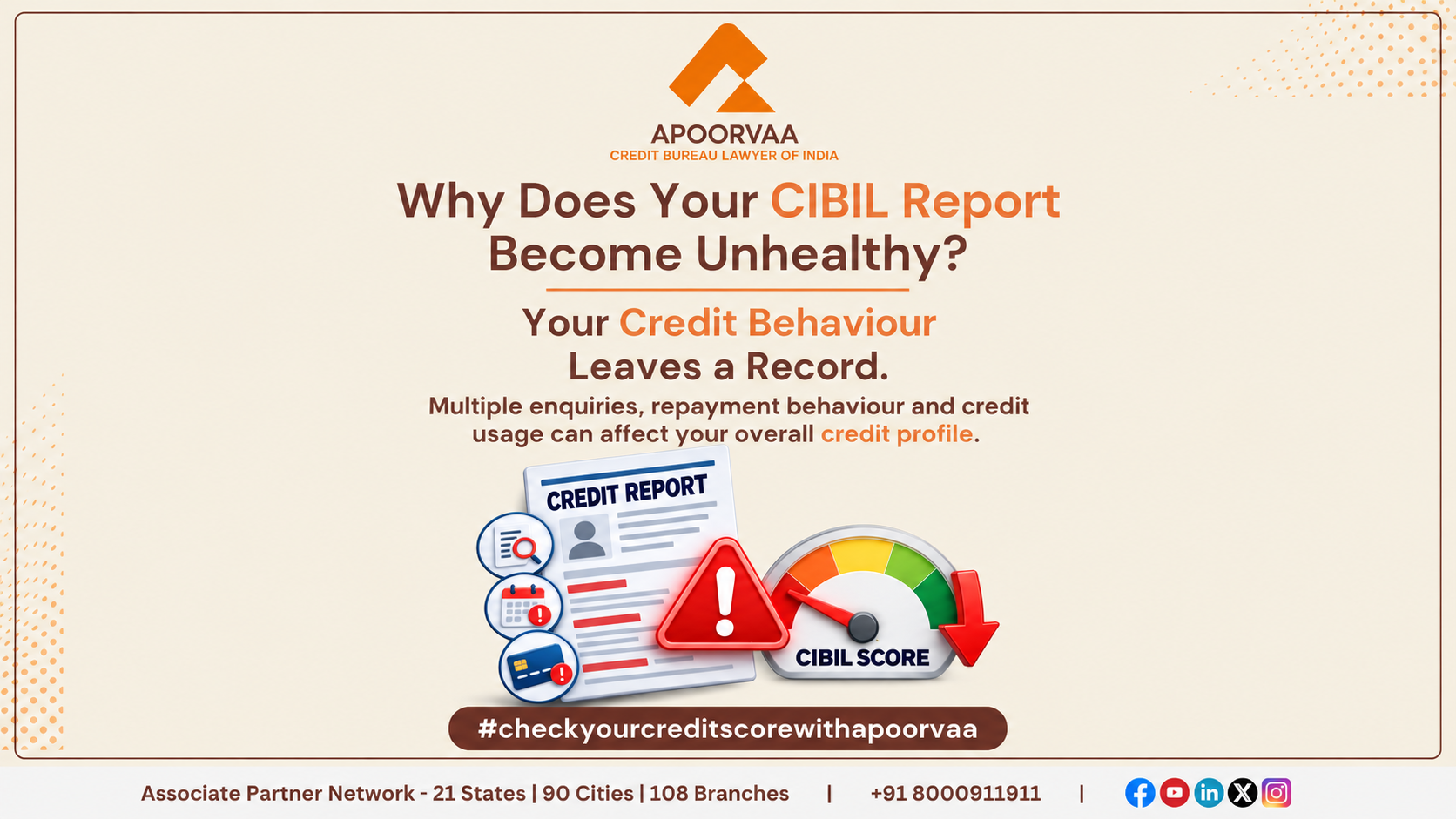
When someone discovers a low CIBIL Score, the first question is usually:
“How can I improve my CIBIL Score?”
But I believe there is a more important question to ask first:
“What inside my complete CIBIL Report may be affecting my credit profile?”
A low score is an outcome. It does not, by itself, explain the reason behind that outcome.
Two customers can have similar CIBIL Scores but completely different credit histories. One may have delayed EMI payments. Another may have high credit-card utilisation. Someone else may have multiple recent loan enquiries, an old settled account, or information in the report that they believe is inaccurate.
That is why looking only at the score can give you an incomplete picture.
The score tells you where you stand. The complete CIBIL Report can help you understand what may be affecting that position.
Here are 10 factors worth understanding.
1. EMI and Loan Repayment History
Your repayment behaviour is one of the most important parts of your credit profile.
When you take a loan from a bank or NBFC, paying EMIs according to the agreed schedule matters. Repeated delays, missed payments or bounced EMIs can become part of your repayment history.
A common misunderstanding is:
“I have paid all the money now, so why is my past repayment behaviour relevant?”
Your current financial position and your historical credit behaviour are not necessarily the same thing.
When trying to understand a weak credit profile, repayment history is therefore one of the first areas that deserves attention.
2. Credit-Card Payment Behaviour
A credit card is also a credit facility, and how it is managed can influence the broader credit profile.
Repeated late payments or irregular payment behaviour can matter.
Customers sometimes concentrate entirely on loans while overlooking their credit cards. But if you regularly use credit cards, their payment behaviour forms part of your overall credit history too.
This is why credit health should not be judged only by asking:
“Are my loan EMIs regular?”
Your different credit facilities together contribute to the overall picture.
3. High Credit Utilisation
Payment behaviour is not the only consideration with credit cards.
Credit utilisation also matters.
Suppose you have a ₹1,00,000 credit-card limit and regularly use a very large portion of that available limit. Even if payments are being made, high utilisation can still be relevant to your credit profile.
This does not mean that using your available limit automatically creates a bad CIBIL Report.
The important point is that credit health involves more than simply whether a payment was eventually made.
How credit is being used can matter along with how it is being repaid.
4. Multiple Loan and Credit Enquiries
This is particularly relevant to today’s video.
Suppose a borrower applies to one bank and the loan does not proceed.
The borrower then approaches another bank.
Then another.
Then an NBFC.
The assumption is:
“If one lender says no, I’ll keep applying until someone says yes.”
But repeated applications can result in multiple credit enquiries.
If a lender has already raised a concern about your credit profile, creating more applications does not necessarily solve the underlying issue.
The better question is:
“Why did the first application face difficulty?”
If the concern relates to your CIBIL Report, understand that concern before blindly creating more loan enquiries.
5. Settled or Written-Off Accounts
Terms such as “Settled” and “Written-Off” can be important when understanding a credit profile.
A borrower may have resolved a difficult account in the past and assume:
“That matter is over, so it should no longer matter.”
But historical account status can remain relevant to the overall credit profile.
There is also an important distinction here:
Negative information is not automatically incorrect information.
If an account genuinely went through settlement or another negative credit event, the fact that the information is unfavourable does not automatically make it an error.
This distinction becomes especially important when considering Credit Rectification.
6. Overdue and DPD History
Borrowers often focus only on whether an account is overdue today.
But a CIBIL Report can also reflect historical repayment behaviour.
DPD — Days Past Due broadly indicates payment delay associated with a credit facility during a reporting period.
This means that:
“My account is regular now”
and
“My account has always been regular”
are two different statements.
A current zero overdue position should therefore not automatically be interpreted as proof that the entire historical repayment profile has always been healthy.
7. Multiple Credit Obligations
Having several active credit facilities does not automatically mean you have a bad CIBIL Report.
However, the complete credit picture can include multiple obligations such as:
home loans, vehicle loans, personal loans, credit cards and other finance facilities.
This matters because borrowers sometimes evaluate each facility separately while lenders may also look at the broader financial and credit position.
A person may be paying every EMI but still need to understand how much credit exposure and financial obligation already exists.
Credit health should be viewed as a complete profile, not one account at a time.
8. Co-Borrower or Guarantor Exposure
This is one of the most overlooked areas.
Someone may say:
“It wasn’t my loan. I was only the guarantor.”
Or:
“I was only the co-borrower.”
But becoming a co-borrower or guarantor should never be treated as merely signing a document.
Depending on the facility and reporting circumstances, such credit exposure can be relevant to your credit profile.
This is particularly important when people become co-borrowers or guarantors for family members, business associates or related businesses without considering how that financial obligation may affect them later.
9. Incorrect or Outdated Reporting
Until now, we have mostly discussed genuine credit behaviour.
But there is another possibility.
What if information appearing in the CIBIL Report does not match the customer’s understanding of the account?
A customer may encounter an unfamiliar account, an unexpected balance or status, or information they believe is outdated or inaccurate.
This should not simply be mixed with ordinary “CIBIL Score improvement.”
If there is a genuine reporting concern, the important question is about the accuracy of the Credit Report, not merely how many points the score has fallen.
That distinction matters.
10. Looking Only at the CIBIL Score
The tenth factor is actually a mistake in how people understand credit health.
Suppose your CIBIL Score is 650.
Knowing 650 does not automatically tell you why it is 650.
Is the concern repayment history?
Credit utilisation?
Recent enquiries?
A settled or written-off account?
Historical DPD?
Multiple obligations?
Guarantor exposure?
Or information that appears inaccurate?
That is why immediately searching for:
“How to increase my CIBIL Score?”
may cause you to focus on the outcome before understanding the cause.
A low CIBIL Score is an outcome. The complete CIBIL Report is where you should start looking for the reason.
These 10 Factors Do Not Affect Every Customer in the Same Way
This is the most important point to understand before we move further.
One customer may have genuine repayment delays.
Another may have excellent repayment behaviour but high credit utilisation and several recent enquiries.
A third may have an old settled account.
A fourth may believe that information in the CIBIL Report is inaccurate.
All four may simply say:
“My CIBIL is bad.”
But professionally, they are not the same credit problem.
And that is why there cannot be one generic answer for everyone who has a low CIBIL Score.
Before thinking about improving the number, understand what is affecting the credit profile.
A Low CIBIL Score Does Not Automatically Mean Your Report Is Wrong
After understanding the 10 factors discussed in Part 1, one distinction becomes especially important.
When customers see a low CIBIL Score, some immediately conclude:
“There must be something wrong in my CIBIL Report.”
That is not necessarily the case.
A weaker score can result from genuine credit behaviour—such as repayment delays, high credit utilisation, multiple recent enquiries or historical account status.
In such cases, the information may be negative, but that does not automatically make it inaccurate.
On the other hand, a customer may genuinely find information in the CIBIL Report that appears inconsistent with their understanding of the credit facility.
These are two very different situations.
A weak credit profile and an inaccurate Credit Report are not the same problem.
Genuine Negative History vs Incorrect Reporting
Consider two borrowers.
The first borrower genuinely delayed several EMIs during a period of financial difficulty, and those delays are reflected in the Credit Report.
The second borrower believes an account status, balance or other information appearing in the report does not correctly reflect the actual credit facility.
Both customers may have a credit concern.
But the nature of their concerns is different.
This distinction is particularly important because customers sometimes believe:
“If something is negatively affecting my score, it should be removed.”
That is not the right way to understand Credit Rectification.
Negative does not automatically mean incorrect.
Genuine historical credit behaviour and a genuine reporting issue need to be understood separately.
When Does Credit Rectification Become Relevant?
Credit Rectification should not begin with a promised score.
It should begin with understanding the credit-report concern.
A low score by itself does not prove that the CIBIL Report contains an error. Similarly, a settled account, written-off status or historical DPD should not automatically be labelled incorrect simply because it is negatively affecting the profile.
Professional assessment becomes relevant when there is a genuine concern about information appearing in the credit profile and the customer needs to understand the nature of that concern.
At Apoorvaa – Credit Bureau Lawyer of India, this distinction is important to our approach.
The first question should not be:
“How quickly can my score become 750?”
It should be:
“What exactly is affecting my Credit Report?”
Only after the underlying concern is understood should the appropriate next course of action be considered.
Credit Rectification Is Not the Erasure of Genuine Credit History
Customers should also be cautious about promises such as:
“All negative accounts can be removed.”
“Settled status will disappear immediately.”
“Your CIBIL Score will become 750+.”
“Your loan will be approved after CIBIL correction.”
These statements can create unrealistic expectations.
Credit Rectification should not be confused with artificially rewriting genuine credit history.
Where information is genuinely inaccurate, it may require appropriate attention. But where information correctly reflects actual historical credit behaviour, simply disliking its impact does not make it incorrect.
The objective should be an accurate credit profile—not an artificially perfect one.
Why Repeated Loan Applications May Be the Wrong Response
This brings us directly back to today’s video.
Suppose your loan application does not proceed because a lender raises a credit concern.
The natural reaction may be:
“Let’s try another bank.”
And if that doesn’t work:
“Let’s try another NBFC.”
But if the underlying issue is sitting inside the CIBIL Report, changing lenders does not automatically change that issue.
Meanwhile, repeated credit applications can result in additional enquiries.
Therefore, when a loan application faces a credit-related problem, the better sequence is:
Understand the concern first. Then decide your next credit move.
This does not mean every loan rejection is caused by CIBIL. Lenders evaluate applications using their own eligibility criteria, financial assessment and credit policies.
But when the lender specifically identifies a credit-profile concern, blindly creating more applications may not solve it.
Don’t Wait Until the Next Loan Becomes Urgent
Many customers discover their credit position at the worst possible time.
The home has already been selected.
The business needs working capital.
The machinery purchase is ready.
The vehicle needs financing.
Or an important financial requirement has suddenly arisen.
Only then does the borrower check the complete Credit Report.
That creates unnecessary pressure.
Credit awareness should ideally begin before credit becomes urgent.
If you know that an important loan requirement may arise, understanding your credit profile beforehand can help you identify whether something deserves attention.
Your CIBIL Report should not become important only after a bank raises an objection.
Frequently Asked Questions
Why is my CIBIL Score low even though I am paying my EMIs on time?
Current EMI repayment is important, but your overall credit profile can include historical payment behaviour, credit utilisation, enquiries, account status and other credit information. Looking at the complete CIBIL Report can provide better context than looking only at the current EMI.
Can too many loan enquiries affect my credit profile?
Multiple credit applications over a short period can result in multiple enquiries. Therefore, repeatedly approaching lenders without understanding an existing credit concern may not be the right approach.
Does a settled or written-off account mean my CIBIL Report is incorrect?
No. A negative account status is not automatically an incorrect status. The actual account history and reporting circumstances need to be understood.
Can old DPD still matter if my loan is regular today?
Current repayment status and historical repayment behaviour are different. Earlier payment delays can form part of the credit history even when the account is currently regular.
Can being a guarantor or co-borrower affect my credit profile?
Such obligations should not be treated casually. Depending on the credit facility and reporting circumstances, co-borrower or guarantor exposure can be relevant to the person’s credit profile.
Does Credit Rectification guarantee a higher CIBIL Score or loan approval?
No. Credit Rectification should not be understood as a guarantee of a particular CIBIL Score, loan eligibility or loan approval.
My Perspective
When someone tells me:
“My CIBIL is bad.”
I don’t believe the discussion should stop at the score.
The more useful question is:
Why is the credit profile weak?
Is it because of repayment history?
Credit-card behaviour?
High utilisation?
Multiple enquiries?
Settled or written-off accounts?
Historical DPD?
Existing credit obligations?
Guarantor exposure?
Or is there information that genuinely appears incorrect?
Until the cause is understood, simply trying to “increase the CIBIL Score” can mean focusing on the symptom rather than the underlying concern.
That is why my advice to borrowers is simple:
Don’t chase the score first. Understand your complete CIBIL Report first.
And if a lender has already raised a credit concern, understand what is affecting the profile before repeatedly applying elsewhere.
Final Thought
A low CIBIL Score is an outcome.
Your repayment behaviour, credit usage, enquiries, account history and the information reported in your credit profile can help explain what may be behind that outcome.
Sometimes the issue may be genuine past credit behaviour.
Sometimes several factors may be working together.
And sometimes there may be a genuine reporting concern that deserves closer attention.
The important thing is not to guess.
Check the complete CIBIL Report. Understand what is affecting your credit profile. Then decide your next financial move.
Need Professional Assistance With a Credit Report Concern?
If your CIBIL Report contains information that you do not understand, or you believe there may be a genuine reporting concern affecting your credit profile, professional assessment can help identify the nature of the issue.
Apoorvaa – Credit Bureau Lawyer of India provides professional assistance for genuine Credit Rectification and credit-bureau concerns involving individuals and businesses.
📞 +91 8000 911 911
Credit Rectification does not guarantee removal of genuine credit history, a particular CIBIL Score, loan eligibility or loan approval. Outcomes depend on the facts and reporting circumstances of each case.
Related Credit Education
- CIBIL Problem Not Resolved? Find the Root Cause First
- Good CIBIL Score but Loan Rejected? Understand Why
- Outstanding Bank Dues: Can CIBIL Be Fixed Without Payment?
About the Author
Advocate Apurva Bhagat is the Founder of Apoorvaa – Credit Bureau Lawyer of India. His work focuses on credit-bureau matters, Credit Rectification and credit awareness for individuals and businesses, with an emphasis on identifying the underlying credit-report concern rather than focusing only on the headline score.

Comments are closed