





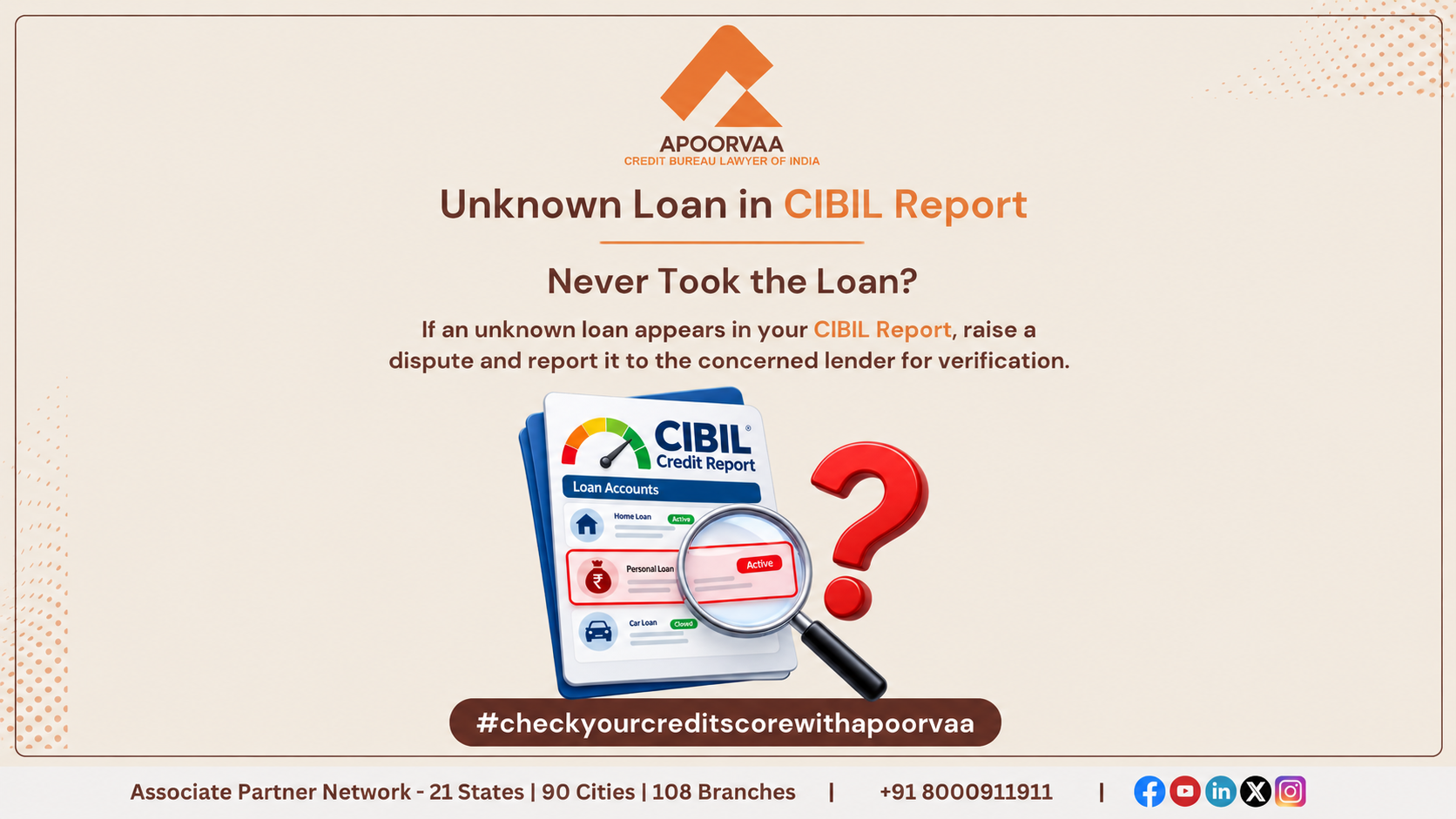
An Unknown Loan in CIBIL Report can be extremely worrying.
Imagine checking your latest credit report and finding a personal loan, consumer loan, credit card or another credit facility that you have never taken.
Your first reaction may naturally be:
“I never borrowed this money. Why is this loan appearing in my CIBIL Report?”
This is not something you should simply ignore.
An unfamiliar account can affect the accuracy of your credit profile and, depending on what is being reported under that account, may potentially create complications when you apply for credit in the future.
The correct approach is not to panic and not to randomly contact multiple people.
You need to follow a structured process:
Review the account → Raise an ownership dispute → Contact the concerned lender → Provide relevant identification and report details → Ask for investigation → Verify the correction
Most importantly, the credit bureau and the lender have different roles in this process.
Understanding that distinction can save considerable time.
First Confirm That the Loan Really Does Not Belong to You
Before raising a dispute, carefully review the account appearing in the report.
Sometimes borrowers do not immediately recognise an account because:
- The lender’s legal name may differ from the brand name they remember.
- A loan may have been originated through another financial platform.
- An old account may appear under the reporting institution’s name.
- A credit facility may have been transferred or assigned.
- The borrower may simply not recognise the lender name shown in the report.
Therefore, do not dispute an account only because the lender’s name looks unfamiliar.
Check whatever account information is available in the credit report, such as:
- Lender/credit institution name.
- Type of credit facility.
- Account ownership information.
- Date opened.
- Current balance.
- Amount overdue.
- Account status.
- Payment history.
- Other identifying details available in the report.
Then compare the information with your own borrowing records.
If, after verification, you are certain that:
“I have never applied for, received or used this credit facility,”
then the account requires investigation.
Why Can Someone Else’s Loan Appear in Your Credit Report?
There is no single explanation for every case.
An unknown account can potentially appear because of issues such as:
- Incorrect mapping of borrower information.
- Data matching problems.
- Similar identifying information between individuals.
- Incorrect information submitted by a lender.
- Mixed or incorrectly associated credit-file information.
- Identity misuse or unauthorized borrowing in some cases.
The cause should not be assumed before investigation.
For example, finding an unknown loan does not automatically prove that someone has committed fraud using your identity.
It may be a reporting or data-association issue.
On the other hand, if the account appears genuinely suspicious, it should be treated seriously and investigated appropriately.
The immediate objective is to establish:
Does this account actually belong to you?
Step 1: Raise an Official CIBIL Dispute
Once you confirm that the account does not belong to you, one of the first steps is to raise a dispute through the official CIBIL dispute mechanism.
The dispute should clearly identify the concerned account and explain the problem.
In this situation, the issue is fundamentally about account ownership.
Your position is:
“This credit account appearing in my report does not belong to me.”
Be precise.
Avoid submitting a vague complaint such as:
“My CIBIL is wrong. Please correct it.”
Instead, identify the exact account that you do not recognise.
Keep records of:
- Dispute reference number.
- Date of submission.
- Account disputed.
- Information submitted.
- Emails or acknowledgements received.
Documentation becomes important if follow-up is required.
Step 2: Don’t Stop After Raising the Bureau Dispute
This is where many borrowers make a mistake.
They raise a CIBIL dispute and then simply wait.
But when the issue concerns an account reported by a particular bank, NBFC or financial institution, the concerned lender’s records need to be investigated as well.
Therefore, I generally recommend acting simultaneously.
While the bureau dispute is being processed, approach the lender whose name appears against the unknown account.
This creates two parallel actions:
Action 1: Dispute the account through the credit bureau.
Action 2: Ask the concerned lender to investigate why its account is appearing in your credit report.
The lender is in a position to examine the underlying loan records and borrower information associated with the account.
Step 3: Contact the Concerned Bank or Financial Institution
Write to the concerned lender through its official customer-service or grievance-redressal channel.
Where required, the matter can subsequently be escalated through the lender’s applicable grievance mechanism.
Your communication should clearly state:
“A credit facility reported by your institution is appearing in my CIBIL Report. I have never taken this loan/account and request you to investigate the ownership and reporting of the account.”
Provide sufficient information for the lender to identify the disputed account.
Depending on what is appropriate and requested through the lender’s official channel, this may include:
- Your name.
- Relevant identification/KYC details.
- Contact details.
- Copy or relevant extract of the credit report showing the account.
- Account information displayed in the report.
- CIBIL dispute reference number, if available.
- A clear declaration that the account does not belong to you.
Be careful when sharing sensitive identity documents. Submit them only through the lender’s official and appropriate channel required for verification.
Step 4: Ask the Lender to Investigate the Underlying KYC and Account Records
This is one of the most important parts of the process.
If you are saying:
“This loan is not mine,”
the lender needs to examine the records connected with that facility.
The investigation may involve checking the borrower information and KYC associated with the account and comparing it with the person whose credit report is being affected.
The objective is to determine whether the account has been incorrectly associated with your credit profile or whether another issue exists.
If the lender confirms that the account does not belong to you, the underlying reporting should be appropriately corrected through the credit reporting process.
This is why contacting only the bureau may not be enough.
The lender’s underlying data needs to support the correction.
What Does “Demerging” Mean in This Situation?
Borrowers sometimes hear the term “demerge” when dealing with this type of credit-report problem.
In practical terms, it refers to separating credit information that has been incorrectly associated with the wrong person’s credit profile.
For example:
Person A has genuinely taken a loan.
But due to an incorrect data association, that loan appears in Person B’s credit report.
The objective is not to delete Person A’s genuine loan history.
The objective is to ensure that Person A’s loan remains associated with Person A and is removed from Person B’s credit profile if it does not belong there.
That is why accurate borrower identification and lender verification are so important.
Why You Should Not Ignore an Unknown Loan
Some people notice an unfamiliar account but ignore it because:
“The outstanding amount is small.”
or
“I don’t need a loan right now.”
That can be a mistake.
An unknown account may contain information such as:
- Outstanding balance.
- Overdue amount.
- DPD.
- Delinquency.
- Settled status.
- Written-off information.
- Other adverse account history.
Even if the account currently shows no major negative information, a loan that does not belong to you should not remain associated with your credit profile.
Your credit report should reflect your credit history, not someone else’s.
What If the Unknown Account Is Affecting Your CIBIL Score?
Borrowers naturally focus on the score:
“How many points will increase after this loan is removed?”
That should not be the first concern.
The first objective is accuracy.
If the account genuinely does not belong to you, the goal is to have the incorrect association investigated and corrected.
What happens to the score afterward depends on the overall information contained in the credit profile and the scoring methodology.
Therefore, nobody should responsibly guarantee:
“Remove this account and your score will increase by exactly 50 or 100 points.”
Credit rectification should focus first on correcting inaccurate information, not promising a particular number.
Keep Everything in Writing
When dealing with an unknown loan, documentation can become extremely important.
Maintain a file containing:
- The credit report where you identified the account.
- Dispute acknowledgement/reference.
- Emails sent to the lender.
- Responses received.
- KYC/verification documents submitted.
- Complaint or grievance reference numbers.
- Any final confirmation received from the lender.
- Updated credit report after correction.
Do not depend entirely on telephone conversations.
A proper written trail makes it much easier to understand what was reported, what was disputed and what action was taken.
What Happens After You Raise the Dispute?
After you raise an ownership dispute for an Unknown Loan in CIBIL Report, the matter needs to be verified against the information maintained and reported by the concerned lender.
This is why borrowers should understand that raising the dispute is the beginning of the correction process, not necessarily the end.
During this period, keep track of:
- Your CIBIL dispute reference number.
- Complaint submitted to the lender.
- Lender acknowledgement or ticket number.
- Emails exchanged with the lender.
- Documents submitted for verification.
- Any response received from either side.
Once the lender investigates the account, the next action depends on what its records establish.
If the account genuinely belongs to you, it cannot simply be removed because you do not recognise it.
But if the investigation confirms that the loan does not belong to you and has been incorrectly associated with your credit profile, the reporting needs to be corrected accordingly.
Who Is Responsible: CIBIL or the Bank?
This is one of the most important concepts to understand in credit-report correction.
Borrowers frequently approach the credit bureau and say:
“This loan is not mine. Just delete it from my report.”
But the information appearing in a credit report originates from credit institutions that report borrower and account data to credit information companies.
Therefore, when ownership of a loan is disputed, the underlying lender information becomes extremely important.
Think of the process in two parts:
The credit bureau reflects reported credit information.
The concerned lender needs to verify the underlying loan and borrower records.
That is why approaching both sides is practical.
The objective is not merely to request deletion.
The objective is to establish through proper verification that the disputed loan does not belong to you and have the incorrect reporting rectified.
What If the Bank Does Not Respond?
Suppose you have:
- Raised the CIBIL dispute.
- Written to the concerned lender.
- Provided the required details.
- Shared the relevant credit-report information.
- Waited for the lender’s response.
But the problem remains unresolved.
Do not keep sending the same complaint randomly to different email addresses.
Follow the lender’s formal grievance-redressal mechanism.
Generally, financial institutions provide different levels of complaint handling or escalation. Use the official escalation mechanism applicable to that particular institution and preserve every acknowledgement and response.
Your escalation should contain the complete chronology.
For example:
Date 1: Unknown account identified in credit report.
Date 2: CIBIL dispute raised.
Date 3: Complaint submitted to lender.
Date 4: Supporting documents provided.
Current position: Account remains disputed/unresolved.
A well-documented complaint is much stronger than repeatedly writing:
“Please correct my CIBIL urgently.”
What If the Complaint Still Remains Unresolved?
If the concerned regulated entity does not satisfactorily resolve an eligible complaint through its internal grievance mechanism, the borrower may need to examine the applicable external grievance-redressal route.
Depending on the institution and circumstances, this can include the grievance framework available through the Reserve Bank of India, including the applicable Ombudsman mechanism.
However, escalation should be based on the actual facts of the case.
Keep copies of:
- Original complaint.
- Lender acknowledgement.
- Lender’s final response, if received.
- CIBIL dispute details.
- Credit report.
- Relevant account information.
- Supporting identification documents.
- Subsequent correspondence.
The objective should remain consistent:
Establish that the disputed account does not belong to you and seek correction of inaccurate credit information through the appropriate process.
What If You Suspect Identity Misuse?
An unfamiliar loan appearing in a credit report does not automatically mean identity theft.
It could result from an incorrect data association or another reporting issue.
But sometimes the circumstances may indicate something more serious.
For example, you may discover a loan that:
- You never applied for.
- Was opened recently.
- Contains significant outstanding dues.
- Is being actively reported.
- Has resulted in collection communication.
- Appears alongside other unfamiliar credit activity.
In such circumstances, do not limit your concern only to:
“How do I improve my CIBIL Score?”
You need to understand how the credit facility was created in the first place.
Ask the lender to investigate the underlying application and KYC/account records associated with the loan.
Where the facts genuinely indicate unauthorized use of identity or suspected fraud, appropriate complaints with the relevant authorities may also need to be considered based on the circumstances.
The priority becomes both:
Correcting the credit report and protecting yourself from further unauthorized activity.
Common Mistakes Borrowers Make with an Unknown Loan
Mistake 1: Ignoring the Account
If the account does not belong to you, don’t leave it in the report simply because your current score looks acceptable.
Credit-report accuracy matters independently of the score.
Mistake 2: Raising Repeated Disputes Without Contacting the Lender
If the underlying lender records are the source of the incorrect association, simply submitting the same dispute repeatedly may not address the root cause.
Contact the concerned lender and request an investigation.
Mistake 3: Saying Only “My CIBIL Is Wrong”
Be specific.
Identify:
- Which account is disputed.
- Which lender reported it.
- Why you believe it does not belong to you.
- What correction you are requesting.
Specific complaints are easier to investigate.
Mistake 4: Sending Documents Without Keeping Copies
Maintain a complete record of everything submitted.
You may need those documents during escalation.
Mistake 5: Sharing KYC Documents Through Unverified Channels
An unknown loan is already a sensitive issue.
Do not send PAN, Aadhaar or other identity documents to random email addresses, WhatsApp numbers or individuals claiming they can correct the report.
Use official and appropriate channels.
Mistake 6: Paying an Unknown Loan Just to “Fix CIBIL”
This can be a serious mistake.
If you genuinely never took the loan, do not assume that paying the reported outstanding amount is the correct solution merely because someone says your score will improve afterward.
First establish ownership and accuracy of the account.
If the loan belongs to someone else, the issue is incorrect association—not your repayment liability.
Practical Step-by-Step Checklist
If you discover an Unknown Loan in CIBIL Report, follow a structured approach:
Step 1 — Download and review your latest credit report.
Identify the exact unfamiliar account.
Step 2 — Verify that you genuinely do not recognise the facility.
Compare the lender, account type, opening date and other available information with your own records.
Step 3 — Raise an official ownership dispute with CIBIL.
Clearly state that the concerned account does not belong to you.
Step 4 — Contact the lender simultaneously.
Use its official customer-service or grievance-redressal channel.
Step 5 — Provide the necessary information for investigation.
Share the relevant report details and identification information through the appropriate official channel.
Step 6 — Request verification of account ownership and underlying records.
Ask the lender to investigate why its loan is associated with your credit profile.
Step 7 — Preserve all written communication.
Keep dispute numbers, complaint numbers, emails and acknowledgements.
Step 8 — Escalate through the proper grievance mechanism if required.
Do not simply repeat the same complaint indefinitely.
Step 9 — Obtain a fresh credit report after the correction process.
Do not assume that the matter is complete merely because you received an email saying it was resolved.
Verify the actual report.
Frequently Asked Questions
Why is a loan I never took showing in my CIBIL Report?
There can be different reasons, including incorrect data association, reporting errors, matching issues or, in some circumstances, unauthorized use of identity. The exact reason should be established through investigation rather than assumed.
Can CIBIL directly delete an unknown loan?
A dispute can be raised with CIBIL, but the information associated with the account generally needs to be verified with the concerned credit institution. This is why lender involvement is important in an ownership dispute.
Should I contact the bank as well as CIBIL?
Yes. For an account you genuinely do not own, raising the bureau dispute while simultaneously approaching the concerned lender for investigation can help address both the credit-report dispute and the underlying lender records.
What documents should I keep?
Maintain your credit report, dispute reference, lender complaint acknowledgement, relevant KYC/verification records submitted, correspondence and any final resolution communication.
What does demerging mean in a credit report?
In this context, it generally refers to separating credit information that has been incorrectly associated with another individual’s credit profile, so the genuine account remains linked to the correct borrower.
Will removing the wrong loan increase my CIBIL Score?
If inaccurate information is corrected, your credit profile will reflect the revised data. The resulting score depends on the overall credit information and scoring methodology. A specific increase should not be guaranteed.
What if the lender says the loan belongs to me?
Ask for appropriate clarification regarding the account and the basis on which it has been associated with your identity. If you continue to dispute ownership, preserve the lender’s response and consider the appropriate grievance or escalation mechanism based on the facts.
Should I pay the outstanding amount if the loan isn’t mine?
Do not make payment merely to improve your score when you genuinely dispute ownership of the loan. First investigate and establish whether the liability actually belongs to you.
Final Thoughts
Finding an Unknown Loan in CIBIL Report should never be treated merely as a low-score problem.
The more important question is:
Why is a credit facility that I never took associated with my credit profile?
Start by verifying the account carefully.
If it genuinely does not belong to you:
Raise an ownership dispute with CIBIL.
Approach the concerned lender simultaneously.
Provide the necessary information through official channels.
Request investigation of the underlying account and borrower records.
Maintain written documentation throughout the process.
Escalate appropriately if the issue remains unresolved.
And finally, obtain a fresh credit report and verify that the correction has actually been reflected.
Your credit report is an important financial record.
It should contain your credit history—not somebody else’s.
Need Professional Guidance for an Incorrect Loan in Your Credit Report?
An unknown loan account can sometimes be straightforward to identify, but some cases become complicated when the bureau data, lender records, KYC information and account ownership need to be examined together.
If a loan or credit account that you never took is appearing in your credit report, avoid making random disputes, unnecessary payments or relying only on verbal assurances.
At Apoorvaa – Credit Bureau Lawyer of India, we work on Credit Rectification and detailed Credit Report analysis for individuals and businesses.
We can help you understand the disputed account, examine the available credit-report information, identify the appropriate lender and dispute process, and guide you through the necessary steps for rectification based on the facts of your case.
If an unknown loan is appearing in your credit report, get the issue examined before it affects an important loan application or your overall credit profile.
About the Author
Advocate Apurva Bhagat is the Founder of Apoorvaa – Credit Bureau Lawyer of India and works in the field of Credit Rectification, Credit Report analysis and borrower guidance relating to credit-reporting issues.
Through his professional practice and financial-awareness initiatives, he focuses on helping individuals and businesses understand complex credit-report issues and follow the appropriate process for genuine credit-reporting discrepancies.
His approach is simple: before trying to improve a credit score, first make sure the information used to create that credit profile actually belongs to you.

Comments are closed